by Alex Demolitor | Feb 12, 2025 | Definitions
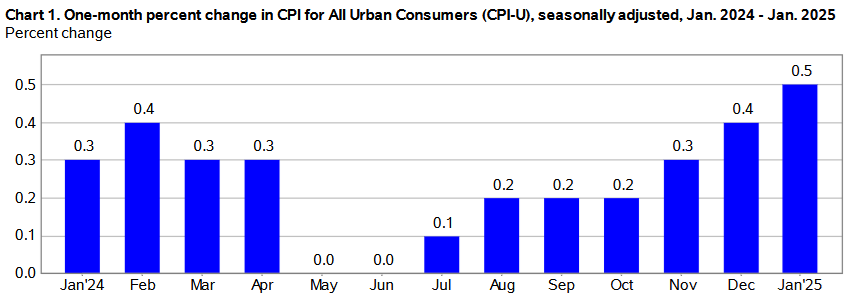
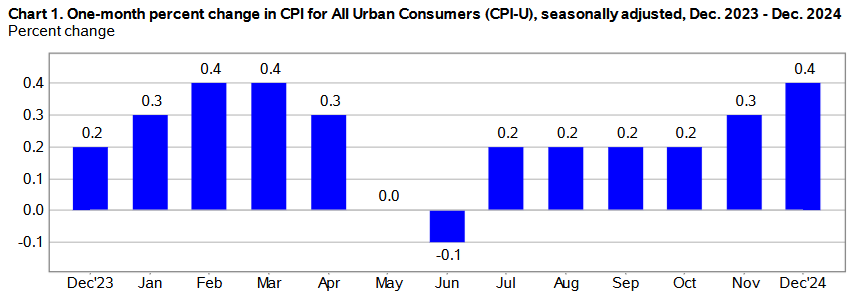
The January 2025 Consumer Price Index of All Urban Consumers (CPI-U) report indicates that inflation increased by 0.5% for the month, surpassing December’s 0.4% rise. These data were released at 8:30 am EST on Wednesday, February 12, 2025, by the Bureau of Labor Statistics. Before seasonal adjustment, the year-over-year (Y-o-Y) inflation rate in the all-items index grew by 3.0%, up from 2.9% in December and 2.7% and 2.6% in November and October.
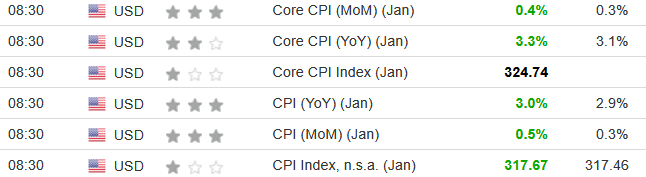
The magnitude of the strength was largely unexpected, as the results easily surpassed economists’ consensus estimates. The table below is courtesy of Investing.com. The left column represents January’s figures, while the right column represents forecasters’ expectations. As you can see, the green metrics highlight January’s outperformance.
The data is likely an unwelcome sign for Fed Chairman Jerome Powell, as he’s shifted his stance in a hawkish direction recently. He said on Feb. 11:
“With our policy stance now significantly less restrictive than it had been and the economy remaining strong, we do not need to be in a hurry to adjust our policy stance. We know that reducing policy restraint too fast or too much could hinder progress on inflation.”
Thus, with January’s results amplifying that message, it could be a while before investors receive the rate cuts they desire.
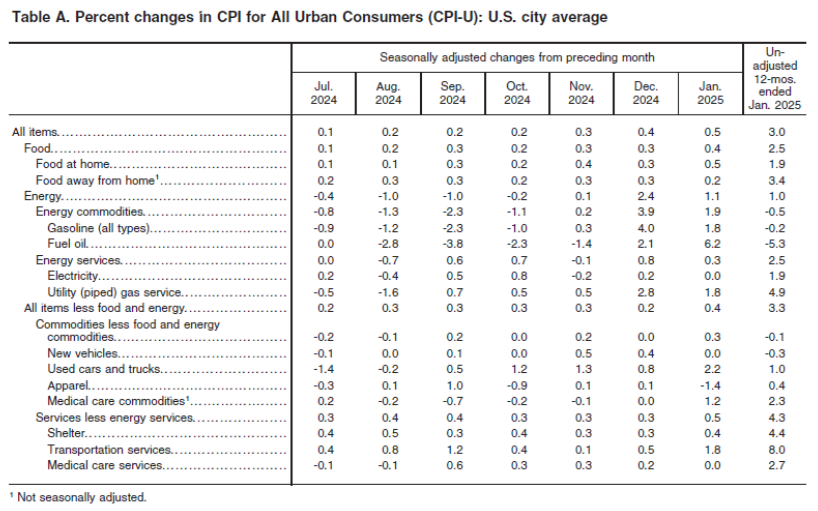
Used cars and trucks were primary outliers again this month, with energy-related items like gasoline, fuel oil, and utilities also recording significant MoM increases. Likewise, food inflation was the highest in five months.
Core inflation (which excludes the impacts of food and energy), rose by 0.4% in January, a jump from December’s 0.2% print. And despite the decline in real-time rents, shelter rose by 0.4% MoM and accounted for “nearly 30 percent of the monthly all items increase.”
Food Prices
The food index hit a five-month high in January, and four of the six major grocery store food indexes increased:
- Cereals and bakery products (-0.4%)
- Meats, poultry, fish, and eggs (+1.9%)
- Dairy and related products (+0.3%)
- Fruits and vegetables (-0.5%)
- Nonalcoholic beverages (+0.9%)
- Other food at home (+0.3%)
In addition, the food away from home index rose by 0.2%, as restaurant inflation slowed in January.
Energy Prices
The energy index rose by 1.1% in January, with gasoline and natural gas up by 1.8%, respectively, while electricity was flat.
Core CPI January 2025
The January core CPI rose by 0.4% month-over-month and 3.3% Y-o-Y. Below is an itemized breakdown of the main price fluctuations seen in the core CPI reading:
- Shelter index: (+0.4%) [December: +0.3%]
- Rent index: (+0.3%) [December: +0.3%]
- Owners’ equivalent rent: (+0.3%) [December: +0.3%]
- Motor vehicle insurance: (+2.0%) [December: +0.4%]
- Medical care services: (+0.0%) [December: +0.2%]
- Physician services: (+0.1%) [December: +0.1%]
- Hospital services: (+0.9%) [December: +0.2%]
- Airline fares: (+1.2%) [December: +3.9%]
Seasonally Unadjusted CPI Data for January 2025
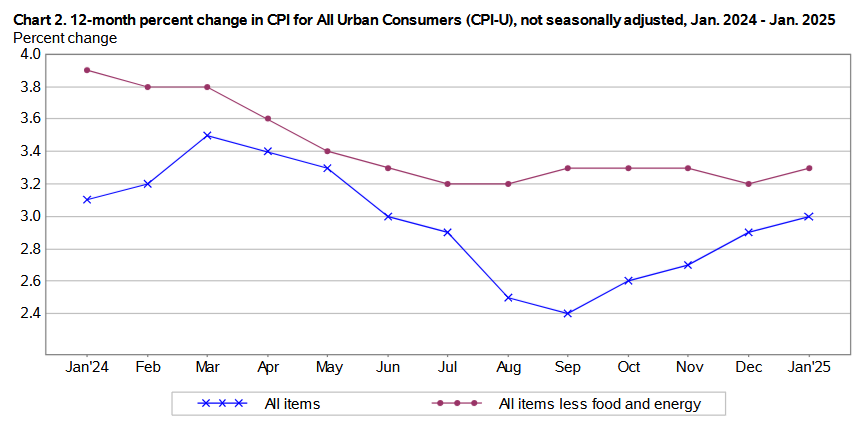
Before seasonal adjustments, the CPI-U for January 2025 increased by 3.0% Y-o-Y to an index level of 317.671. Since these figures are unadjusted, they include regular seasonal price fluctuations that can create volatility in the results.
Seeking Shelter
With inflation refusing to recede, the financial markets remain unnerved at the prospect of higher-for-longer interest rates. However, one sign of hope is the eventual decline of rental inflation.
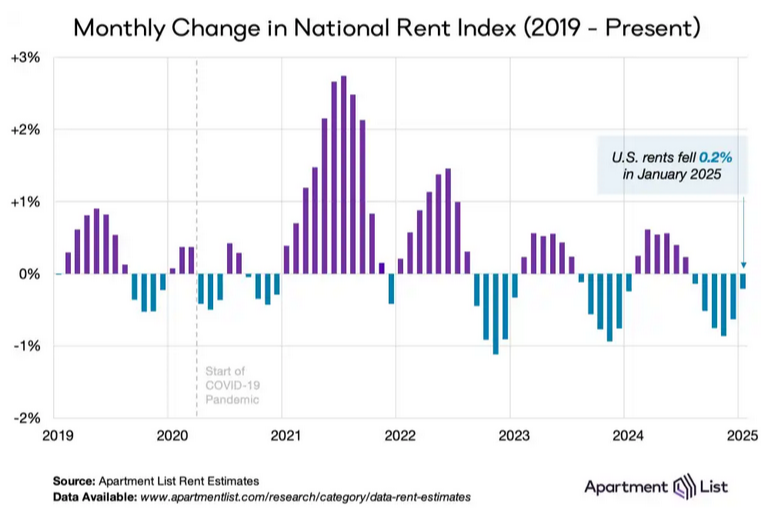
The shelter CPI accounts for more than 30% of the headline CPI’s movement, and Apartment List noted on Jan. 27:
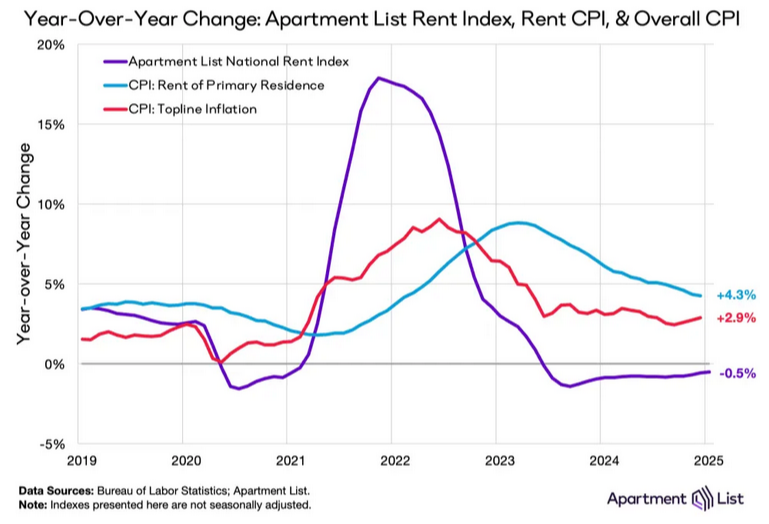
‘Our national rent index started the year with its sixth straight month-over-month decline, falling by 0.2 percent in January. Year-over-year growth also remains negative at -0.5 percent, but is slowly inching back toward positive territory.”
The report added:
“The Apartment List National Rent Index has proven to be a strong leading indicator of the CPI housing and rent components (collectively referred to as “shelter”), since our index captures price changes in new leases, which are only later reflected in price changes across all leases (what the CPI measures)….
“Despite the progress, shelter CPI remains elevated and is one of the key factors continuing to exert upward pressure on topline CPI. In fact, if you strip out shelter, the remainder of the CPI price basket has increased by just 1.9 percent year-over-year as of December, right in line with the Fed’s long-term 2 percent inflation target. As shelter inflation continues to trend down, it will help improve the overall inflation picture.”
Consequently, while January’s CPI print worsened the inflation outlook, there are some positive signs that could flip the script in the months ahead.
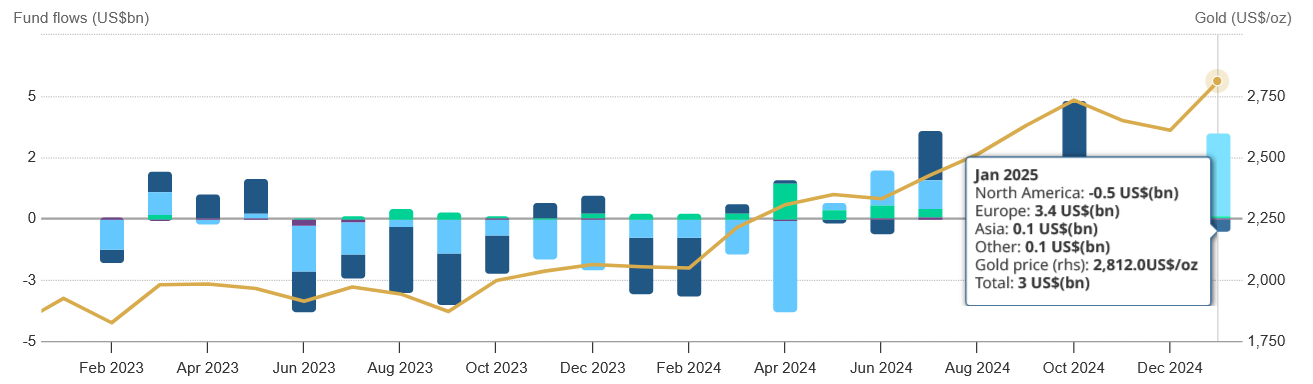
In the meantime, while some assets have suffered recently, as higher interest rates on risk-free assets like Treasury bonds make risky assets like stocks seem less attractive, gold has shined bright. Moreover, the World Gold Council noted on Feb. 10 that gold’s “record-breaking performance attracted investor attention.”
An excerpt read:
“European funds saw their largest monthly inflow since March 2022, adding US$3.4bn during January. UK and Germany dominated inflows. In the UK, government bond yields fell notably during the second half of January as easing inflation pressure and soft economic data prints raised investor expectations for rate cuts from the Bank of England during 2025. Reduced opportunity cost of holding gold, alongside a robust gold price performance, drove local investors into gold ETFs.”
As such, more upside could materialize as inflation, geopolitical uncertainty, and tariff concerns fester throughout 2025.
Are you thinking about diversifying into precious metals? Talk to your financial advisor about initiating a gold IRA account today, allowing you to invest in this red-hot asset on a tax-advantaged basis. Additionally, our complimentary CPI inflation calculator remains at your disposal, enabling you to assess inflation’s impact on your finances. Remember, seek the guidance of a financial advisor before making any investment decision.
by Alex Demolitor | Jan 15, 2025 | Definitions
The December 2024 Consumer Price Index of All Urban Consumers (CPI-U) report indicates that inflation increased by 0.3% for the month, surpassing November’s 0.2% rise. These data were released at 8:30 am EST on Wednesday, January 15, 2025, by the Bureau of Labor Statistics. Before seasonal adjustment, the year-over-year (Y-o-Y) inflation rate in the all-items index grew by 2.9%, a rise from the 2.7% and 2.6% witnessed in November and October.
Despite the monthly acceleration, the results matched or missed economists’ consensus estimates. The table below is courtesy of Investing.com. The left column represents December’s figures, while the right column represents forecasters’ expectations. As you can see, a weaker-than-expected core CPI was the headliner.
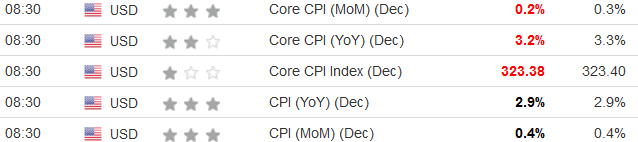
The data may be a relief for FOMC Chairman Jerome Powell, as the committee shifted from a dovish labor-market-driven tone to a hawkish inflation-driven tone. He said during his post-meeting press conference on Dec. 18:
“Inflation itself is way down, but people are still feeling high prices. The best we can do for them is to get inflation back down to its target and keep it there so that people are earning, you know, big, real wage increases so that their, their wages are going up, their compensation is going up faster than inflation year upon year upon year. And that’s what will restore people’s good feeling about the economy. That’s what it will take, and that’s what we’re aiming for.”
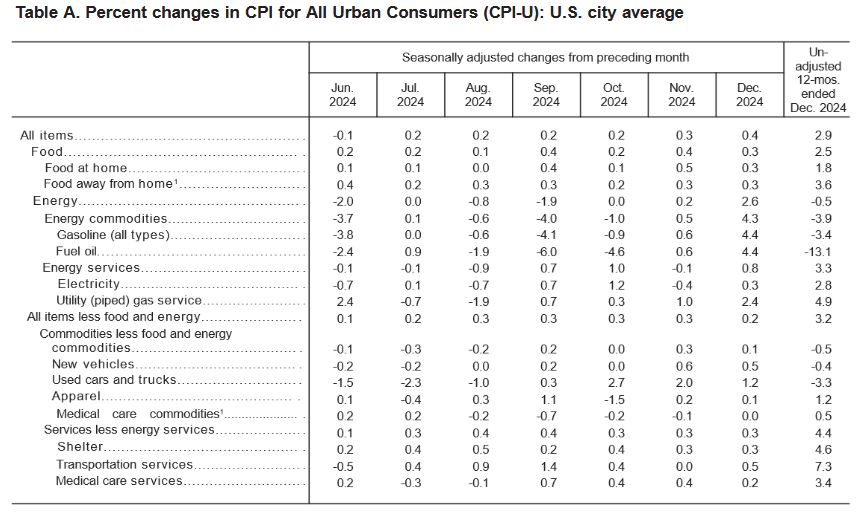
Used cars and trucks were the primary outlier again this month, with the segment rising by 1.2% MoM in December. Similarly, energy-related items like gasoline and utilities recorded significant increases.
Core inflation (which excludes the impacts of food and energy), rose by 0.2% in December, a decline from November’s 0.3% print. Moreover, with real-time rents down sharply on an annual basis, a weaker shelter component should aid the core CPI in the months ahead.
Food Prices
The food index slowed in December, rising by 0.3% versus 0.4% in November. Four of the six major grocery store food indexes increased:
- Cereals and bakery products (+1.2%)
- Meats, poultry, fish, and eggs (+0.6%)
- Dairy and related products (+0.2%)
- Fruits and vegetables (-0.1%)
- Nonalcoholic beverages (-0.4%)
- Other food at home (+0.3%)
In addition, the food away from home index rose by 0.3%, as restaurants priced their products in line with overall food inflation.
Energy Prices
The energy index rose by 2.6% in December, a noticeable jump from the 0.2% recorded in November. Gasoline and natural gas prices rose by 4.4% and 2.4%, respectively, while electricity rose by 0.3%.
Core CPI December 2024
The December core CPI rose by 0.2% month-over-month and 3.2% Y-o-Y. Below is an itemized breakdown of the main price fluctuations seen in the core CPI reading:
- Shelter index: (+0.3%) [November: +0.3%]
- Rent index: (+0.3%) [November: +0.2%]
- Owners’ equivalent rent: (+0.3%) [November: +0.2%]
- Motor vehicle insurance: (+0.4%) [November: +0.1%]
- Medical care services: (+0.2%) [November: +0.4%]
- Physician services: (+0.1%) [November: +0.3%]
- Hospital services: (+0.2%) [November: +0.0%]
- Airline fares: (+3.9%) [November: +0.4%]
Seasonally Unadjusted CPI Data for December 2024
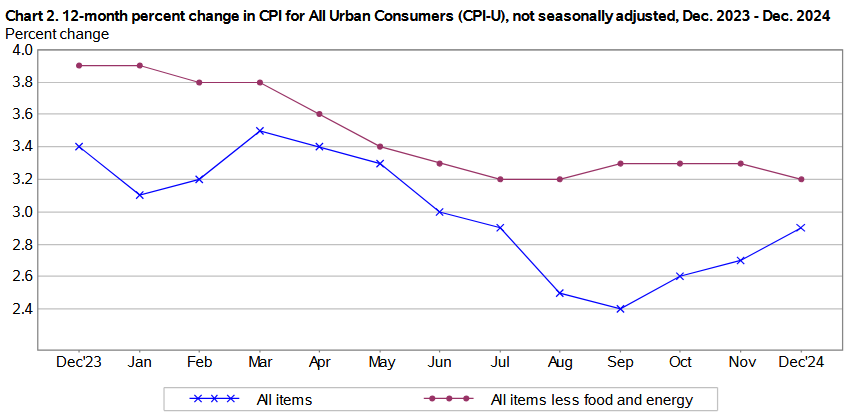
Before seasonal adjustments, the CPI-U for December 2024 increased by 2.9% Y-o-Y to an index level of 315.605. Since these figures are unadjusted, they include regular seasonal price fluctuations that can create volatility in the results.
Too Hawkish?
With the FOMC shifting its stance in a hawkish direction on Dec. 18, inflation had taken precedence over the labor market. Powell added:
“You saw in the SEP that risks and uncertainty around inflation we see as higher. Nonetheless, we see ourselves as still on track to continue to cut. I think the actual cuts that we make next year will not be because of anything we wrote down today. We’re, we’re going to react to data. That’s just the general sense of what the Committee thinks is likely to be appropriate.”
To explain, the FOMC releases its Summary of Economic Projections (SEP) four times per year, and include members’ forecasts for GDP growth, inflation, unemployment, and the federal funds rate (FFR).
If you analyze the red box below, you can see that the consensus estimate was for 100 basis points of rate cuts and a 3.4% FFR in 2025. But, with economic data outperforming, the FFR projection was increased to 3.9%, which means only 50 basis points of rate cuts.
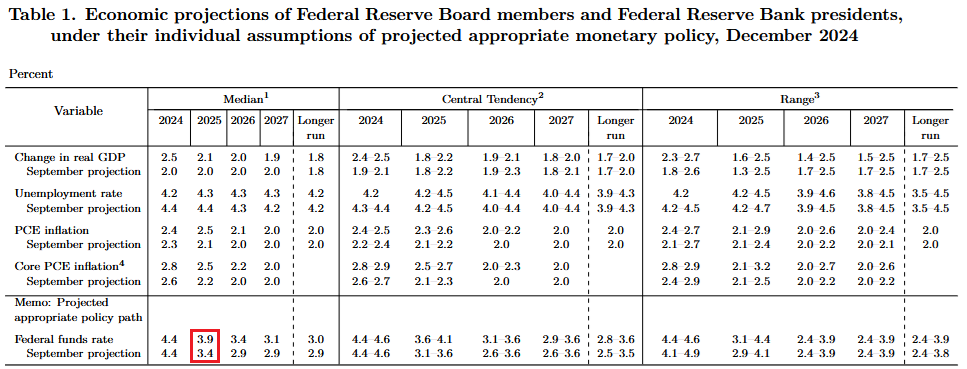
Add it all up, and the hawkish shift implies stricter monetary policy throughout 2025. Yet, with the core CPI data underperforming today, more of the same could lead to a shift back to dovish projections in the months ahead.
In the meantime, asset prices have suffered recently, as higher interest rates on risk-free assets like Treasury bonds make risky assets like stocks, gold, and silver seem less appealing.
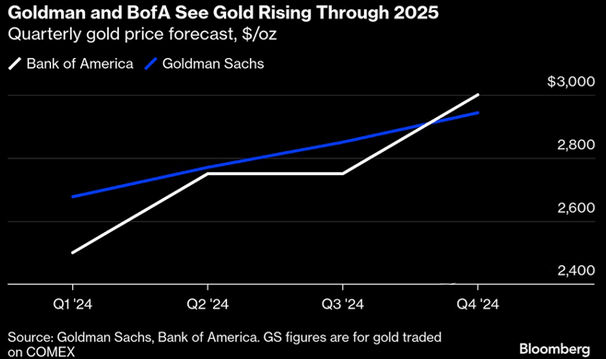
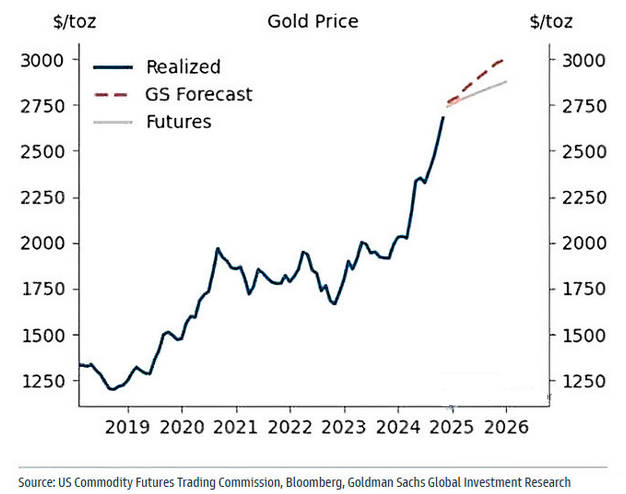
However, Goldman Sachs and Bank of America still expect the yellow metal to exceed $2,800 and post a new record high in 2025. If you analyze the Bloomberg chart below, you can see that both investment banks see gold maintaining its strength throughout the year.
Are you thinking about diversifying into precious metals? Talk to your financial advisor about initiating a gold IRA account today, allowing you to invest in this red-hot asset on a tax-advantaged basis. Additionally, our complimentary CPI inflation calculator remains at your disposal, enabling you to assess inflation’s impact on your finances. Remember, seek the guidance of a financial advisor before making any investment decision.
by Alex Demolitor | Dec 11, 2024 | Definitions
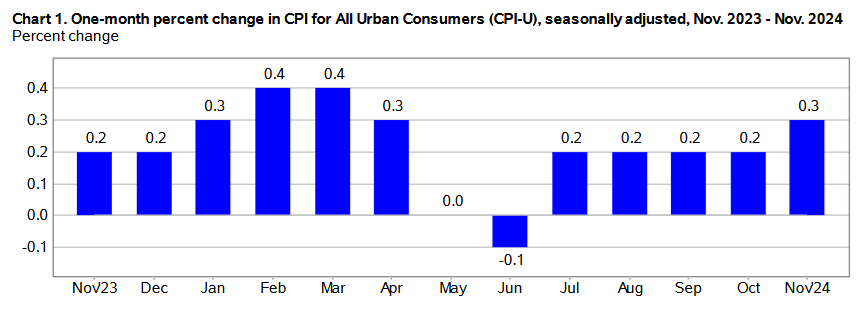
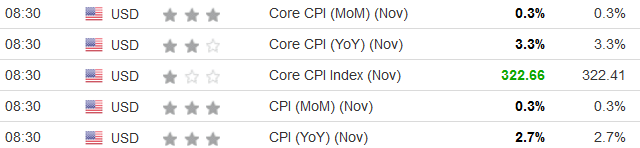
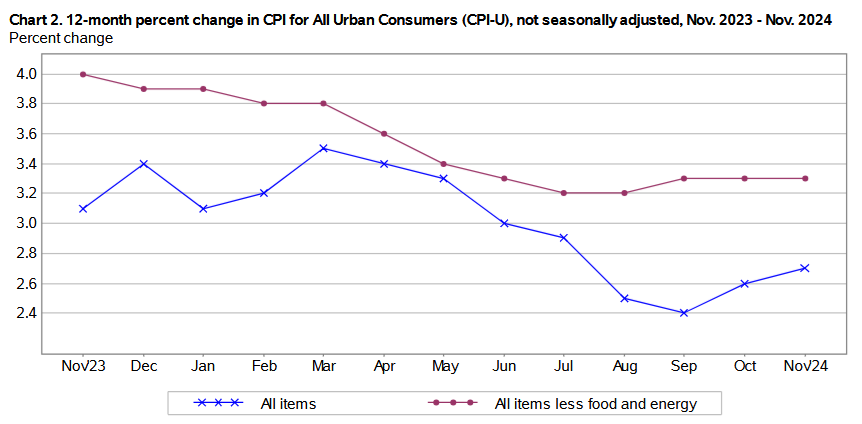
The November 2024 Consumer Price Index of All Urban Consumers (CPI-U) report indicates that inflation increased by 0.3% for the month, outperforming October’s 0.2% rise. These data were released at 8:30 am EST on Wednesday, December 11, 2024, by the Bureau of Labor Statistics. Before seasonal adjustment, the year-over-year (Y-o-Y) inflation rate in the all-items index grew by 2.7%, a rise from the 2.6% witnessed in October.
Although the CPI data exceeds the FOMC’s 2% target, the results aligned with economists’ estimates. The table below is courtesy of Investing.com. The left column represents November’s figures, while the right column represents forecasters’ expectations. As you can see, most metrics (marked in black) matched consensus predictions.
FOMC Chairman Jerome Powell should welcome the news, as the data supports the committee’s current trajectory. With economic data holding up and inflation behaving, Powell said on Nov. 14, “The economy is not sending any signals that we need to be in a hurry to lower rates. The strength we are currently seeing in the economy gives us the ability to approach our decisions carefully.”
As a result, while the FOMC is widely expected to cut interest rates by 25 basis points at next week’s meeting, Powell may maintain a gradual approach to monetary easing.
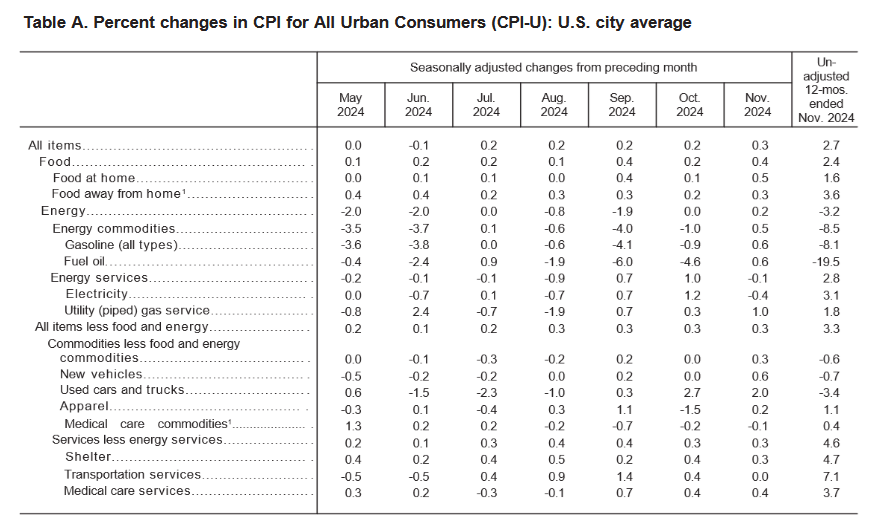
Used cars and trucks were the primary outlier this month, with the segment rising by 2% MoM in November. And outside of utilities (up by 1% MoM), no other metric increased by more than 0.6% MoM. Core inflation (which excludes the impacts of food and energy), rose by 0.3% in November, matching August, September, and October’s prints. However, shelter slowed to 0.3% MoM, down from 0.4% MoM in October.
Food Prices
The food index continued its upward trend, rising by 0.4% in November and doubling October’s 0.2% print. Four of the six major grocery store food indexes increased:
- Cereals and bakery products (-1.1%)
- Meats, poultry, fish, and eggs (+1.7%)
- Dairy and related products (-0.1%)
- Fruits and vegetables (+0.2%)
- Nonalcoholic beverages (+1.5%)
- Other food at home (+0.1%)
In addition, the food away from home index rose by 0.3%, a slight uptick from October’s 0.2% result.
Energy Prices
The energy index rose by 0.2% in November after recording a flat performance in October. Gasoline and natural gas prices rose by 0.6% and 1.0%, respectively, while electricity slumped by 0.4%.
Core CPI November 2024
The November core CPI rose by 0.3% month-over-month and 3.3% Y-o-Y. Below is an itemized breakdown of the main price fluctuations seen in the core CPI reading:
- Shelter index: (+0.3%) [October: +0.4%]
- Rent index: (+0.2%) [October: +0.3%]
- Owners’ equivalent rent: (+0.2%) [October: +0.4%]
- Motor vehicle insurance: (+0.1%) [October: -0.1%]
- Medical care services: (+0.4%) [October: +0.4%]
- Physician services: (+0.3%) [October: +0.5%]
- Hospital services: (+0.0%) [October: +0.5%]
- Airline fares: (+0.4%) [October: +3.2%]
Seasonally Unadjusted CPI Data for November 2024
Before seasonal adjustments, the CPI-U for November 2024 increased by 2.7% Y-o-Y to an index level of 315.493. Since these figures are unadjusted, they include regular seasonal price fluctuations that can create volatility in the results.
No Rush to Cut?
With resilient economic data allowing Powell to take a patient approach to rate cuts, little occurred to disrupt his thesis this week.
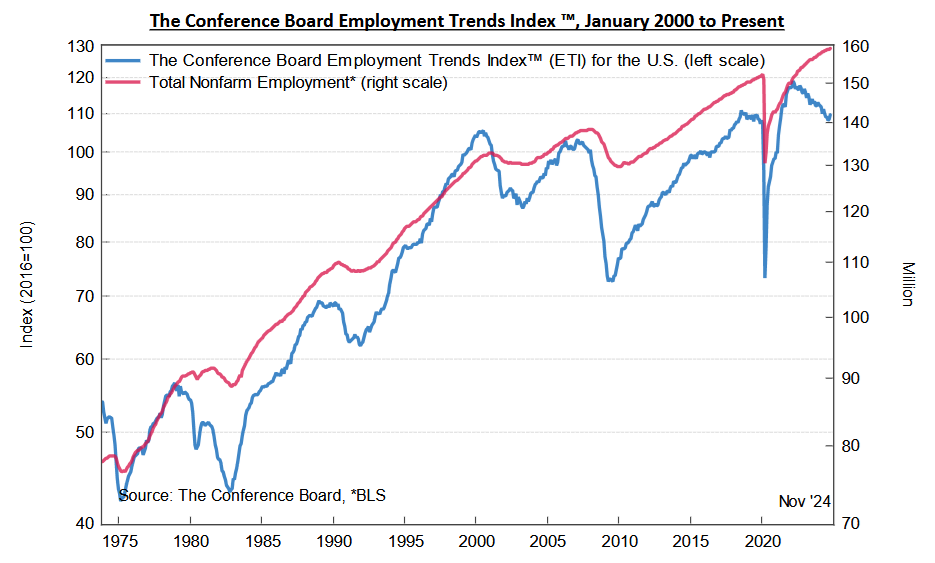
For example, The Conference Board released its Employment Trends Index (ETI) on Dec. 9. Economist Mitchell Barnes noted, “The ETI rose again in November, marking consecutive monthly gains for the first time in 2024. The increases in October and November add up to the largest two-month increase in the ETI since the torrid period of job gains in 2022 coming out of the pandemic.”
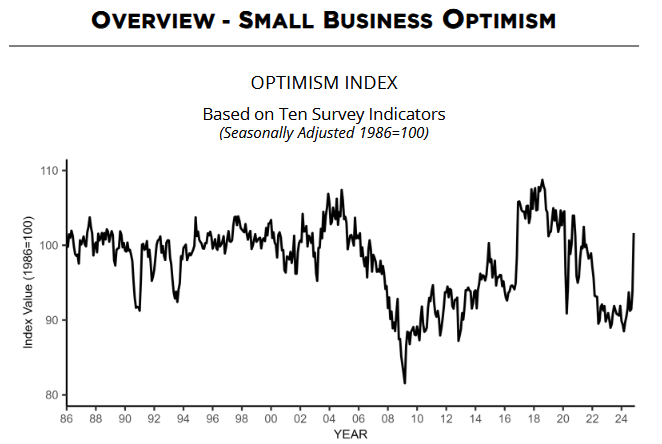
Similarly, the NFIB released its Small Business Optimism Index on Dec. 10. The report stated: “The NFIB Small Business Optimism Index rose by eight points in November to 101.7, after 34 months of remaining below the 50-year average of 98. This is the highest reading since June 2021. Of the 10 Optimism Index components, nine increased, none decreased, and one was unchanged.”
Add it all up, and there aren’t many catalysts to entice the FOMC to accelerate rate cuts. Consequently, interest rates should remain high until the U.S. economy showcases further weakness.
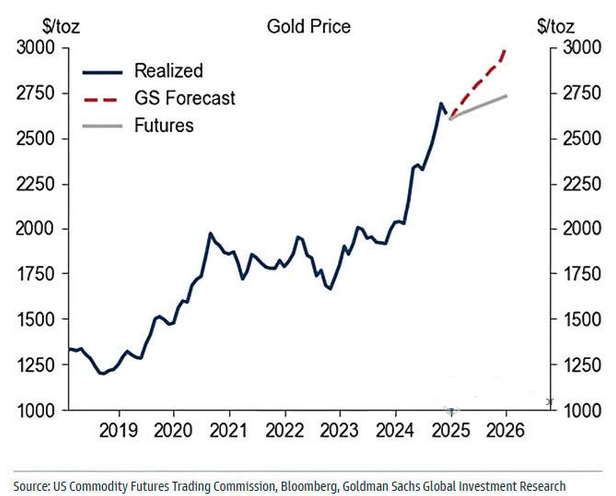
In the meantime, risk assets remain elevated, and gold continues to perform well despite a stronger U.S. dollar and elevated interest rates. On Dec. 2, Goldman Sachs reiterated its year-end 2025 price target of $3,000, with Commodities Strategist Lina Thomas writing, “Since 2022, gold prices have surged 40% even as US interest rates were climbing. That is very strange. Typically, higher interest rates make gold less attractive – because gold doesn’t pay any interest, unlike bonds.”
“That was a wake-up call for central banks worldwide. They began to diversify their reserves away from the dollar and into an asset no one can freeze – and that is gold. We don’t see central bank demand slowing down. And with the Fed cutting rates, investors are jumping back in, too.”
Thus, with the investment bank predicting a more bullish outcome than the futures market (the dotted red line below measures Goldman Sachs’ forecasted price), gold could have plenty of room to run.
Are you thinking about diversifying into precious metals? Talk to your financial advisor about initiating a gold IRA account today, allowing you to invest in this red-hot asset on a tax-advantaged basis. Additionally, our complimentary CPI inflation calculator remains at your disposal, enabling you to assess inflation’s impact on your finances. Remember, seek the guidance of a financial advisor before making any investment decision.
by Alex Demolitor | Nov 13, 2024 | Definitions
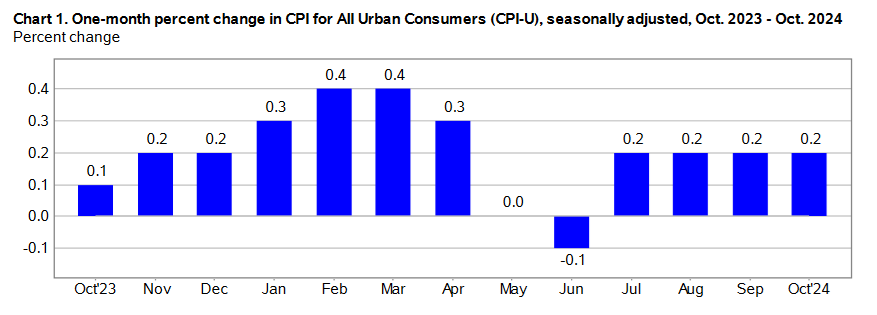
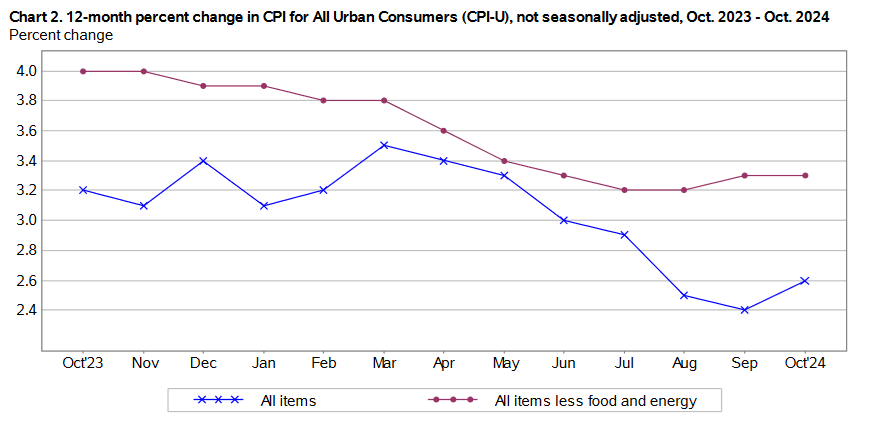
The October 2024 Consumer Price Index of All Urban Consumers (CPI-U) report indicates that inflation increased by 0.2% for the month, matching July, August, and September’s 0.2% rise. These data were released at 8:30 am EST on Wednesday, November 13, 2024, by the Bureau of Labor Statistics. Before seasonal adjustment, the year-over-year (Y-o-Y) inflation rate in the all-items index grew by 2.6%, a slight uptick from the 2.4% witnessed in September.
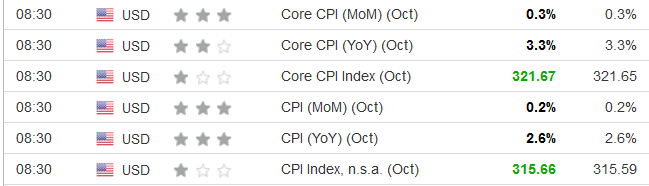
Despite that, the CPI data mostly matched economists’ estimates. The table below is courtesy of Investing.com. The left column represents October’s figures, while the right column represents forecasters’ expectations. Outside of the index levels (marked in green), the rest of the results (marked in black) aligned with the consensus.
This is welcome news to FOMC Chairman Jerome Powell. The committee’s decision to cut interest rates by 25 basis points on Nov. 7 should avoid scrutiny as the inflation results may calm fears of another price acceleration. He said during his post-meeting press conference:
“Inflation has moved down a great deal from its highs of two years ago, and we judge, as I mentioned, that it’s on a sustainable path back to 2%. The job’s not done on inflation, but we judged in September that it was appropriate to begin to recalibrate our policy stance to reflect this progress, and today’s decision is really another step in that process.”
He added:
“We’re not declaring victory, obviously, but we feel like the story is very consistent with inflation, continuing to come down on a bumpy path over the next couple of years and settling around 2%. That story is intact, and it won’t be one or two really good data months or bad data months aren’t going to really change the pattern at this point now that we’re this far into the process.”
As a result, while October’s CPI data is another chapter in Powell’s inflation story, the momentum continues to trend in a positive direction.
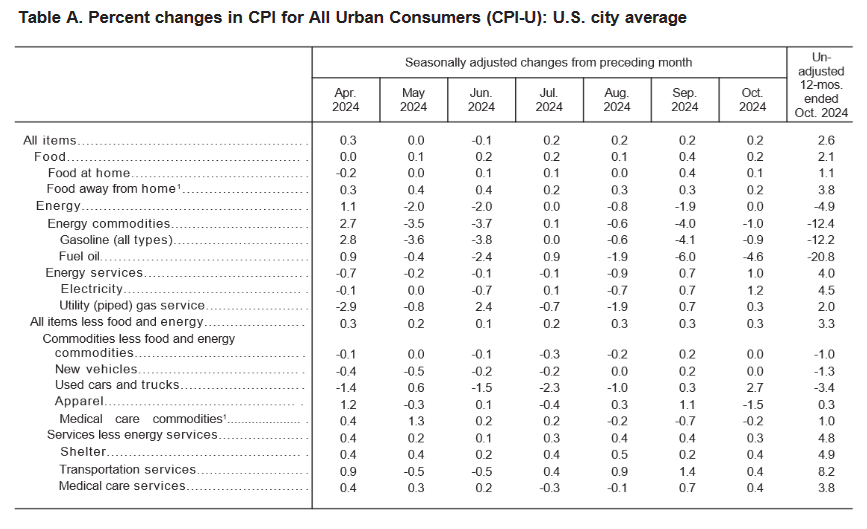
Most headline inflation metrics were well-behaved in October, with only used cars and trucks and electricity increasing by 2.7% and 1.2% month-over-month. Core inflation (which excludes the impacts of food and energy), rose by 0.3% in October, matching August and September’s print. But, the shelter index rose by 0.4%, a noticeable increase from the 0.2% reported in September.
Food Prices
The food index showcased progress in October, rising by 0.2%, and declining from September’s 0.4% print. Five of the six major grocery store food indexes increased:
- Cereals and bakery products (+1.0%)
- Meats, poultry, fish, and eggs (-1.2%)
- Dairy and related products (+1.0%)
- Fruits and vegetables (+0.4%)
- Nonalcoholic beverages (+0.4%)
- Other food at home (+0.1%)
In addition, the food away from home index rose by 0.2% — a decline from August and September — which means restaurant prices largely tracked overall inflation in October.
Energy Prices
The energy index was flat in October after declining by 1.9% in September. Gasoline prices dropped by 0.9% (1.9% without seasonal adjustments), while electricity and natural gas prices rose by 1.2% and 0.3%, respectively.
Core CPI October 2024
The October core CPI rose by 0.3% month-over-month and 3.3% Y-o-Y. Below is an itemized breakdown of the main price fluctuations seen in the core CPI reading:
- Shelter index: (+0.4%) [September: +0.2%]
- Rent index: (+0.3%) [September: +0.3%]
- Owners’ equivalent rent: (+0.4%) [September: +0.3%]
- Motor vehicle insurance: (-0.1%) [September: +1.2%]
- Medical care services: (+0.4%) [September: +0.7%]
- Physician services: (+0.5%) [September: +0.9%]
- Hospital services: (+0.5%) [NA]
- Airline fares: (+3.2%) [September: +3.2%]
Seasonally Unadjusted CPI Data for October 2024
Before seasonal adjustments, the CPI-U for October 2024 increased by 2.6% Y-o-Y, rising to an index level of 315.664. Since these figures are unadjusted, they include regular seasonal price fluctuations that can create volatility in the results.
More Cuts to Come?
While investors are eager for rate cuts and a return to pre-pandemic monetary policy, Powell cautioned that the ebbs and flows of economic data will decide the FOMC’s future path.
“Nothing in the economic data suggests that the committee has any need to be in a hurry to get there,” he said. “We are seeing strong economic activity, we are seeing ongoing strength in the labor market; we’re watching that carefully. But we do see maintaining strength there. And so we think that the right way to find neutral, if you will, is carefully, patiently.”
He added:
“The precise timing of these things is not as important as the overall arc of them, and the arc of them is to move from where we are now to the sense of neutral, a more neutral policy. We don’t know exactly where that is, we only know it by its works. We’re pretty sure it’s below where we are now.”
So, while resilient economic data allows Powell to take a patient approach, the long-term trend should eventually produce lower rates in the months ahead.
In the meantime, a major divergence for risk assets unfolded following the Nov. 6 U.S. Presidential election. Bitcoin and Ethereum soared, while gold and silver sold off. However, the U.S. dollar was a major beneficiary, and gold often has a negative correlation with the greenback.
Yet, the short-term correction should give way to higher prices over time, as Goldman Sachs forecasts gold will hit $3,000 in 2025. The blue line below tracks gold’s price path, while the gray line at the top measures the implied futures price, and the dotted red line measures Goldman Sachs’ forecasted price. As you can see, the investment bank is more bullish than the futures market and expects gold to outperform for the foreseeable future.
Are you thinking about diversifying into precious metals? Talk to your financial advisor about initiating a gold IRA account today, allowing you to invest in this red-hot asset on a tax-advantaged basis. Additionally, our complimentary CPI inflation calculator remains at your disposal, enabling you to assess inflation’s impact on your finances. Remember, seek the guidance of a financial advisor before making any investment decision.
by Amine Rahal | Jun 30, 2023 | Definitions, Inflation
In the realm of economics, three terms often crop up in discussions about the health of an economy: inflation, recession, and depression. While they are interconnected in various ways, each term represents a distinct economic phenomenon with different implications for the economy and, by extension, for investors, businesses, and consumers. This article will delve into the definitions of inflation, recession, and depression and explore how they are linked. Let’s start by looking at a comparison table:
|
Inflation |
Recession |
Depression |
| Definition |
General increase in prices. |
Significant decline in economic activity, typically for two quarters or more. |
Severe and prolonged downturn in economic activity. |
| Impact on Economy |
Decreases purchasing power. Can stimulate economic activity when moderate, but leads to instability when too high. |
Results in higher unemployment, decreased consumer spending, and economic slowdown. |
Severe declines in employment and production, often causing significant economic hardship. |
| Common Causes |
Excessive growth in the money supply, demand-pull, or cost-push factors. |
Various, including financial crises, economic bubbles, or external shocks. |
Often a severe or prolonged recession, but can also be caused by a financial crisis or large-scale economic dislocation. |
| Central Bank Response |
May raise interest rates to slow economic activity and curb inflation. |
May lower interest rates and increase government spending to stimulate economic activity. |
Similar to recession, but response typically needs to be larger and more sustained. May involve significant fiscal policy responses as well. |
| Link to Other Two Terms |
High inflation can lead to a recession. Recession can lead to low inflation or deflation. |
Can turn into depression if severe and prolonged. Lower demand during a recession can lead to lower inflation. |
Could lead to deflation due to lower demand. However, policy responses could potentially lead to inflation. |
Inflation
Inflation is the rate at which the general level of prices for goods and services is rising, eroding purchasing power. In other words, as inflation increases, each unit of currency buys fewer goods and services. Inflation is updated monthly.
Moderate inflation is typical in a growing economy and can even stimulate economic activity. However, if it gets out of hand, it can lead to economic instability. The BLS uses the CPI to measure inflation.
The Federal Reserve, like most central banks, aims to control inflation by adjusting interest rates. Lower interest rates encourage spending and investment, which can boost economic activity and, potentially, inflation. Higher interest rates can slow economic activity and curb inflation.
Recession
A recession is typically defined as a significant decline in economic activity spread across the economy, lasting more than a few months. This is often seen in real GDP, real income, employment, industrial production, and wholesale-retail sales. Economists generally agree that two consecutive quarters of negative GDP growth indicate a recession.
Recessions can be caused by various factors, including financial crises, external shocks, and the bursting of economic bubbles. Policymakers often respond to recessions by lowering interest rates and increasing government spending, aiming to stimulate economic activity.
Depression
A depression represents a severe and prolonged downturn in economic activity. It’s more extended and more profound than a recession, characterized by significant declines in output, employment, and trade, often lasting several years. The most notable example is the Great Depression of the 1930s.
Depressions are rare, and economists don’t have a standardized definition like they do for a recession. However, they generally agree that depressions involve a substantial contraction in economic activity that lasts several years.
How Are They Linked?
Inflation, recession, and depression are intertwined in many ways:
- Inflation and Recession: Too much inflation can lead to a recession. When prices rise too quickly (hyperinflation), consumers can struggle to afford goods and services, and businesses can find it challenging to plan for the future. If the central bank tries to combat high inflation by raising interest rates too quickly, it can cool the economy too much and lead to a recession.
- Recession and Inflation: On the flip side, recessions can lead to lower inflation or even deflation (a general decrease in prices). In a recession, demand for goods and services falls, which can lead to lower prices.
- Recession and Depression: If a recession is particularly severe and prolonged, it can turn into a depression. While there’s no strict dividing line, depressions involve higher unemployment, lower output, and more significant declines in standards of living than recessions.
- Inflation and Depression: Inflation rates during a depression can vary. Sometimes, depressions can involve deflation, as demand for goods and services falls and businesses lower prices to try to entice customers. However, economic policy responses to a depression could lead to inflation. For example, if the government responds by increasing the money supply or government spending dramatically, it could eventually lead to increased inflation.
In summary, inflation, recession, and depression are all interconnected elements of economic cycles. By understanding these terms and their relationships, we can better grasp the complexities of economic health and make
FAQ
Q1: What causes inflation? A1: Inflation can be caused by various factors, including excessive growth in the money supply, demand-pull inflation where demand for goods and services outpaces supply, or cost-push inflation where the cost of raw materials or wages increase.
Q2: How can inflation be controlled? A2: Central banks often aim to control inflation by adjusting interest rates. By raising interest rates, central banks can decrease borrowing and spending, thus reducing inflation. Conversely, lowering interest rates can stimulate borrowing and spending, potentially leading to increased inflation.
Q3: What are the signs of a coming recession? A3: Common signs of a coming recession include a decline in the GDP, higher unemployment rates, lower consumer spending, decrease in business profits, and a volatile stock market.
Q4: How can a recession affect the average person? A4: During a recession, people might face job loss or reduced working hours. They may also see the value of their investments decrease, and it could become harder to get credit.
Q5: What’s the difference between a recession and a depression? A5: The main difference between a recession and a depression is the duration and severity of the economic downturn. A recession is a temporary decline in economic activity, typically lasting six months to a year. A depression, on the other hand, is a severe and prolonged economic downturn, often lasting several years.
Q6: How do governments respond to a depression? A6: In a depression, governments may enact expansive fiscal policies, such as increasing government spending, cutting taxes, or both, to stimulate the economy. Central banks may also adopt expansionary monetary policies, such as lowering interest rates or implementing quantitative easing.
Q7: Can a depression lead to inflation? A7: A depression could potentially lead to deflation due to lower demand. However, the economic policy responses to a depression, such as increasing the money supply or government spending, could eventually lead to increased inflation.
Q8: How does a recession affect inflation? A8: A recession typically leads to lower inflation or even deflation. This is because, in a recession, the demand for goods and services falls, which can lead to lower prices. However, the specific impact on inflation can vary depending on the nature and severity of the recession, and the policy responses to it.
Q9: What role do central banks play in managing the economy through these cycles? A9: Central banks play a crucial role in managing the economy through inflation, recession, and depression. They often use tools like interest rates and open market operations to influence the money supply, aiming to stabilize prices and maintain low unemployment rates.
by Sarah Bauder | Jul 13, 2021 | CPI, Definitions
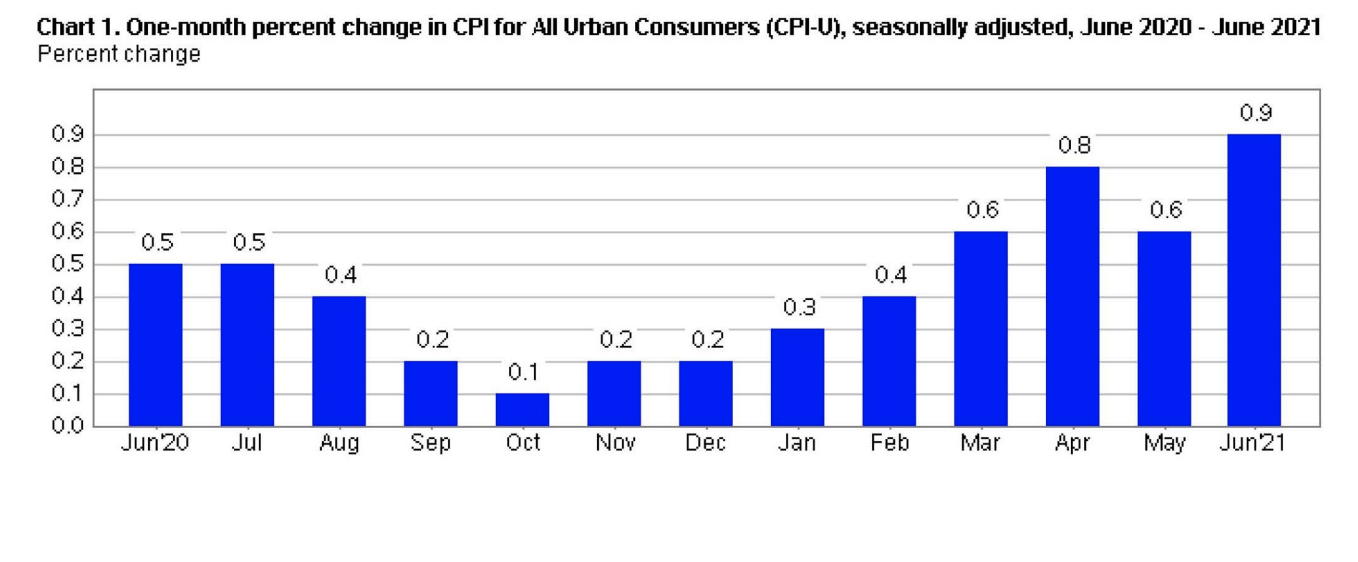
The Consumer Price Index for All Urban Consumers (CPI-U) edged up 0.9% in June on a seasonally adjusted basis, reported the US Bureau of Labor Statistics. In May, it had increased 0.6%.
“This was the largest 1-month change since June 2008 when the index rose 1%. Over the last 12 months, the all items index increased 5.4% before seasonal adjustment; this was the largest 12-month increase since a 5.4% increase for the period ending August 2008.” explained the bureau in its report.
(Source: U.S. Bureau of Labor Statistics)
Food
The index for food edged up 0.8% for the month. The index for food at home likewise increased 0.8% in June. Five of the six major grocery store category indexes all saw percentage increases over the month including the fruits and vegetables index by 0.7%, the index for meats, poultry, fish, and eggs by 2.5%, and the index for beef by 4.5%. The index for food away from home edged up 0.7% in June.
Over the last 12-month period, the food at home index rose 0.9%. All six of the component grocery store food group indexes saw percentage increases, with the fruits and vegetables index having the largest rise at 3.2%.
“The index for food away from home rose 4.2% over the last year, the largest 12-month increase in that index since the period ending in May 2009,” stated the US Bureau of Labor Statistics.
Energy
In June, the index of energy rose 1.5%. The index for gasoline rose 2.5% over the month. The price of gas increased 2.2%, prior to season adjustment. The natural gas index likewise increased 1.7%. Conversely, the index for electricity dropped 0.3% in June, after rising by 0.3% in May.
Since this time last year, the index for energy soared 24.5%. Over the last 12-month period, gas prices skyrocketed 45.1%. Likewise, the natural gas index increased 15.6%, and the electricity index rose 3.8% since this time last year.
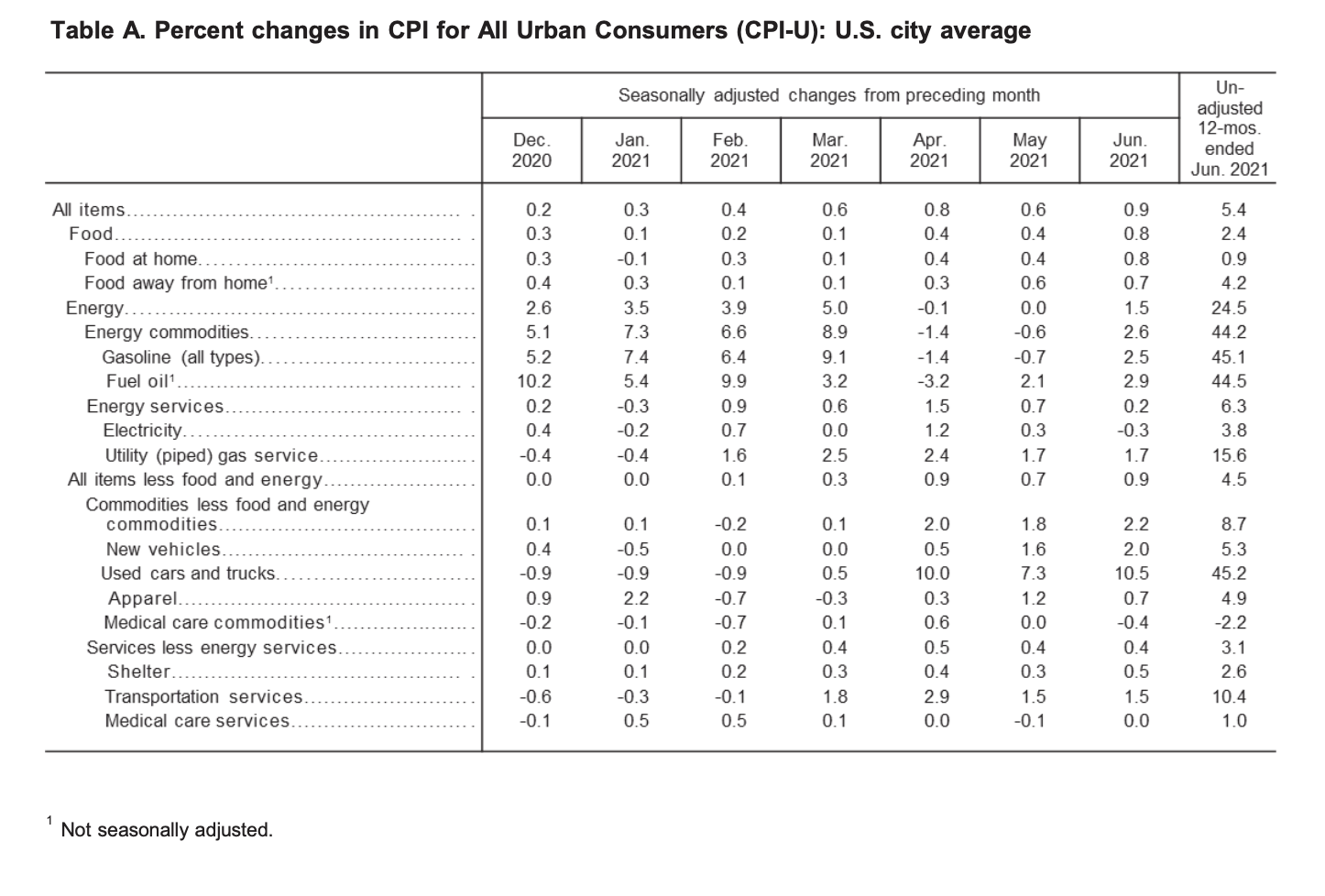
(Source: U.S. Bureau of Labor Statistics)
All Items Less Food and Energy
In June, the index for all items less food and energy increased 0.9%. Several of the component indexes all saw increases over the month including the shelter index by 0.5%, the index for owners’ equivalent rent rose 0.3%, and the rent index edged up 0.2%.
“The index for used cars and trucks rose sharply for the third consecutive month, increasing 10.5% in June. This was the largest monthly increase ever reported for the used cars and trucks index, which was first published in January 1953,” explained the bureau in its report.
Over the last 12 month period, the all items less food and energy index increased 4.5%.
“The index for used cars and trucks increased 45.2%, the largest 12-month change ever reported for that index. The index for new vehicles rose 5.3% over the past 12 months, its largest 12-month increase since the period ending January 1987. The motor vehicle insurance index increased 11.3% in the last year, while the index for car and truck rental rose 87.7% over that period. The shelter index increased 2.6% over the last 12 months. The medical care index rose 0.4% over the past 12 months, its smallest 12-month increase since the period ending March 1941,” reported the US Bureau of Labor Statistics.
Source cited: https://www.bls.gov/news.release/archives/cpi_07132021.htm