Note: we are an independent blog. Our content doesn't constitute financial advice. We strive for accuracy, but please always cross-check inflation numbers directly with the BLS. We may receive compensation from some services and products reviewed on this site (learn more).
Select Page
Amine Rahal
Amine is an entrepreneur, investor and financial writer that covers the US economy, inflation, alternative investments, cryptocurrencies and more. He has been involved in the space for over a decade.
Cambridge Credit Counseling is a nonprofit agency founded in 1996 and based in Agawam, Massachusetts. It is a member of the NFCC and the FCAA, HUD approved for housing counseling, ISO 9001 registered, and listed by the Justice Department as approved to deliver pre bankruptcy counseling. What makes it unusual among the agencies I have reviewed is the fee: Cambridge does not publish a flat rate. It sets your fee against what your household can afford, inside whatever ceiling your state allows.
4-5YEARS
That is how long a debt management plan ties up your budget
Worth knowing whether it is the right tool before you commit to it. Our quiz takes two minutes and asks the three questions that decide it.
Massachusetts, Connecticut, New York, Missouri, Kansas
The fee is means tested, which is a double edged thing
Cambridge is explicit that two clients with identical debts can pay different fees, because the fee is set against what the household can carry and capped by state rule. I respect the honesty of saying that out loud. Most agencies quote an average and let you discover the variance later.
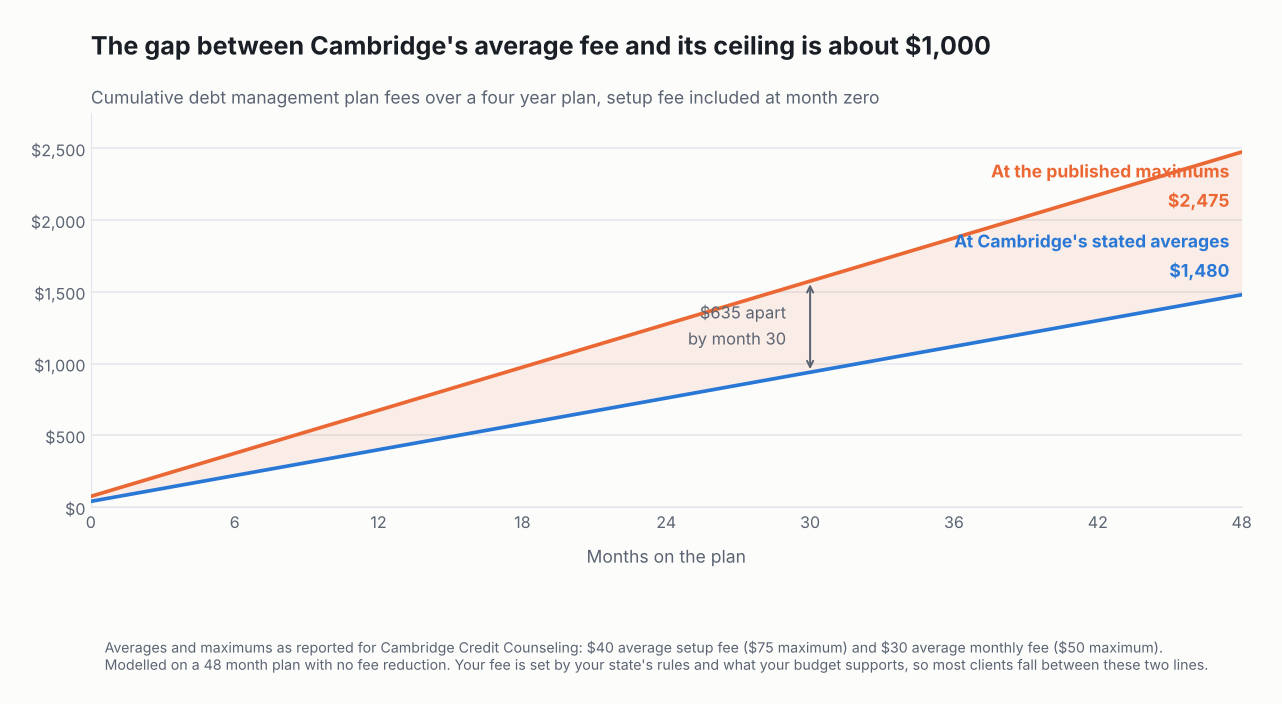
The practical consequence is that you cannot price this agency before you call it. You can only bound it. The reported figures are a $40 average setup fee against a $75 ceiling, and a $30 average monthly fee against a $50 ceiling.
Over a four year plan the difference between being quoted the average and being quoted the ceiling is roughly $1,000. That is the number to have in your head when you ask what your fee will be, because it is the one question the website cannot answer for you.
Ask for your fee in writing on the first call. If the counselor quotes the top of the range, ask directly what would move it down, because hardship reductions exist at most agencies and are almost never volunteered.
One point of perspective. Even at the ceiling, roughly $2,500 over four years is small next to the interest a plan removes. If a plan takes a $25,000 balance from 24 percent down to single digits, the saving dwarfs the fee. Fees matter, but they are the second question, not the first. Our guide to what credit counseling services actually cost works through that comparison in full.
The ratings gap you will run into
This is where a Cambridge search gets confusing, and it is worth explaining rather than papering over.
Platform
Score
Reviews
How I read it
ConsumerAffairs
★★★★★ 5.0 / 5
2,668
Large volume, but a flawless average across thousands of reviews is rare anywhere.
Better Business Bureau
★★★★☆ 3.83 / 5
6
Only six reviews. Too small to carry weight either way.
BBB rating
A+, accredited
n/a
Reflects complaint handling, which is a genuine positive.
After two decades of reading these platforms I have stopped treating a perfect score as the good news it looks like. ConsumerAffairs discloses in its own footer that companies may pay to be listed as Authorized, and solicited reviews skew upward everywhere, not only there. A 5.0 across 2,668 reviews tells me the agency collects feedback systematically. It does not tell me nobody has ever had a bad experience.
The BBB number has the opposite problem. Six reviews is noise. One unhappy person swings it half a point. Neither figure is a lie, and neither one on its own should decide anything for you.
What I weight instead: how long the agency has operated, whether it holds approvals that can be independently checked, and whether its complaint record is clean. On all three Cambridge does well. Thirty years, multiple verifiable approvals, an A+ grade.
Counseling is free. Committing to a plan is not.
Before you book the call, it helps to know which direction your numbers point:
Accounts current and the rate is the problem, counseling fits
Accounts months behind, counseling usually cannot help
No realistic surplus at all, the conversation is a different one
Thirty years operating under one name, with approvals you can verify yourself
You cannot find out your fee without speaking to them
Fees scale to what the household can afford rather than a flat rate
Monthly ceiling of $50 is higher than the cheapest agencies charge
HUD approved housing counseling, plus foreclosure work in five named states
Headline 5.0 rating sits on a platform where companies can pay for placement
Free initial assessment with no obligation to enroll
Thin independent review volume outside its own preferred platform
Where Cambridge is genuinely useful: housing
Most credit counseling agencies treat housing as a sideline. Cambridge is HUD approved to deliver housing counseling nationwide, and it names Massachusetts, Connecticut, New York, Missouri and Kansas for foreclosure intervention and mortgage default work specifically.
If your card debt grew because your mortgage payment got ahead of you, that combination matters more than a few dollars of monthly fee. A counselor who can look at both sides of the balance sheet in one appointment is worth seeking out.
Cambridge against the cheapest agency I have reviewed
The most useful comparison is with American Consumer Credit Counseling, which publishes a flat rate instead of means testing. Here is what a four year plan costs under each, for a household with four enrolled accounts.
Cambridge
ACCC
Setup fee
$40 average, $75 max
$39 flat
Monthly fee, four accounts
$30 average, $50 max
$28
Total over 48 months
About $1,480, up to $2,475
About $1,383
Can you price it before calling?
No
Yes
On those assumptions ACCC comes out roughly $100 cheaper over the life of the plan, and considerably cheaper for anyone enrolling only two or three accounts. Cambridge can close that gap or beat it for a household whose income pulls the means tested fee down, which is exactly the case its model is built for.
A hundred dollars spread over four years should not be the deciding factor. The quality of the counseling call, and whether housing is part of your picture, matter more.
How Cambridge sits against the alternatives
Every nonprofit agency runs roughly the same product. The differences that actually show up in your bank account are the fee level, whether the agency can handle anything beyond cards, and whether the counselor will tell you a plan is wrong for you.
Against Trinity Debt Management: similar nonprofit model with a faith based framing. Choose on fee and on how the counselor handles your call.
Against Take Charge America: both are long established NFCC members. Take Charge America has been operating since 1987 and carries far more independent review volume.
Against the settlement industry: a different product entirely, for people already behind. Our ranked list of debt relief companies covers that side, and the debt relief hub explains which camp you belong in.
When a Cambridge plan is the wrong answer
Your accounts are already charged off. Rate concessions come from card issuers, and they do not offer them on debt they have written off.
Your surplus is zero. A plan needs a payment it can live on. If there is nothing left after essentials, the honest answer is a different one.
The problem is spending, not interest. A plan will not survive if the balance keeps growing. Fix the inflow first, which is what getting spending under control is about.
You are in a state with its own programmes. Several states run their own assistance routes worth checking alongside a national agency, as our Ohio debt relief programmes page shows.
Ask for the fee in writing, including whether a reduction applies to your household.
Ask which of your creditors has actually agreed to a concession, and at what rate.
The free first step I point almost everyone to is the National Foundation for Credit Counseling, which Cambridge belongs to. A counseling conversation costs nothing, leaves no mark on your credit file, and there is no downside to having it even if you walk away afterwards. You can reach an NFCC counselor here.
My verdict
Cambridge is a credible, long running nonprofit with real approvals behind it and an unusually sensible attitude to fees. If your situation involves a mortgage as well as cards, its housing counseling makes it a stronger fit than most of its peers.
Two things keep it from being my first recommendation. The fee is unknowable until you call, and the headline rating rests on a platform with a commercial relationship to the companies it lists. Neither is disqualifying. Both are reasons to ask harder questions on the call than the marketing invites.
Work out your route before you book the call
Counseling, consolidation and settlement solve different problems, and picking the wrong one costs years. Two minutes, no email, and you will walk into the conversation knowing what you are asking for.
Yes. Cambridge Credit Counseling is a nonprofit agency founded in 1996 in Agawam, Massachusetts. It is accredited by the Better Business Bureau with an A+ rating, a member of the NFCC and the FCAA, approved by HUD for housing counseling, ISO 9001 registered, and listed by the Department of Justice as approved to provide pre bankruptcy counseling.
How much does Cambridge Credit Counseling charge?
The initial assessment is free. For a debt management plan the reported setup fee averages $40 with a $75 maximum, and the monthly fee averages $30 with a $50 maximum. Cambridge sets fees against what your household can afford within your state’s legal ceiling, so two clients with the same debts can be quoted different amounts.
Why can Cambridge not tell me my fee upfront?
Because the fee is means tested. It depends on your income, your expenses and the maximum your state allows an agency to charge. The agency states this openly. The practical answer is to ask for your specific fee in writing during the first call and to ask what would reduce it.
Why does Cambridge have 5 stars on one site and 3.83 on another?
Volume and collection method. The 5.0 comes from 2,668 ConsumerAffairs reviews, a platform where companies can pay to be listed as Authorized and where feedback is actively solicited. The 3.83 comes from just six BBB reviews, which is far too small a sample to mean much. Neither number should decide this on its own.
Does Cambridge Credit Counseling help with mortgages?
Yes. It is HUD approved to deliver housing counseling nationwide and names Massachusetts, Connecticut, New York, Missouri and Kansas for foreclosure intervention and mortgage default counseling. That is a wider housing remit than most credit counseling agencies carry.
Will a debt management plan show on my credit report?
Some creditors note that an account is being paid through a plan. That notation is not itself a negative score factor. The real effect comes from the accounts being closed, which lowers your available credit in the short term, offset over time by falling balances and a clean payment record.
How long has Cambridge Credit Counseling been in business?
Since 1996, which is about thirty years under the same name. Longevity is one of the few quality signals in this industry that cannot be manufactured, and it is worth more than a nonprofit label on its own.
Can Cambridge settle my debts for less than I owe?
No. A debt management plan repays the full balance at a reduced interest rate. Settling for less than the full balance is a different product with different consequences for your credit file and a possible tax bill on the forgiven amount.
Is the first appointment really free?
Yes. The initial financial assessment carries no fee and no obligation to enroll. Any agency that asks for payment before it has reviewed your budget is one to walk away from.
I have been writing about debt relief since the early 2000s, and American Consumer Credit Counseling is one of the handful of agencies that has been doing the same thing under the same name that entire time. ACCC is a nonprofit credit counseling agency founded in 1991 and run out of Auburndale, just outside Boston. The counseling session itself is free. The fees sit on the debt management plan, and they are genuinely low: $39 to enroll and $7 per account each month, capped at $70.
Not sure a debt management plan is even the right tool?
Counseling suits some situations and is the wrong answer for others. Three questions sort it out:
Is your problem the interest rate, or the balance itself?
Are your accounts current, or already charged off?
Can your budget carry a fixed payment for four or five years?
130 Rumford Avenue, Suite 202, Auburndale, Massachusetts
Free counseling session
Yes, by phone or online, in English and Spanish
Debt management plan setup
$39 one time
Debt management plan monthly
$7 per account, $70 maximum, $26 stated average
Memberships and approvals
NFCC member, BBB accredited, Council on Accreditation, HUD approved housing counseling
Bankruptcy counseling
Listed on the Department of Justice approved agency roster
What is actually free and what you pay for
This is the distinction that trips up most readers, and it is not specific to ACCC. Credit counseling and a debt management plan are two different products that happen to be sold by the same organisation.
The counseling appointment is a budget review. A certified counselor goes through your income, your bills and your balances, and tells you what your realistic options are. That costs nothing and carries no obligation. I have covered this split in more detail in our guide to credit counseling services and what they really cost.
The debt management plan is the paid product. You make one payment to ACCC each month, ACCC distributes it to your creditors, and in exchange most card issuers drop your rate to somewhere in the single digits and stop the late fees. That rate concession is the whole point. The plan does not reduce what you owe.
ACCC’s fees, in plain numbers
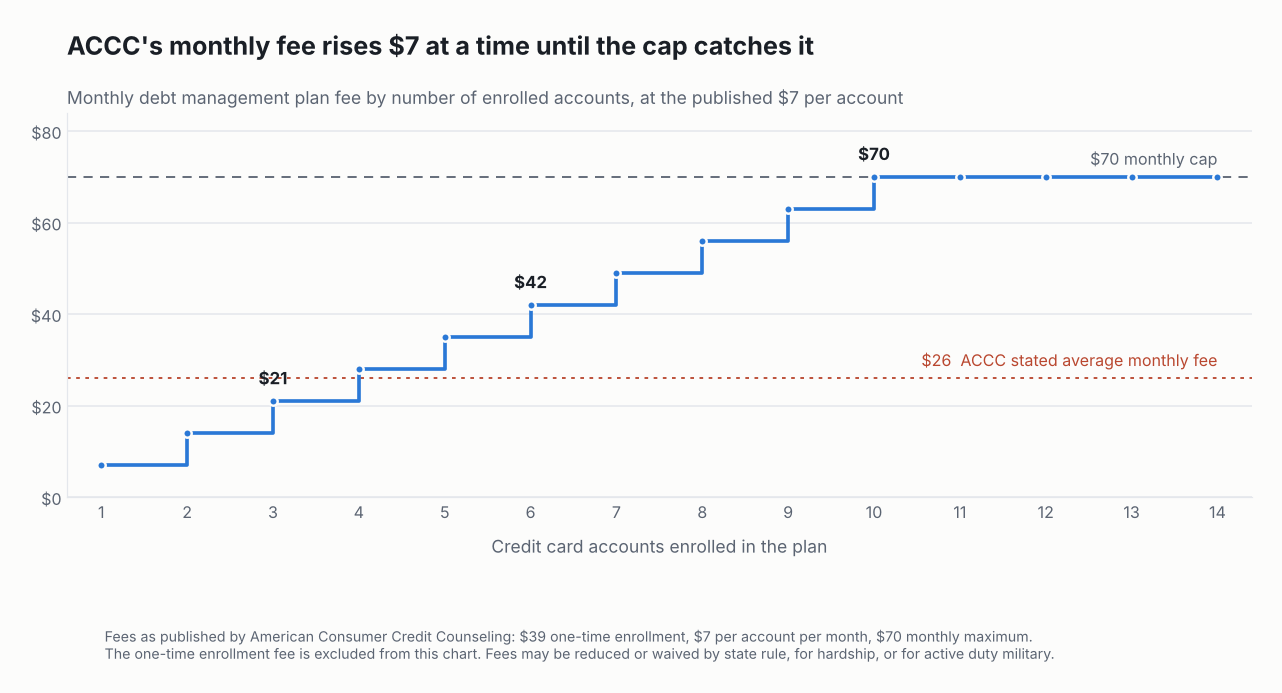
ACCC publishes a $39 one time enrollment fee and a monthly fee of $7 per enrolled account, with a hard ceiling of $70 a month. The agency separately states an average monthly fee of $26, which implies the typical client enrolls about four accounts.
The per account model cuts both ways. A reader with three cards pays $21 a month, while someone with nine pays $63. The $70 ceiling only bites above ten accounts, which is a situation very few people are in.
Three things worth knowing about those numbers. First, ACCC says fees can be reduced or waived by state rule, for financial hardship, or for active duty military. Ask. Agencies rarely volunteer it.
Second, the fee page carries a mid 2025 update stamp and says fees are subject to change, so confirm the current figure on your call rather than quoting mine back to the counselor.
Third, and this is the part people miss: the fee is nearly irrelevant next to the interest saving. If a plan drops a $20,000 balance from 24 percent to 8 percent, you are saving several hundred dollars a month in interest. A $26 fee against that is noise. I walk through the arithmetic on a balance that size in how to pay off $20,000 in credit card debt.
What the review platforms say, and which numbers to trust
Platform
Score
Reviews
What it tells you
Better Business Bureau
★★★★★ 4.98 / 5
1,927
A real sample. This is the number that counts.
BBB rating
A+, accredited
n/a
Letter grades measure complaint handling, not service quality.
Trustpilot
★★★☆☆ 3.6 / 5
3
Three reviews is not a sample. Ignore this score.
Nearly 2,000 BBB reviews averaging 4.98 is an unusually strong record for this industry, and I do not say that lightly. The Trustpilot profile is unclaimed and has three reviews on it, which is why a 3.6 appears in search results next to the 4.98. One of those numbers is signal and the other is rounding error.
One small thing I noticed while checking: ACCC’s own reviews page still describes the agency as having 22 years in business, which does not square with a 1991 founding. It is a stale page rather than a red flag, but it is a reminder to verify dates and fees on the call rather than from site copy.
A free counseling call is not the same as enrolling
If your accounts are current and the interest rate is what is sinking you, counseling is the right first call. If your accounts are already months behind, it probably is not. Our quiz tells you which camp you are in before you pick up the phone.
Fees are at the low end of the industry, and the $70 ceiling is real
A plan locks you into a fixed payment for four to five years
Nearly 2,000 BBB reviews at 4.98, which very few agencies can match
Card accounts on the plan are closed, which shortens your available credit
On the Justice Department’s approved list, so it can handle pre bankruptcy counseling
Creditor concessions are set by the card issuer, not by ACCC
Counseling and housing counseling both offered, in English and Spanish
Site copy carries dated figures, so verify fees on the call
How ACCC compares with the other agencies we have reviewed
Nonprofit status tells you almost nothing on its own. Every agency in this table is a nonprofit. What separates them is fee level, how long they have been operating, and how much verifiable review volume sits behind the score.
ACCC is one of the few that publishes a flat, checkable number rather than pointing you at a state table. Most of the others, Cambridge included, set the fee against what your household can carry, which is defensible but means you cannot price them before you call. That transparency is worth something before you have even spoken to anyone.
When ACCC is the wrong call
A debt management plan fixes an interest rate problem. It does not fix a balance problem, and it cannot help at all with debt that card issuers no longer hold.
Your accounts are already charged off or sold to collectors. Issuers do not offer rate concessions on debt they have written off.
How to verify any credit counseling agency in five minutes
This is the part I wish more people did, because it takes less time than reading a review like this one. The first time I mystery shopped a counseling agency, years ago, the counselor spent forty minutes on a budget and never once mentioned enrolling in anything. That is still the test I apply to all of them.
Ask for the fee in writing before enrolling, including whether a hardship waiver applies to you.
Confirm the agency is licensed to operate in your state. Requirements vary and several states cap what can be charged.
The National Foundation for Credit Counseling is the other free first step worth knowing about. ACCC is a member. Speaking to an NFCC counselor costs nothing, does not touch your credit score, and there is no downside to the conversation even if you decide against a plan afterwards. If you would rather be pointed straight at a counselor, you can reach the NFCC here.
What actually happens on the first call
People put this call off for months because they imagine a sales pitch. In my experience with the reputable agencies it is closer to a tax appointment, and it follows the same shape almost everywhere.
Income and expenses. The counselor builds a monthly budget with you. Have your pay stubs, rent or mortgage, utilities and minimum payments to hand or you will be doing this twice.
Debts listed out. Every balance, every rate, every creditor. Pull a free credit report first so nothing gets missed.
The surplus calculation. Income minus essential expenses is what can go toward debt. This single number decides whether a plan is viable.
Options, not an offer. A good counselor will name self repayment, a plan, settlement and bankruptcy, and tell you which fits. If a plan is the only option you hear, that is a signal.
Paperwork, only if you want it. Nothing is binding on the call. You should leave with a written proposal showing the payment, the fee and the payoff date.
Three questions worth asking before you enroll
What rate has each of my creditors actually agreed to? Concessions are set by the card issuer and vary. A projected payoff date built on assumed rates is a guess.
What is my fee, in writing, and does a hardship waiver apply? ACCC publishes $7 per account with a $70 ceiling, so you can check what you are quoted against that.
What happens if I miss a payment? Creditors can withdraw the concession. Find out how many missed payments it takes before that happens.
My verdict
ACCC is a legitimate, long established nonprofit with the cheapest published fee structure of any agency I have looked at this year, and a review record that very few competitors can match on volume. If a debt management plan is the right tool for your situation, this is a reasonable place to start the conversation.
The caveat is not about ACCC. It is that a plan is the right tool far less often than the industry implies. Get the free session, get the numbers, and only then decide. If you want a sanity check on the broader picture first, how I worked through six figures of card debt covers what actually moved the needle.
Before you call anyone
Find out whether counseling, consolidation or settlement fits your numbers
Two minutes, no email required, and it will tell you which of the three routes your situation actually points to. Walking into a counseling call already knowing the answer changes the conversation.
Yes. ACCC is a nonprofit credit counseling agency founded in 1991, accredited by the Better Business Bureau with an A+ rating, a member of the National Foundation for Credit Counseling, and listed on the Department of Justice roster of agencies approved to provide pre bankruptcy counseling. It holds close to 2,000 BBB customer reviews averaging 4.98 out of 5.
How much does ACCC charge?
The counseling session is free. A debt management plan costs a one time enrollment fee of $39 plus $7 per enrolled account each month, capped at $70 a month. ACCC states an average monthly fee of $26. Fees may be reduced or waived depending on your state, for financial hardship, or for active duty military.
Does a debt management plan hurt your credit score?
Enrolling is not itself a negative mark. The practical effect comes from the card accounts being closed, which reduces your available credit and can raise your utilisation ratio in the short term. Most people see the score recover and then improve as balances fall and payments land on time every month.
How long does an ACCC debt management plan take?
Most plans run between three and five years. The length depends on your total balance and what monthly payment your budget supports, not on the agency. If a counselor quotes you a far shorter timeline than that, ask them to show you the arithmetic.
Is credit counseling the same as debt settlement?
No, and the difference matters. Credit counseling arranges a lower interest rate and you repay the full balance. Debt settlement attempts to get creditors to accept less than the full balance, which damages your credit and can create a taxable event. Counseling suits people whose accounts are current. Settlement is aimed at people who are already behind.
Can ACCC help with medical, tax or student loan debt?
A debt management plan is built around unsecured credit card debt. ACCC offers counseling on broader budgeting and housing issues, and it is HUD approved for housing counseling, but tax debt and federal student loans have their own programmes and are not resolved through a card focused plan.
Why does ACCC show 4.98 stars on the BBB but 3.6 on Trustpilot?
Sample size. The BBB figure comes from 1,927 reviews. The Trustpilot figure comes from three, on an unclaimed profile. A score built on three reviews moves a full point if one person posts. Weight the BBB number and disregard the other.
Does ACCC charge for the first appointment?
No. The initial counseling session is free and carries no obligation to enroll in anything. If an agency asks for payment before it has reviewed your budget, that is a reason to hang up.
Is ACCC available in every state?
ACCC delivers counseling by telephone and online nationwide, in English and Spanish, and appears on the Justice Department approved list for that delivery. State rules do affect what fees can be charged, so the figure you are quoted may differ from the published average.
Wondering if Take Charge America is a good option for debt settlement or debt relief? In this review of the company, we’ll look at their reviews and ratings from across the web, and we’ll break down their services when it comes to managing and decreasing debt.
Wondering if credit counseling is your best move? Nonprofits like Take Charge America shine for some situations and fall short for others. Our free quiz compares counseling, settlement, consolidation and bankruptcy against your actual numbers.
Take Charge America (TCA) is a nonprofit credit counseling agency that provides debt management, financial education, and housing counseling services. Founded in 1987, TCA has helped thousands of individuals regain financial stability through structured debt relief programs and personalized financial counseling.
Headquarters: Phoenix, Arizona
States Covered: Nationwide (Available in most U.S. states)
February 2025 Update: As per a recent press release, Take Charge America has expanded its free housing counseling and mortgage assistance services to California, thanks to a $250,500 grant from the California Housing Finance Agency (CalHFA). This initiative allows the nonprofit agency to provide confidential support to homeowners and renters struggling with delinquency, foreclosure risk, or navigating the homebuying process. The services include rental and mortgage delinquency assistance, reverse mortgage counseling, pre-purchase and post-purchase guidance, and rental counseling for first-time or low-income renters. As a nonprofit, Take Charge America remains committed to offering free, unbiased advice tailored to each client’s financial situation. Residents can schedule a virtual appointment by visiting TakeChargeAmerica.org or calling (866) 987-2008.
Minimum Requirements to Qualify:
Minimum Debt: No strict minimum, but best suited for those with $5,000+ in unsecured debt
Income Minimum: Must have verifiable income to support a repayment plan
Take Charge America is known for its commitment to consumer financial education, transparent practices, and effective debt relief solutions. Here’s how they are rated across major platforms:
Source
Rating
Detail
Better Business Bureau
★★★★★ A+
Accredited business since 1994. Re-checked October 2026.
Trustpilot
★★★★★ 4.7/5
1,845 reviews, 93 percent rated five star. Re-checked October 2026.
Google Reviews
★★★★★ 4.6/5
Carried forward from our previous review.
ConsumerAffairs
★★★★★ 4.5/5
Carried forward from our previous review.
Investopedia
★★★★★ 4.3/5
Carried forward from our previous review.
Accreditations
NFCC member, FCAA member, Council on Accreditation audited, HUD approved for housing counseling.
For context on what those accreditations actually mean and how the fee structures compare across agencies, see our guide to credit counseling services.
Pros and cons
👍 Pros
👎 Cons
👍 Running since 1987, BBB accredited since 1994
👍 First counseling session is free with no obligation
👍 Carries NFCC, FCAA and Council on Accreditation credentials
👍 Housing, student loan and pre-bankruptcy counseling in house
👍 Strong independent review scores across several platforms
👎 No published national fee schedule, so costs are quoted at enrollment
👎 A plan reduces interest, not the principal you owe
👎 Enrolled credit cards have to be closed
👎 Three to five year commitment, which is a long time to stay consistent
👎 Not a fit if your balances are beyond what any interest cut can fix
Key Features & Benefits:
1. Free Credit Counseling
Take Charge America provides a free, confidential financial review to help clients explore available debt relief options and develop a customized financial plan.
2. Debt Management Plans (DMPs)
TCA works with creditors to reduce interest rates and eliminate late fees.
Clients make one consolidated monthly payment to TCA, which is then distributed to creditors.
Most DMPs last 36 to 60 months, depending on the debt amount.
3. Nonprofit & Transparent Fee Structure
As a nonprofit agency, TCA offers low-cost solutions with fees regulated by state laws.
Fees typically range from $0 to $50 for enrollment and $25 to $75 monthly.
4. Housing & Bankruptcy Counseling
Provides HUD-approved housing counseling for mortgage assistance and foreclosure prevention.
Offers pre-bankruptcy counseling and debtor education, as required by federal law.
5. Financial Education & Resources
Free online courses, budgeting guides, and financial tools.
Personalized coaching to help clients develop better financial habits and avoid future debt.
Limitations & Considerations:
While Take Charge America has many benefits, here are some potential downsides:
Debt management plans require consistent payments – If you miss a payment, you may lose program benefits.
Not all debts qualify – Secured debts like mortgages and auto loans are not eligible.
State restrictions apply – Some services may not be available in all states.
Customer Support Review:
Take Charge America receives high marks for customer service and program transparency. Many clients praise the easy enrollment process and supportive financial counselors.
Here’s what a customer named Jessica had to say:
“Take Charge America helped me lower my credit card interest rates and develop a realistic repayment plan. Their team was professional, patient, and always available to answer my questions. I highly recommend them!”
Frequently Asked Questions (FAQ)
What types of debt does Take Charge America handle?
TCA specializes in unsecured debts, such as credit card debt, medical bills, personal loans, and collections. They do not handle secured debts like auto loans or mortgages.
How does Take Charge America’s debt management plan work?
A DMP consolidates all your eligible debts into one monthly payment. TCA negotiates with creditors to lower interest rates and waive fees, helping you pay off debt faster.
Are there any upfront fees?
TCA’s fees vary by state, but they do not charge high upfront fees like for-profit debt relief companies. Many clients qualify for low-cost or waived fees.
Will using a debt management plan affect my credit score?
DMPs may initially impact your credit score, but as you make consistent payments and reduce your debt, your score is likely to improve over time.
How long does a debt management plan take?
Most DMPs take 3 to 5 years to complete, depending on the amount of debt enrolled.
Is Take Charge America available in all U.S. states?
TCA operates in most states, but some services may not be available in all locations. Check their website or call for details.
Does Take Charge America offer student loan assistance?
Yes, TCA provides guidance on student loan repayment options but does not offer direct consolidation services.
What qualifications do I need to enroll in a debt management plan?
You must have verifiable income to ensure you can make consistent monthly payments.
What should I expect during the free consultation?
During the consultation, a financial counselor will review your debt situation, discuss repayment strategies, and outline your best options.
Final Thoughts: Is Take Charge America Right for You?
Take Charge America is a trusted nonprofit credit counseling agency that provides debt management plans, financial education, and personalized counseling. Their low fees, nonprofit status, and strong industry reputation make them an excellent choice for individuals struggling with credit card debt and looking for a structured path to financial stability.
If you’re seeking a reputable debt management program, Take Charge America is a solid option.
Are you thinking of investing in physical gold or silver to diversify against inflation, market uncertainty, or geopolitical risk? Below is our 2026 roundup of top-rated U.S. precious metals dealers and Gold IRA companies, with a practical focus on what actually affects outcomes: premiums (markups), annual IRA fees, storage, buyback terms, and how “pushy” the sales process feels.
Our top pick in 2026: Noble Gold Investments 🥇
If you want a beginner-friendly Gold IRA company with a simple onboarding process, strong reputation signals, and a free educational guide, Noble Gold is our current top recommendation.
Education-first help, white-glove gold IRA rollovers, investors who want hands-on guidance
High-net-worth investors who want a premium, education-led experience
Investors wanting broad coin/bullion selection and flexible starting amounts
Tip: Most readers do best by shortlisting 2–3 companies, requesting their free info kits, then comparing premiums, annual IRA fees, buyback policies, product selection, and service.
What to request from each company (so you can compare apples to apples):
A written fee schedule: custodian fee, annual maintenance, storage/insurance, and any transaction fees
A quote showing the premium over spot for the exact products you want (example: 1 oz Gold Eagle vs 1 oz bar)
Your storage options (segregated vs non-segregated) and which depository is used
Buyback details: how they price repurchases and typical timelines
Cost reality check
What a Gold IRA typically costs (so you can spot bad deals)
Cost bucket
What it is
What to ask
Dealer premium
Markup over spot for coins/bars (varies by product)
“What percent over spot is this exact item?”
Custodian fee
IRA administration (often annual; sometimes setup fee too)
“Send me the full fee schedule in writing.”
Storage + insurance
Vault storage (segregated vs non-segregated) + insurance
“Which depository? What’s the annual storage rate?”
Exit costs
Selling back (spread), shipping, liquidation fees (if any)
“How do you price buybacks and how fast do you settle?”
Note: The company you choose matters, but the product you choose can matter just as much. Proof/collectible coins often carry higher premiums than standard bullion.
How we rank
Our ranking criteria (and what we weigh most)
Pricing transparency: clear explanations of premiums, fees, and what you’re actually buying
Customer experience: responsiveness, education quality, and low-pressure onboarding
IRA execution: rollover paperwork support, custodian/depository coordination, and process reliability
Product quality: availability of common bullion options (coins/bars) and IRA-eligible metals
Reputation signals: BBB, Trustpilot, Google, complaint history, and consistency across platforms
Note: Third-party review platforms can be imperfect. We treat ratings as one data point, not the whole story.
When in doubt, we prioritize written quotes and written fee schedules.
Why we ranked it #1: Noble tends to work well for readers who want a straightforward onboarding, a beginner-friendly experience, and a broad selection of common coins and bars without needing a very large minimum to get started.
Noble is one of the better-known precious metals firms in the U.S. with a broad selection of coins and bars. They’re beginner-friendly, strong on education, and can help IRA and 401(k) owners diversify with gold and silver through approved custodians. Compared with some competitors, Noble feels like a cleaner starting point for the average investor who wants a simple setup and a free educational guide before moving forward.
Questions to ask Noble (so you avoid surprises)
“Can you show me the all-in annual IRA costs for my target account size?”
“What are today’s premiums for popular bullion (not proof/collectible coins)?”
“Which storage option are you quoting: segregated or non-segregated?”
Best for
Newer investors who want a straightforward IRA rollover experience
People who want a wide selection of common IRA-eligible metals
Investors starting around the $10k range
Not ideal for
Investors who only want ultra-low premiums with minimal guidance
Why we ranked it #2: GoldenCrest is a strong fit for investors who want education-first guidance and help coordinating the rollover process. For many readers, the “win” isn’t chasing the lowest premium, it’s avoiding mistakes: product mismatch, unclear fees, or a confusing IRA setup.
GoldenCrest Metals is an education-first dealer that helps clients open and fund Precious Metals IRAs and also supports cash purchases. What stands out is its boutique, hands-on service model, easy phone access, and frequent promos aimed at lowering first-year costs. It partners with approved custodians and mainstream depositories and is designed for investors who want more guidance through the rollover process.
Questions to ask GoldenCrest (so you can compare fairly)
“For the exact products I’m considering, what’s the premium over spot today?”
“Which custodian/depository options do you recommend, and what are the annual fees for each?”
“If I need to sell later, how do you price buybacks and what’s the typical timeline?”
Best for
First-time Gold IRA rollovers and hands-on guidance
Investors who care about education and support
People comparing premiums and fee schedules carefully
Not ideal for
Ultra-DIY buyers who only want the absolute lowest premium
Why we ranked it #3: Augusta is best suited to investors who want a high-touch, education-led process and are comfortable with the higher minimum. For the right person, the “premium” experience is the point.
Augusta is a selective gold IRA provider known for a high-touch education model and premium customer experience. They’re often a better match for investors with larger balances who want a slow, thorough, and explained approach before purchasing.
Questions to ask Augusta (to understand value vs cost)
“What are the total first-year costs including custodian + storage, and what can be waived?”
“Which products do you recommend for lower premiums (coins vs bars)?”
“How does your buyback process work and what’s typical turnaround time?”
Why we ranked it #4: Birch is often appealing if you want a lower starting minimum and broad product availability, while still getting help with rollovers and storage coordination.
Birch Gold Group is a well-known provider with broad product availability and a lower entry minimum than many competitors. It’s often a good match for investors who want selection and support without committing $10k+ immediately.
Questions to ask Birch (to keep costs tight)
“What are my lowest-premium bullion options today (coins vs bars)?”
“What are the annual custodian + storage fees for the storage setup you’re quoting?”
“If I sell back, how is the buyback price determined?”
Best for
Investors starting around $5k–$10k
Those who want a wide selection of coins and bullion
IRA rollovers with guidance and support
Not ideal for
People who only care about the lowest possible premium
Buyers who want to avoid any phone-based sales process
Website:americanhartfordgold.com Phone: 1-800-462-0071 Location: California Minimum investment: $10,000 CEO: Sanford Mann Gold IRA support: Yes
American Hartford Gold is a large, well-known dealer with strong visibility and a big review footprint. Like many mainstream firms, you’ll want to compare bullion vs premium coin pricing and confirm the full fee schedule (custodian + storage) before funding an IRA.
Best for
Investors who want a recognizable, high-volume dealer
People who plan to compare product pricing carefully
IRA rollovers where you want phone support
Not ideal for
People who want a fully self-serve, online checkout experience
Anyone not willing to ask about markups and fees in writing
Advantage Gold is known for educational positioning and broad visibility. If you’re comparing them with other firms, focus on all-in annual IRA costs (custodian + storage + any maintenance), plus the premium you’ll pay on common IRA-eligible coins.
Best for
Investors who want education and guided onboarding
IRA rollovers where you want help with paperwork
People comparing multiple custodians/storage options
Website:roslandcapital.com Phone: 1-866-942-2962 Location: California Minimum investment: $2,000 CEO: Marin Aleksov Gold IRA support: Yes
Rosland is a long-running dealer with broad retail reach and a lower entry point than many IRA-first firms. If you’re IRA-focused, ask about custodian choice, storage partners, and exact premiums on the products you’re considering.
Best for
Smaller starting amounts vs typical $10k minimums
Buyers who want phone support and a known brand
People comparing both cash metals and IRAs
Not ideal for
Ultra-DIY investors who only want “lowest premium online”
Website:americanbullion.com Phone: 1-800-465-3472 Location: California Minimum investment: $10,000 CEO: Nevtan Akcora Gold IRA support: Yes
American Bullion is a long-time player in the Gold IRA category. If you’re comparing options, focus on the custodian fee schedule and the premium you’ll pay on a few standard IRA-eligible products.
Best for
Investors who want rollover support through the process
People starting around the $10k level
Those who value phone-based guidance
Not ideal for
Self-serve buyers who want transparent online pricing and checkout
Website:goldalliance.com Phone: 1-888-642-3314 Location: Nevada Minimum investment: $20,000 CEO: Joseph Sherman Gold IRA support: Yes
Gold Alliance is a Nevada-based firm and is often positioned around customer support. Because the minimum is higher, ask specifically about first-year total costs and get a quote for common bullion products to compare premiums.
Best for
Investors who prioritize service and higher-touch support
Website:monex.com Phone: 1-800-444-8317 Location: California Minimum investment: $10,000 CEO: Louis Carabini Gold IRA support: Yes
Monex is one of the oldest brands in the category and has been operating since the 1960s. If you’re comparing Monex with newer IRA-focused firms, make sure you understand how pricing is quoted, the buyback process, and any account-related fees.
Best for
Investors who prefer established legacy brands
People comparing multiple quote-based dealers
IRA buyers who want help with setup and logistics
Not ideal for
People who only want instant online pricing and checkout
Website:goldco.com Phone: 1-855-465-3472 Location: California Minimum investment: $10,000 CEO: Trevor Gerszt Gold IRA support: Yes
Goldco is a major name in the Gold IRA category and offers a broad range of IRA-eligible coins and bars. Because some firms emphasize premium coin offerings, always ask for bullion options + premiums, and confirm buyback process details.
Best for
Investors who want a large, established IRA-focused firm
People who want guided rollover help
Buyers comparing coin selection and education resources
Not ideal for
Anyone who won’t compare premiums across 2–3 dealers
Website:jmbullion.com Phone: (800) 276-6508 Location: Texas (Dallas) Minimum investment: None (order minimums vary by payment method) CEO: Robert (Rob) Pacelli Gold IRA support: Yes
JM Bullion is one of the largest online bullion retailers in the U.S. and is often appealing for buyers who want a lower barrier to entry. If you’re using an IRA, confirm exactly how their IRA program works with partner custodians, and compare product premiums + total annual IRA costs.
Best for
Buyers who want broad inventory and a low starting barrier
People comparing multiple bullion products quickly
Investors who want to research and self-educate
Not ideal for
People who want one dedicated rep guiding everything end-to-end
Investors who don’t want to compare fees across custodians
What to look for in a gold investment company
Reviews and ratings: Use them as a data point, but still ask hard questions about fees and premiums.
Premiums and markups: Ask what percent over spot you’ll pay for each product. Compare the same product across 2–3 companies.
IRA support: Confirm how they handle rollovers, paperwork, and storage coordination.
Product mix: Know the difference between standard bullion, proof coins, and collectibles (premiums can be dramatically different).
Sales transparency: Avoid pressure to buy high-priced collectibles that don’t match your goals.
Buyback terms: Ask how they price buybacks and what the typical settlement timeline is.
Tip: Gold doesn’t pay dividends or interest. Ask about liquidity and buyback policies before committing.
If someone is pushing a “once in a lifetime” coin deal, that’s a reason to slow down and compare.
If you’re looking for a company not listed here, see Gold IRA Guide’s extended list: Best Gold IRA Companies.
Gold Investment FAQ
What is a gold investment company?
A gold investment company is a dealer that sells physical precious metals (gold, silver, etc.).
Many also help facilitate precious metals IRAs by coordinating with approved custodians and depositories.
Are there fees or costs associated with gold IRAs?
Yes. Costs can include dealer premiums (markup over spot), custodian fees, storage fees, insurance, and transaction fees.
Always request a written fee schedule and compare at least 2–3 companies.
How long does a 401(k) or IRA rollover into gold usually take?
It depends on your current custodian/plan administrator and whether paperwork is complete.
Many rollovers land in 1–3 weeks, but some take longer.
Ask your dealer how they support paperwork, and ask your custodian what their typical processing window is.
What are the risks of investing in gold?
Key risks include price volatility, opportunity cost (gold produces no income), storage/security expenses for physical metals, and liquidity friction if selling during periods of stress. Diversification and a long-term view can help manage risk.
Are gold bars or gold coins better?
Bars often have lower premiums. Widely recognized bullion coins are popular for liquidity.
Proof and collectible coins can carry much higher premiums, so confirm what you’re buying and why.
What’s the best way to compare quotes from 2–3 companies?
Pick two identical products and request written quotes showing premium over spot.
Then compare the annual custodian + storage fees for the IRA structure being quoted.
This removes most of the confusion fast.
What percentage of a portfolio should be allocated to gold and silver?
There’s no one-size-fits-all answer. Some investors allocate a small portion as a hedge.
Your allocation depends on risk tolerance, time horizon, income needs, and broader diversification.
Should I store gold at home or in a vault?
Storing significant amounts at home can increase security and insurance concerns.
Many investors prefer professional vault storage, especially for IRA holdings which must follow custodial rules.
Should I use my IRA or 401(k) to invest in gold?
If you want physical metals inside a retirement account, you generally need a self-directed IRA structure with an approved custodian.
This can help avoid early withdrawal penalties, but fees and rules apply.
Amine Rahal (Writer)
Amine is an entrepreneur, investor and financial writer covering the U.S. economy, inflation, alternative investments, and cryptocurrencies.
He has been involved in the space for over a decade.
Lauren Brown, CFA (Reviewer)
Lauren has 13+ years of experience in wealth management and financial planning. She is a CFA charterholder with a Bachelor’s degree in Finance
and has worked with asset management firms advising high-net-worth clients.
Track live gold and silver prices on your phone
Our free GoldLens app gives you real-time precious metals prices, charts, price alerts and portfolio tracking, so you can act while the market moves.
I have been reviewing debt relief companies for over twenty years, and I have a simple test before I recommend anyone: can I independently verify who they are, what they charge and what their customers say? First Advantage Debt Relief fails that test on every count. As of August 2026 the company has no Better Business Bureau profile, no Trustpilot profile, no verified Google Business listing, no published fee schedule, and its own website is returning an SSL error and will not load at all.
That does not automatically make it a scam, and I am not calling it one. It does mean I cannot tell you it is safe, and when the subject is your unsecured debt, “I cannot verify this” and “proceed at your own risk” are the same sentence. Below is exactly what I checked, what came back, and where to go instead.
Before you hand your details to anyone, work out what you actually need. Our two minute quiz compares settlement, consolidation, nonprofit counseling and bankruptcy against your real numbers, with nothing to buy at the end.
Already decided settlement is right and want a firm you can verify? New Era Debt Solutions charges no upfront fees and has the highest share of five-star reviews we track.
First things first: there are two “First Advantage” companies
A large share of the people landing on this page are looking for the wrong company, so let me clear that up immediately.
First Advantage (fadv.com)
First Advantage Debt Relief
What it does
Employment background screening and identity verification
Markets debt settlement to consumers
Size
Around 80,000 customers, 200 million screens a year, publicly traded
Unknown, no verifiable public record
Headquarters
Atlanta, Georgia
Listed as Delaware
Related?
No. Despite the shared name, we found no corporate relationship between the two.
If you got here because an employer ran a background check on you, you want fadv.com and nothing on this page applies to you. If you got here because you are carrying credit card debt and saw an ad, keep reading.
What I checked, and what came back
Here is the verification pass in full, run in August 2026. I have shown you the misses as well as the hits, because the misses are the story.
Check
Result
What it means
Company website loads
No
Both firstadvantagedebtrelief.com and the www version return a Cloudflare 525 SSL handshake error
BBB business profile
None found
A BBB search returns no results for the company name
Trustpilot profile
None found
The Trustpilot page for the domain does not exist
Verified Google Business listing
None found
No standalone verified profile with customer reviews
Published fee schedule
None
Third-party reviews report 15 to 25 percent of enrolled debt, unconfirmed by the company
AFCC or IAPDA membership
Not found
The two industry bodies most settlement firms join
Named, verifiable leadership
Not confirmed
See the correction note below
Domain exists and resolves
Yes
The domain is registered and behind Cloudflare, it just will not serve a page
A correction to our earlier review
The previous version of this page carried several claims I have not been able to substantiate, and I would rather correct them in public than quietly delete them. It stated a BBB rating of A, a Google rating of 4.6 and a Trustpilot rating of 4.5. None of those three profiles exist. It also described the company as an arm of AmeriSave Mortgage Corporation and named three executives as its leadership. I could find no independent evidence of any corporate relationship between First Advantage Debt Relief and AmeriSave, and I have removed those names accordingly. The same page also contradicted itself, describing leadership as “not publicly listed” a few paragraphs after naming three people. All of it is gone.
I am telling you this because a review is only worth what its sourcing is worth, and readers deserve to know when we get something wrong.
August 2026 update: a live First Advantage site, and what its own footer says
When I first ran these checks, the domain named in this company’s marketing, firstadvantagedebtrelief.com, would not load at all. I rechecked it today. It still returns a Cloudflare 525 SSL handshake failure on both the apex and www versions, so that finding stands.
What has changed is that a live site now trades under the First Advantage name in this same category, at firstadvantage.io, and it ranks near the top of Google for the head term. Most people looking for this business will land there rather than on the dead domain. I could not establish from public records whether it is run by the same operator, because neither site names a legal entity, a registered address or a single individual. What I can report is what that live site says about itself.
Its own footer states that First Advantage is “not a lender, debt-settlement company, or credit-repair organization” and that “We connect consumers with third-party debt-relief providers.” The same footer labels the page an advertisement.
That is the clearest answer to the question most people are actually asking. First Advantage is real, and it is not a scam in the sense of taking your money and disappearing. But it is not a debt settlement company either, by its own admission. It is an advertising and lead generation business that collects your details and passes them to firms that do the negotiating.
Here is why that distinction matters more than it sounds. The company you end up dealing with, the fee percentage you are quoted and the outcome you get are all decided by whoever buys your enquiry, not by First Advantage. You cannot vet a firm you have not been introduced to yet. In twenty years of writing about this industry I have found that to be the single most reliable predictor of a bad experience, not fraud exactly, but a loss of control over who is handling the most stressful financial decision of your life.
None of this is illegal, and plenty of reputable businesses run on referrals. It does mean that if you fill in that form you are buying a surprise, and there is no reason to when you can approach a provider with a public BBB profile and a published fee schedule directly.
The lead generation question
The most substantive independent assessment I found comes from Finder’s review of First Advantage Debt Relief, which concludes that the operation gathers consumer information and passes it to third-party providers rather than performing debt settlement itself, and criticises it for a lack of transparency about that model.
I want to be careful here. I cannot independently confirm the ownership structure, and the company’s site being offline means I cannot read its own disclosures either. What I can tell you is what a lead generation model means for you in practice, because it is a real and common structure in this industry and it is not automatically bad:
The company you fill the form in with is not the company that handles your debt. Your file gets sold to whichever partner pays for it.
You may be contacted by several firms, not one. Readers routinely tell me about weeks of calls after a single form submission.
Your recourse is muddled. If the settlement goes wrong, the brand you trusted is not the entity holding your money.
Nobody is accountable for the outcome, because the introduction was the product.
If you are comfortable with that trade in exchange for getting several quotes at once, fine, go in with your eyes open. If you thought you were hiring a debt settlement company, you were not.
How debt settlement is supposed to work
So you can judge any firm against a standard rather than against marketing copy, here is the model a legitimate settlement company follows:
You stop paying your creditors and pay into a dedicated account you control instead. Your credit takes a hit. There is no version of settlement where it does not.
The firm negotiates once enough has accumulated, typically aiming to settle each account for a fraction of the balance.
Fees are charged only after a settlement is reached, usually 15 to 25 percent of the enrolled debt.
Forgiven debt over 600 dollars can be taxable and you may receive a 1099-C.
Timeline is typically 24 to 48 months, and creditors can sue you during it.
The FTC’s guidance on debt relief services and the Telemarketing Sales Rule puts it bluntly: a company “can’t collect any money from customers until you’ve settled or otherwise resolved at least one of their debts”. That rule has been in force since October 2010, so anyone asking for money upfront is a red flag, full stop. If you are weighing settlement against other routes, our debt relief guide lays out the full set of options and our breakdown of how to pay off 20,000 dollars in credit card debt runs the numbers side by side.
How to vet any debt relief company in ten minutes
Run this checklist on First Advantage Debt Relief, or on anyone else, before you give up your phone number. It is the same one I use.
Pull up their BBB profile. Not a rating badge on their own site, the actual bbb.org page. No profile is itself information.
Search Trustpilot and Google independently. A company with thousands of customers and zero reviews anywhere is a contradiction.
Check the CFPB complaint database at consumerfinance.gov for the exact legal entity name.
Ask for the legal entity name and state of incorporation, then look it up on that state’s business registry.
Ask who holds your funds. It should be a dedicated account in your name at a third-party processor, never the company’s own account.
Ask whether they settle in house or refer you out. If they refer, ask which partners and look up each one.
Confirm no fee is charged before a first settlement. This is federal law, not a courtesy.
Check your own state’s licensing. Several states require debt settlement providers to register.
Skip the guesswork entirely. The quiz asks what you owe, what you earn and how far behind you are, then tells you whether settlement, consolidation, a nonprofit plan or bankruptcy actually fits. Two minutes, no signup, nothing to buy.
I do not enjoy writing a review that ends in a shrug, and I want to be precise about what I am and am not saying. I am not saying First Advantage Debt Relief has taken anyone’s money and run. I have no evidence of that. I am saying that in August 2026 there is nothing publicly available to check them against, their own website will not load, and a serious independent publisher has concluded that the operation is a lead broker rather than a service provider.
Debt settlement asks you to stop paying your creditors, damage your credit on purpose and hand a stranger control of a two-to-four-year process during which you can be sued. That is a large amount of trust. Extend it only to a company you can look up. There are at least twenty in this market that meet that bar, and the cost of choosing one of them instead is nothing.
If circumstances change or the company puts verifiable information in the public record, I will update this page. That is a standing offer, and it applies to every company we cover.
Frequently asked questions about First Advantage Debt Relief
Is First Advantage Debt Relief legit?
We could not verify it. As of August 2026 First Advantage Debt Relief has no Better Business Bureau profile, no Trustpilot profile, no verified Google Business listing with customer reviews, no published fee schedule, and its own website returns a Cloudflare SSL error and will not load. None of that proves wrongdoing, but it means there is no public record to check the company against. When a settlement firm asks you to stop paying creditors and hand over control of a multi-year process, unverifiable is not good enough.
Is First Advantage Debt Relief the same as First Advantage the background check company?
No. First Advantage at fadv.com is a publicly traded employment background screening and identity verification company headquartered in Atlanta that runs more than 200 million screens a year. First Advantage Debt Relief markets debt settlement to consumers and lists a Delaware address. We found no corporate relationship between the two. If an employer ran a background check on you, fadv.com is the company you want.
Is First Advantage Debt Relief owned by AmeriSave Mortgage?
We found no independent evidence of any corporate relationship between the two, and an earlier version of this review said otherwise. That claim, and the executive names attached to it, have been removed. If you have seen this connection asserted elsewhere, ask for the source before you rely on it.
What does First Advantage Debt Relief charge?
No fee schedule is published anywhere and the company website is offline, so there is nothing official to quote. Third-party reviews report a fee of 15 to 25 percent of enrolled debt, which is the industry-standard range, but that is unconfirmed. Note that under federal telemarketing rules a debt settlement company cannot legally charge you any fee before it has settled at least one of your debts.
Why is the First Advantage Debt Relief website not working?
Both firstadvantagedebtrelief.com and the www version return a Cloudflare 525 error, which means Cloudflare cannot complete an SSL handshake with the origin server. The domain is registered and resolving, it simply is not serving a page. This may be a temporary misconfiguration. Either way, you cannot read the company’s own disclosures or terms while it is down.
Is First Advantage Debt Relief a lead generator?
Finder’s independent review concludes that the operation collects consumer information and passes it to third-party providers rather than settling debt itself. We cannot confirm the ownership structure directly, particularly with the website offline. If it is a lead generator, the practical consequence is that the company you fill in the form with is not the company that will handle your debt, you may be contacted by several firms, and accountability for the outcome is split.
What is the minimum debt for First Advantage Debt Relief?
Third-party sources report a minimum of around 10,000 dollars in unsecured debt, which is typical for settlement programs. This is not confirmed by the company. Most settlement firms set a floor somewhere between 7,500 and 10,000 dollars because below that the fees rarely justify the credit damage.
Does First Advantage Debt Relief have a BBB rating?
No BBB business profile resolves for First Advantage Debt Relief under that name. An earlier version of this review reported an A rating, which we could not substantiate and have removed. Always check bbb.org directly rather than trusting a rating badge displayed on a company’s own website.
How does debt settlement work?
You stop paying your creditors and pay into a dedicated account in your own name instead. Once enough accumulates, the settlement company negotiates with each creditor to accept less than the full balance. Fees, typically 15 to 25 percent of enrolled debt, are charged only after a settlement is reached. The process usually takes 24 to 48 months, your credit score falls significantly, creditors can sue you during it, and forgiven debt over 600 dollars may be taxable.
What are safer alternatives to First Advantage Debt Relief?
Any settlement company with a checkable public record. New Era Debt Solutions, TurboDebt and Accredited Debt Relief all have verifiable BBB profiles, public review histories and disclosed fee structures. If you are still current on your payments and the real problem is interest rather than the balance itself, a nonprofit debt management plan through an agency such as Money Management International is usually the better route.
How can I check whether a debt relief company is legitimate?
Look up its actual bbb.org profile rather than a badge on its own site. Search Trustpilot and Google independently. Search the CFPB complaint database for the exact legal entity name. Ask for the legal entity name and state of incorporation and check that state’s business registry. Confirm your funds sit in a dedicated account in your name at a third-party processor. Confirm no fee is charged before the first settlement, which is federal law. Check whether your state requires debt settlement providers to be licensed.
Will First Advantage Debt Relief hurt my credit?
Any debt settlement program will. The model requires you to stop paying your creditors, which produces missed payment marks, and settled accounts are reported as settled for less than the full balance rather than paid in full. Expect a significant drop that takes years to recover. This is true of every settlement company, not just this one, and it is the main reason to rule out a nonprofit debt management plan first.
Is First Advantage Debt Relief a real thing?
Yes, though not in the way most people assume. A live operation trades under the First Advantage name in debt relief at firstadvantage.io, and its own footer states that it is not a debt settlement company and that it connects consumers with third-party providers. So the brand is real, but it is an advertising and lead generation service rather than a firm that negotiates with your creditors. Separately, the domain named in older marketing, firstadvantagedebtrelief.com, has returned an SSL handshake failure every time I have checked it, including in August 2026.
Is First Advantage Financial legitimate?
First Advantage Financial, First Advantage USA and 1st Advantage Debt Relief are all name variants people search for, and they lead to the same confusion. I could not find any of them attached to a company with a BBB profile, a Trustpilot page or a verified Google Business listing. The live First Advantage debt relief site publishes no legal entity name, no registered address and no named leadership. That is not proof of wrongdoing, but it does mean there is nothing for you to check, and for a business asking for your debt balances and contact details that absence is the whole point. Note that First Advantage the background screening company at fadv.com is a separate, publicly traded business with no connection to any of this.
Amine is an entrepreneur, investor and financial writer that covers the US economy, inflation, alternative investments, cryptocurrencies and more. He has been involved in the space for over a decade.
Amine Rahal
Amine is an entrepreneur, investor and financial writer that covers the US economy, inflation, alternative investments, cryptocurrencies and more. He has been involved in the space for over a decade.



![Take Charge America: We Review This Nonprofit Credit Counseling Agency [2026 Update]](https://cpiinflationcalculator.com/wp-content/uploads/2025/02/TakeChargeAmericaHomepage-1080x675.jpg)