Note: we are an independent blog. Our content doesn't constitute financial advice. We strive for accuracy, but please always cross-check inflation numbers directly with the BLS. We may receive compensation from some services and products reviewed on this site (learn more).
Select Page
Amine Rahal
Amine is an entrepreneur, investor and financial writer that covers the US economy, inflation, alternative investments, cryptocurrencies and more. He has been involved in the space for over a decade.
If you’re overwhelmed by unsecured debt such as credit cards, personal loans, medical bills, or collections, and you’re looking for a legitimate way to reduce what you owe, Accredited Debt Relief (www.AccreditedDebtRelief.com) is a name you’ll probably come across. This review is updated for 2026 and focuses on the details that matter most: what the program actually is, what it costs, who it’s for, what to ask before you enroll, and what current ratings look like.
Not Sure If Debt Settlement Is the Right Move?
Before you speak with any debt relief company, I’d start with our quick Debt Relief Quiz. It can help you think through whether settlement, consolidation, credit counseling, or bankruptcy may be the better path based on your situation.
Disclosure: We highly recommend analyzing different options and speaking to a counsellor. We may earn compensation if you use some links on this page. That does not change the price you pay or the way we review debt relief companies.
Accredited Debt Relief at a glance
Feature
Details
What I’d ask before enrolling
Best for
People with $5,000 or more in unsecured debt who want to lower their monthly payments through personalized consolidation options.
Which specific option are you recommending for me, and what are the costs of each?
Typical debt handled
Credit cards, personal loans, medical bills, collections, and some other unsecured debts.
Which of my creditors do you commonly work with?
Minimum debt
$5,000 or more in unsecured debt. Eligibility depends on your income, debt type, and financial situation.
Do I qualify based on my debt amount, creditors, income, and hardship?
Possible options
Debt relief programs and consolidation loan options, matched to your specific financial situation.
Am I being evaluated for a debt relief program, a consolidation loan, or another product?
Fees
Settlement fees are based on a percentage of enrolled debt and are charged after results, not upfront. Typically 15% to 25%, varying by state.
What is the total fee, and are there separate account or maintenance fees?
Track record
Company-stated: 1.3M+ clients helped, $15B+ in client debt resolved, 15+ years in operation (founded 2011).
What results are typical for someone with my debt amount and budget?
Get started
Start with a neutral quiz first, then compare provider options if settlement looks like a fit.
Headquarters commonly listed: San Diego, California
Founded: 2011 (15+ years in operation), with 2,200+ US-based employees
Minimum debt to qualify:$5,000 or more in unsecured debt (exact eligibility depends on income, debt type, and state).
What they evaluate: Personalized debt consolidation options, including debt relief programs and loan solutions, matched to your individual financial situation.
Company-stated benefit: Accredited says some clients may reduce eligible monthly debt payments by 40% or more and become debt-free in 24 to 48 months. This is not a guarantee and depends on your debt, budget, creditors, and plan.
Experience and impact (company-stated): Accredited says it has helped more than 1.3 million clients and resolved more than $15 billion in client debt.
Important trust note:
Corporate structures in the debt relief industry can be confusing. Accredited Debt Relief operates as a DBA (doing business as) of Beyond Finance, LLC. That is not a red flag, but it is a reason to confirm who will service your plan, who negotiates on your behalf, and what fees you will pay before signing anything.
Your Debt Relief Options: Quick Comparison
Start with the option that matches your ability to make payments.
Best if: you can afford a reduced monthly payment. Upside: lower interest, usually low credit impact. Tradeoff: usually no principal reduction; plan resets if you miss a payment.
Best if: no payment plan is realistic. Upside: may provide a legal fresh start. Tradeoff: serious credit/legal consequences.
What Accredited Debt Relief can help with
Debt settlement programs typically focus on unsecured debt. That usually includes:
Credit card debt
Personal loans
Medical bills
Collections
Some private student loans, depending on the lender and program
Student loans: Most debt settlement programs do not settle federal student loans. Private student loans are different and can vary by lender, hardship options, and the provider’s policies. If student debt is a big part of your situation, ask directly: “Which exact student loan lenders do you work with, and are we talking about federal or private student loans?”
Secured debts: Mortgages and auto loans are different because they are tied to collateral. If your main problem is secured debt, debt settlement is often not the right tool.
Want to Compare Accredited Debt Relief?
If your debt is mostly unsecured and you’re already considering settlement, Accredited Debt Relief may be worth comparing. Just make sure you understand whether you’re being offered debt settlement, a consolidation loan, or another type of program.
Here’s the plain-English version. I’ve reviewed enough debt relief offers over the years to know that the big headline numbers are only part of the story. The process, risks, and fee structure matter just as much.
Consultation: You share your debts, budget, income, and what caused the hardship. With Accredited this is free and no-obligation.
Program recommendation: The company explains whether a settlement program, a consolidation loan, or another option may fit your profile.
Dedicated account: If you enroll in settlement, you typically deposit money into a dedicated account that is later used to fund settlement offers.
Negotiations: Settlements are usually attempted one debt at a time as funds accumulate.
Approval: In many programs, you can approve settlement offers before they are finalized. Confirm this in writing.
Fees: Reputable settlement providers generally charge fees after results, not upfront. Still, you should ask for the full fee schedule, account fees, and cancellation terms.
If you’re new to this, it’s worth knowing how to spot a bad actor. The FTC’s page on debt relief and credit repair scams explains a key red flag: legitimate providers cannot charge you a fee before they actually settle or reduce a debt, so anyone demanding a large upfront payment should be treated with caution. The CFPB’s explainer on what a debt relief program is and whether you should use one is also a good neutral starting point. And remember that canceled debt can sometimes create tax questions, so the IRS page on cancellation of debt is worth reviewing if you settle a large balance.
Pros and cons of Accredited Debt Relief
Pros
Strong third-party ratings: Accredited Debt Relief has a strong public review profile across BBB, Trustpilot, Google, and ConsumerAffairs.
BBB accreditation: BBB lists Accredited Debt Relief as accredited with an A+ rating.
Industry accreditation: Accredited is an active member of the Association for Consumer Debt Relief (ACDR), reflecting adherence to ethical industry standards.
Certified specialists: Its specialists are certified by the International Association of Professional Debt Arbitrators (IAPDA).
Both relief and loan options: Accredited evaluates clients for both a settlement program and consolidation loans, so you may be presented with more than one path.
Guided process: If you’re overwhelmed, a structured plan, 1:1 support, and a client dashboard/app for tracking can help you move forward.
Cons
Credit impact risk: Many debt relief strategies involve missed payments before resolution, which can damage credit and increase collection pressure.
Not all debts qualify: Secured debts (mortgages, auto loans) and federal student loans are usually not eligible.
Timelines vary: Marketing may highlight 24–48 months, but your budget and creditor mix determine how quickly settlements can happen.
Fees can be significant: Always ask for the full cost in writing, including settlement fees and any dedicated account fees. Results are not guaranteed.
Not available everywhere: Availability and fee caps vary by state, so confirm the program operates where you live.
Customer reviews and ratings snapshot
Ratings change over time, so treat this section as a snapshot, not a guarantee of your experience. Updated for August 2026.
Accredited Debt Relief
BBB: A+ rating and accreditation. Public customer reviews are around ★ 4.9/5. (view source)
Trustpilot: Around ★ 4.8/5 across about 11,900 reviews. (view source)
Google & ConsumerAffairs: Consistently around ★ 4.8–4.9/5 across thousands of reviews. The volume across platforms makes isolated manipulation unlikely, which is a meaningful signal.
Industry accreditation: Association for Consumer Debt Relief (ACDR). (view source)
Awards and recognition: Multiple consecutive years of customer-service and financial-wellness awards (see the full list below). I’d still treat awards as a supporting trust signal, not the main reason to enroll.
What reviews usually do not tell you: whether the program fits your specific creditor mix, monthly budget, hardship, and tolerance for credit damage. Those factors matter more than any star rating.
Company-reported client outcomes
Accredited points to a survey of its program graduates (reported as of August 2026). These are company-reported figures, so weigh them accordingly:
92% of surveyed graduates said Accredited made their payments more affordable.
8 in 10 said they would recommend Accredited to a friend struggling with debt.
Graduates reported a 42% average improvement in self-rated financial habits (from 5.7 to 8.1 out of 10).
Awards and recognition
Accredited Debt Relief has earned national recognition for customer service across multiple consecutive years. I’d treat this as a supporting trust signal, not the main reason to enroll, but the consistency is worth noting.
American Business Awards (Stevie®)
2026: Gold Stevie® Award, Customer Service Department of the Year
2026: Gold Stevie® Award, Customer Service Innovation of the Year
2026: Silver Stevie® Award, Customer Service Department of the Year
2026: Bronze Stevie® Award, Innovation in Customer Service
2025: Gold Stevie® Award, Customer Service Department of the Year in Financial Services
2024: Silver Stevie® Award, Achievement in Finance
ConsumerAffairs Buyer’s Choice Awards
2025: Best Customer Service, Best Value, and Best Overall Process
2024: Best Customer Service, Best Experience with Staff, and Best Transparency
Additional recognition
2025: Gold, Customer Service Department of the Year (Best in Biz Awards)
2025: Organization of the Year for Excellence in Customer Service (Business Intelligence Group)
2025: Financial Wellness Champion (Banking Tech Awards USA)
2025: Top 12 Best Online Platforms in Finance and Money (Newsweek)
2026: Finalist, Organization of the Year, Customer Service Award (Business Intelligence Group)
Who Accredited Debt Relief may be best for
Accredited may be a better fit if:
You have $5,000 or more in unsecured debt, especially credit cards, personal loans, or medical bills.
You are struggling to keep up with minimum payments.
You want a guided process instead of negotiating with creditors on your own.
You want to explore both settlement and consolidation loan options before committing.
You understand that settlement can hurt your credit before it helps your overall debt burden.
You can commit to a monthly plan long enough for settlements to be funded.
Accredited may not be the right fit if:
Your debt is mostly secured, such as a mortgage or auto loan.
You are current on every account and mainly want a lower interest rate.
You need legal protection quickly because of lawsuits, wage garnishment, or severe collection pressure.
You have mostly federal student loans.
You cannot afford the monthly deposits required to make settlement offers realistic.
Debt settlement vs. consolidation vs. credit counseling
One thing I’d be careful about is treating all “debt relief” offers as the same. They are not. Settlement, consolidation, credit counseling, and bankruptcy can all solve different problems.
Option
Best for
Main risk
Debt settlement
People with serious unsecured debt who cannot realistically repay balances in full.
Credit damage, collection pressure, lawsuits, fees, and tax questions on forgiven debt.
Debt consolidation loan
Borrowers with decent credit who can qualify for a lower interest rate.
You may simply move debt around without reducing the balance.
Credit counseling
People who can afford to repay debt but need lower rates, structure, and guidance.
You usually still repay the full principal balance; the plan resets if you miss a payment.
Bankruptcy
People who need legal protection or have no realistic repayment path.
Serious credit, legal, and asset-related consequences depending on your case.
Start With the Quiz Before You Call a Provider
If you are not sure whether settlement, consolidation, credit counseling, or bankruptcy makes the most sense, the Debt Relief Quiz is a better first step than jumping straight into a sales call.
Even if you like Accredited Debt Relief, it’s still smart to compare a few different routes before you commit. I’d especially compare the offer against:
CuraDebt review if your situation is more complex or includes tax debt questions.
Questions to ask Accredited Debt Relief before enrolling
Before signing up, I’d ask these questions and save the answers in writing:
Am I being offered debt settlement, a consolidation loan, or another product?
Who will actually service my plan?
Who negotiates with my creditors?
What is the full fee schedule?
Are there separate dedicated account fees?
Will I be asked to stop paying creditors?
What happens if a creditor refuses to settle?
What happens if a creditor sues me?
Can I approve or reject each settlement before it is finalized?
What happens if I cancel the program?
Does the program operate in my state, and do fee caps apply where I live?
Bottom line: Is Accredited Debt Relief legit?
Accredited Debt Relief appears to be a legitimate debt relief company with strong public ratings, BBB A+ accreditation, ACDR membership, IAPDA-certified specialists, and a substantial company-stated track record (1.3M+ clients, $15B+ resolved, 15+ years). It may be worth considering if you have significant unsecured debt and you understand the risks of debt settlement.
That said, I would not treat any provider as a magic fix. The most important thing is choosing the right path for your situation. Debt settlement can make sense for some people, but it can also hurt your credit, create collection pressure, involve fees, and lead to tax questions if debt is forgiven.
My take: start with the Debt Relief Quiz first. Then, if settlement looks like a realistic option, compare Accredited Debt Relief with at least one or two other providers before you enroll.
Ready to Figure Out Your Best Debt Relief Option?
If you’re not sure where to start, take the quick Debt Relief Quiz first. It can help you compare settlement, consolidation, credit counseling, and bankruptcy before you speak with a provider.
Yes. Accredited Debt Relief is a DBA of Beyond Finance, LLC, with a public BBB profile, A+ accreditation, strong review profiles across major platforms, IAPDA-certified specialists, and membership in the Association for Consumer Debt Relief (ACDR).
Does Accredited Debt Relief offer loans?
Accredited is best known for debt relief and settlement-related services, but consolidation options, including loans, may be available through partners depending on your credit profile. Ask directly whether you are being offered settlement, a loan, or another type of program.
How long does Accredited Debt Relief hurt your credit?
Debt settlement can hurt your credit, especially if the strategy involves missed payments before settlements are reached. Make sure you understand the credit impact before enrolling in any settlement program.
What types of debt does Accredited Debt Relief handle?
Programs usually focus on unsecured debts like credit cards, personal loans, medical bills, and collections. Federal student loans, mortgages, and auto loans are generally not handled through typical debt settlement programs.
How much debt do you need for Accredited Debt Relief?
Accredited Debt Relief works with people who have $5,000 or more in unsecured debt. Exact eligibility depends on your income, debt type, creditors, and state.
How much does Accredited Debt Relief charge?
The initial consultation is free with no obligation. Settlement fees are success-based, calculated as a percentage of enrolled debt and charged after a settlement is reached, not upfront. They typically range from 15% to 25% and vary by state and program type.
Is debt settlement better than debt consolidation?
Not always. Debt consolidation may be better if you have decent credit and can qualify for a lower rate. Debt settlement may be more realistic if you cannot afford to repay your balances in full, but it comes with more risk. That is why I recommend starting with a neutral comparison tool like our Debt Relief Quiz.
Should I use Accredited Debt Relief or take the Debt Relief Quiz first?
I’d take the Debt Relief Quiz first. It gives you a more neutral starting point before speaking with any provider. If settlement looks like a fit, then Accredited Debt Relief is one company you can compare.
What is the most trusted debt relief company?
There is no single answer, because reputation depends on what you are measuring. On third party ratings, Beyond Finance and Accredited Debt Relief, which are the same parent company, both hold strong review profiles and BBB accreditation. On longevity, New Era Debt Solutions has one of the longest public track records in the sector. On cost, no settlement company beats a nonprofit debt management plan. The safest approach is to check the BBB complaint volume, the published fee range and the state licensing for any company you shortlist, rather than relying on a ranking.
What is the downside to Accredited Debt Relief?
The downsides are the ones built into debt settlement itself rather than anything unusual about this company. Fees run roughly 15% to 25% of enrolled debt, and that money does not reach your creditors. Your credit score falls while accounts go delinquent during negotiation, and recovery takes time after the programme ends. Creditors are never obliged to negotiate, so some accounts may not settle, and you can still be pursued by collections or sued while enrolled. Forgiven balances above $600 can be treated as taxable income. Accredited Debt Relief also does not handle secured debts such as mortgages and car loans, or federal student loans. None of that makes the company illegitimate, but it is why comparing a nonprofit credit counselling plan first is worth the hour it takes.
Which is better, National Debt Relief or Accredited Debt Relief?
They are close competitors running the same basic model, so neither is universally better. On our volume weighted score across BBB, Google and Trustpilot, Accredited Debt Relief edges ahead at 4.81 out of 5 against National Debt Relief at 4.69. Both charge in the usual 15% to 25% range of enrolled debt, both hold BBB accreditation, and both work with similar unsecured debt types. National Debt Relief is the older and larger brand with the longer public track record, while Accredited Debt Relief tends to score better specifically on customer service. In practice the deciding factors are the fee percentage each quotes against your actual balances, which of your accounts each will accept, and how plainly each puts the terms in writing. Get both quotes before you choose.
Beyond Finance (www.beyondfinance.com) is one of the largest debt consolidation companies in the United States, helping consumers resolve unsecured debts such as credit cards, personal loans, and medical bills. What sets it apart from most competitors is a built-in financial wellness program with accredited financial therapists, not just a settlement back-office.
Best starting point
Not sure if debt settlement is right for you?
Before you choose any company, take our free debt relief quiz. It is the best starting point if you want help comparing debt settlement, debt consolidation, credit counseling, and bankruptcy based on your situation.
Operating since 2011, Beyond Finance has become one of the biggest names in the debt relief industry. It is best known for its debt resolution programs, its digital dashboard, and a financial wellness offering that is genuinely unusual for this category. If you are overwhelmed by unsecured debt and looking for a structured path forward, Beyond Finance may be worth a look, but it is important to understand the fees, timeline, and risks before enrolling.
Debt resolution can hurt your credit while you are in the program and is not the right fit for everyone
Quick Visual Breakdown
Each bar below shows where Beyond Finance falls on a typical industry scale, so you can see its numbers in context rather than in the abstract.
Fees: 15–25%
0%35%
Industry settlement fees generally run up to about 35% of enrolled debt; Beyond’s band sits in the typical 15–25% range and varies by state.
Program Length: 24–48 months
0 mo60 mo
Most programs run somewhere under five years; Beyond’s typical 24–48 month window is middle-of-the-pack for the category.
Minimum Debt: $5,000+
$0$25k+
The shaded zone is where you’d typically qualify: Beyond Finance is generally a fit at $5,000 and up in unsecured debt.
Financial Wellness
✓ Built into the program
Accredited financial therapists and a client dashboard are included as standard, a genuine point of difference in this category, not a measurable score.
What Makes Beyond Finance Different
Most debt relief companies do the same core thing: enroll your unsecured debt, negotiate with creditors, and help you pay off a reduced balance. Beyond Finance does that too, but it is one of the few major companies in the space to build a financial wellness program directly into the client experience, with two accredited financial therapists on staff.
The financial wellness program
Beyond Finance’s wellness offering is led by two named experts the company has publicly tied to the program:
Dr. Erika Rasure, PhD, CFT™, Beyond Finance’s Chief Financial Wellness Advisor, a Certified Financial Therapist who also serves on the financial review boards of Investopedia, The Balance, and the Verywell sites.
Nathan Astle, CFT™, a Client Financial Therapist at Beyond Finance and founder of the Financial Therapy Clinical Institute, focused on the behavioral and emotional side of money.
According to Beyond Finance, the two lead roughly five live financial wellness sessions per week for enrolled clients, alongside budgeting tools, a content library, and a client community. The idea is to address the habits behind the debt, not just the balance. Beyond reports that graduating clients rate their own financial habits at an average of 5.9 out of 10 before the program and 8.2 after, a company-reported figure, so weigh it accordingly, but a reasonable signal that the wellness piece is more than window dressing.
Whether that matters to you depends on what you want. If you only need a number negotiated down, it may not move the needle. If part of your problem is the cycle that created the debt, it is a genuine point of difference worth factoring in.
How Beyond Finance Works
1
Free Consultation
You speak with an advisor about your debt, income, and monthly budget at no cost.
2
Personalized Match
Beyond identifies whether a resolution program or a consolidation loan fits your situation.
3
Monthly Deposits
In a resolution program, you deposit into a dedicated account while the company works on settlements.
4
Settlements Reached
As creditors agree to reduced payoffs, your funds are used to resolve those debts over time.
Important reminder
Debt resolution can reduce what you owe, but it can also damage your credit.
Not every creditor will necessarily settle.
Fees matter, and your actual savings may be lower than the headline number sounds.
If you are unsure which path makes sense, start with the debt relief quiz first.
What Beyond Finance Handles
Commonly handled
Credit card debt
Personal loans
Medical debt
Retail store cards
Certain private student loans
Usually not handled
Mortgages
Auto loans
Federal student loans
Child support
Recent tax debt
Beyond Finance Pros and Cons
Pros
Large national company with strong brand recognition
Integrated financial wellness program with accredited financial therapists, rare in this category
Evaluates both resolution programs and consolidation loans, not just one product
No upfront fees in the traditional sense; fees are success-based
Helpful online dashboard and mobile access
Good fit for people with larger unsecured debt balances
Cons
Fees can still be relatively high (15–25% of enrolled debt)
Your credit score may drop during the program
Settlement is not guaranteed with every creditor
Collection activity may continue while debts are unresolved
The process can take years, not months
Not ideal if you have only a small amount of debt, or mostly secured/federal debt
Need help comparing options?
Take the debt relief quiz before contacting any company
This is the smartest first step if you are unsure whether debt settlement, debt consolidation, or another approach is the better fit for your financial situation.
If you are comparing providers, here is a cleaner side-by-side look at Beyond Finance versus several other well-known debt relief companies often considered by consumers.
Company
Best For
Typical Fee Range*
Minimum Debt
Standout Feature
Beyond Finance
People who want a major brand plus financial wellness support
15% to 25%
About $5,000+
Therapist-led wellness program + digital dashboard
Consumers looking for a widely recognized settlement provider
15% to 25%
About $5,000+
DBA of Beyond Finance; large nationwide presence
Freedom Debt Relief
People who want one of the most established brands in the space
15% to 25%
About $7,500+
Long track record and scale
National Debt Relief
Consumers seeking a straightforward settlement-focused provider
15% to 25%
About $7,500+
Simple program structure
ClearOne Advantage
People comparing several mainstream settlement providers
15% to 25%
Usually around $10,000+
Common shortlist competitor
TurboDebt
People looking at newer or more aggressively marketed providers
15% to 25%
Varies
Heavy marketing visibility
*Fee ranges are broad estimates and can vary based on state, debt profile, and the specific agreement offered to you.
How Beyond Finance Stacks Up
Category
My Take
Ease of use
Strong. The dashboard and app are among its biggest advantages.
Fee competitiveness
Average to slightly expensive, depending on your offer.
Brand trust
Strong overall, with a large public review footprint.
Differentiation
High. The therapist-led wellness program is genuinely uncommon in this category.
Biggest caution
Resolution can hurt your credit and may take several years to complete.
Ratings and Reviews
Beyond Finance has one of the largest combined review footprints of any debt relief company in the country. Ratings change over time, so treat this as a snapshot as of August 2026.
Platform
Rating
Reviews
Google
★ 4.6 / 5
26,000+ reviews
Trustpilot
★ 4.6 / 5
22,900+ reviews
Better Business Bureau
★ 4.8 / 5
13,000+ reviews; A+ accreditation
ConsumerAffairs
★ 4.7 / 5
4,000+ reviews
App stores (iOS / Google Play)
★ 4.7–4.9 / 5
25,000+ combined ratings
What reviews say most often: responsive client support, real relief from monthly payment pressure, and appreciation for the financial wellness resources. Common concerns: timelines that feel long and a wish for clearer fee communication upfront, which is exactly why you should get a written fee schedule before you sign.
Publisher Rankings and Awards
Beyond Finance is regularly cited among the top debt relief companies by independent publishers, including being named #1 for customer service by Investopedia, Best Overall 2025 by Finder.com, and earning recognition from Forbes, CBS News, CNBC, and Bankrate. It has also won multiple Gold Stevie® Awards for customer service across 2024–2026 and several ConsumerAffairs Buyer’s Choice Awards. I’d treat publisher rankings and awards as a supporting trust signal, not the main reason to enroll. They reflect customer service and visibility, not whether settlement is the right tool for your specific debt.
Still undecided?
Use the quiz to compare debt relief paths side by side
If you are on the fence about Beyond Finance, do not guess. The quiz is the best place to start if you want help understanding which type of debt relief may actually fit your needs.
Borrowers who are struggling to keep up with minimum payments
Consumers who want a structured program plus support for building better financial habits
People who value a client dashboard, mobile app, and access to financial wellness resources
Borrowers who understand the risks of debt resolution and still want to explore it
Who Should Think Carefully Before Enrolling
People with only a small amount of debt
Consumers who can still qualify for a good debt consolidation loan
Anyone trying to protect their credit score in the near term
People who may not be able to stay consistent with monthly program deposits
Borrowers whose debt is mainly secured, tax-related, or federal student loan debt
My Take on Beyond Finance
Beyond Finance is a legitimate and well-known debt relief company, and I can see why it lands on a lot of shortlists. It is large: the company says it has helped 1.3 million+ clients and resolved over $15 billion in debt, the dashboard is a genuine plus, and the financial wellness program, with two accredited financial therapists actually built into the client experience, is something most competitors simply do not offer.
That said, debt resolution is never something I would jump into casually. Even with a reputable company, the process itself can hurt your credit, take years, and cost more than many consumers expect once fees are factored in. The wellness program is a real differentiator, but it does not change the underlying math of settlement. That is why I think the smartest first move is to take the debt relief quiz and compare the big-picture options before committing to any specific provider.
FAQ About Beyond Finance
Is Beyond Finance legit?
Yes. Beyond Finance is generally considered a legitimate debt relief company, operating since 2011, with an A+ BBB accreditation and a large public review footprint across Google, Trustpilot, BBB, and ConsumerAffairs.
When was Beyond Finance founded?
Beyond Finance has been helping people since 2011 and is headquartered in Chicago, Illinois. (Its sister brand, Accredited Debt Relief, operates as a DBA of Beyond Finance, LLC.)
What makes Beyond Finance different?
Its integrated financial wellness program. Beyond Finance has two accredited financial therapists, Dr. Erika Rasure and Nathan Astle, who lead regular live wellness sessions for clients, alongside budgeting tools and educational content. That focus on financial habits, not just the debt balance, is uncommon in this industry.
How much does Beyond Finance cost?
Fees are success-based with no upfront charge, typically falling in the 15% to 25% range of enrolled debt. Your exact offer can vary by state and personal profile, so always get the full fee schedule in writing.
How long does it take Beyond Finance to pay off debt?
Many debt resolution programs, including Beyond Finance, commonly take around 24 to 48 months depending on your total enrolled debt and monthly contribution.
Will my credit score be affected?
It can be. Debt resolution often involves missed or reduced payments before settlements are completed, which can negatively affect your credit score. Understand the specific impact before enrolling.
Does Beyond Finance evaluate for loans?
Yes. In addition to debt resolution programs, Beyond Finance evaluates consolidation loan options as part of its matching process. Which one fits depends on your credit profile and situation.
Is Beyond Finance accredited?
Yes. Beyond Finance holds an A+ accreditation with the Better Business Bureau and is a member of the Association for Consumer Debt Relief (ACDR). Its debt specialists are IAPDA-certified.
What should I do before signing up?
Before enrolling with any provider, I recommend taking the debt relief quiz so you can compare resolution with other possible solutions first.
Is Beyond Finance a good idea?
It depends on your situation, and it is worth being clear-eyed. Beyond Finance tends to suit someone carrying several thousand dollars of unsecured debt with genuine hardship and no realistic path to paying the balances in full. It is a poor fit if you could clear the debt yourself within a few years, if what you owe is mostly secured debt or federal student loans, or if you cannot tolerate a credit score hit and collection calls while accounts are negotiated. Debt settlement damages your credit while it works, and creditors are never obliged to settle. Before signing, get the fee schedule in writing, confirm exactly which accounts are enrolled, and compare a nonprofit credit counseling debt management plan so you know what the alternative costs.
Final takeaway
Take the quiz before you choose a debt relief company
Beyond Finance may be worth considering, especially if the financial wellness support appeals to you, but the best first step is still to compare all your debt relief options in one place.
Editorial note: This review is for informational purposes only and should not be considered legal, tax, or financial advice. Debt resolution has pros and cons, and it may not be the best fit for every consumer.
Yes. Americor is a legitimate, BBB-accredited (A+) debt relief company founded in 2008 in Irvine, California, with a 4.69/5 average rating across 24,900+ third-party reviews. It offers debt settlement plus in-house consolidation loans through its lending affiliate Credit9. The main caution: some customers report confusion between the settlement program and the loan offers, and loan APRs can reach 29.99% for weaker credit. It’s a solid fit if you qualify for a low-rate loan, less ideal if you only want debt reduction.
Before you call Americor: two minutes with our free quiz shows whether settlement, consolidation, credit counseling or bankruptcy actually fits your numbers, and which of our vetted partners handle your situation best.
Comparing before you commit? Beyond Finance and Accredited Debt Relief are the two highest rated providers in our rankings, and both quote you for free.
Americor (www.americor.com) is a U.S.-based debt relief company that offers debt settlement, credit counseling, and, unlike many competitors, their own in-house debt consolidation loans through their lending affiliate Credit9. Based in Irvine, California, they promote themselves as a one-stop solution for people struggling with high-interest unsecured debts like credit cards and personal loans. While Americor is one of the few debt relief companies that also lends money, this model may not be the best fit for everyone, especially if you’re already behind on payments or have a low credit score.
Not sure if Americor is the right fit for you?
Every debt situation is different. Take our quick 60-second quiz to find out whether settlement, consolidation, or credit counseling actually fits your numbers — no guessing, no sales pitch.
Settlement fee: 14–29% of enrolled debt, charged only after a settlement is negotiated and you approve it
Minimum debt: $7,500 in unsecured debt
Program length: 24–48 months, with the first settlement typically reached within 3–6 months
Consolidation loans: up to $45,000 through partner lender Credit9 (APRs to 29.99%)
Is Americor Legitimate? Ratings & Reviews
Americor is a legitimate, licensed debt relief provider and direct lender. They are accredited by the American Association for Debt Resolution (AADR, formerly the AFCC) and certified by the International Association of Professional Debt Arbitrators (IAPDA). They’ve helped hundreds of thousands of clients resolve debt, but mixed reviews highlight concerns about customer service and confusion around their loan offers.
Platform
Rating
Reviews
Notes
Trustpilot
★★★★★4.7
17,390
Verified on Trustpilot, Aug 2026
BBB
★★★★★4.72
4,800+
A+, accredited since Nov 2015
Google
★★★★★4.6
3,200+
Per Americor
Combined
★★★★★4.69
25,000+
Read that 4.7 with the context Trustpilot itself provides. Americor runs a claimed profile on a paid Trustpilot subscription and actively invites customers to review, which Trustpilot discloses on the page. The distribution is 90% five-star and 3% one-star. To their credit they have replied to 98% of negative reviews, typically within 48 hours. A solicited 4.7 is not a fake 4.7, but it is not the same thing as 17,390 people turning up unprompted.
Certifications: AADR (formerly AFCC), IAPDA
Americor has plenty of 5-star reviews, especially for fast approvals and early program success. Worth knowing, though: a large share of those 5-star ratings come from people who just finished their first phone call, not people who completed the program. Reviews from graduates are more mixed, so read beyond the star average before you enroll. To see how these numbers stack up against 21 other providers, check our full ranking of the best debt settlement companies, ordered by volume-weighted third-party ratings.
Services Offered by Americor
💬 Debt Settlement
They negotiate with your creditors to reduce what you owe. No fees until a settlement is reached and approved by you.
🏦 Debt Consolidation Loans
Through their lending affiliate Credit9, Americor offers in-house loans for qualified borrowers to consolidate high-interest debts.
📊 Credit Counseling
Their team may recommend educational or budgeting tools to support your financial goals.
🔀 Hybrid Debt Relief Programs
A combination of settlement and consolidation options depending on your financial profile.
Pros :
They’re a Lender: Unlike most debt relief companies, Americor can issue debt consolidation loans directly through Credit9, no third-party lenders involved.
Quick Pre-Approval: You may receive a quote for a consolidation loan in minutes online.
Comprehensive Approach: They offer both settlement and lending under one roof.
No Upfront Fees for Settlement: They follow FTC rules and charge settlement fees only after results.
Cons :
High Loan APRs: If you qualify for a loan with poor credit, interest rates may be as high as 29.99%.
Not Available in All States: Some consumers are not eligible depending on where they live.
Mixed Customer Experience: Some clients report confusion between settlement programs and loans, leading to unmet expectations.
May Encourage Borrowing: Debt consolidation loans aren’t always a smart move, especially if your financial situation is unstable.
⚠️ Watch Out: Settlement Program vs. Loan Confusion
The most common complaint pattern we found: people believe they’re signing up for a consolidation loan and end up enrolled in a settlement program (or vice versa). These are very different products with very different credit consequences. In 2022, Americor and Credit9 paid a $200,000 settlement to the Colorado Attorney General over cross-lending practices. Before signing anything, get the exact product name, fee structure, and credit impact in writing. If you’re unsure which product you actually need, our debt relief guide explains the difference in plain English.
Debt Types They Can Help With
According to Americor, they help with the following types of debt:
Credit Card Debt
Medical Bills
Personal Loans
Collections & Charge-Offs
Certain Payday Loans
They do not work with secured debts (auto loans, mortgages), tax debts, or federal student loans. If your main problem is IRS or state tax debt, a specialist like Tax Relief Advocates or CuraDebt is a better-suited category of provider.
How Americor Compares to Other Debt Relief Companies
Americor’s 4.69/5 volume-weighted average puts them in solid company, but they’re not alone in this space. TurboDebt (4.87/5) and Accredited Debt Relief (4.81/5) both score higher across a similar review volume. National Debt Relief (4.69/5) lands at essentially the same rating with more than double the review count. On the settlement-only side, New Era Debt Solutions and Pacific Debt Relief take a different approach: no lending arm at all, which removes the loan-confusion issue entirely.
Where Americor genuinely stands apart is the in-house lending through Credit9. Beyond Finance and Freedom Debt Relief can route you to loans through partners, but Americor is one of the very few that actually issues them. Whether that’s a feature or a bug depends entirely on your situation.
Settlement or a loan? The right answer depends on your numbers.
Answer a few quick questions about your debt, income, and credit, and we’ll point you toward the option that actually makes sense for your situation.
Before you sign anything with Americor, get a second quote from Accredited Debt Relief. Same process, and no fees until a debt is actually settled.
🔑 Key Takeaways
Americor is legitimate: BBB A+ accredited, AADR and IAPDA certified, founded 2008, 4.69/5 across 24,900+ reviews.
They’re one of the only debt relief companies that also issues consolidation loans directly (through Credit9).
No upfront fees for settlement, per FTC rules — but loan APRs can reach 29.99% for weaker credit.
Biggest risk: confusing the settlement program with the loan product. Get everything in writing.
Best fit: decent credit + wanting a loan. Poor credit + wanting debt reduction only? Compare settlement-focused alternatives first.
Final Thoughts
Americor is a solid option if you qualify for a low-interest debt consolidation loan and want the convenience of working with a lender that also offers settlement. But if your credit score is low and you’re primarily seeking debt reduction, not new financing, a loan-first company may not be the right starting point. If you’re weighing more serious options, our comparison of bankruptcy vs. debt relief covers when each path makes sense, and if your balances are still manageable, this first-person guide on how to reduce debt in 2026 may save you from needing a program at all. Before committing to anything, take a few minutes to figure out which type of debt relief actually fits your situation — the answer isn’t the same for everyone.
Yes. Americor is a legitimate debt relief provider and a licensed lender. They’re accredited by the American Association for Debt Resolution (AADR, formerly the AFCC) and certified by the IAPDA (International Association of Professional Debt Arbitrators). That said, legitimacy and fit are two different things — it’s still important to compare your options before enrolling. Our free debt relief quiz can help you figure out whether settlement, consolidation, or counseling makes the most sense for you.
How does Americor’s program work?
Americor offers two types of services: debt settlement, where they negotiate with creditors to reduce what you owe, and debt consolidation loans through Credit9, which combine multiple debts into one monthly payment, with interest. Depending on your situation, they may offer both. Some customers prefer the convenience of an in-house loan, while others want to avoid taking on more debt and choose a settlement plan.
Does Americor charge upfront fees?
No. If you enroll in their debt settlement program, they only charge fees after a settlement is reached. This is required by the FTC. However, if you take a consolidation loan, interest will apply from day one, just like any personal loan.
Does using Americor hurt your credit?
It depends. Their debt settlement programs can initially hurt your credit score, especially if you stop making payments during negotiation. If you take out a consolidation loan and keep up with payments, it may actually improve your score over time. However, if you’re primarily looking to get out of debt, not take on new loans, Americor’s loan-first approach may not be ideal.
What kind of interest rates does Americor charge on loans?
Interest rates vary based on your credit score and debt-to-income ratio. Some clients report rates as low as 14.99%, while others get approved at nearly 30% APR. Be sure to read the fine print before accepting a loan offer.
What types of debt does Americor help with?
Americor focuses on unsecured debts such as credit cards, medical bills, personal loans, collections, and certain payday loans. They do not help with secured debt (like mortgages or car loans), student loans, or IRS tax debt.
Can I apply for a debt consolidation loan online with Americor?
Yes. Americor allows you to check your eligibility online in just a few minutes. However, just because you’re approved doesn’t mean it’s the best choice. A new loan only helps if the math works — if you’re not sure it does, our debt relief quiz can help you compare consolidation against settlement and counseling based on your actual situation. If your case is complex enough to involve legal questions, our guide to debt consolidation lawyers and attorneys is also worth a look.
Is Americor better than National Debt Relief or TurboDebt?
It depends on your goals. If you want a loan and your credit is decent, Americor is one of the few debt relief companies that lends directly. If you’re seeking traditional settlement with no new credit lines, a settlement-focused company may be a better fit — see our full reviews of National Debt Relief and TurboDebt for a direct comparison. The honest answer is that “best” varies by person — take our free quiz to see which type of program matches your debt load, income, and credit.
How long does Americor’s program take?
Most Americor settlement plans take between 24 to 48 months. Debt consolidation loans may last anywhere from 2 to 5 years, depending on your repayment terms.
What’s the main downside of Americor?
The biggest drawback is the potential confusion between settlement and loan offers. Some users enroll expecting help reducing debt, only to be pitched high-interest loans. If your credit is already suffering, you may not even qualify for their loan, and settlement could still impact your credit further. If you’re uncomfortable taking on more debt, focus your search on companies that only do debt reduction — and if you’re not sure which route to take, start with our debt relief quiz.
Is Americor available in my state?
Americor operates in most U.S. states, but exclusions vary by product (settlement vs. loans) and change over time, so confirm eligibility directly during your consultation. Debt relief rules also differ by state — things like statutes of limitations and wage garnishment protections. For state-specific guidance, start with our state hubs, such as California debt relief programs (Americor’s home state) or Texas debt relief options.
How much does Americor charge?
Settlement fees run 14% to 29% of your enrolled debt depending on your state and situation, and Americor only collects after a settlement is negotiated and approved by you. You need at least $7,500 in unsecured debt to enroll, and programs typically run 24 to 48 months.
Does Mario Lopez really support Americor?
Yes. Americor announced Mario Lopez of Access Hollywood as a spokesperson on 10 October 2025, and their CEO David Norris described his “trusted reputation and authentic connection with families” in the announcement. Lopez also fronts American Relief Organization, which is powered by Americor. A celebrity endorsement is a paid marketing arrangement, not an independent assessment of the product, so weigh it the same way you would weigh any advertisement. Judge the company on its fees, its complaint record and its licensing instead.
Is it a good idea to use a debt relief program?
It depends on your situation. Debt settlement can make sense if you are already behind on unsecured debt, cannot realistically repay it within five years, and can fund a settlement account each month. It is usually the wrong move if you can clear the balance through a consolidation loan at a reasonable rate, a nonprofit debt management plan, or your own payoff plan, because settlement damages your credit and any forgiven balance may be taxable. Take a free comparison of your options before you enrol with anyone.
What do negative Americor reviews actually complain about?
The recurring themes in critical reviews and forum threads are confusion between the debt settlement programme and the separate consolidation loan product, collection calls and lawsuits continuing during the programme, and the gap between what a first sales call promises and how the programme feels a year in. Note also that a large share of Americor five-star ratings come from people who have just completed their first phone call rather than people who finished the programme. Read reviews from graduates rather than new enrollees.
I have been writing about small business economics for a little over two decades, and the question that has changed the most in that time is not what a business is worth. It is where you go to sell it. Twenty years ago the answer was a local broker and a classified ad. Today you have open marketplaces charging a few hundred dollars, curated digital marketplaces taking fifteen percent, franchise broker networks with a thousand agents, and mid-market advisory firms that will not return your call under a million in revenue.
The honest version of the answer is that there is no best place to sell a business. There is only the right place for what you are selling and how big it is. Put a $90,000 Shopify store in front of a Sunbelt franchise office and nothing happens. Put a $12 million HVAC company on Flippa and you will get tyre kickers and a headache. Below is what each option actually costs, who it actually serves, and how to work out which bucket you are in.
First, the number that decides everything
What is your business actually worth?
Every other decision follows from this one. Where you list, what you accept, whether you go this year or wait two. Earned Exits will run a valuation at no cost and you keep the number whether you sell through them or not.
No cost, no obligation, and no commitment to list.
The short version
Three questions sort almost everyone. What are you selling, what does it earn, and do you want to do the work yourself or pay someone to do it.
If you are selling
Go here
Roughly what it costs
A website, app or online store under $100k
Flippa
$29 to $199 to list, plus 10% at closing
A profitable online business, $100k to $10M
Empire Flippers or Quiet Light
15% falling to 8% above $700k
A SaaS or startup
Acquire.com
$25 to $100 a month plus 6% to 8%
A local bricks-and-mortar business, DIY
BizBuySell or BusinessesForSale.com
$199 to $1,200 total, no commission
A local business, want help
Transworld or Sunbelt
10% to 12%, declining above $1M. Quoted to us at 12%
An owner-operated company, $1M to $40M revenue
Earned Exits or a mid-market advisor
Success fee at closing, around 10%
The one rule worth remembering. Marketplaces sell you exposure. Brokers sell you a process. If your business is simple enough that a buyer can understand it from a listing page, pay for exposure. If it needs explaining, pay for the process. The mistake I see most often is a seller with a complicated business buying a cheap listing and then wondering why nothing happens for six months.
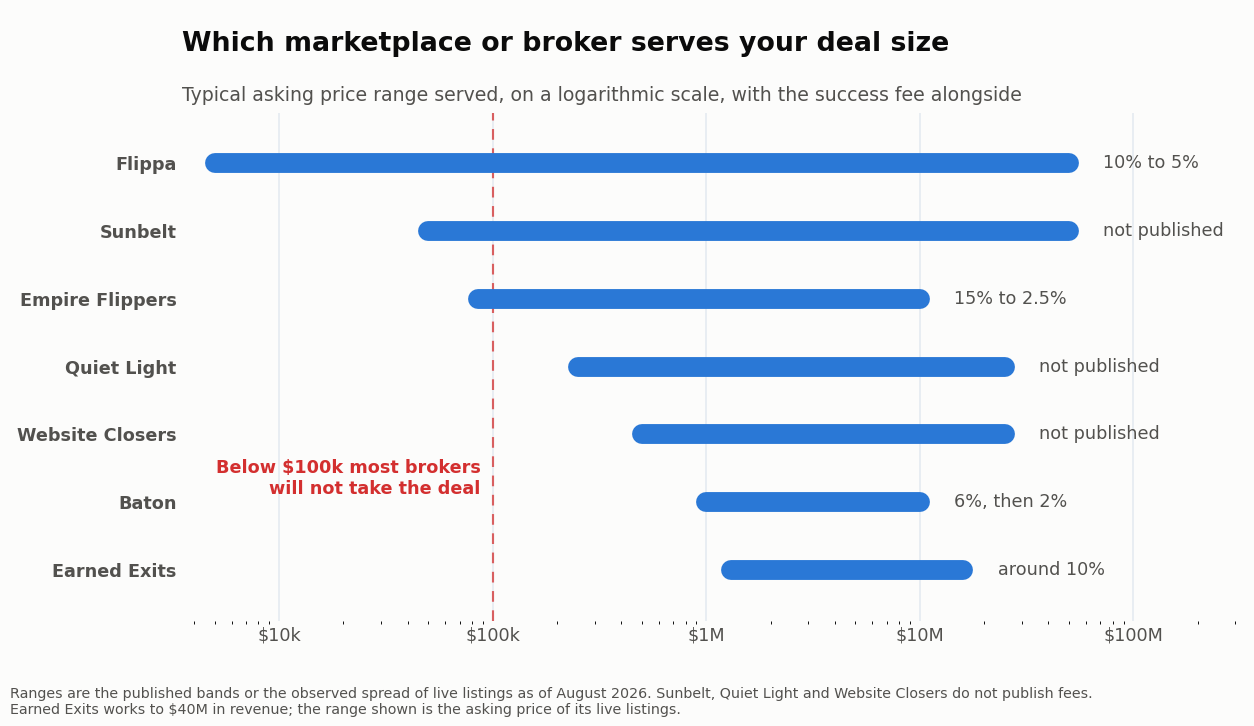
Deal size, not business type, is what really decides your options. Below $100,000 most brokers will not take the deal at all, which leaves the open marketplaces. Above $1M the field narrows again, this time to advisers.
The open marketplaces: you pay to be seen, not to be sold
These are classified sites. You write the listing, you field the enquiries, you negotiate, you close. Nobody takes a percentage. For a straightforward local business with clean books, this is the cheapest route by a wide margin, and it is how a large share of small business sales in America actually happen.
BizBuySell
The biggest one, and it is not close. Owned by CoStar Group since 2012, the same company behind LoopNet and Apartments.com. It is explicit about what it is not: their own FAQ says they are a marketing platform charging advertising fees, not a brokerage firm.
Listing prices on a six month term run $74.95 a month for Basic, $99.95 for Showcase and $199.95 for Diamond. Three month terms cost more per month, twelve month terms cost less. There is no commission at any point.
What makes BizBuySell genuinely useful even if you never list there is the quarterly data. Their Q2 2026 report put the median sale price at $349,250 on median revenue of $692,087 and median cash flow of $155,921, across 2,117 completed transactions, according to their own quarterly Insight Report. That is the closest thing the small business market has to a public price index, and it is worth reading before you set an asking price.
Largest buyer audience of any US business-for-sale site, 50M+ annual visits by their own count
No commission, so on a $400,000 sale you keep roughly $400,000 more than a 10% broker deal would leave you
Publishes real transaction data quarterly, which almost nobody else does
You do all the work: screening, NDAs, negotiation, coordinating diligence
Volume of listings means a mediocre listing disappears
Transaction volume was down 10% year on year in their own Q2 2026 report, so the buyer pool is softer than it was
BusinessesForSale.com
The main alternative, run by Dynamis, a family-operated UK company with US offices in North Carolina. Pricing is a flat one-off rather than monthly: $199 for one month, $299 for three, $399 for six, billed in a single installment, with a 20 day free trial that does not ask for card details. Their own line on fees is blunt: no commission, no hidden charges, choose a package and pay the one off fee.
They report over 55,000 active listings across 145 countries and 1.2 million monthly buyers. The international reach is the real differentiator. If your buyer might be overseas, this is where they are looking.
Genuinely free trial with no card required, so you can test the water at zero risk
Strongest international buyer pool of the open marketplaces
Flat one-off pricing is cheaper than BizBuySell over six months, $399 against roughly $450
Smaller US-specific audience than BizBuySell
Publishes no median sale price or deal size data
BizQuest
Worth one line only: BizQuest is owned by the same parent as BizBuySell. LoopNet acquired it around 2010 and CoStar now owns both. Listing on both is not the diversification it appears to be. I tried to pull their current pricing directly and the site returned errors on every attempt, so I am not going to quote a number I could not verify.
Before you pay for a listing
Is your business even ready to list?
The most expensive mistake in this whole process is going to market with financials a buyer cannot follow. Deals die in diligence, not in negotiation. A valuation review tells you what needs cleaning up before a buyer sees it.
Free valuation, and you keep the number either way.
The digital marketplaces: curated, and they take a cut
If you are selling something that lives on the internet, a different set of platforms applies. These vet what they list, which means you get rejected sometimes, and it means buyers trust what is on the shelf. That trust is what you are paying the commission for.
Empire Flippers
The most structured of the digital marketplaces. No fee to submit or list. The commission is tiered and blended: 15% flat under $700,000, dropping to 8% on the portion between $700,000 and $5M, then 2.5% above $5M. There is a minimum commission of $10,000, which is the part people miss. On a $40,000 sale that minimum is effectively a 25% rate.
To list you need at least $2,000 a month in net profit averaged over twelve months, plus a twelve month trading history and verified expenses. They take a two month exclusivity period. Their public scoreboard reports $604.2 million in lifetime sales across 2,665 listings sold, with 101 of those above $1M. Our full Empire Flippers review works through what that commission actually costs at each deal size, and what their vetting does not cover.
Vetting is real, which is why their buyer pool takes listings seriously, around 650 NDAs signed weekly
No upfront cost at all, so the risk sits with them until you sell
Tiered commission means large deals are not punished the way a flat 15% would punish them
The $10,000 minimum commission makes anything under about $67,000 expensive in percentage terms
Two month exclusivity locks you in before you know whether it is working
The $2,000 monthly profit floor rules out a lot of smaller sites
Flippa
The opposite philosophy: open, self-serve, and it will accept businesses that are not yet profitable. Below $100,000 you list yourself for $29 to $199 and pay a 10% success fee at closing. At $100,000 and above you get a dedicated broker, an upfront fee of $799 to $1,499, and the success fee steps down: 10% to $499,900, 9% to $999,900, 8% to $4.9M, 7% to $9.9M, 6% to $49.9M and 5% above that. Those rates are on their pricing page but only appear once you move the asking price slider, which is why they are so often reported as unpublished. Full detail in our Flippa review.
Their published median closing times are useful: 15 days under $50,000, 49 days between $50,000 and $250,000, and 73 days above $250,000.
One thing I will not soften. Flippa currently holds an F rating with the Better Business Bureau, with three complaints filed and a failure to respond to two of them. A pattern of not answering complaints is a reasonable thing to weigh before you hand a platform your escrow.
Lowest barrier to entry anywhere, $29 gets you listed
Accepts pre-revenue and unprofitable assets that Empire Flippers would reject
Fastest median close of any platform at the small end, 15 days under $50k
Fee disclosure is scattered: rates sit behind a slider, the Terms point to a Success Fee Page that 404s, and the sell page still advertises “from 3%”, which matches no tier
BBB rating of F with unanswered complaints
Open listing model means far more low-quality inventory to compete against
Acquire.com
Startup and SaaS focused, and the cleanest pricing of the lot. It scales by asking price: under $250k is $25 a month plus an 8% closing fee, $250k to $1M is $50 a month plus 7%, above $1M is $100 a month plus 6%. Free valuation, automated NDAs and escrow are included. They report $500M+ in closed deal volume across 2,000+ startups sold.
They hold ★★★★★4.5 out of 5 on Trustpilot across 195 reviews, which is the highest verified rating of any platform in this article.
Fee structure is published in full and scales sensibly with deal size
Best verified customer rating here, 4.5 on Trustpilot from 195 reviews
Escrow and legal document tooling included rather than billed separately
Heavily SaaS-weighted, so a content site or ecommerce store is a worse fit
Their guided advisory tier only takes profitable SaaS above $100k revenue
Quiet Light and Website Closers
Both are brokerages rather than marketplaces, and neither publishes commission rates. Quiet Light targets businesses valued $250,000 to $25 million with at least $75,000 in annual profit, and reports 750+ businesses sold totalling over $500 million, with 85% of listings selling within 90 days. Website Closers reports $2.23 billion transacted across 2,345 businesses, takes no upfront fees or retainers, and carries an A+ BBB rating along with ★★★★★4.8 out of 5 from 206 reviews on Reviews.io.
With both, you will have to get on a call to find out what it costs. That is normal at this end of the market, but go in knowing that industry standard for sub-$5M digital deals sits around 8% to 12%.
The broker networks: a thousand agents, wildly different experiences
Transworld and Sunbelt are the two names you will hear if you ask a local accountant. Both are franchise networks, which is the single most important fact about them. You are not hiring Transworld. You are hiring whoever owns the Transworld office in your county, and the quality range across offices is enormous.
Transworld
Sunbelt
Founded
1979, franchising since 2010
1978, franchising since the mid 1990s
Scale
250+ offices, 1,000+ brokers, 15,000+ businesses sold
Does not publish an office or deal count
Deal size
Not published
Roughly $50,000 to $50M+
Fees
Not on the website. Quoted to us in writing: 12% on the first $1M, 10% on the second, 8% on the third
Not published, set per office
Trustpilot
★★★☆☆2.8 from 3 reviews
★★★☆☆3.2 from 1 review
BBB
A-, not accredited, flagged for failing to respond to a complaint
No corporate profile, individual offices rated separately
What a Transworld franchise actually quoted us
Neither network publishes fees, so I asked one directly. A Transworld Business Advisors franchise in Ontario put this in writing in March 2026:
“We work on success fees. You pay us only when the business sells, and it is 12% of the selling price for the 1st million, 10% for the 2nd million, 8% of the 3rd million and so on.”
That is a declining scale, and 12% sits at the top of the main street range. Three things came out of that exchange worth knowing before you talk to any franchise broker.
There are usually upfront working fees. Their explanation: part of the fee is charged upfront because launching a sale costs money, in listing fees on industry sites, marketing spend and management time. It is credited against the final payout.
The rate is not negotiable, but the upfront can be. I pushed back and said another firm had quoted 10%. The answer was that rates are set by corporate, the advisor has no say, and they do not compete on price. What I did get was the upfront working fees waived entirely, with the 12% left intact. If you negotiate with a franchise broker, that is where the give is. We collected the same detail from eight companies in our guide to what business brokers actually charge.
You agree the asking price before you sign anything. They value the business off three years of P&L, you discuss it, and if you cannot agree on a number you can walk away before any exclusivity attaches. Only then does the marketing agreement and its exclusive mandate come into force. Worth confirming in writing with whichever office you use.
One thing that surprised me. This broker did not come from a referral or a cold list. He found the business because it was listed on an open marketplace and messaged me through it. If you list on BizBuySell or BusinessesForSale.com, expect brokers to approach you as well as buyers. It costs nothing to hear the pitch, but know that is what is happening.
Those Trustpilot numbers are almost meaningless at three reviews and one review respectively, and I would not weigh them heavily either way. The more useful signal is that neither network publishes what it charges, and neither publishes a corporate-level complaint record you can inspect. Look up the specific office you would be working with on BBB before you sign anything. That profile exists and it is the one that matters.
One Sunbelt franchise office does publish an industry fee guide, and it is a fair description of the market: 10% to 12% on main street deals with a $10,000 to $20,000 minimum, and lower middle market work at 4% to 6% or on a Double Lehman scale, sometimes with a $5,000 to $15,000 retainer.
Baton, the hybrid
Worth knowing about because it prices differently from everyone else. Baton is a New York advisory firm with a marketplace attached. Their free tier gets you a valuation and an anonymised teaser listing at no cost. Their seller plan is $1,000 a month, credited back to you at closing, with a three month minimum, and a success fee of 6% on the first $5M and 2% above that, dropping to 3% if you bring your own buyer. They require $100,000 in adjusted annual cash flow and typically work on businesses valued $1M to $10M. A+ with the BBB, though with zero customer reviews on file.
I will flag one inconsistency: their marketing page leads with free to start while the pricing page discloses the $1,000 monthly retainer. Both are true, they describe different tiers, but the framing is generous to itself.
If you are in the $1M to $40M band
This is the range where the wrong choice costs the most
Below about a million in revenue you have plenty of good options. Above it, listing sites stop working and the quality of your advisor becomes the single biggest variable in what you walk away with. Earned Exits works specifically in this band and will tell you where you stand before you commit to anything.
Free valuation first. No retainer, fees are paid from the sale.
Earned Exits, and where it actually fits
Full disclosure before anything else: Earned Exits is a partner of this site, and I earn a commission if you engage them. That is exactly why I want to be precise about who they are wrong for, and why I published a full Earned Exits review covering their fees, track record and regulatory history rather than a recommendation.
They are a national brokerage and M&A advisory working with companies doing $1M to $40M in revenue. Current listings on their site run from roughly $1.3M to $16M in asking price, across HVAC, waste management, powersports, water services, IT and manufacturing. They report $2.1 billion in combined transactions, a 93% closing rate for clients whose financials are what they call buyer ready, and a typical process of about 117 days with a buyer identified inside 60 days once the numbers are in order.
If you are selling a $60,000 content site or a $250,000 corner cafe, they are not the right call. Go back up this page to Flippa, BizBuySell or Empire Flippers. Earned Exits is built for owner-operated companies in the lower middle market, and the economics only work in that band.
Where they are a good fit, the differentiators worth knowing: a free valuation with no obligation, a three person dedicated team per client rather than a single agent, and an add-backs process that reworks your financials to show true seller discretionary earnings before a buyer sees them. That last one is not a gimmick. Most owner-operated companies understate their real earnings through legitimate personal expenses run through the business, and getting that presentation right is often worth more than anything that happens in the negotiation.
On fees, their own referral page gives the clearest indication they publish: a typical company they sell is around $10 million and their commission on that sale is around $1 million. Call it roughly 10%, paid at closing, with no retainer. Their consulting packages are refunded in full out of the commission if you go on to list with them.
Free valuation with no obligation and no retainer, so the cost sits with them until close
Specialised in the $1M to $40M revenue band rather than trying to serve everyone
Add-backs work on financials before going to market, which is where most value is won or lost
No independent Trustpilot or BBB profile I could locate, so there is no third-party complaint record to inspect
Wrong fit for anything under roughly $1M in revenue
Colorado licensed and nationally operating, but no IBBA or CBI certification is published
How to choose in about five minutes
Work down this list and stop at the first one that describes you.
Your situation
What to do
Under $50,000, digital, want it gone quickly
Flippa. Median close is 15 days at this size and the listing costs less than a tank of fuel.
$100k to $2M, online, profitable for a year
Empire Flippers. The 15% hurts but their buyer pool is the reason deals close.
SaaS at any size
Acquire.com. Purpose-built and the only one publishing its full fee table.
Local business, clean books, you have time
BizBuySell plus BusinessesForSale.com. Under $900 total for six months on both, and no commission on either.
Local business, no time or messy books
A broker. Interview three, check each office on BBB individually, and do not sign a twelve month exclusive.
$1M to $40M revenue, owner-operated
A mid-market advisor. This is where advisor quality moves the number more than anything else you control.
You have no idea what it is worth
Get a valuation before you do anything else. Every option above gets easier once you have a number.
Two things nobody tells you. First, you can list on an open marketplace and hire a broker later, but not the other way round: most broker agreements claim any buyer who came through their listing period. Second, an exclusive longer than six months is a bad trade at any commission rate. If they cannot move it in six months, the problem is the price or the business, and another six months of exclusivity will not fix either.
What this costs you in real money
Same business, $500,000 sale price, three routes:
Route
You pay
You keep
BizBuySell Showcase, six months
About $600
$499,400
Empire Flippers, if digital
$75,000 at 15%
$425,000
Main street broker at 10%
$50,000
$450,000
That $75,000 gap is not an argument against brokers. It is an argument for knowing what you are buying. A broker who gets you $560,000 instead of $500,000 has more than paid for themselves. A broker who gets you the same price you would have got yourself has cost you a year of your life and a tenth of your business. The question is never whether the fee is high. It is whether this particular person will beat the price you could get alone.
Two guides worth reading before you list
Before you go state by state, these two cover the parts that apply no matter where you operate.
Three things, in order of how much money they move.
What differs
Why it matters
State income tax
Nine states levy no personal income tax. On a one million dollar exit that gap can be worth six figures on identical deal terms.
Tax clearance and bulk sale rules
Several states require a clearance certificate or advance notice before closing. Buyers who know the rule will hold back funds until you produce it.
Buyer depth
A restaurant in a metro area may see a dozen credible buyers. The same business two hours out may see two, and price follows competition.
What does not change anywhere
This is the part owners underestimate. In twenty years I have never seen a deal fall apart over which state it was in. I have seen plenty die over these:
Books that do not reconcile. If your financials do not tie to your tax returns, every number you quote becomes negotiable.
Customer concentration. One client at 40 percent of revenue takes a chunk off your multiple before anyone opens the lease.
Owner dependence. If the business cannot run for three weeks without you, a buyer is purchasing a job rather than an asset.
Waiting too long. The best time to prepare is a year before you want to sell. Most owners start the month they decide.
Free, no obligation, and you keep the number whether you sell this year or in five years.
Where you are selling from: all 50 state guides
Each guide covers the local filing steps, the state tax picture, what buyers in that market tend to look for, and a city by city view where it makes a difference. Pick your state:
One thing I would push back on gently: owners often anchor to what a similar business sold for in 2019 and assume that number still applies. It rarely does in either direction. Multiples move with borrowing costs, and the nominal price of everything has shifted underneath us. If you want to sanity check an old comparable against today, run it through our CPI inflation calculator first, and if you are tracking where costs are heading, the CPI release schedule tells you when the next read lands.
If debt is part of the picture
A fair number of owners reading this are selling partly to clear personal or business debt, and that changes the order of operations. Settling debt before a sale can protect your proceeds, but doing it badly can damage your credit right when you need financing to close. If that is your situation, our two minute debt relief quiz maps the options against your actual numbers, and the ranked list of debt relief companies shows who we rate and why.
Frequently Asked Questions
Does the state I sell in actually change anything?
Yes, in three ways that cost real money. First, tax: nine states have no personal income tax, so an owner in Texas or Florida can keep a materially larger share of the same sale price than an owner in California or New York. Second, clearance: states such as Pennsylvania, New Jersey, California and Washington require a tax clearance or bulk sale notice before the deal funds, and missing it can leave the buyer liable for your unpaid tax, which buyers price in. Third, buyer depth: metro markets have more active buyers and tighter timelines than rural counties in the same state.
How long does it take to sell a small business?
Six to twelve months is normal once you are actually on the market, and that assumes clean books. Add three to six months if you need to rebuild financials first. The owners who close fastest are the ones who spent a year preparing before they ever spoke to a buyer.
What multiple will I get?
For most small businesses under two million in revenue it lands somewhere between two and four times seller’s discretionary earnings, with the range driven by recurring revenue, customer concentration and how much the business depends on you personally. Industry matters less than people expect. Owner dependence matters far more.
Do I need a business broker?
If the business is worth under about 250,000 dollars the fee often eats the benefit, and a direct sale to an employee, competitor or family member is common. Above that, a broker earns their keep through buyer screening and confidentiality alone. Get a valuation first either way, so you can judge whether the broker’s suggested asking price is realistic.
Should I sell the assets or the company itself?
Buyers almost always want an asset sale, because they get a stepped-up basis and leave old liabilities behind. Sellers usually prefer a stock or membership interest sale for the capital gains treatment. This is the single largest tax variable in most deals and it is worth paying a CPA to model both before you agree to a structure.
Will inflation change what my business is worth?
Indirectly, and more than most owners realise. Valuations are built on earnings multiples, and earnings move with input costs, wages and pricing power. A business that could not pass cost increases through to customers over the last few years often shows compressed margins that a buyer will notice immediately.
What do I need to have ready before I list?
Three years of financials that reconcile to your tax returns, a clean add-back schedule, current lease and key contracts, an employee roster with roles and pay, a customer concentration breakdown, and any licences that transfer. Buyers walk over messy books more often than over price.
Can I sell if the business still has debt?
Yes, and it is routine. Most debt is settled out of proceeds at closing. What complicates a deal is personal guarantees, liens filed against the assets, and any tax debt, because those attach to the sale itself rather than to you personally.
Where is the best place to sell my business?
There is no single best place. Match the platform to the business. Digital businesses under $100,000 do best on Flippa, profitable online businesses between $100,000 and $10 million on Empire Flippers or Quiet Light, SaaS on Acquire.com, and local bricks-and-mortar businesses on BizBuySell or BusinessesForSale.com if you are willing to run the sale yourself, or through a broker network if you are not. Companies doing $1 million to $40 million in revenue need a mid-market advisor rather than a listing site.
How much does it cost to sell a business online?
It depends entirely on whether you pay for exposure or for a process. Open marketplaces charge a flat advertising fee and take no commission: BizBuySell runs $74.95 to $199.95 a month and BusinessesForSale.com charges $199 to $399 as a one-off. Commission-based platforms charge nothing upfront but take a percentage at closing, typically 15% at Empire Flippers falling to 8% above $700,000, 6% to 8% at Acquire.com, and roughly 10% to 12% for a main street business broker.
Can I sell my business without a broker?
Yes, and a large share of small business sales in America happen this way. Listing on BizBuySell or BusinessesForSale.com costs a few hundred dollars and no commission, which on a $500,000 sale is the difference between keeping roughly $499,000 and roughly $450,000. The trade is that you handle buyer screening, NDAs, negotiation and diligence coordination yourself. It works well for a simple business with clean books and badly for a complicated one.
What is the difference between a business marketplace and a business broker?
A marketplace sells you exposure. You write the listing, buyers contact you directly, and you keep the full sale price minus a flat fee. A broker sells you a process. They value the business, prepare the financials, find and screen buyers, and run the negotiation, in exchange for a percentage at closing. The practical test is whether a buyer could understand your business from a listing page. If yes, pay for exposure. If it needs explaining, pay for the process.
Do business brokers charge upfront fees?
It varies and you should ask directly. Most main street brokers work on success fees only, typically 10% to 12% with a $10,000 to $20,000 minimum. Lower middle market and M&A advisory firms more often charge a retainer, commonly $5,000 to $15,000, credited against the final fee. Baton charges $1,000 a month refunded at closing. Earned Exits and Website Closers both state they take no retainer and are paid from the sale.
Disclosure. We have no affiliate or partnership arrangement with Flippa and earn nothing if you use them. I am, however, a paying Flippa customer right now, with a business listed and a broker I am working with weekly. That gives me first-hand detail you will not get from a desk review, and it also gives me a reason to think well of them. Weigh the positive parts of this review with that in mind. The criticism further down is the same criticism I would make either way.
Correction, 19 August 2026. An earlier version of this review said Flippa does not publish its success fee. That was wrong, and the error was mine. Flippa does publish a full tier table on its pricing page, but only inside an interactive slider that does not render for anything that reads the page without running JavaScript. The rates are below. What remains fair criticism is set out honestly further down.
Flippa charges a success fee of 10% falling to 5% depending on your asking price, plus either a self-service listing package or an upfront brokerage fee. The full table is below, and it is the most useful thing on this page.
I have been writing about small business economics for over two decades, and I want to be straight about how I got this wrong the first time. Flippa’s Terms of Service point sellers to a “Success Fee Page.” That page, flippa.com/success-fees, returns a 404. The help centre article on pricing gives no percentages and links to the pricing page. And on the pricing page the numbers only appear once you drag a slider. Every one of those things is still true. But the fee is there, and I should have found it.
Compare Flippa against what everyone else charges
Flippa at 10% is not the same deal as Empire Flippers at 15% with a $10,000 minimum, and neither is the same as a broker at 10% to 12%. We put every marketplace and broker side by side on real published pricing and the deal size each one serves.
Verified directly from flippa.com/pricing on 19 August 2026. Move the asking price slider on that page and the fee changes with it.
Asking price
Success fee
Upfront cost
Sub $10,000
10%
Self-service listing, $29 to $199
$10,000 to $49,900
10%
Self-service listing
$50,000 to $99,900
10%
Self-service listing
$100,000 to $249,900
10%
$799, six month brokerage term
$250,000 to $499,900
10%
$899, six month brokerage term
$500,000 to $999,900
9%
$899, six month brokerage term
$1M to $4.9M
8%
$1,299, six month brokerage term
$5M to $9.9M
7%
$1,299, six month brokerage term
$10M to $49.9M
6%
$1,499, six month brokerage term
$50M and above
5%
$1,499, six month brokerage term
Two structural points that matter more than the headline rate.
The model changes at $100,000. Below that you are on self-service: you pay $29 to $199 for a listing, you run the sale yourself, and Flippa takes 10% at the end. At $100,000 and above you get a dedicated M&A broker, and the upfront fee jumps to $799 or more.
The fee is not blended. Unlike Empire Flippers, where 15% applies only to the first $700,000 and the rate steps down on the portion above it, Flippa’s rate appears to apply to the whole purchase price at the band you fall into. On a $1,000,000 sale that is 8% of the lot, or $80,000.
What is still wrong with the disclosure. Flippa’s sell page says in one place that “success fees start from 5%” and in another that sell-side fees start “at 3%.” The 5% matches the $50M+ tier. The 3% matches no published tier at all. And the Terms of Service still send sellers to a Success Fee Page that does not exist. Publishing the numbers behind a slider while three other Flippa pages point somewhere else is not good disclosure, even though the numbers are real.
Flippa at a glance
Detail
What it is
Open, self-serve marketplace for websites, apps, stores, domains and small online businesses
Founded
June 2009, spun out of SitePoint by Mark Harbottle and Matt Mickiewicz
CEO
Blake Hutchison, since September 2018
Funding
$11M Series A led by OneVentures, September 2021, after twelve years bootstrapped
Offices
Melbourne, Austin and Amsterdam
Listing cost
$29 to $199 for assets under $10k; $49 to $599 per six months for larger
Success fee
10% falling to 5% by asking price band
Minimum to list
None. Accepts unprofitable and pre-revenue assets
Vetting
“Vetted by Flippa” applies only at $50,000 and above
Median time to close
15 days under $50k, 49 days $50k to $250k, 73 days above $250k
BBB
F, not accredited, 3 complaints with 2 unanswered
Listing costs, escrow and buyer verification
Everything below is published plainly and has been for a while.
Self-service package
Price
Term
Entry
$29
60 days
Boosted
$49
3 months
Premium, includes NDA protection
$199
6 months
Above $100,000 you are into brokerage rather than self-service, and the upfront fee replaces the listing package: $799 at $100k to $249.9k, $899 to $999.9k, $1,299 to $9.9M and $1,499 above that, each for a six month brokerage term.
Payment processing. FlippaPay runs from about 0.5% to 1% depending which Flippa page you read, and holds funds in a regulatory trust account administered by licensed payment partners until you approve release. Escrow.com is the alternative at 3.25% up to $5,000, then a sliding scale down to 0.89% above $25,000, with Flippa applying a 20% discount to the variable portion.
Buyer verification is a $5 card hold, rising to an additional $500 authorisation for bids or offers of $5,000 or more.
“Achieve the quickest sale, highest price, and lowest fees with Flippa.” The first two claims are supportable from their own median close times. The third is unverifiable, because the fee is not published.
The $50,000 vetting cliff
Flippa markets trust hard. There is a verifications team, integrations with Shopify, Stripe, QuickBooks, Google Analytics and AdSense, and badges on listings. Here is what those badges actually mean, from Flippa’s own help centre.
“Data Verified” means only that data from a third party platform has been connected to the listing. It is a plumbing confirmation, not an audit. Nobody has checked whether the numbers make sense.
“Vetted by Flippa” is the real one. Flippa checks revenue via platform access or a live screen share, primary expenses via invoices, and traffic via analytics. It applies only to listings of $50,000 and above.
So the entire $29 to $199 self-serve band, which is most of the marketplace by volume, gets no Flippa vetting at all. And even above the cliff, the Terms of Service state that for “Vetted by Flippa” listings, Flippa “makes no warranties or representations as to the accuracy and completeness.”
Flippa also publishes the size of the team doing this work. Their safety page says the marketplace integrity and listing review team is ten people, and that each revenue-generating asset gets a 25 point check before going live. Their own throughput figure is over 20,000 assets a year.
Ten people, twenty thousand assets. That is roughly eight assets per person per working day, at a 25 point check each. Both numbers are Flippa’s. Draw your own conclusion about how deep the check can be.
What happens when a deal goes wrong
This is where I would want a buyer to pay attention.
Flippa’s dispute process opens 48 hours after an auction ends or an offer is accepted, and the other party gets 72 hours to respond. Flippa reviews and can resolve in either party’s favour or “without fault,” and says it typically resolves without fault absent evidence of improper conduct.
The critical sentence: Flippa will not process a dispute once payment has been made via PayPal, or once funds have been released from Escrow.com or FlippaPay, unless both parties agree to unwind the deal. Release the money and the platform’s dispute machinery is finished.
After that, Flippa points you to independent legal advice or arbitration, referencing the ICDR for cross-border matters. Flippa’s own 2025 data says 85% of its transactions are cross-border. So for most disputes, the realistic fallback is international arbitration over an asset that might have cost $8,000.
The Terms also state Flippa is “not a party to any transaction,” and excessive disputes may result in sanctions including a permanent ban.
Not accredited. 3 complaints, 2 unanswered. File opened May 2024.
SmartCustomer (was Sitejabber)
★★☆☆☆1.8
139 reviews. 65% one star, 20% five star.
Trustpilot
Widely reported around 4.2
I could not retrieve the page to confirm the review count.
A 4.2 on one platform and a 1.8 on another is not a contradiction. It is a bimodal distribution, and it is exactly what you would expect from a high-volume open marketplace. Most transactions go fine. A minority go badly, and the people they go badly for are very motivated to write about it.
The BBB complaints, which are the best-documented material available
April 2025, unanswered. A buyer purchased an ecommerce fashion brand and roughly $70,000 of the previous owner’s outstanding balance landed in their account. When the buyer raised it, Flippa deferred to the broker and seller to sort out directly.
November 2024, unanswered. A complainant won an auction, the seller refused to complete, the complainant left negative feedback on the seller’s page, and Flippa deleted the complainant’s account.
May 2024, resolved. A listing did not sell. Flippa charged $60 to relist despite the dashboard saying “relist for free”, and applied a 90 day exclusivity clause.
Two of the three went unanswered, which is why the rating is an F. The pattern in the first two is the same one the Terms describe: Flippa positions itself outside the transaction, and the dispute lands between buyer and seller.
What I could not verify, and will not repeat
Search for “Flippa scam” and you will find a great deal. Most of it does not survive contact.
The tiered success fee figures that circulate everywhere, usually 10% then 7.5% then 5%, trace back to competitor blogs with no primary source. Several of the most prominent “Flippa problems” articles are published by competing marketplaces. There is a dedicated anonymous complaint site that names no victims, no dates and no losses, and carries a disclaimer that its content may be incorrect and includes satire. None of that is evidence.
What I can tell you is what I looked for and did not find: no lawsuit, class action, court judgment, FTC action or regulatory enforcement action against Flippa. I am not saying none exists. I am saying I could not find a record of one.
What I have actually experienced, buying and selling on Flippa
I have been in the internet industry since the nineties, and I have been buying and selling domains on Flippa for years. It is one of the oldest marketplaces still standing in this business, and longevity counts for something in a category where platforms appear and vanish inside a single cycle. For domains and smaller digital assets it has been a reliable place to transact, and I say that as someone who has been on both sides of the table there more than a few times.
Right now I am going through the process again, and this time with a real business rather than a domain.
The current sale, and what the $799 actually bought
I have a digital agency listed. The asking price puts it in the $100,000 to $249,900 band, which is the tier where Flippa stops being self-service and gives you a dedicated M&A broker. The upfront cost for that was $799 for a six month brokerage term, with the 10% success fee payable at closing on top.
I want to be specific about what that money has bought, because “you get a broker” is vague and the difference between a good one and a bad one is most of the outcome.
My broker responds within hours, not days, and has done consistently for months.
He writes the outreach messages to buyers, and when I asked him to handle a tricky reply about seller financing, he drafted the response and set the expectation with the buyer for me.
When I asked to pause the listing while I explored an offer that came from outside the platform, he arranged it, and told me plainly where I stood on the exclusivity clause rather than letting me find out later.
He pushes back. When I suggested dropping the price, he told me not to yet, because no buyer had objected to it, and the problem was volume rather than pricing. He was right.
The results as of today, taken from my own seller dashboard:
Metric
Where it stands
Signed NDAs
42, all accepted
Watchers
46
Page views
840
Active discussions
43
Forty two buyers signing an NDA on a service business in the low six figures is real deal flow, and it arrived without me writing a single outreach message. That is what the fee is for.
The honest caveat: the business has not sold yet. Volume of interest is not the same as a closed deal, and I have said elsewhere in this review that a lot of NDAs with no offers is a normal and frustrating stage. I will update this section when it closes, or when it does not.
None of that changes the criticism in this review. The fee disclosure is still scattered across four pages that point at each other, the Manager Agreement I signed still refers to a “Pricing Schedule” that is not attached to it, and nothing under $50,000 is vetted. Good service from an individual broker and sloppy platform disclosure are perfectly capable of coexisting, and here they do.
What Flippa is genuinely good at
Having spent this long on the problems, the balance matters.
Nothing else in this market gets you listed for $29. Nothing else accepts pre-revenue and unprofitable assets. Empire Flippers would reject the overwhelming majority of what sells on Flippa, and a broker would not return the call.
The speed is real. A published median of 15 days to close under $50,000 is faster than any curated alternative, and it is a direct consequence of the open model. Their 2025 data reports transaction value up 36% year on year, six and seven figure deals up 30%, and 400,000+ weekly active buyers.
At the top end they run a genuine advisory arm: 15 in-house M&A advisors with CM&AA accreditation plus a network of over 200 third party brokers, supporting $100k to $50m+ businesses. Their largest publicised deal is a $35 million portfolio of 36 apps. The VIP programme for businesses over $10 million exists, though its price is not published either.
Pros and cons
Cheapest entry anywhere: $29 gets a real listing in front of a large buyer pool
Success fees are genuinely tiered and drop with deal size, from 10% down to 5% above $50M
Accepts unprofitable, pre-revenue and tiny assets that every curated marketplace rejects
Fastest published median close in the market at the small end, 15 days under $50,000
FlippaPay holds funds in a regulatory trust account with a two-step buyer release
Genuine M&A advisory tier with accredited advisors for larger deals
From my own live listing: the $799 broker tier produced 42 signed NDAs without me writing a single outreach message
Listing fees are refundable if no qualified buyer makes contact within 30 days
Fee disclosure is scattered: the rates sit behind a slider, the Terms point to a Success Fee Page that 404s, and the sell page still advertises “from 3%”, which matches no published tier
Nothing under $50,000 is vetted by Flippa, and vetting above that is disclaimed in the Terms
A ten person integrity team against 20,000+ assets a year, both their own figures
BBB rating of F with two of three complaints unanswered
The dispute process ends the moment funds are released, with international arbitration as the fallback
Documented cases of complainants having their accounts removed
Should you use Flippa?
If you are
Verdict
Selling a small site, app or store under $50,000
Yes. Nothing else is close on cost or speed, and the curated marketplaces would reject you anyway.
Selling something not yet profitable
Yes. Flippa is one of the only places that will take it.
Selling a profitable business worth $100,000 or more
Consider the alternatives. At 10% up to $499,900 Flippa is cheaper than Empire Flippers, but a curated marketplace gets you a more serious buyer pool. Weigh the fee saving against that.
Buying under $50,000
Assume nothing is verified. Get platform access yourself, check traffic quality, and do not release funds until you are certain.
Buying above $50,000
Better, but the Terms still disclaim the accuracy of the vetting. Verify independently.
Selling an offline business
No. Wrong marketplace entirely.
The single most useful piece of advice I can give a Flippa buyer is about timing, not diligence: the dispute process dies the moment you release funds. Everything you intend to check, check before that click. There is no chargeback culture here and no platform arbitration afterwards.
If you are above the Flippa band
Above $100k, run the numbers against a curated marketplace
Flippa takes 10% up to $499,900. Empire Flippers takes 15% but blends it down above $700,000 and vets 91% of applicants out. On a $400,000 sale that is $40,000 against $60,000, and the difference in buyer quality is the thing you are actually buying.
Selling an offline company doing $1M to $40M in revenue? That is a different route again.
Questions to settle before you list or bid
Sellers: confirm your success fee in writing. The published tier is 10% up to $499,900, but your signed Manager Agreement refers to a “Pricing Schedule” rather than stating a rate, so get the number on paper.
Sellers: is there an exclusivity period, and what happens if it does not sell?
Buyers: is this listing “Vetted by Flippa” or only “Data Verified”? Below $50,000 it is neither.
Buyers: can I get direct read access to analytics and payment platforms, not screenshots?
Buyers: what exactly am I confirming when I click release, and what recourse remains afterwards? (None through Flippa.)
Flippa is a legitimate marketplace founded in 2009, spun out of SitePoint, with an $11 million Series A from OneVentures in 2021 and offices in Melbourne, Austin and Amsterdam. It is not a scam. However it holds an F rating with the Better Business Bureau, is not BBB accredited, and has three complaints on file of which two went unanswered. I could find no lawsuit, class action or regulatory enforcement action against the company.
How much does Flippa charge to sell?
Flippa charges a tiered success fee of 10% on asking prices up to $499,900, 9% from $500,000 to $999,900, 8% from $1M to $4.9M, 7% from $5M to $9.9M, 6% from $10M to $49.9M and 5% above $50M. On top of that, businesses under $100,000 pay a self-service listing package of $29 to $199, and businesses at $100,000 and above pay an upfront brokerage fee of $799 to $1,499 for a six month term. The rates are published on flippa.com/pricing but only appear once you move the asking price slider, and the Terms of Service still point to a Success Fee Page that returns a 404.
Does Flippa verify listings?
Only partly, and only above a threshold. Vetted by Flippa applies exclusively to listings of $50,000 and above, where Flippa checks revenue, primary expenses and traffic. Everything below $50,000 receives no Flippa vetting. The separate Data Verified badge means only that a third-party platform has been connected to the listing, not that anyone has audited the figures. The Terms of Service also disclaim any warranty as to the accuracy and completeness of the vetting.
Is it safe to buy a website on Flippa?
It can be, with your own diligence. FlippaPay holds funds in a regulatory trust account until the buyer approves release, and Escrow.com is available as an alternative. The critical limitation is that Flippa will not process a dispute once funds have been released, so all verification must happen before that point. Below $50,000 nothing is vetted by Flippa, so get direct read access to analytics and payment platforms rather than accepting screenshots.
How long does it take to sell on Flippa?
Flippa publishes median close times by size band: 15 days for assets under $50,000, 49 days for $50,000 to $250,000, and 73 days above $250,000. Those are among the fastest in the market and are a direct consequence of the open, self-serve model. Larger advisory-led deals take substantially longer, with named 2025 deals closing in 69, 186 and 286 days.
Flippa vs Empire Flippers: which is better?
They serve different sellers. Flippa is open, costs $29 to $199 to list below $100,000 plus a 10% success fee, accepts unprofitable and pre-revenue assets, and closes fastest at the small end. Empire Flippers rejects 91% of applicants, requires $2,000 a month in net profit, and charges 15% falling to 8% with a $10,000 minimum commission. Below roughly $70,000 Flippa is substantially cheaper because of that minimum commission. Above $100,000 the curated route usually produces a more serious buyer pool.
What happens if a Flippa deal goes wrong?
A dispute can be raised 48 hours after an auction ends or an offer is accepted, and the other party has 72 hours to respond. Flippa reviews and may resolve in either party favour or without fault. Crucially, Flippa will not process a dispute once payment has been made or funds released from escrow, unless both parties agree to unwind. After that point Flippa directs users to independent legal advice or arbitration, referencing the ICDR for cross-border matters, and 85% of Flippa transactions are cross-border.
Who owns Flippa?
Flippa was founded in June 2009 by Mark Harbottle and Matt Mickiewicz, spun out of their company SitePoint. It ran bootstrapped until September 2021, when it raised an $11 million Series A led by OneVentures. Blake Hutchison has been CEO since September 2018. Flippa has acquired Domain Holdings Group in 2015, Alts Cafe in 2022 and BitsForDigits in 2023.
Amine is an entrepreneur, investor and financial writer that covers the US economy, inflation, alternative investments, cryptocurrencies and more. He has been involved in the space for over a decade.
Amine Rahal
Amine is an entrepreneur, investor and financial writer that covers the US economy, inflation, alternative investments, cryptocurrencies and more. He has been involved in the space for over a decade.