Note: we are an independent blog. Our content doesn't constitute financial advice. We strive for accuracy, but please always cross-check inflation numbers directly with the BLS. We may receive compensation from some services and products reviewed on this site (learn more).
Select Page
Amine Rahal
Amine is an entrepreneur, investor and financial writer that covers the US economy, inflation, alternative investments, cryptocurrencies and more. He has been involved in the space for over a decade.
Disclosure. We have no affiliate or partnership arrangement with Empire Flippers and earn nothing if you use them. I am a registered user who has browsed their marketplace for years and has submitted a business to them, though I did not go on to list. We do partner with a broker in a different part of this market, and that is disclosed on the pages where it applies.
Empire Flippers rejects 91% of the businesses that apply to list. That is their own published number, from their own data, and it is the single most useful fact about the company.
Everything else about them follows from it. The 15% commission is high. The buyer pool is real. The listings mostly sell. Those three things are connected, and the connection is the vetting.
I have been writing about small business economics for over two decades, and I have watched a lot of marketplaces try to solve the trust problem in this space. Empire Flippers solved it by throwing away nine out of ten sellers. Whether that is worth 15% to you depends entirely on which side of the door you are standing.
15% is a lot. Make sure it is the right 15%
Empire Flippers is one of eleven routes to selling an online business, and it is the right one for a specific profile. We compared all of them on real published fees, minimum deal sizes and who each one actually serves.
Curated marketplace for online businesses. Vetted listings, published prices.
Founded
May 2011, originally as AdSense Flippers, by Justin Cooke and Joe Magnotti
CEO
Andy Allaway, who joined in 2017 and took the role by late 2024
Listing fee
None
Commission
15% under $700k, 8% on the portion $700k to $5M, 2.5% above $5M
Minimum commission
$10,000
Minimum to list
$2,000 a month net profit, twelve month average
Rejection rate
91%
Exclusivity
Two months
Lifetime volume
$604.2 million across 2,665 businesses sold
Average time to sale
127 days
Trustpilot
★★★★☆4.2 from 114 reviews
The fee, and the trap inside it
There is no cost to submit or list. The commission is tiered and blended, which is fairer than a flat rate on larger deals:
Sale price band
Commission on that portion
Under $700,000
15%
$700,000 to $5,000,000
8%
Above $5,000,000
2.5%
So a $1,000,000 sale is not 15%. It is 15% on the first $700,000 and 8% on the remaining $300,000, which works out at $105,000 plus $24,000, or $129,000, an effective 12.9%.
Here is the part people miss. There is a $10,000 minimum commission. On a $40,000 sale, 15% would be $6,000, but you pay $10,000. That is an effective 25%. The minimum stops biting at $66,667. Below roughly $70,000, Empire Flippers is one of the most expensive ways to sell an online business, and the marketing does not lead with that.
Sale price
What you pay
Effective rate
$40,000
$10,000
25.0%
$66,667
$10,000
15.0%
$200,000
$30,000
15.0%
$1,000,000
$129,000
12.9%
$5,000,000
$449,000
9.0%
The 91% rejection rate, and what it does and does not mean
Empire Flippers published the data behind this, which almost nobody in the industry does. The sample was 6,413 submissions between July 2020 and June 2021. Only 9% passed.
The breakdown is more interesting than the headline:
64% never got past the five minute check. They failed on basics before a human looked closely.
31% failed ID verification. That is the single biggest rejection reason, and it tells you what they are really filtering for.
25% did not earn enough or lacked sufficient trading history.
Read that again. The top reason for rejection is not business quality. It is sellers who could not or would not prove who they are. That is a fraud filter, and it is the thing buyers are actually paying the commission for.
What you need to get in
$2,000 a month in net profit, averaged over twelve months (their older seller page still says $1,500, the requirement appears to have been raised)
Twelve months of revenue history minimum
Google Analytics or Clicky running for at least three months before you apply
Ad-dependent sites must have been on the same domain for the full twelve months
Service businesses need at least 50% of revenue from multiple clients
Financials for up to three years, or the life of the business, whichever is longer
Prohibited outright: adult, gambling, payday loans, hacking, CBD and hemp oil, and what they politely call dubious medical claims. Automatic rejection for penalised domains, short term 301 redirect boosts and artificially inflated social metrics.
Vetting takes three to four weeks typically. A small affiliate site can be through in about a week. A product based ecommerce business can take the full four.
“The #1 Curated Online Business Marketplace.” Curated is the operative word and the whole business model. It is also why 91% of applicants never see the inside of it.
What “vetted” does not cover
This is the most important thing in this review for buyers, and it comes from Empire Flippers’ own Terms of Use.
“Empire does not independently verify the expenses of the Business.”
Revenue gets verified. Traffic gets verified. Identity gets verified hard. Expenses do not. And expenses are exactly where a seller inflates profit, because overstating net profit is a subtraction problem, not an addition one.
A few more clauses worth knowing before you buy:
There is no third party escrow. Buyers deposit the purchase price with Empire Flippers, who hold it as broker.
“All sales are final and we make no guarantees, expressed or implied.”
Buyers in default forfeit their deposit with no refund entitlement.
Empire Flippers makes no warranty about future performance of what you buy.
None of that is unusual for a broker. It is unusual to market a 91% rejection rate as hard as they do while disclaiming the accuracy of what survives it. Both things are true at once, and a buyer should hold both.
Migration, and the inspection period nobody defines
Empire Flippers runs a dedicated migrations department, which genuinely is a differentiator. No other broker in this space staffs a whole team for asset transfer, and they claim over two thousand migrations completed.
Timelines from their own pages, and they do not agree with each other:
Terms of Use: “typically takes 2 to 8 weeks to complete, but could take substantially longer”, with no guaranteed timeframe
Migrations overview: “three to eight weeks”, with Amazon FBA at the long end
Seller FAQ: from sale to seller payment, “1-3 weeks on average”
One detail buyers should know: during the migration period, all revenue the business earns goes to the buyer, not the seller.
On the inspection period, I went looking for a defined length and could not find one. The Terms of Use define no inspection period at all. In practice, first hand buyer accounts describe roughly a two week window with a revenue threshold the business has to hit to pass. Their own podcast discusses it as a negotiable term. So treat it as customary rather than contractual, and get the length and the pass threshold in writing before you fund.
Once you release the funds, it is over. Their own framing on the podcast: once the seller gets paid, the deal is done.
Ratings and what people actually complain about
Platform
Score
Reviews
Trustpilot
★★★★☆4.2
114
Glassdoor (employees)
★★★★☆4.3
41
BBB
No profile found
n/a
Google Business Profile
None found
n/a
No BBB file and no Google profile is consistent with what they are: a Delaware LLC with a fully distributed team and no physical office. Their careers page describes the staff as digital nomads. There is no shopfront for anyone to review.
The Trustpilot score of 4.2 from 114 reviews is decent but thin for a company that has closed 2,665 deals. The complaints that are there fall into clear patterns.
The real complaints
Losing control of your own listing. One seller had their account closed for going offline for a few days and for raising their asking price after seeing buyer interest, and described it as “not a free marketplace.” That is the flip side of curation: they run the process, not you.
Cold outreach. A September 2025 reviewer reported being contacted five or six times over two months about selling a business they never wanted to sell.
Late surprises in the deal. A more measured three star review flagged three concrete process failures: an unexpected counter offer after a “best and final”, undisclosed inventory costs added later, and a deviation from the agreed transfer process.
Expertise outside their core. Two separate reviewers felt the team was strong on small ecommerce and weaker elsewhere, one describing it as “dealing with amateurs” despite premium fees.
The counterweight, from someone who actually sold
Nate Shivar sold his site through Empire Flippers in 2021 and wrote it up in detail. His verdict on the fee is the fair one: every dollar in their pocket is a dollar less in yours, and their transition team alone was worth it. His main criticism is not about competence but about commoditisation. His phrase: your website will never be a special white glove snowflake on the Empire Flippers marketplace.
That is the honest shape of it. It is a machine. Machines are consistent and they are not personal.
Track record
Their public scoreboard is unusually transparent and updates live:
$604,197,420 in lifetime sales volume
2,665 businesses sold
101 of those above $1 million, totalling $259.8 million
127 days average time to sale
Around 650 NDAs signed weekly by buyers
Their best anecdote, and it is a real one: in 2021 a twenty year old pet care site sold for $1,029,303 in five hours and sixteen minutes from listing going live to the buyer placing a deposit. The buyer did not contact the team first. Asset transfer completed in 22 days.
They have made the Inc. 5000 repeatedly and were named in the Financial Times Americas’ Fastest-Growing Companies 2021 list.
One thing to ignore on their site. Empire Flippers Capital, their investor fund arm, rebranded as WebStreet and separated from the company in April 2023. A legacy EF Capital page advertising a $25,000 minimum and 20% projected returns is still live on empireflippers.com and is roughly three years out of date. If you land on it, it is not a current Empire Flippers offering.
What I have seen of Empire Flippers first-hand
I should be clear about the limits of my own experience here, because it is different from my experience with Flippa.
I have been in the internet industry since the nineties and have bought and sold plenty of digital assets over that time, but I have never completed a sale through Empire Flippers. What I have done is watch their marketplace for years, browse listings, and go partway through their submission process with a business of my own.
What I can tell you is what the industry thinks of them, and what happened when I dealt with them directly.
The reputation is real, and it is specific
Empire Flippers is younger than Flippa, founded in 2011 against Flippa’s 2009, and it arrived with a narrower purpose: profitable online businesses rather than domains and odds and ends. That focus is why the reputation formed the way it did.
I know several operators who will not buy a digital business anywhere else. Not because Empire Flippers is cheap, because at 15% it plainly is not, but because the filtering means they can look at a listing and take the numbers seriously without spending two weeks proving the seller exists. When you buy often, that saved time is worth more than the fee.
That is the whole product, and it is worth understanding it in those terms. You are not paying 15% for a listing page. You are paying it so the person on the other side has already been made to prove who they are.
The submission process, and one thing that impressed me
I submitted a business to Empire Flippers while it was already listed with another marketplace, and I asked them directly whether that was a problem or a conflict of interest.
The answer I got back was to check whether my existing listing carried exclusivity terms before going any further, and that if I was under an exclusive arrangement I should resolve that first.
That is a small thing, but it is the correct answer, and it is not the answer a firm chasing inventory gives. They could have taken the submission and let me discover the conflict later. Reading my own agreement afterwards, they were right: I was under exclusivity, and proceeding would have created a genuine problem.
It is one interaction and I am not going to build a verdict on it. But it matched the reputation, which is the point of telling you about it.
The caveat that keeps this honest: I have not been through their vetting to completion, their migration, or a closed sale. Everything I have said about those in this review comes from their published material and from other people’s documented experiences, not from mine.
Pros and cons
No listing fee and no retainer, so the risk sits entirely with them until you sell
The 91% rejection rate is real and published with its underlying data, which is why buyers trust the marketplace
Tiered commission means large deals are not punished the way a flat 15% would punish them
A dedicated migrations department, which no other broker in this space staffs
Live public scoreboard, quarterly reports and a genuinely useful podcast archive
The $10,000 minimum commission makes anything under about $67,000 punishingly expensive, up to 25%
They do not independently verify seller expenses, which is where profit is most easily overstated
No third party escrow: they hold the money themselves
No defined inspection period in the Terms of Use, only custom and practice
Two month exclusivity locks you in before you know whether it is working
Their own site contradicts itself on the minimum profit threshold and on who holds which job title
Sellers report losing control of pricing and process once listed
Should you use Empire Flippers?
If you are
Verdict
Selling an online business earning $6,000+ a month in profit
Yes. This is the sweet spot. The fee is real but the buyer pool and the migration team earn it.
Selling something worth under $70,000
No. The $10,000 minimum commission eats you alive. Use Flippa or a direct sale.
Selling a SaaS business
Maybe. Acquire.com is purpose-built for SaaS and publishes its full fee table.
Selling a bricks and mortar business
No. Wrong marketplace entirely. You want BizBuySell or a local broker.
Buying
Yes, with your own diligence. Verify expenses yourself. They do not.
Not sure what you have
Get a valuation before you do anything else.
Before you commit to 15%
A 15% fee on the wrong number is an expensive mistake
The commission only matters once you know what the business is actually worth. Work out the number first, then decide whether the marketplace, a broker or a direct sale gets you closest to it.
Yes. Empire Flippers has been operating since 2011, publishes a live scoreboard showing $604.2 million in lifetime sales across 2,665 businesses sold, holds a 4.2 out of 5 rating on Trustpilot from 114 reviews, and has appeared on the Inc. 5000 multiple times. The main caveats are commercial rather than legitimacy: a $10,000 minimum commission that makes small deals very expensive, no third-party escrow, and their own Terms of Use stating they do not independently verify seller expenses.
How much does Empire Flippers charge?
There is no listing fee. Commission is tiered and blended: 15% on the portion under $700,000, 8% on the portion between $700,000 and $5 million, and 2.5% above $5 million. Critically, there is a $10,000 minimum commission, so a $40,000 sale costs you 25% rather than 15%. The minimum stops mattering above about $66,667.
What are the requirements to sell on Empire Flippers?
Your business must earn at least $2,000 per month in net profit averaged over the last twelve months, have at least twelve months of revenue history, and have Google Analytics or Clicky tracking for at least three months before you apply. Ad-dependent sites must have been on the same domain for the full twelve months, and service businesses need at least 50% of revenue from multiple clients.
Why does Empire Flippers reject so many businesses?
They reject 91% of applicants, based on their own published analysis of 6,413 submissions. The single biggest reason is identity verification failure at 31%, followed by insufficient earnings or trading history at 25%. Sixty-four percent never get past their initial five-minute check. The rejection rate functions primarily as a fraud filter, which is what buyers are paying the commission for.
Does Empire Flippers verify the numbers on a listing?
Partially. They verify revenue, traffic and seller identity. Their Terms of Use state plainly that “Empire does not independently verify the expenses of the Business.” Since overstating net profit is most easily done by understating expenses, buyers should treat expense figures as unverified and do their own work on them.
Does Empire Flippers use escrow?
No third-party escrow. Buyers deposit the purchase price with Empire Flippers, who hold the funds as broker until the transfer completes. Their Terms of Use also state that all sales are final, with no refunds and no warranty as to the future performance of the business.
How long does it take to sell on Empire Flippers?
Their published average time to sale is 127 days. Vetting alone takes three to four weeks before your listing goes live, and migration after the sale runs two to eight weeks depending on the business model, with Amazon FBA at the longer end. Listings publish every Monday.
Is Empire Flippers better than Flippa?
They serve different sellers. Empire Flippers vets hard, charges 15% and suits profitable businesses above roughly $70,000 in value. Flippa is open, charges $29 to $199 to list below $100,000 plus a 10% success fee, accepts unprofitable and pre-revenue assets, and suits smaller or faster sales. Below about $70,000 the Empire Flippers minimum commission makes Flippa substantially cheaper.
Every article ranking for this question is written by a business broker or by a marketplace that sells broker leads. I checked. That is not a conspiracy, it is just who bothers to write about fees, but it does mean almost everything you will read describes the range in a way that makes the range sound reasonable.
I have been writing about small business economics for over two decades, and over the past year I have collected actual fee quotes rather than industry averages. Some came from published pricing pages. One came from a broker quoting me directly for a business I am selling. That is what is below.
The short answer: 5% to 15%, paid at closing, and where you land depends almost entirely on what your business is worth. Small deals pay the highest percentages. That feels backwards and it is not a mistake.
The fee only matters once you know the number
A 12% fee on a great price beats a 6% fee on a poor one, every time. Work out what the business is actually worth first, then judge whether anyone is worth their percentage.
15% under $700k, 8% on the portion to $5M, 2.5% above. $10,000 minimum
Published
Baton
6% on the first $5M, 2% above. 3% if you bring the buyer
Published
Earned Exits
Roughly 10% at closing, no retainer
Implied by their own referral page maths
Acquire.com
8% under $250k, 7% to $1M, 6% above
Published
Website Closers
Not published. Flat fee, reverse Lehman or straight Lehman by deal size
Their own site, no numbers given
Quiet Light
Not published. You have to get on a call
Their own site, no numbers given
Two of the eight will not tell you what they charge without a phone call. That is worth noticing before you spend an hour on one.
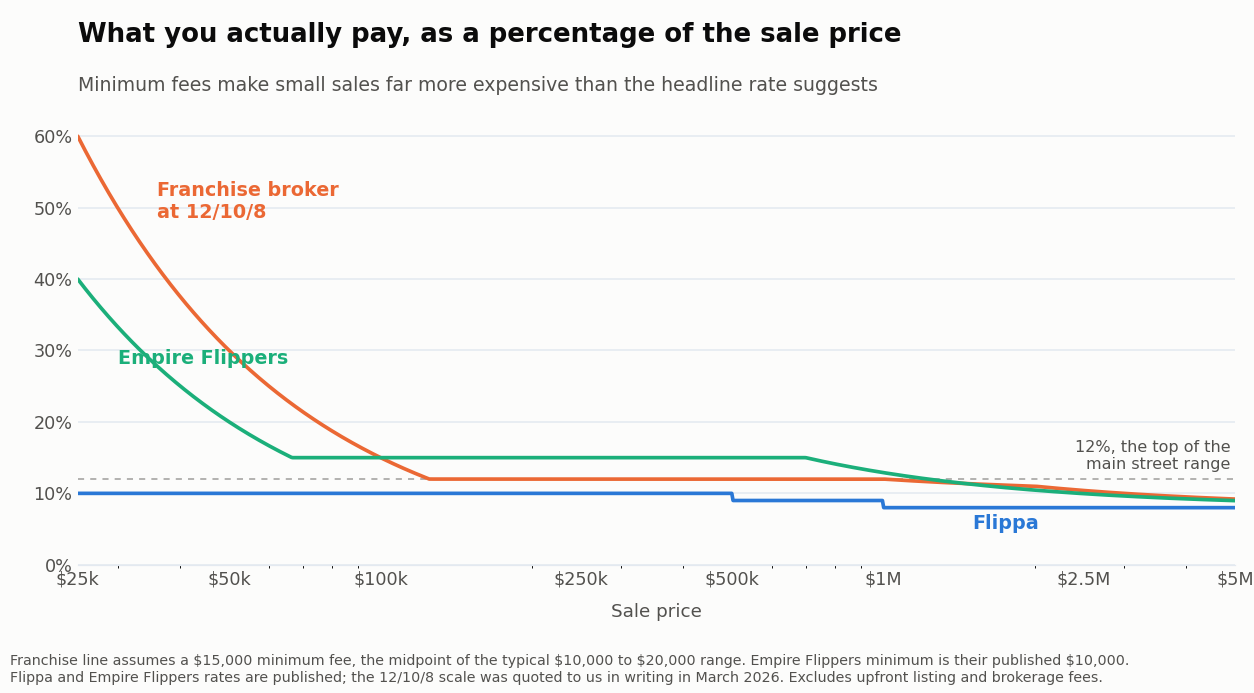
The percentages brokers quote and the percentages sellers actually pay are two different things. On a $50,000 sale a franchise broker at 12% with a $15,000 minimum takes 30%, and Empire Flippers takes 20%. The quoted rate only becomes the real rate somewhere north of $150,000.
Why small deals pay more, and why that is not a rip-off
The percentages above look regressive. A $200,000 business pays 12% while a $10 million business pays 6%. Sellers reasonably ask why.
The answer is that the work does not scale with the price. Preparing a $200,000 business for sale, finding buyers, running diligence and closing takes a broker most of the same hours as a $2 million business. Sometimes more, because smaller businesses tend to have messier books and first-time owners who need more hand-holding.
At 12% on $200,000 the broker earns $24,000 for perhaps six months of work, out of which the franchise takes its cut. That is not a windfall. At 6% on $10 million it is $600,000 for a similar number of hours, which is why the rate falls.
The practical version. Most brokers also enforce a minimum fee, commonly $10,000 to $20,000 at the main street end. Empire Flippers publishes theirs at $10,000, which means a $40,000 sale costs an effective 25%. If your business is worth under about $150,000, check the minimum before you check the percentage. The minimum is the number that will actually apply to you.
The negotiation nobody writes about
This is the part I have not seen covered honestly anywhere, and it comes from my own file rather than from research.
In March 2026 a Transworld Business Advisors franchise approached me about a business I had listed. I asked what they charge. The answer came back in writing:
“We work on success fees. You pay us only when the business sells, and it is 12% of the selling price for the 1st million, 10% for the 2nd million, 8% of the 3rd million and so on.”
So I tried to negotiate. I told them another firm had quoted 10% and asked them to match it. The reply was that rates are set by corporate, the advisor has no say, and, in their words, they do not usually compete on pricing.
But I did get something. A week later, after they had reviewed the financials, they came back and waived the upfront working fees entirely while keeping the 12%.
That is the lesson. With a franchise brokerage the headline percentage is usually fixed and the upfront fees usually are not. The advisor genuinely cannot move the rate, but they can absorb costs their office would otherwise bill you for. If you go in demanding a lower percentage you will hear no. If you ask what they can do on the upfront, you may well get all of it.
What upfront fees actually are
Their explanation, which I found reasonable: launching a sale costs real money before anyone earns a commission. Listing fees on industry websites, marketing spend to promote the business, and a lot of management time preparing the offering, negotiating and fielding buyer questions. The upfront covers some of that and is credited against the final payout.
Typical shapes you will encounter:
No retainer at all. Flippa, Empire Flippers, Earned Exits and Website Closers all state they take nothing upfront beyond a listing or brokerage fee.
A listing or brokerage fee. Flippa charges $29 to $199 for self-service, or $799 to $1,499 for a six month broker-led term depending on asking price.
A monthly retainer, credited at close. Baton charges $1,000 a month with a three month minimum, refunded from the fee at closing.
Working fees. The franchise model. Waivable, as above.
Valuation fees. One Sunbelt franchise publishes an industry guide putting these at $7,000 to $20,000 in the lower middle market. Several firms, including Earned Exits, do a valuation free.
What you actually pay, at four deal sizes
Same business, same broker effort, four different prices. This is the table I wish someone had shown me the first time.
Sale price
Franchise broker at 12/10/8
Flippa
Empire Flippers
$50,000
$10,000 to $20,000 minimum fee, so 20% to 40%
$5,000 plus a $29 to $199 listing
$10,000 minimum, so 20%
$200,000
$24,000 (12%)
$20,000 (10%) plus $799
$30,000 (15%)
$1,000,000
$120,000 (12%)
$80,000 (8%) plus $1,299
$129,000 (blended 12.9%)
$5,000,000
$420,000 (12/10/8 blended)
$350,000 (7%) plus $1,299
$449,000 (blended 9%)
A few things fall out of that table.
For context on what small businesses actually sell for, BizBuySell’s quarterly Insight Report put the median sale price at $349,250 in Q2 2026, which places most sellers squarely in the band where minimum fees bite.
Under about $150,000, minimum fees dominate everything. The percentage is almost irrelevant. Ask for the minimum in dollars, not the rate.
Between $200,000 and $1M, the spread is real money. On a $1M sale the gap between the cheapest and most expensive option here is roughly $49,000. That is worth a few hours of comparison.
Blended scales beat flat ones as you get bigger. Empire Flippers is the most expensive option at $200,000 and cheaper than a 12% franchise broker at $1M, because their rate steps down on the portion above $700,000 while a flat 12% does not step down at all until the second million.
Ask this exact question. “Is your fee blended or flat?” A 12% flat fee on $1.5M is $180,000. A 12/10 blended fee on the same sale is $170,000. Brokers do not always volunteer which one they are quoting, and the wording in the agreement is what counts, not the conversation.
Who pays the broker?
The seller, in almost every case. The fee comes out of the sale proceeds at closing, usually paid directly from the escrow account before the balance reaches you. You do not write a cheque.
Buyers occasionally pay a fee on the buy side if they engage their own advisor, but in a standard business sale the listing side pays. If a broker approaches you as a buyer and asks for a fee, understand who they actually represent before you go further.
Is a business broker worth it?
The honest answer is that it depends on one thing: whether that particular broker gets you a higher price than you would get alone, by more than their fee.
On a $500,000 business at 10%, the broker needs to add $50,000 to the price just to break even against selling it yourself. That is a 10% lift, and a good broker in a competitive process clears it comfortably, because competition between buyers is what moves price. A mediocre one does not.
Where brokers earn their money:
Recasting the financials. Most owner-operated businesses understate real earnings through legitimate personal expenses. Presenting adjusted earnings properly can move the valuation more than anything in the negotiation.
Creating competition. One interested buyer is a negotiation. Five is an auction.
Confidentiality. Selling quietly, so staff, clients and suppliers do not find out before you are ready.
Keeping the deal alive through diligence, which is where most deals die.
Where they do not: if you already have a buyer, a broker adds paperwork and a percentage. If your business is small, simple and clean, an open marketplace listing at a few hundred dollars does most of the same job. Our comparison of where to sell a business, linked below, works through which route fits which situation.
Red flags in a fee agreement
An exclusive longer than six months. If they cannot move it in six months the problem is the price or the business, and another six months of exclusivity fixes neither.
A tail that catches buyers you found. Most agreements say a sale to any buyer during the term owes the full fee, even one you sourced. Ask for a carve-out in writing before you sign, naming anyone already in conversation.
A tail period after the listing ends. Commonly 90 days for smaller assets and 180 for larger ones. Reasonable in principle, but know the length.
A fee due on the full price including earn-outs and seller financing. This is standard, and it means you may owe the fee on money you have not received yet.
A fee schedule that is not in the document. More common than it should be. If the agreement refers to a pricing schedule, check the schedule is actually attached.
Before you sign with anyone
A broker is one of eleven ways to sell, and the cheapest is not always the worst
On a $500,000 sale the gap between a $600 marketplace listing and a 12% brokered sale is about $59,400. Sometimes the broker is worth every penny of it. Sometimes you are paying for something you could do in a weekend. We laid out every option with its real pricing.
Free, no signup, real published pricing throughout.
Fee structures you will hear named
Name
How it works
Where you see it
Flat percentage
One rate on the whole price
Main street brokers, most marketplaces
Declining scale
Rate drops on each additional tranche
Transworld at 12/10/8
Blended tiers
Different rate applies to each portion
Empire Flippers, Flippa
Double Lehman
10% on the first $1M, 8% on the second, 6% third, 4% fourth, 2% on the rest
Lower middle market
Reverse Lehman
Rate rises with price, rewarding a higher sale
Occasionally offered, ask for it
Minimum fee
A floor in dollars regardless of percentage
Almost everywhere, $10k to $20k
If someone quotes you “Double Lehman” without explaining it, that is 10/8/6/4/2 on successive millions. On a $3M sale that is $100,000 plus $80,000 plus $60,000, or $240,000, an effective 8%.
Reverse Lehman is worth asking about and almost nobody does. It inverts the incentive: the broker earns a higher percentage on the portion above your target price, so pushing for more actually pays them. If you believe your business is worth more than the valuation suggests, propose it.
How to compare two quotes properly
Ask every broker the same six questions and write the answers down.
What is your fee at my expected sale price, in dollars?
Is that blended or flat?
What is the minimum fee?
What do I pay upfront, and is it credited at closing?
How long is the exclusive, and what is the tail after it ends?
If I bring my own buyer, what do I owe?
Question one is the important one. A percentage is easy to shrug at. A dollar figure is not, and it is the same number.
Related reading
Flippa review, including the full 10% to 5% tier table
For main street businesses under about $1 million, 10% to 12% of the sale price is typical, with a minimum fee of $10,000 to $20,000. Above $1 million the rate usually declines: a Transworld franchise quoted us 12% on the first million, 10% on the second and 8% on the third. Lower middle market and M&A advisory work more often runs 4% to 8%, sometimes on a Double Lehman scale of 10/8/6/4/2 on successive millions. Digital marketplaces sit in a similar range, with Flippa at 10% falling to 5% and Empire Flippers at 15% blended down to 2.5%.
How much do business brokers charge to sell a small business?
For a small business the minimum fee usually matters more than the percentage. Most brokers enforce a floor of $10,000 to $20,000, so a $50,000 sale can cost 20% to 40% in effective terms even where the quoted rate is 10%. Empire Flippers publishes a $10,000 minimum, which makes a $40,000 sale an effective 25%. Always ask for the minimum in dollars before you ask about the rate.
Is a 2% broker fee normal?
Not for a whole business sale. 2% appears only at the top of large transactions, as the final tranche of a declining scale. Empire Flippers charges 2.5% on the portion of a sale above $5 million and Baton charges 2% above $5 million, but both charge far more on the first tranche. If someone quotes a flat 2% on a small or mid-sized business, ask carefully what it covers, because it is well below what the work costs to deliver.
Who pays the broker when selling a business?
The seller, in almost every case. The fee comes out of the sale proceeds at closing and is typically paid directly from the escrow account before the balance reaches the seller. Buyers sometimes pay a separate fee if they engage their own buy-side advisor, but in a standard sale the listing side pays.
Do business brokers charge upfront fees?
It varies, and it is negotiable more often than the percentage is. Flippa, Empire Flippers, Earned Exits and Website Closers all state they take no retainer. Baton charges $1,000 a month with a three month minimum, credited back at closing. Franchise brokerages commonly charge upfront working fees to cover listing costs and marketing. When we pushed a Transworld franchise on price they held firm at 12% but waived the upfront working fees entirely, which suggests that is where the flexibility sits.
Can I negotiate business broker fees?
The percentage is often fixed, especially at franchise networks where rates are set by corporate and the individual advisor genuinely cannot change them. What is negotiable is usually everything else: upfront and working fees, the length of the exclusive period, the tail period after it ends, and carve-outs for buyers you introduce yourself. Ask what they can do on the upfront rather than on the rate.
Is it worth using a business broker?
It is worth it if that broker adds more to your sale price than their fee costs. At 10% on a $500,000 business they need to add $50,000 just to break even against selling it yourself. A good broker clears that by creating competition between buyers, recasting your financials to show true earnings, keeping the sale confidential and holding the deal together through due diligence. If you already have a buyer, or the business is small and simple with clean books, a marketplace listing at a few hundred dollars does much of the same work.
What is a Double Lehman fee structure?
A declining scale of 10% on the first million of sale price, 8% on the second, 6% on the third, 4% on the fourth and 2% on everything above. On a $3 million sale that works out at $240,000, an effective 8%. It is common in the lower middle market. Reverse Lehman inverts it so the rate rises with price, which aligns the broker with pushing for a higher number, and it is worth asking for even though it is rarely offered.
What should I ask a broker before signing?
Six questions. What is your fee at my expected sale price in dollars, not percent? Is that blended or flat? What is the minimum fee? What do I pay upfront and is it credited at closing? How long is the exclusive and what is the tail afterwards? And if I bring my own buyer, what do I owe? Get all six answered in writing, and check that any fee schedule the agreement refers to is actually attached to the agreement.
Selling a business in 2026 is absolutely doable, but buyers are typically more careful than they were during “easy money” years. They want clean financials, clear owner separation, and fewer surprises. This guide walks you through the exact process, compares your main selling options, and includes practical checklists you can use right away.
Before you talk to buyers, get a realistic valuation range. In 2026, the “right” price is the one a buyer can justify with financing and clean diligence. A strong valuation baseline helps you price confidently and negotiate better terms.
1) Compare Your Main Options to Sell a Business in 2026
There isn’t one “best” way to sell. The right path depends on your timeline, confidentiality needs, business type, and how much you want to stay involved after closing. Here’s a practical comparison you can use to choose a strategy.
Option
Best for
Typical timeline
Cost
Price potential
Your effort
Business broker / M&A advisor
Owners who want process + buyer sourcing + negotiation help
4–10+ months
Success fee (often % of sale) + possible retainers
High (if marketed well)
Medium
Direct outreach (DIY)
Owners with strong networks or obvious strategic buyers
3–9+ months
Lower cash cost, higher time cost
Medium–High
High
Online marketplaces
Digital assets, content sites, SaaS, small service businesses
1–6+ months
Listing + success fees vary
Medium (can be high if asset is clean)
Medium
Private equity / roll-up
Profitable businesses with systems + growth levers
6–12+ months
Advisor/legal costs can be higher
High (often with earnout/rollover)
Medium
Management/employee buyout
Owners who value legacy + continuity
4–12+ months
Lower marketing cost, financing work needed
Medium
Medium–High
Partial sale / recap
Owners who want liquidity but aren’t fully done
4–10+ months
Deal complexity costs more
Medium–High
Medium
If you run an online or content-heavy business, you may also want to review our breakdown of selling websites and digital assets on Flippa: Flippa.com review and what to expect.
Pros and cons (real-world, not fluff)
👍 Broker / advisor-led sale
Better buyer sourcing and tighter process control
More leverage in negotiations if multiple buyers compete
Less time drain on you during outreach and filtering
👎 Watch-outs
Fees reduce net proceeds, so the sale price must justify it
Some advisors “spray and pray” listings, hurting confidentiality
You still need strong documentation and quick responses
👍 DIY/direct sale
Lower cash cost and full control of buyer conversations
Great if you already know likely strategic buyers
Can move fast if the buyer is pre-qualified and motivated
👎 Watch-outs
Time intensive (calls, follow-ups, documentation, negotiation)
Higher risk of leaks if you don’t run a tight NDA process
Easy to accept weak terms without realizing it
2) Prep Work That Usually Increases Price (and Speeds Up Closing)
In 2026, the fastest way to lose leverage is messy documentation. The fastest way to gain leverage is to walk into diligence with a clean, organized story.
Buyer-ready checklist (copy/paste friendly)
Financials: last 3 years P&L + balance sheet + trailing 12 months, plus clear explanations for any big swings.
Add-backs: a simple list of owner expenses that won’t continue after sale (with proof).
Owner dependence: documented SOPs, training guides, vendor contacts, and role handoffs.
Customer concentration: top customers, contract terms, renewal dates, churn/retention metrics.
Operations: key suppliers, lead sources, fulfillment workflow, software stack, KPIs.
Legal: entity docs, IP ownership, leases, licenses, employee agreements, and any past disputes.
Taxes: last returns filed, sales tax status where applicable, payroll compliance basics.
One underrated prep move: clean up any messy receivables, vendor issues, or unresolved disputes. Buyers hate uncertainty. If your business has unpaid invoices or collection risk, read this first: what business debt collection is and how it works.
Also keep an eye on the broader environment. Inflation and rates influence buyer financing, which can influence valuation and terms. If you want to track the data that moves markets, see our CPI release schedule and this explainer on how CPI affects inflation.
Most small businesses are priced off a “cash flow story” plus risk. In plain English: buyers want to know what they’ll actually earn, how stable it is, and how hard it is to keep it going after you leave.
A practical way to estimate value
Start with a clean trailing 12-month profit view.
Add back true one-time and owner-only expenses (carefully).
Identify the top 3 risks buyers will price in (concentration, owner dependence, volatility).
Compare “as-is” vs “cleaned-up” value drivers (SOPs, contracts, recurring revenue, team).
Transferable lead gen: not dependent on one person’s relationships.
Process maturity: documented operations + measurable KPIs.
Clean books: fewer “trust me” explanations in diligence.
Sanity-check your asking price. If you’re debating “price high and negotiate down” vs “price fair and attract better buyers,” start by seeing a valuation range you can defend.
Closing: funds move, contracts assign, keys hand over, transition begins.
Confidentiality tip: Don’t send full financials, customer lists, or vendor terms until there’s an NDA and the buyer looks real. “Curious” buyers can unintentionally leak info.
5) Negotiation: The Terms That Matter More Than Price
A headline price is nice, but your net proceeds and risk after closing are often driven by terms. In 2026 especially, it’s common to see more structure (seller financing, escrow, earnouts) when buyers want downside protection.
Term
Why it matters
Seller-friendly move
Working capital
Can change net proceeds at closing
Define a realistic “normal” level using historical averages
Earnout
You may not control outcomes after close
Use objective metrics, short windows, and clear control provisions
Seller note
Adds risk but can increase price
Secure it where possible and limit subordination
Escrow/holdback
Funds withheld for claims
Cap exposure, shorten survival periods, define claim process
Transition support
Sets expectations for your time post-close
Define duration, hours, and what’s “in scope”
6) Taxes & Deal Structure (Asset Sale vs Stock Sale)
Important: tax outcomes vary a lot by entity type (LLC, S-Corp, C-Corp), state, and deal structure. Use this section as a conversation starter with your CPA and attorney, not as tax advice.
Asset sale (common in small business)
Buyer picks which assets and liabilities transfer
Often cleaner for buyers, sometimes less favorable for sellers
Purchase price allocation can affect taxes significantly
Stock/equity sale (more common in larger deals)
Buyer acquires the entity (and its history)
Seller often prefers it, buyer may push back due to risk
Reps/warranties and diligence tend to be heavier
At a minimum, expect your CPA to ask about purchase price allocation, working capital, and transition compensation. This is also where state compliance and “good standing” checks come up.
7) Major City Considerations (So This Feels Local, Not Generic)
Even when your business is “online,” buyers still care about local realities: leases, payroll, licensing, taxes, and concentration in a single metro area. Here are practical considerations that come up often in major U.S. markets:
New York City: expect deeper diligence on leases, payroll, and customer churn in higher-cost environments.
Los Angeles / San Diego: buyers often focus on documentation, compliance, and clear role separation if the owner is deeply involved.
Chicago: be ready to explain margins, seasonality, and customer concentration cleanly.
Miami / Orlando / Tampa: buyers typically scrutinize lead sources, reviews, and how steady demand is throughout the year.
Seattle: clear SOPs and stable retention metrics can matter as much as topline growth.
Dallas / Houston / Austin: entity status and tax compliance are often checked early by serious buyers and lenders.
Denver / Phoenix / Atlanta: buyers look for scalable systems and clean staffing/contractor agreements.
If you want truly local guidance, we’ve published state-specific selling guides you can use as a starting point:
Want the simplest next step? Get a valuation estimate, then build a short action plan: fix the top 2 value leaks, choose your route (broker vs DIY vs marketplace), and set a timeline you can commit to.
Disclosure: This page contains affiliate links. If you use them, we may earn a commission at no extra cost to you.
If you decide to use a broker
Brokers vary enormously and the marketing rarely tells you what you need. Two worth reading before you sign: our Earned Exits review, which goes through fees, deal band and the public record on a firm we partner with, and the wider comparison of every marketplace and broker with published pricing. If the business is online rather than offline, start instead with our Empire Flippers review for curated marketplaces or the Flippa review for open ones.
FAQ: How to Sell a Business in 2026
How long does it take to sell a business in 2026?
If your documentation is clean and the buyer is qualified, some deals can move in a few months. Many sales take longer because of buyer financing, diligence delays, and negotiation over terms (earnouts, working capital, escrow). The best way to shorten the timeline is to prepare your financials and contracts before you go to market.
What’s the biggest mistake owners make when selling?
Two common ones: (1) waiting too long to organize documents, then scrambling during diligence, and (2) focusing on the headline price while ignoring terms that reduce net proceeds or increase post-close risk.
Should I use a broker, or sell it myself?
If you have strong buyer access (competitors, partners, industry contacts) and you’re comfortable running a structured process, DIY can work. If you want better buyer sourcing, tighter confidentiality, and negotiation support, a strong broker/advisor can be worth it. Either way, your outcome improves when your documentation is clean.
How do I keep the sale confidential from employees and competitors?
Use a teaser first (no company name), require NDAs before sharing sensitive details, and only disclose customer/vendor specifics to qualified buyers. If you work with an advisor, insist on a controlled buyer list (not public blasting).
Do buyers usually need financing in 2026?
Many buyers use financing, especially for small and mid-size deals. That’s why clean financials matter: lenders want stable cash flow, verifiable revenue, and clear add-backs. Financing can also influence terms (seller notes, earnouts, escrow).
Is an earnout normal, and should I accept it?
Earnouts are common when buyers want protection or when growth claims are hard to verify. The risk is control: after closing, your payout may depend on decisions you don’t control. If you accept an earnout, push for clear definitions, short measurement periods, and guardrails on how the business is operated.
What documents do I need for due diligence?
At minimum: financial statements (3 years + trailing 12), tax filings, customer and vendor lists (often summarized first), leases, contracts, payroll basics, insurance, licenses, and proof of ownership for IP and key assets. Organized data rooms close faster and reduce renegotiation risk.
Can I sell my business if I have debt or collections?
Often yes, but it impacts structure. Some buyers prefer asset purchases to avoid inheriting liabilities. It also affects diligence, working capital, and what gets paid off at closing. If receivables or collections are part of your story, get organized early so you can explain it clearly.
How do I decide between an asset sale and a stock sale?
Asset sales are common because buyers can pick what transfers. Stock sales can be cleaner for sellers but may be riskier for buyers due to inherited history. Your entity type, liabilities, contracts, and tax situation heavily influence the best structure. This is where your CPA and attorney matter most.
What if my business is mostly online?
Online businesses can sell very well when the traffic and revenue are stable and verifiable. Buyers will still look for concentration risk (one channel, one platform, one ad account) and owner dependence (content creation, partnerships, operations). If you’re in that category, marketplaces can be one route, but you still need clean documentation and a strong transfer plan.
If you’re thinking about selling a business in Colorado, I’d approach it as a positioning exercise first and a transaction second. After writing about financial deals, private businesses, and buyer behavior for more than two decades, I can tell you this much: owners usually leave money on the table long before the listing ever goes live. They do it through messy books, vague growth stories, owner-dependent operations, and unrealistic pricing. Colorado can be a strong market for good businesses, but buyers here still want the same thing buyers want everywhere else: clean numbers, low friction, and confidence that the business will keep running after you step away.
Want a realistic valuation range before you go to market?
One of the smartest first steps is getting a clearer sense of what your business may be worth before you start talking to buyers. It helps anchor expectations and can save a lot of wasted time.
I’ve seen Colorado owners make two opposite mistakes. The first is assuming a strong local economy automatically means a premium valuation. The second is undervaluing a solid business because they are tired, burned out, or eager to move on. The right answer is rarely emotional. It comes from the fundamentals: cash flow quality, customer concentration, owner involvement, recurring revenue, margins, and how transferable the operation really is. If you need a broader starting point, my guides on how much you can sell your business for and how to sell a business in 2026 help frame the bigger picture.
Why Colorado businesses can attract strong buyer interest
Colorado is appealing for a mix of reasons that tend to matter to acquirers: population growth, a healthy small-business culture, active metro markets, and a good spread of industries instead of one single story. In practice, that means a quality company in the right niche can attract strategic buyers, individual operators, private investors, or search-fund-style buyers looking for owner-operated businesses with room to grow.
Denver metro tends to attract the broadest buyer pool and usually the most deal competition.
Boulder often gets attention for service, tech-adjacent, wellness, specialty retail, and founder-led brands.
Colorado Springs can appeal to buyers looking for disciplined operations and stable service businesses.
Fort Collins has strong appeal for professional services, home services, light industrial, and lifestyle businesses.
Mountain and resort markets can be attractive, but buyers usually scrutinize seasonality, staffing, housing pressure, and customer concentration more closely.
That said, Colorado buyers are not blind to risk. If your revenue swings too much, depends heavily on one founder, or relies on a few key accounts, you will feel that in the offers.
What your business is really worth in Colorado
The fastest way I can explain valuation is this: buyers do not pay for effort, history, or how attached you are to the business. They pay for future cash flow and how confident they feel about keeping that cash flow alive after closing.
Factor
Why buyers care
How it affects value
Seller’s discretionary earnings or EBITDA
This is the earnings base many buyers start from.
Higher quality earnings usually support better multiples.
Owner dependence
If everything runs through you, risk goes up.
Heavy owner dependence often pushes value down.
Recurring or repeat revenue
Predictability matters a lot to buyers.
Recurring revenue often improves both price and deal quality.
Customer concentration
Too much dependence on one or two clients increases fragility.
High concentration can reduce multiple or trigger holdbacks.
Operational cleanliness
Messy books and undocumented processes scare buyers.
Clean reporting can materially improve buyer confidence.
Growth story
Buyers want believable upside, not fantasy.
A credible expansion story can improve urgency and valuation.
One thing I’ve noticed over the years is that owners often obsess over “the multiple” too early. The multiple matters, of course, but it tends to improve when the business feels transferable, documented, and durable. That is the real work.
Colorado-specific issues sellers should not ignore
If I were selling a Colorado business today, I would pay close attention to state-level admin and tax cleanup before going to market. Colorado’s Department of Revenue has a dedicated page for buying or selling a business, including Tax Status Letter guidance for buyers and sellers, and that is exactly the kind of thing serious buyers appreciate because it reduces uncertainty. The same goes for filing and entity housekeeping with the Secretary of State and closing or updating tax accounts properly if ownership changes. Colorado DOR’s buying or selling a business page, Colorado Secretary of State business forms, and the SBA’s close or sell your business guide are all worth reviewing before a deal gets serious.
Make sure your entity filings are current and not delinquent.
Separate personal expenses from business expenses before buyers start digging.
Understand which licenses, permits, leases, and contracts are transferable and which are not.
Review state and local tax obligations, especially if the business collected sales tax.
Prepare for buyer questions about employees, payroll, and final account closures if a structure change is involved.
Colorado’s tax guidance also makes clear that buyers can request a Tax Status Letter and that ownership changes often require attention to state tax accounts. That is not glamorous work, but it is exactly the kind of detail that helps a deal move instead of stall.
Best types of Colorado businesses to sell right now
In my view, Colorado tends to be especially interesting for buyers when the business is practical, profitable, and not too dependent on hype. A flashy concept can attract attention, but stable fundamentals usually win.
Business type
Why buyers like it
Common watchouts
Home services
Strong local demand, repeat customers, easier expansion story.
Attractive when client retention is strong and delivery is team-based.
Founder dependence and concentration risk.
Specialty retail and ecommerce hybrids
Works well when margins are healthy and channel mix is diversified.
Inventory, ad-spend dependence, supplier issues.
Light industrial and B2B service
Often more resilient and less trend-driven.
Equipment condition, contract renewal risk.
Hospitality and resort-adjacent businesses
Can draw lifestyle buyers and strategic buyers alike.
Seasonality, labor pressure, rent and housing dynamics.
How to prepare your Colorado business before listing it
If you want a better outcome, I’d focus on reducing buyer friction. Every awkward answer in diligence lowers confidence. Every clean, organized answer increases it.
Clean up the books. Use clear profit-and-loss statements, balance sheets, and add-backs that can actually be defended.
Document core operations. Buyers love businesses that feel teachable and repeatable.
Reduce owner dependence. If key customer relationships, pricing, approvals, and vendor management all run through you, fix that before marketing.
Review contracts and leases. Transferability matters more than owners think.
Identify risks before buyers do. That includes tax issues, legal disputes, customer concentration, and staff turnover.
Build a believable growth story. Not “we can double next year,” but “here are the levers a new owner can pull.”
Many owners guess at value based on revenue, gut feel, or what a friend sold for. I would not do that. A more grounded estimate can change how you time the deal, position the business, and negotiate.
Most small and lower-middle-market deals I review still come down to the same handful of structures: asset sales, stock or membership-interest sales, seller financing, earnouts, and retention-based adjustments. Colorado is not magically different here, but local business owners do sometimes underestimate how much deal structure affects what they actually walk away with.
Asset sale: Often simpler for buyers, especially when they want to avoid taking on unknown liabilities.
Entity sale: Can be attractive in the right situation, but diligence usually gets tighter.
Seller note: Common when the buyer wants you to share some risk.
Earnout: Sometimes fair, sometimes messy. It depends entirely on how clearly it is defined.
Working capital adjustments: Easy to overlook and surprisingly important.
This is one reason I like reminding owners that the headline price is not the whole story. Deal quality matters just as much.
Colorado cities and regions buyers pay closest attention to
Denver
Denver is usually the broadest market and often the easiest place to attract multiple buyer types. If your business has scale, team depth, and a clear expansion story, Denver can be a very solid exit market.
Boulder
Boulder buyers often care a lot about brand, culture, defensibility, and lifestyle positioning. That can work in your favor if the business is differentiated, but it also means buyers may push hard on narrative consistency and margins.
Colorado Springs
I tend to think Colorado Springs plays well for practical businesses: home services, B2B services, trades, and owner-operated companies with stable local demand. Buyers here often like straightforward operations over flashy storytelling.
Fort Collins
Fort Collins can be attractive for service businesses, niche manufacturers, specialty retail, and multi-location growth stories. It also appeals to buyers who want a Colorado market without defaulting to Denver.
Mountain, ski, and resort markets
These can sell well, but buyers usually go deep on seasonality, rent, staffing, and customer dependency. If your business is in a tourism-heavy area, you need to explain how the company performs outside the peak cycle.
Common mistakes Colorado sellers make
👍 What helps a sale
Clean financials and sensible add-backs
Documented processes and delegated management
Balanced customer base
A believable growth narrative
Early cleanup of tax, filing, and contract issues
👎 What hurts a sale
Pricing based on emotion instead of market reality
Owner dependence on sales, fulfillment, or relationships
Messy books and missing documents
Surprises in diligence
Assuming local momentum alone will carry the valuation
One pattern I’ve seen again and again is that owners who start preparing six to twelve months early tend to get better outcomes than owners who rush. That does not mean you need a year-long process every time. It just means preparedness usually pays.
A practical Colorado seller checklist
Bring your bookkeeping up to date and normalize earnings.
Review Colorado state filings and fix anything stale or delinquent.
Clarify which licenses, permits, contracts, and leases transfer with the business.
Check state tax accounts, sales tax issues, and any open account cleanup items.
Build a buyer-ready package with financials, operations notes, team overview, and growth opportunities.
Set a valuation expectation based on fundamentals, not just hope.
Think carefully about deal structure, not just the asking price.
If you are also comparing how business selling differs from consumer finance exits and distressed situations, some of our finance-side coverage may be useful context too, including our pages on business debt collection and business banking options. Those are obviously different topics, but they overlap with how buyers think about working capital, collections, and operational discipline.
Thinking about selling in the next 6 to 18 months?
That is usually the sweet spot for getting prepared without rushing. A valuation estimate can help you decide whether to sell now, improve a few things first, or hold off until the numbers look stronger.
If I had to boil this down, I’d say Colorado can be a very good place to sell a business, but not because buyers hand out generous offers for free. You still need to earn the premium through clean numbers, transferability, and a story that makes sense. I’ve watched strong owners get weak offers because they were underprepared, and I’ve watched ordinary-looking businesses get surprisingly good outcomes because they were buttoned up and easy to underwrite.
That is why I’d focus less on hype and more on readiness. If your books are clean, your operation is teachable, and your valuation expectations are grounded, you give yourself a much better shot.
Choosing a broker in Colorado
If you are looking at brokers based in the state, one worth knowing about is Earned Exits, a Lone Tree firm working with companies in the $1 million to $40 million revenue band. They are a partner of this site, which is precisely why our Earned Exits review goes through their fees, their actual track record and the public record on the people behind the firm before recommending anything.
Frequently Asked Questions About Selling a Business in Colorado
How do I sell a business in Colorado?
I’d break it into stages: clean up the financials, prepare buyer materials, review Colorado filings and tax accounts, decide on valuation expectations, then take the business to market in a controlled way. Most owners get into trouble when they reverse that order and start shopping the company before they are actually ready.
What is the best way to value a Colorado business?
The best starting point is usually a cash-flow-based approach, then adjusting for risk factors like owner dependence, customer concentration, and operational quality. I would not rely on a revenue multiple alone unless the business type really supports that shorthand.
Do I need to notify Colorado tax authorities when I sell my business?
In many cases, yes, there are state tax account and closure or transfer issues to review. I strongly recommend checking Colorado’s official Department of Revenue guidance before closing because buyers often want comfort around tax compliance and account status.
Is Denver the best place in Colorado to sell a business?
Denver usually offers the broadest buyer pool, but it is not automatically the best fit for every business. Some companies do just as well, or better, in places like Colorado Springs, Fort Collins, or Boulder if the buyer profile is a better match.
Should I sell the assets or the entity?
That depends on the business, the tax picture, and what the buyer is trying to avoid. In smaller deals, asset sales are often more common because buyers like the cleaner liability profile. But every case is different, and this is one of those areas where legal and tax advice matters.
How long does it take to sell a business in Colorado?
It varies a lot, but owners should usually think in terms of months, not weeks. Preparation alone can take time, and then there is buyer outreach, negotiations, diligence, and closing. The businesses that close faster are usually the ones that were ready before the process started.
What makes a Colorado business harder to sell?
In my experience, the biggest issues are owner dependence, messy books, customer concentration, unstable margins, and unresolved filing or tax issues. Resort-market seasonality can also complicate things in certain parts of Colorado.
What should I do before I list my Colorado business for sale?
I would clean up the books, review state filings, prepare a simple buyer package, reduce reliance on the owner, and get a more realistic sense of value. Those few steps alone can improve both the price conversation and the quality of buyers you attract.
iMerge Financial carries one of the strongest customer ratings I have seen in consumer lending, 4.84 stars across 360 Better Business Bureau reviews. It also tells you less about itself than almost any company I have reviewed. Untangling those two facts is the whole point of this review.
A rating like that would normally end the conversation. Here it starts one, because iMerge publishes no licence number, no NMLS identifier, no loan amount range, no term length, no credit score requirement and not one lending partner. It never states plainly whether it lends at all.
0 licence numbers
iMerge publishes no NMLS number and no state lending licence anywhere on its website.
Before you hand a Social Security number to anyone, it is worth knowing which route you actually need. Our free two minute quiz compares a consolidation loan against settlement, nonprofit counselling and bankruptcy using your real balances and income.
701 Palomar Airport Road, Suite 300, Carlsbad, California
Started
March 2020, incorporated December 2020
CEO
Zach Myers. He is the only officer named anywhere we could find.
BBB
Accredited since May 2023, A+, ★★★★★4.84 out of 5 from 360 reviews
BBB complaints
5 closed in three years, 3 of them in the last twelve months
Licensing
No NMLS number and no state lending licence published anywhere on its site
CFPB complaints
Zero
Litigation
Named in a federal Fair Credit Reporting Act suit filed April 2024 in the Southern District of Ohio
What iMerge discloses about licensing
Every company in this category has to decide how loudly to say it is not a lender. Some bury it in a policy page, others put it in their terms of use. iMerge does not appear to say it anywhere.
Its homepage presents personal loans, business loans and debt consolidation.
Its terms of use contain no statement of lender, broker or lead generator status, only a requirement that you provide accurate information if applying for a loan through the site. The nearest thing to a disclosure is a line saying the service does not constitute an offer or solicitation for loan products which are prohibited by any state law, which tells a reader almost nothing.
The document that does tell you what is happening is the privacy notice required under the Gramm-Leach-Bliley Act. It discloses that iMerge shares personal information for non-affiliates to market to you and for joint marketing with other financial companies.
That is a description of lead generation, and it is the operative fact about this business.
It also does not name a single lending partner before you apply, which most comparable services do somewhere on the site.
One smaller thing worth catching. The about page claims 11 plus years of professional experience. BBB records the business as started in March 2020, which is six years. Those can both be defensible if the claim refers to the founder’s career rather than the company, but it is written as though it refers to the company.
iMerge Financial’s homepage leads with a lead capture form. No licence number, NMLS ID or lending partner is named anywhere on the page.
What the site publishes about rates and terms
Detail
What iMerge discloses
APR range
4.95% to 30.00%
Worked example
$30,000 at 9% over 60 months, $37,365 total repayment
Origination fee
Loans “may be subject to origination fees”. No percentage published.
Loan amounts
Not published
Term lengths
Not published
Minimum credit score
Not published
Lending partners
None named
NMLS or state licence
None published
The APR range is genuinely useful, and a 4.95% floor is competitive. Everything below it in that table is a blank, and the blanks are what make this impossible to compare against a lender that discloses properly.
The absence of a licence number on a site that solicits loan applications is the finding, not an oversight I am inferring. Comparable services generally publish something, whether an NMLS identifier, a state lender licence, or at minimum a state consumer lender registration. Here there is nothing.
The 2024 lawsuit, and what it does not tell us
In April 2024 a plaintiff filed Adkins v. iMerge Financial et al, case 2:24-cv-01569, in the United States District Court for the Southern District of Ohio.
The cause of action is the Fair Credit Reporting Act, 15 U.S.C. section 1681. The co-defendant is Five Lakes Law Group, PLLC, a debt settlement firm.
We could not retrieve a final outcome, so treat it as a filed claim rather than a finding. A lawsuit is an allegation, not a verdict.
What makes it worth mentioning is how precisely it matches the complaint pattern. The recurring grievance in the BBB file is people saying their credit was pulled after they responded to a pre-qualification mailer they never asked for.
An FCRA claim is exactly the legal shape that grievance takes. And the co-defendant being a debt settlement law firm matches the other recurring complaint, which is applicants being moved from a loan conversation to a debt programme.
What the complaints say
Theme one: the mailers
You are trying to deceive the public by, at first glance the unopened envelope, it looks like a government check refund. (21 May 2024)
Received an unsolicited letter marketing to me a pre-selected personal loan. This is deceptive and should be very illegal. (12 October 2024)
Received a prequalified letter from Imerge financial. No where in this letter does it say its from a consolidation agency. My credit was ran for nothing and points will be deducted. (BBB complaint, 12 November 2025)
Theme two: call volume
Imerge has called me 15 times in the last week, EVEN AFTER I TOLD THEM I WASN’T INTERESTED. (16 July 2026)
Business will not stop harassing me from multiple different numbers after following the unsubscribe and stop functions provided. (BBB complaint, 23 July 2026)
Theme three: from loan enquiry to debt programme
They offered me the exact opposite with a Debt consolidation offer. BEWARE of this company. (14 May 2024)
They didnt help me at all and it seemed like they just wanted my social to get my information. (25 July 2024)
Five complaints in three years is a low number in absolute terms and I am not going to inflate it. What is notable is that three of the five landed in the last twelve months, and that the themes are identical to companies with ten times the complaint volume.
What the 4.84 rating is built on
Three hundred and sixty reviews averaging 4.84 is a strong number and most of those reviewers are presumably real people who had a fine experience.
I found no evidence of a paid review solicitation platform behind them, which is not always the case in this sector.
What I would point out is the shape of the data. Multiple five star reviews posted on consecutive days, many naming an individual representative, is the pattern you see when closed customers are asked to post.
That is normal practice and not misconduct. It simply means the average reflects people who completed a process, not people who answered a mailer and hung up.
Set that against a company with no published licence, no named partners, and a live FCRA claim, and the rating is not the most informative number on the page.
Pros and cons
👍 A 4.84 rating from 360 BBB reviews, unusually high for this sector
👍 Only five BBB complaints in three years, and zero at the CFPB
👍 Publishes an APR range with a 4.95% floor and a worked repayment example
👍 No evidence of a paid review solicitation platform inflating its numbers
👎No NMLS number and no state lending licence published anywhere
👎 Never states whether it lends, brokers or refers. Its GLBA notice discloses data sharing for non-affiliate marketing.
👎 Names no lending partners, so you cannot see who will actually hold your loan
👎 No loan amounts, terms, credit score requirement or origination fee percentage published
👎 Named in a federal Fair Credit Reporting Act suit alongside a debt settlement law firm
👎 Complaints describe mailers resembling government cheques and calls continuing after opt out
The three questions I would ask on the call
If you do ring the number on the letter, these three will tell you everything within about ninety seconds.
Are you the lender, or are you referring me to someone else? A straight answer is a good sign. Evasion is the answer.
What is your NMLS number or state licence number? Any licensed originator gives this instantly. Write it down and check it at NMLS Consumer Access.
What is the origination fee as a percentage, and is it deducted or financed? If they cannot say, they do not know who is funding you yet, which means you are a lead rather than an applicant.
And one instruction rather than a question: do not give a Social Security number until you have the first two answers. A soft pull for a rate estimate does not require it in most cases, and the recurring complaint here is precisely about credit being pulled off a mailer response.
If you want to stop this category of post entirely, opt out of prescreened credit offers at OptOutPrescreen.com, the official industry site, and read the Federal Trade Commission’s explanation of how prescreened offers work. It is the single most effective thing you can do.
Want to know if consolidation is even the right move?
iMerge may work perfectly well if you have solid credit and you simply want one form to produce a few offers. The rating is real, the complaint count is genuinely low, and plenty of people report a smooth experience with a named representative.
I would not start here if you want to know who is lending to you before you hand over a Social Security number, because that information is not available until late in the process.
And I would not start here if your credit is weak, because the 4.95% floor will not be your rate and the conversation is likely to turn toward a debt programme instead.
If your balances are manageable and the real enemy is the interest rate rather than the principal, a nonprofit debt management plan beats almost every consolidation loan on cost. Family Credit Management is one such agency we have reviewed.
Frequently Asked Questions
Is iMerge Financial legit?
It is a real registered company. iMerge, LLC trades as iMerge Financial from 701 Palomar Airport Road, Suite 300, Carlsbad, California, started in March 2020, and has been BBB accredited since May 2023 with an A+ rating and 4.84 stars from 360 reviews. It has zero CFPB complaints.
The concerns are about disclosure rather than legitimacy: no NMLS number, no state lending licence, no named lending partners, and no clear statement of whether it lends or refers.
Is iMerge Financial a lender?
Its own site never says. The homepage presents personal loans, business loans and debt consolidation, but the terms of use contain no statement of lender, broker or lead generator status. The clearest evidence is its Gramm-Leach-Bliley privacy notice, which discloses that it shares personal information for non-affiliates to market to you and for joint marketing with other financial companies. That describes a lead generation model.
Does iMerge Financial have an NMLS number?
We could not find one. No NMLS identifier and no state lending licence number appears on its homepage, about page, terms of use, GLBA privacy notice, contact page or BBB profile. For a business soliciting loan applications, the absence of any licensing claim is itself worth noting. Ask for it directly and verify it at NMLS Consumer Access before providing personal information.
What is the iMerge Financial lawsuit about?
A case titled Adkins v. iMerge Financial et al, number 2:24-cv-01569, was filed in April 2024 in the United States District Court for the Southern District of Ohio. The cause of action is the Fair Credit Reporting Act. The co-defendant is Five Lakes Law Group, PLLC, a debt settlement firm. We could not verify the final outcome, so treat it as an allegation rather than a finding.
What does iMerge Financial charge?
It publishes an APR range of 4.95% to 30.00% and one worked example: 30,000 dollars at 9% over 60 months repaying 37,365 dollars in total. It states that loans may be subject to origination fees but does not publish a percentage, and it does not publish loan amounts, term lengths or a minimum credit score. Those blanks make it difficult to compare against a lender that discloses them.
Why did iMerge Financial send me a pre-qualified letter?
Direct mail is central to how the company acquires applicants, and it is the most common complaint theme against it. Complainants describe envelopes that resemble a government cheque and letters that do not make clear the sender is a debt consolidation operation. Pre-qualified generally means a list broker matched your credit profile against a screen. It is not an offer and no underwriter has seen your file.
Will responding to iMerge Financial affect my credit?
The company states it may perform credit checks to evaluate eligibility. Several complainants report their credit being pulled after responding to a mailer and describe that as unexpected. Ask explicitly whether the check is a soft or hard inquiry before giving a Social Security number, and note that the federal lawsuit against the company is brought under the Fair Credit Reporting Act.
Why does iMerge Financial keep calling me?
Persistent outbound contact after opt out requests is the second most common complaint theme. One reviewer documented fifteen calls in a week after declining, and a BBB complainant described contact from multiple different numbers after using the unsubscribe and stop functions. Send a written opt out, and cut the source by opting out of prescreened credit offers at OptOutPrescreen.com.
Is a 4.84 star rating from 360 reviews trustworthy?
The reviews appear genuine and we found no evidence of a paid review solicitation platform, which distinguishes iMerge from some competitors. The caveat is who gets asked. Star averages in this sector reflect customers who completed a process, not the larger group who responded to a mailer and went no further. Read the rating alongside the complaint themes rather than instead of them.
What are the alternatives to iMerge Financial?
If you want a consolidation loan, apply directly to established lenders that publish their loan amounts, terms, origination fees and credit requirements up front, so you can compare like for like. If a loan will not solve the problem, compare debt relief providers with public fee schedules and long complaint histories you can actually examine. If the interest rate is the issue rather than the balance, a nonprofit debt management plan is usually the cheapest route.
Amine is an entrepreneur, investor and financial writer that covers the US economy, inflation, alternative investments, cryptocurrencies and more. He has been involved in the space for over a decade.
Amine Rahal
Amine is an entrepreneur, investor and financial writer that covers the US economy, inflation, alternative investments, cryptocurrencies and more. He has been involved in the space for over a decade.