by Sarah Bauder | May 10, 2026 | CPI, Inflation
Inflation is a general increase in the price of goods and services over time. In plain English, it means your money does not buy as much as it used to. That can sound like an economics textbook problem, but it is really a personal finance problem. Inflation affects your savings, investments, debt, retirement income, property costs, and everyday household budget.
I have been writing about financial and investment-related topics for more than two decades, and inflation is one of those subjects that always comes back into focus when people start feeling squeezed. You may not follow every monthly CPI report, but you definitely notice when groceries, insurance, rent, utilities, and borrowing costs start taking a bigger bite out of your income.
Inflation is commonly measured using the Consumer Price Index, or CPI. The CPI tracks price changes across a basket of consumer goods and services. If you want to compare the buying power of money across different years, you can also use our CPI inflation calculator.
According to the U.S. Bureau of Labor Statistics, the Consumer Price Index for All Urban Consumers rose 3.8% over the 12 months ending April 2026. Core CPI, which excludes food and energy, rose 2.8% over the same period. That is lower than the worst inflation Americans experienced in 2022, but it is still high enough to matter when you are planning your savings, investments, and retirement.
Quick Takeaway
Inflation does not just make things more expensive. It changes the real value of your savings, income, investments, debt payments, and future retirement needs. The key is to think in terms of purchasing power, not just the dollar amount sitting in your account.

Historical CPI data helps show how inflation changes purchasing power over time. Source: Bureau of Labor Statistics
The Main Effects of Inflation on Your Personal Finances
Inflation does not affect every part of your financial life in the same way. Some assets may benefit from inflation. Some get hurt by it. Some debts become easier to handle, while others become more expensive.
| Area of Your Finances |
How Inflation Can Affect It |
What to Watch |
| Savings |
Cash can lose purchasing power if interest rates do not keep up with inflation. |
Real return after inflation and taxes. |
| Stocks |
Companies may raise prices, but they may also face higher costs and lower margins. |
Pricing power, earnings growth, and valuation. |
| Bonds |
Fixed payments can become less valuable when inflation rises. |
Interest rates, duration, and inflation protection. |
| Property |
Property values and rents may rise, but ownership costs can rise too. |
Mortgage type, insurance, taxes, repairs, and rates. |
| Retirement |
Future expenses may be much higher than today’s expenses. |
Inflation-adjusted income and withdrawal planning. |
The Effects of Inflation on Your Savings
One area most exposed to inflation is cash savings. A savings account can be a smart place for emergency money, short-term goals, and cash you may need quickly. I am not against holding cash. In fact, I think many people underestimate how important liquidity is when life gets messy.
But cash has one major weakness: it can quietly lose purchasing power if the interest rate on your account is lower than inflation.
For example, if you have $1,000 in a savings account earning 1% annually, you would have $1,010 after one year before taxes. But if inflation is running at 3.8%, you would need about $1,038 just to preserve roughly the same purchasing power. Your bank balance went up, but your real buying power went down.
This is what makes inflation so frustrating. You may not technically “lose” money in a savings account, but the money can still buy less over time.
Important point: The real return on savings is the interest rate you earn minus inflation. If your savings account earns 2% and inflation is 4%, your real return is roughly negative 2% before taxes.
This does not mean you should invest your emergency fund in the stock market. It means you should separate short-term savings from long-term wealth-building money. Cash is useful for stability and flexibility. But long-term money usually needs a plan that has a better chance of keeping up with inflation.
To understand how inflation has changed purchasing power historically, you can review our historical CPI tables or compare specific years using the calculator.
The Impact of Inflation on Stocks
Investing in stocks comes with more risk than keeping money in a savings account. Stock prices move up and down, and nobody can guarantee short-term returns. But over long periods, stocks have often helped investors protect and grow purchasing power better than cash.
That said, stocks are not automatically protected from inflation.
Inflation can affect stocks in a few different ways. When the economy is strong, companies may be able to raise prices, grow revenue, and increase earnings. That can support share prices. But when inflation rises too quickly, companies may also face higher costs for wages, raw materials, energy, shipping, rent, and financing. If those costs rise faster than revenue, profit margins can suffer.
This is why inflation can be especially difficult for companies that do not have pricing power. A business with a strong brand, essential products, and loyal customers may be able to pass some cost increases on to consumers. A weaker business may have to absorb those costs.
From an investor’s perspective, the real question is not only whether stocks go up in dollar terms. It is whether your investment return beats inflation over time.
Investor takeaway: During inflationary periods, focus on real returns, diversification, company quality, pricing power, debt levels, and your time horizon. Inflation can create pressure in the short term, but high-quality businesses may still help preserve purchasing power over the long term.
For a broader look at portfolio decisions during different economic conditions, you can read our guide on investing during inflation and deflation.
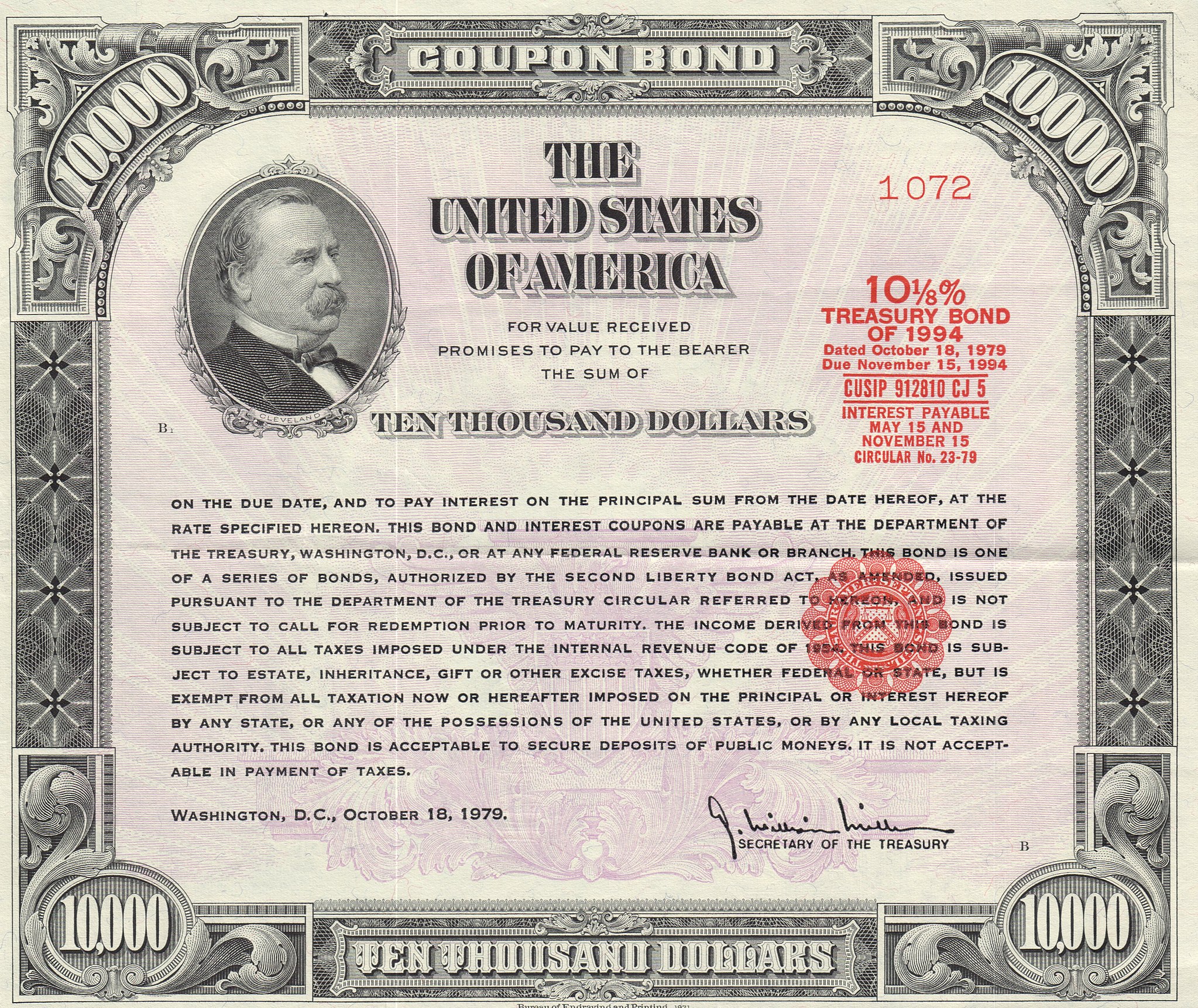
1979 $10,000 Treasury Bond. Fixed-income investments can be affected by inflation because future payments may lose purchasing power. Photo: Wikipedia
The Effects of Inflation on Bonds and Treasury Bills
Bonds and Treasury bills are often viewed as safer investments than stocks, but inflation can still affect them. The main issue is that many debt securities pay fixed interest. If inflation rises, those fixed payments may not buy as much as they did before.
For example, a bond paying 3% may look reasonable when inflation is 2%. But if inflation rises to 4% or 5%, the real value of that bond income may fall. This is one reason bond investors pay close attention to inflation expectations and interest rates.
Inflation can also affect bond prices through interest rates. When inflation is high, the Federal Reserve may keep interest rates higher to help bring inflation down. The Federal Reserve says it sets U.S. monetary policy to promote maximum employment and stable prices. When rates rise, older bonds with lower yields may become less attractive, which can push their market value down.
One option for investors worried about inflation is Treasury Inflation-Protected Securities, also known as TIPS. According to TreasuryDirect, TIPS are designed to help protect investors from inflation because the principal adjusts with changes in the Consumer Price Index.
TIPS are not perfect. They can still fluctuate in value, and they may have tax considerations depending on the account where they are held. But they can be useful for people who want part of their fixed-income portfolio linked to inflation.
You can learn more in our guide to inflation-protected bonds.
Property Ownership and Inflation
Property ownership can benefit from inflation, but it is not as simple as saying real estate always wins when prices rise.
On the positive side, property values and rents may rise over time. If you own a home with a fixed-rate mortgage, your principal and interest payment stays the same even as wages, rents, and general prices increase. That can make a fixed mortgage feel more affordable in real terms over time.
This is one reason many homeowners who locked in low fixed mortgage rates before rates rose have been reluctant to sell. Their monthly mortgage payment may be difficult to replace in the current rate environment.
However, inflation can also make property ownership more expensive. Home insurance, property taxes, repairs, materials, labor, utilities, and maintenance costs can all rise. Higher mortgage rates can also reduce buyer demand, which may make it harder to sell a property at the price you want.
| How Inflation Can Help Property Owners |
How Inflation Can Hurt Property Owners |
| Fixed-rate mortgage payments may become cheaper in real terms. |
Insurance, taxes, repairs, and maintenance may rise. |
| Property values may rise over long periods. |
Higher mortgage rates can reduce affordability for buyers. |
| Landlords may be able to raise rents. |
Operating costs may rise along with rental income. |
Real estate can be a useful inflation hedge in some situations, but it still depends on location, financing, purchase price, cash flow, and ownership costs.
Warren Buffett and the Matter of Inflation
Warren Buffett has written and spoken about inflation for decades, and his perspective is still useful for everyday investors. Buffett has long warned that inflation can quietly reduce the real value of investment returns, even when investors appear to be making money on paper.
In his classic 1977 Fortune essay, “How Inflation Swindles the Equity Investor,” Buffett explained why inflation can be difficult for both bondholders and stock investors. Bonds are vulnerable because future payments are made in dollars that may be worth less. Stocks can also struggle when inflation increases business costs, interest rates, and the amount of capital companies need just to maintain operations.
That does not mean Buffett believes people should avoid stocks. His broader investing philosophy has long favored owning high-quality businesses with durable competitive advantages, strong pricing power, and the ability to generate cash over long periods. Those traits can matter even more when inflation is eating into purchasing power.

Warren Buffett has written about inflation’s impact on investors for decades. Photo: Reuters/Carlo Allegri
The lesson for personal finance is simple: inflation is not just about higher grocery or gas prices. It also affects the real value of savings, bonds, retirement income, and investment returns. That is why investors need to think in terms of after-inflation returns, not just headline returns.
Inflation and Retirement Planning
Inflation becomes especially important when you are planning for retirement. If you are working, you may be able to earn more, change jobs, negotiate higher pay, or adjust your budget. Once you retire, your options may be more limited.
Retirees who depend heavily on fixed income can be vulnerable when prices rise. Even moderate inflation can have a major effect over long periods.
| Today’s Annual Spending |
After 10 Years at 3% Inflation |
After 20 Years at 3% Inflation |
| $40,000 |
About $53,756 |
About $72,245 |
| $60,000 |
About $80,635 |
About $108,367 |
| $80,000 |
About $107,512 |
About $144,489 |
This is why retirement planning should include inflation assumptions. A plan that looks comfortable in today’s dollars may look much tighter once you account for future housing, healthcare, food, insurance, travel, and utility costs.
Some people look at annuities, TIPS, dividend-paying stocks, real estate, or other income-producing assets as part of an inflation-aware retirement plan. None of these are perfect on their own, but they can each play a role depending on your age, risk tolerance, income needs, and total financial picture.
If you are researching this topic, you may also want to read our article on whether annuities are a good investment for inflation protection.
Planning for Inflation
Inflation is part of financial life. You cannot control the CPI, the Federal Reserve, energy prices, food prices, or global supply shocks. But you can build a financial plan that does not fall apart when prices rise.
In my view, the best approach is not to chase one perfect inflation hedge. It is to build layers of protection across your finances.
Practical Inflation Checklist
- Keep an emergency fund. Cash still matters, even if it does not always beat inflation.
- Watch your real return. Compare your savings and investment returns against inflation.
- Be careful with variable-rate debt. Credit cards and adjustable-rate loans can become more expensive when rates rise.
- Consider inflation-protected options. TIPS and other inflation-linked assets may help in certain portfolios.
- Invest for the long term. Diversified portfolios may help protect purchasing power over time.
- Review retirement assumptions. Future expenses may be much higher than today’s expenses.
- Follow CPI data. Use the CPI release schedule to track monthly inflation updates.
Gold is another asset people often consider during inflationary periods. I understand why. Gold has a long history as a store of value, and many investors look to it during periods of currency uncertainty or market stress. But gold is not a guaranteed inflation hedge in every period. It can be useful as a diversifier, but it should not be treated as a complete financial plan.
If you want to explore that topic further, we have a guide on gold and inflation. You can also use our inflation-adjusted gold return calculator to compare gold’s performance in real purchasing power terms.
For a broader look at possible inflation hedges, you may also find our article on inflation-resistant investments helpful. And if you want to understand why inflation can be measured in different ways, read our guide to different ways of measuring inflation.
Final Thoughts
Inflation affects personal finances because it changes the value of money. It can weaken the buying power of cash savings, pressure stocks and bonds, change the math on debt, complicate property ownership, and make retirement more expensive than expected.
The key is to think beyond nominal dollars. A $50,000 savings account, a 5% investment return, or a $60,000 retirement budget only tells part of the story. The more important question is what those dollars can actually buy after inflation.
That is why I believe inflation should be part of every serious financial plan. Not because you can predict it perfectly, but because ignoring it can make your savings, investments, and retirement plan look stronger than they really are.
If you want to stay current, you can review the latest 2026 U.S. inflation rate and CPI data and compare it with prior years such as the 2025 CPI and inflation data.
Frequently Asked Questions About Inflation and Personal Finances
How does inflation affect your personal finances?
Inflation affects your personal finances by reducing the purchasing power of your money. If prices rise faster than your income, savings, or investment returns, you may be worse off even if your account balances are higher in dollar terms.
How does inflation affect savings?
Inflation can reduce the real value of savings when the interest rate on your savings account is lower than the inflation rate. Savings accounts are still useful for emergency funds and short-term needs, but they may not be enough for long-term purchasing power protection.
How does inflation affect stocks?
Inflation can affect stocks by increasing business costs, interest rates, and pressure on consumer spending. Some companies can handle inflation better than others, especially those with strong pricing power, healthy balance sheets, and products people continue buying even when prices rise.
How does inflation affect bonds?
Inflation can hurt traditional bonds because fixed interest payments lose purchasing power when prices rise. Bond prices can also fall when interest rates increase. Inflation-protected securities, such as TIPS, are designed to help address this risk, although they can still fluctuate in value.
Is inflation good or bad for homeowners?
Inflation can help homeowners with fixed-rate mortgages because their monthly principal and interest payments stay the same while prices and wages may rise. However, homeowners may also face higher insurance, taxes, repairs, utilities, and maintenance costs.
Is inflation good or bad for debt?
Inflation can make fixed-rate debt easier to repay over time because the payment stays the same while the value of money declines. However, inflation can make variable-rate debt more expensive if interest rates rise, which is especially important for credit cards, adjustable-rate mortgages, and some personal loans.
How does inflation affect retirement?
Inflation can make retirement more expensive because future living costs may be higher than today’s costs. Retirees and future retirees should account for inflation when estimating income needs, withdrawal rates, healthcare costs, housing costs, and long-term savings goals.
What is the best way to protect your money from inflation?
There is no single best inflation hedge for everyone. A practical approach may include emergency savings, diversified investments, inflation-protected bonds, fixed-rate debt management, real estate, and possibly precious metals or other real assets depending on your goals and risk tolerance.
Why does my personal inflation rate feel higher than official CPI?
Your personal inflation rate may feel higher than official CPI if your biggest expenses are rising faster than the national average. For example, someone spending heavily on rent, groceries, insurance, healthcare, or gasoline may feel more pressure than the headline CPI number suggests.
How often is CPI data released?
The Bureau of Labor Statistics usually releases CPI data monthly. You can follow upcoming release dates using the CPI release schedule and compare current inflation data with historical CPI trends to see how prices have changed over time.
by Alex Demolitor | Aug 14, 2024 | CPI, Monthly CPI Updates
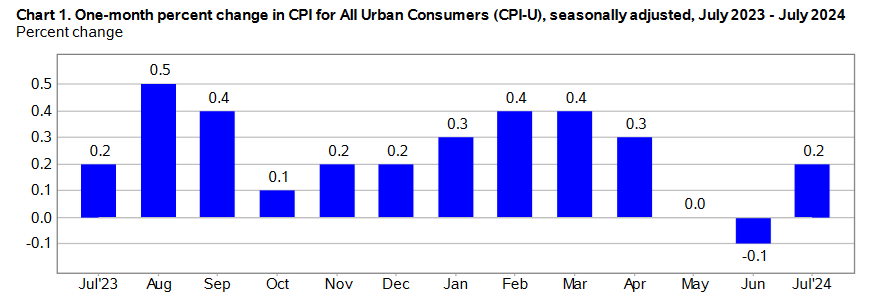
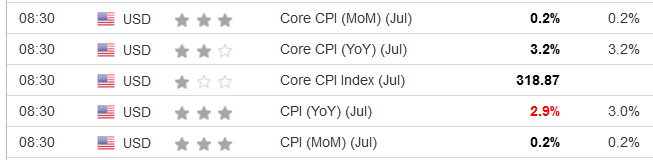
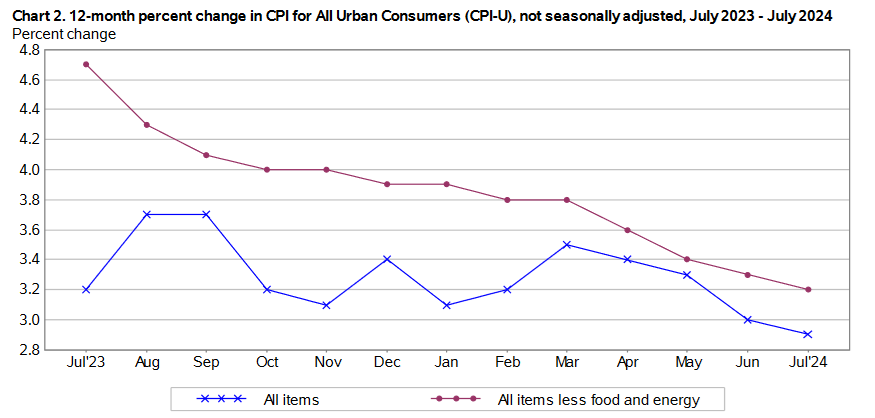
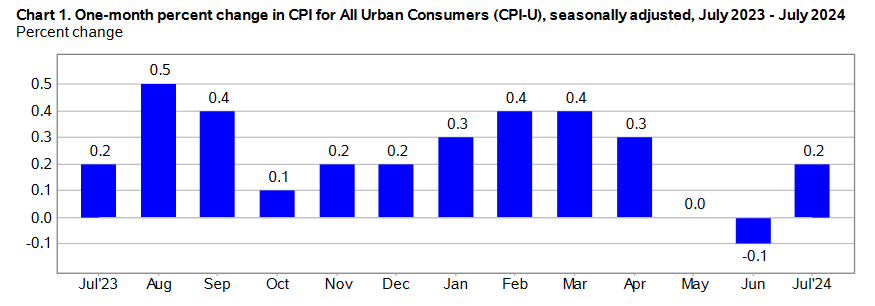
The July 2024 Consumer Price Index of All Urban Consumers (CPI-U) report indicates that inflation increased by 0.2% for the month, a rise from June’s 0.1% decline. These data were released at 8:30 am EST on Wednesday, August 14, 2024, by the Bureau of Labor Statistics. Before seasonal adjustment, the year-over-year (Y-o-Y) inflation rate in the all-items index grew by 2.9%, decelerating from June’s 3.0% Y-o-Y CPI print.
Doing little to derail the chances of future rate cuts, most of the CPI metrics matched economists’ consensus estimates. The table below is courtesy of Investing.com. The left column represents July’s figures, while the right column represents forecasters’ expectations. As you can see, the Y-o-Y CPI (marked in red) was weaker than expected, while the others (marked in black) met expectations.
To that point, while Fed Chairman Jerome Powell said on Jul. 31 that “we’re not quite at that point” where a lower overnight lending rate is justified, he added, “We’re getting closer to the point at which it’ll be appropriate to reduce our policy rate.”
Moreover, the FOMC’s latest Monetary Policy Statement noted that “The Committee judges that the risks to achieving its employment and inflation goals continue to move into better balance.” In other words, the FOMC has become more attentive to a slowing U.S. labor market, which may pave the way for less emphasis on inflation and foster monetary easing.
Global markets had a mixed response to the CPI release, with American and European indices largely remaining range-bound. Likewise, Treasury bonds, precious metals, and the U.S. dollar had mostly small reactions since the as-expected CPI data wasn’t much of a surprise.
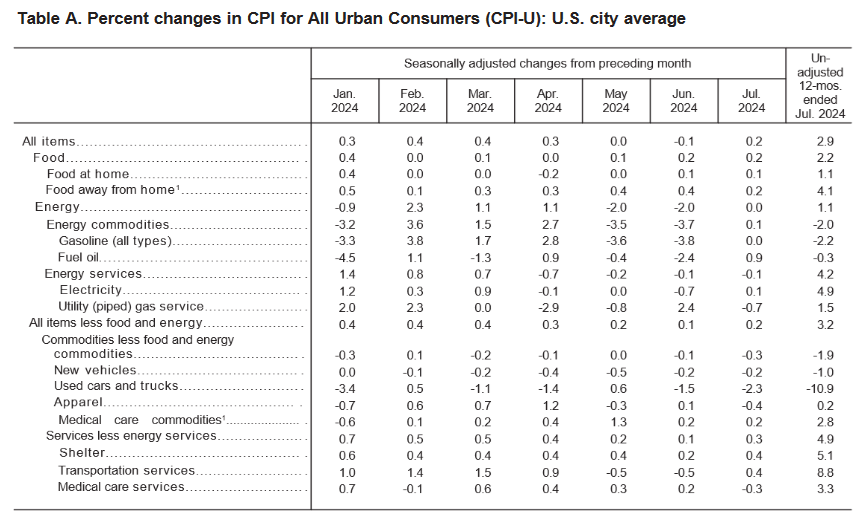
July’s headline inflation deceleration was driven by lower used cars and trucks prices (-2.3%), utility gas (-0.7%), and apparel (-0.4%). Core inflation (which excludes the impacts of food and energy), rose 0.2% in July, a small increase from June’s 0.1% rise. The shelter index rose 0.4% and accounted for nearly 90% of the headline CPI’s rise.
Food Prices
The food index increased by 0.2% in July, matching the 0.2% print from June. Three of the six major grocery store food indexes showcased inflation, while three realized deflation.
- Cereals and bakery products (-0.5%)
- Meats, poultry, fish, and eggs (+0.7%)
- Dairy and related products (-0.2%)
- Fruits and vegetables (+0.8%)
- Nonalcoholic beverages (+0.5%)
- Other food at home (-0.5%)
In addition, the food away from home index rose by 0.2% in July, a noticeable slowdown from the 0.4% recorded in May and June. Consequently, restaurants pared back some of their pricing practices this month.
Energy Prices
The energy index was flat in July after falling 2.0% in June. Electricity and fuel oil prices rose by 0.1% and 0.9%, respectively, while natural gas prices fell by 0.7%. Gasoline prices were also flat in July on a seasonally adjusted basis and up by 0.8% excluding adjustments.
Core CPI July 2024
The July core CPI rose by 0.2% month-over-month, which is within the Fed’s range of expectations. On a Y-o-Y basis, the metric rose 3.2%. Below is an itemized breakdown of the main price fluctuations seen in the core CPI reading:
- Shelter index: (+0.4%) [June: +0.2%]
- Rent index: (+0.5%) [June: +0.3%]
- Owners’ equivalent rent: (+0.4%) [June: +0.3%]
- Motor vehicle insurance: (+1.2%) [June: +0.9%]
- Medical care services: (-0.3%) [June: +0.2%]
- Physician services: (+0.1%) [June: +0.1%]
- Hospital services: (-1.1%) [June: +0.1%]
- Airline fares: (-1.6%) [June: -5.0%]
Seasonally Unadjusted CPI Data for July 2024
Before seasonal adjustments, the CPI-U for July 2024 increased (+2.9%) Y-o-Y, rising to an index level of 314.540. Since these figures are unadjusted, they include regular seasonal price fluctuations that can create volatility in the results.
Growth Concerns Overshadow Inflation?
Because price stability is only one-half of the Fed’s dual mandate, investors always worry that too much emphasis on inflation could slow economic growth and derail the other half of the dual mandate — maximum employment.
As a result, while the financial markets have stabilized in recent days, last week’s ‘flash crash’ and calls for emergency rate cuts highlight the anxiety that occurs alongside rate-cutting cycles. Historically, rate cuts have sometimes preceded recessions, so investors are looking for clues that a hard landing can be avoided. Thus, weaker data is good for financial assets as long as it’s not too weak.
Consequently, 2024 winners like Bitcoin and Ethereum have suffered recently, as have U.S. stocks. And while silver has fallen below the important $30 level, gold has largely maintained its strength. Therefore, the yellow metal has shown an ability to perform during good and bad periods throughout 2024.
Are you thinking about diversifying into precious metals? Talk to your financial advisor about initiating a gold IRA account today, allowing you to invest in this red-hot asset on a tax-advantaged basis. Additionally, our complimentary CPI inflation calculator remains at your disposal, enabling you to assess inflation’s impact on your finances. Remember, seek the guidance of a financial advisor before making any investment decision.
by Alex Demolitor | Jul 11, 2024 | CPI
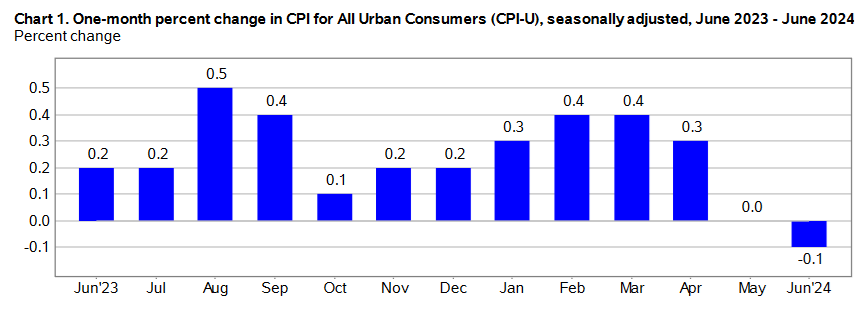
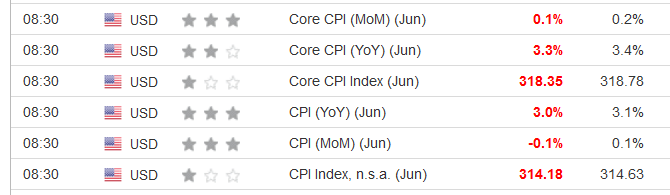
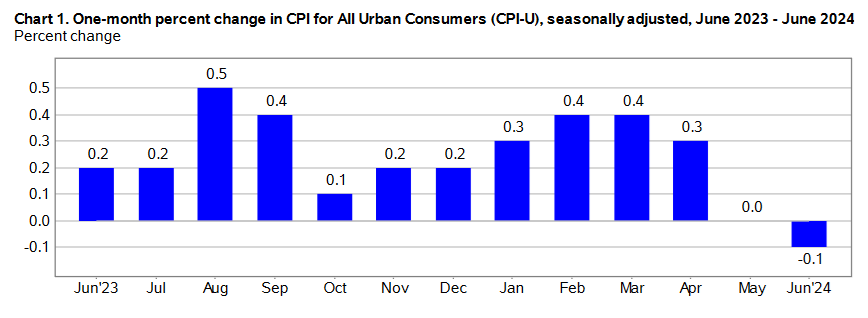
The June 2024 Consumer Price Index of All Urban Consumers (CPI-U) report indicates that inflation declined by 0.1% for the month, a slight drop from May’s flat print (+0.0%). These data were released at 8:30 am EST on Thursday, July 11, 2024, by the Bureau of Labor Statistics. Before seasonal adjustment, the year-over-year (Y-o-Y) inflation rate in the all-items index grew by 3.0%, which is also a drop from May’s 3.3% Y-o-Y CPI reading.
Increasing the chances of a rate cut in the months ahead, the headline and core CPIs came in below economists’ consensus estimates. The table below is courtesy of Investing.com. The left column represents June’s figures, while the right column represents forecasters’ expectations. As you can see, the monthly and Y-o-Y CPIs (marked in red) were weaker than expected.
Yet, while U.S. Federal Reserve Chairman Jerome Powell said on Jul. 10 that “I do have some confidence” that inflation will return to 2%, he cautioned, “I am not ready to say” rate cuts are necessary. “There is a path to getting back to full price stability while keeping the unemployment rate low,” Powell added. “We’re on it. We’re very focused on staying on that path.”
Furthermore, with the U.S. presidential election scheduled for November, he reiterated, “Our undertaking is to make decisions when and as they need to be made, based on the data, the incoming data, the evolving outlook, and the balance of risks, and not in consideration of other factors, and that would include political factors.”
Thus, while Powell has to weigh several variables, June’s weak CPI print should have him feeling more confident about the FOMC’s projections.
Global markets had a mixed response to the CPI slowdown, with American and European indices gyrating, while Treasury bonds and precious metals rallied and the U.S. dollar slumped. Rate cuts by the Fed could help turn the tide for the CAD, which has underperformed the USD in recent months.
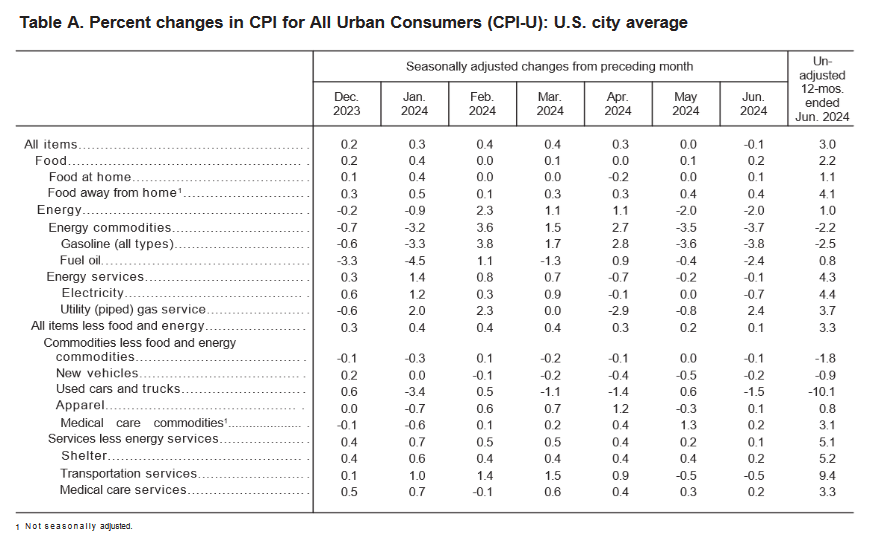
June’s headline inflation deceleration was driven by lower gasoline prices (-3.8%), used cars and trucks (-1.5%), electricity (-0.7%), and transportation services (-0.5%). Core inflation (which excludes the impacts of food and energy), rose 0.1% in June, the weakest monthly reading since August 2021. The shelter index rose 0.2%, with rents up 0.3%. Both were also the smallest increases since August 2021.
Source: Bureau of Labor Statistics
Food Prices
The food index increased by 0.2% in June after rising 0.1% in May. Tomatoes fell by 3.3%, breakfast cereal by 2.0%, while pork chops were up 3.1% and eggs up 3.5%. Four of the six major grocery store food indexes showcased inflation, while two realized deflation.
- Cereals and bakery products (-0.1%)
- Meats, poultry, fish, and eggs (+0.2%)
- Dairy and related products (+0.6%)
- Fruits and vegetables (-0.5%)
- Nonalcoholic beverages (+0.1%)
- Other food at home (+0.5%)
In addition, the food away from home index jumped 0.4% in June matching the results from May. Consequently, restaurants continue to demonstrate resilient pricing power.
Energy Prices
The energy index dropped 2.0% in June, on par with the 2.0% drop in May. Gasoline, electricity, and fuel oil prices fell by 3.8%, 0.7%, and 2.4%, respectively, while natural gas prices rose by 2.4%
Core CPI June 2024
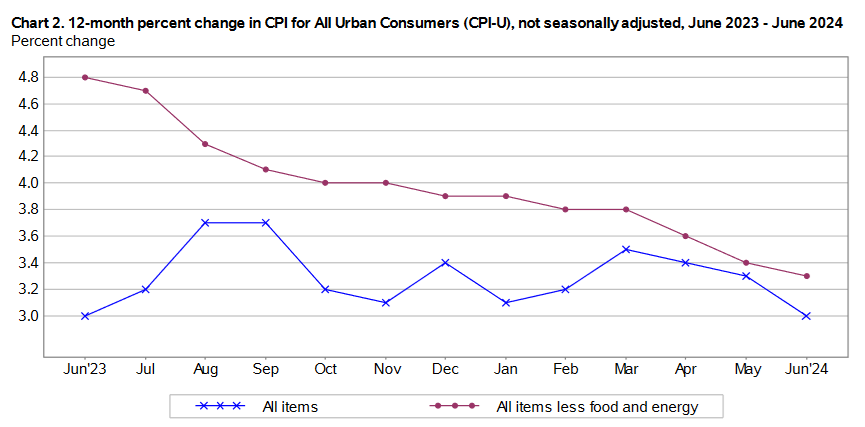
The June core CPI rose by 0.1% month-over-month, the lowest monthly print in 2024. On a Y-o-Y basis, the metric rose 3.3%. Below is an itemized breakdown of the main price fluctuations seen in the core CPI reading:
- Shelter index: (+0.2%) [May: +0.4%]
- Rent index: (+0.3%) [May: +0.4%]
- Owners’ equivalent rent: (+0.3%) [May: +0.4%]
- Motor vehicle insurance: (+0.9%) [May: -0.1%]
- Medical care services: (+0.2%) [May: +0.3%]
- Physician services: (+0.1%) [May: +0.0%]
- Hospital services: (+0.1%) [May: +0.5%]
- Airline fares: (-3.6%) [May: -5.0%]
Source: Bureau of Labor Statistics
Seasonally Unadjusted CPI Data for June 2024
Before seasonal adjustments, the CPI-U for June 2024 increased (+3.0%) Y-o-Y, rising to an index level of 314.175. Since these figures are unadjusted, they include regular seasonal price fluctuations that can create volatility in the results.
Source: Bureau of Labor Statistics
Gold and Silver Still Shining Bright
With the CPI slowdown suppressing Treasury yields and weakening the U.S. dollar, gold remains one of the best-performing assets in 2024. Similarly, silver has soared above $30 an ounce, reaching its highest level in more than a decade. Because precious metals futures contracts are priced in USD, a weaker greenback makes it more affordable for foreign investors to purchase the pair. As such, lower Treasury yields, a weaker dollar, and increased rate-cut enthusiasm create a profitable environment for precious metals enthusiasts.
However, the CPI release noted how gasoline prices declined by 3.6% and 3.8% in May and June. And with crude oil prices rising recently, they usually impact gasoline prices with a lag. As a result, the gasoline index should rise in July and temper some of the downward CPI momentum.
All in all, while 2024 winners like gold, silver, Bitcoin, and Ethereum should maintain their strength absent a recession, the same could be said for U.S. stocks. The S&P 500 and NASDAQ have also rallied sharply in 2024, but big tests loom over the next few weeks. With some of the index’s largest constituents — like Apple, Microsoft, and Meta Platforms — reporting earnings soon, investors expect upbeat results.
Are you thinking about diversifying into precious metals? Talk to your financial advisor about initiating a gold IRA account today, allowing you to invest in this red-hot asset on a tax-advantaged basis. Additionally, our complimentary CPI inflation calculator remains at your disposal, enabling you to assess inflation’s impact on your finances. Remember, seek the guidance of a financial advisor before making any investment decision.
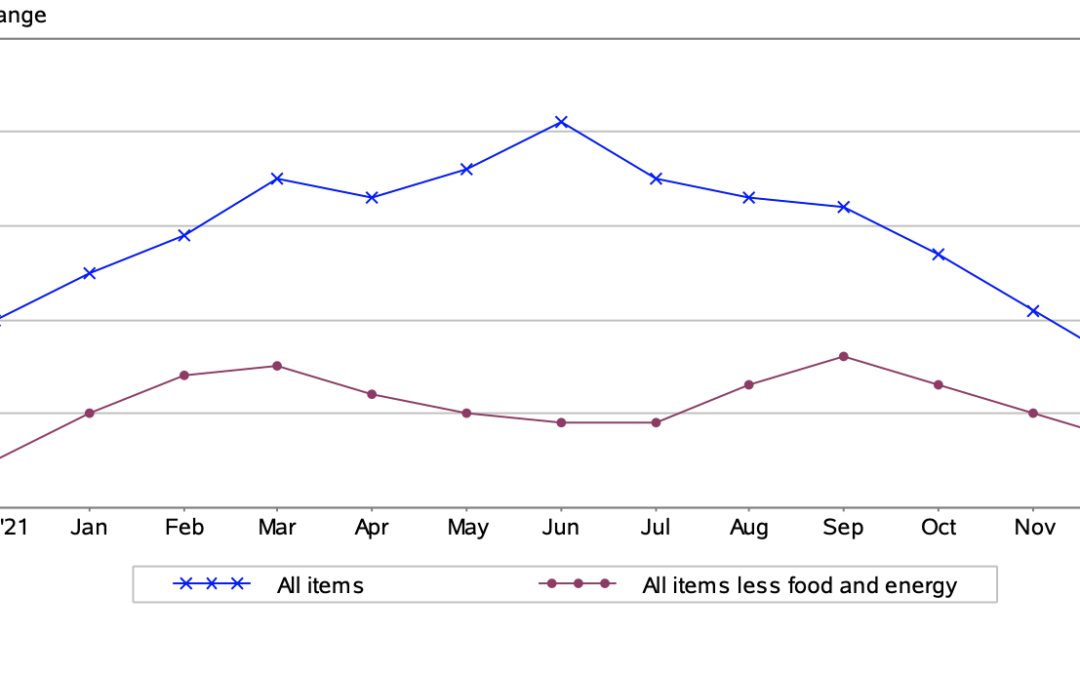
by Sarah Bauder | Jan 12, 2023 | CPI
The Consumer Price Index for All Urban Consumers (CPI-U) decreased by 0.1% on a seasonally adjusted basis, reported the Bureau of Labor Statistics. Year-over-year, before seasonal adjustment the all items index grew by 6.5%.
The primary contributing variable to the deceleration in inflation was the drop in the price of gasoline. The price of foodstuffs at grocery stores increased, as did shelter costs, albeit at a slower pace.
Despite the fact that inflation in the United States appears to be slowing down, the Federal Reserve has indicated that more interest rate hikes will transpire into 2023 to curtail the soaring cost of living.
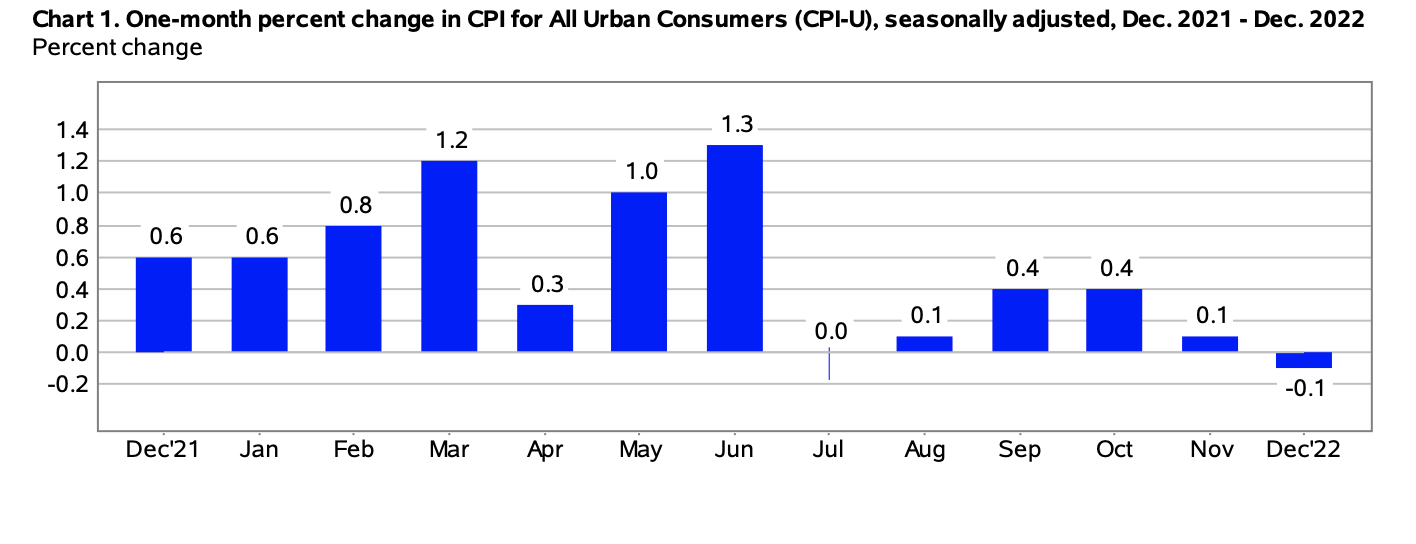
(Source: U.S. Bureau of Labor Statistics)
Food
In December, the index for food rose by 0.3%, after a 0.5% increase from the previous month. Over the last 12-month span, American consumers have paid 11.8% more for food items from grocery stores.
Grocery items that saw price increases in December included meats, poultry, fish, and eggs. Conversely, the prices for fresh fruits and vegetables and bakery products declined. Moreover, American consumers paid more to dine out in restaurants in December.
Gasoline Prices
In December, American consumers again paid less to gas up their vehicles. The price of gasoline dropped by 9.4% over the month, after the 2% decrease seen in November.
In December, prior to seasonal adjustment, the price of gasoline declined 12.5%.
Since this time last year, gasoline prices have decreased by 1.5%.
Energy
In December, the index for energy dropped 4.5%. This was primarily due to the decline in gasoline prices. However, American consumers paid 3% more for natural gas and 1% more for electricity over the month.
Year-over-year, the index for energy grew by 7.3%. Since this time last year, fuel oil prices surged by 41.5%. Likewise, American consumers paid 19.3% more for natural gas and 14.3% more for electricity over the last 12-month period.
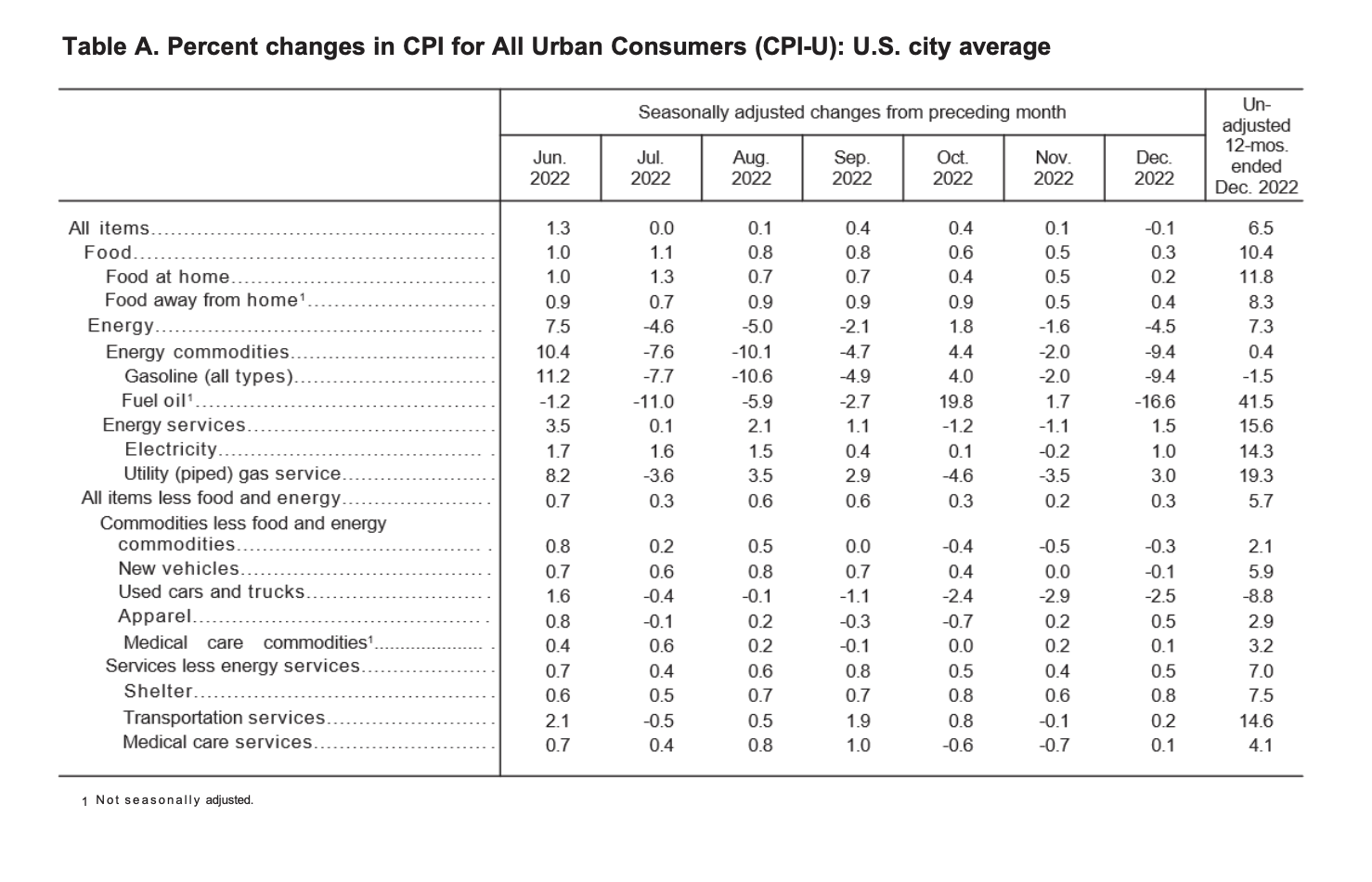
(Source: U.S. Bureau of Labor Statistics)
All Items Less Food and Energy
In December, the all items less food and energy index edged up 0.3%. Unfortunately, American consumers continued to pay more shelter costs. The index for shelter rose 0.8% over the month.
Both the index for rent and the index for owners’ equivalent rent (which is correlated to the value of housing prices) increased by 0.8%, respectively.
“The shelter index was the dominant factor in the monthly increase in the index for all items less food and energy, while other components were a mix of increases and declines,” explained the Bureau of Labor Statistics in its monthly report.
Over the last 12-month period, the composite index for shelter increased by 7.5% – the most significant contributor to the overall percentage increase of the all items less food and energy index.
Other composite indexes that saw percentage increases since this time last year include furnishings and operations (+6.7%), new vehicles (+5.9%), recreation (+5.1%), and medical care (+4.0%).
Year-over-year, the all items less food and energy index increased by 5.7%.
Want to learn more about how inflation is impacting the economy? Have a look at our table highlighting information regarding the 2022 CPI and Inflation Rate for the United States, try our calculator widget, and subscribe to our newsletter.
Source Cited: https://www.bls.gov/news.release/cpi.nr0.htm
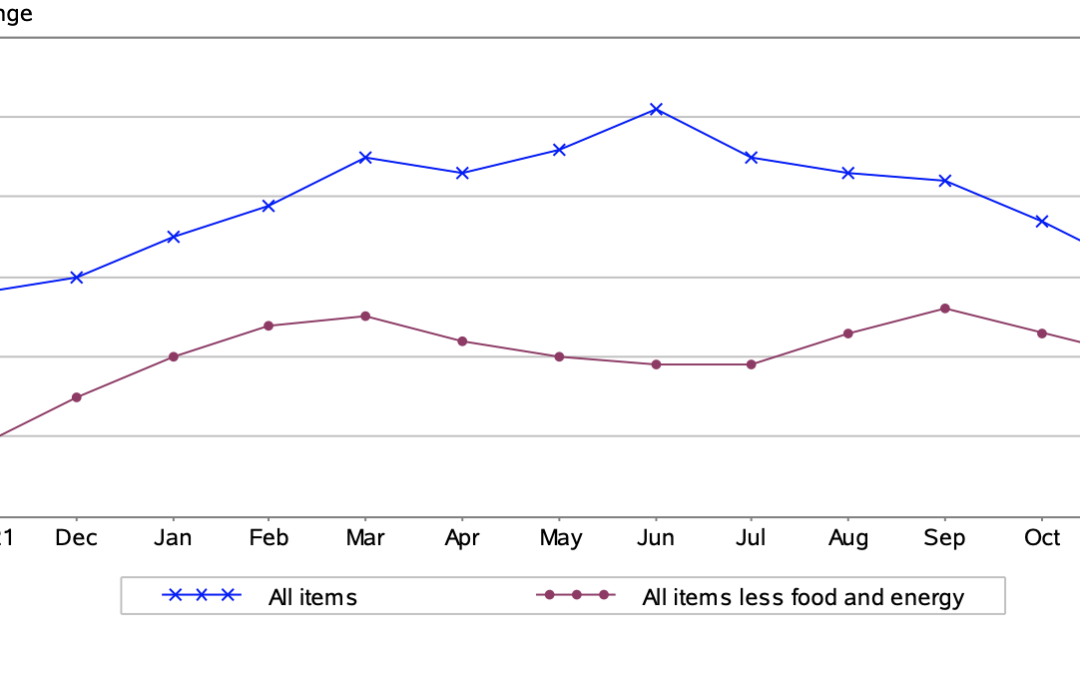
by Sarah Bauder | Dec 13, 2022 | CPI
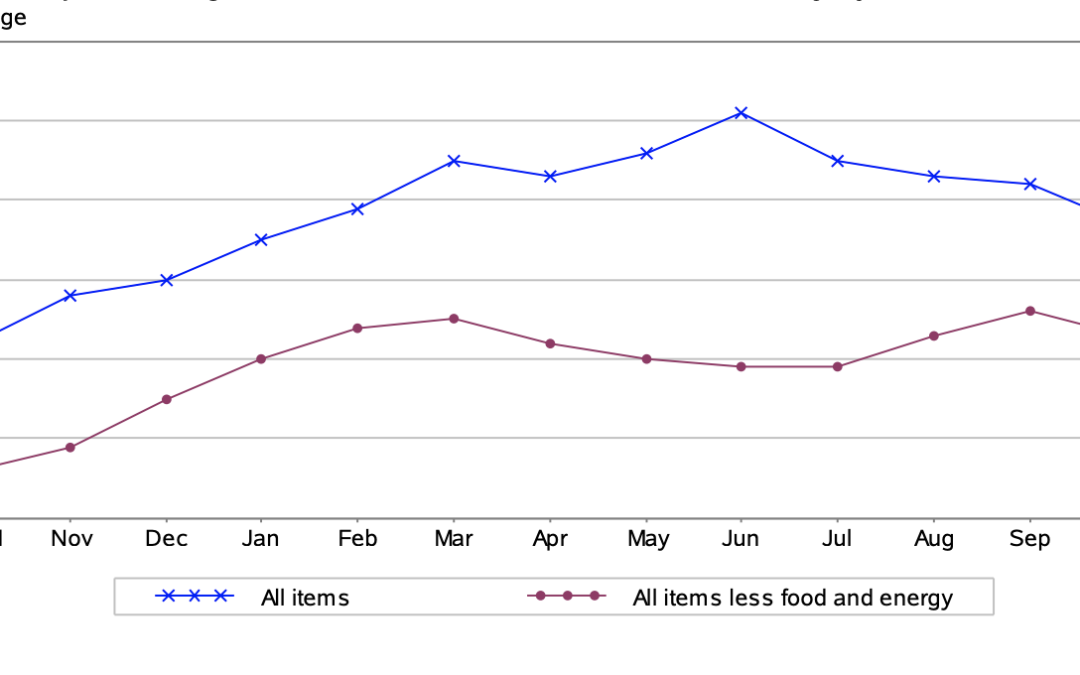
The Consumer Price Index for All Urban Consumers (CPI-U) rose by 0.1% on a seasonally adjusted basis in November, reported the U.S. Bureau of Labor Statistics. Year-over-year, prior to seasonal adjustment the all items index rose 7.1%.
The primary factor for the percentage increase seen in November was the rise in the shelter index. In addition, the cost of foodstuffs at grocery stores increased, while energy costs declined over the month.
“The index for shelter was by far the largest contributor to the monthly all items increase, more than offsetting decreases in energy indexes,” explained the Bureau of Labor Statistics in its monthly report.
For American consumers, this means that they paid more for shelter costs and foodstuffs at grocery stores. Despite the fact that inflation decelerated in November, many Americans are finding it challenging to meet their daily needs.
In November, based on the data inflation cooled in the United States. For its part, the Fed is expected to slow its interest rate hikes in December.
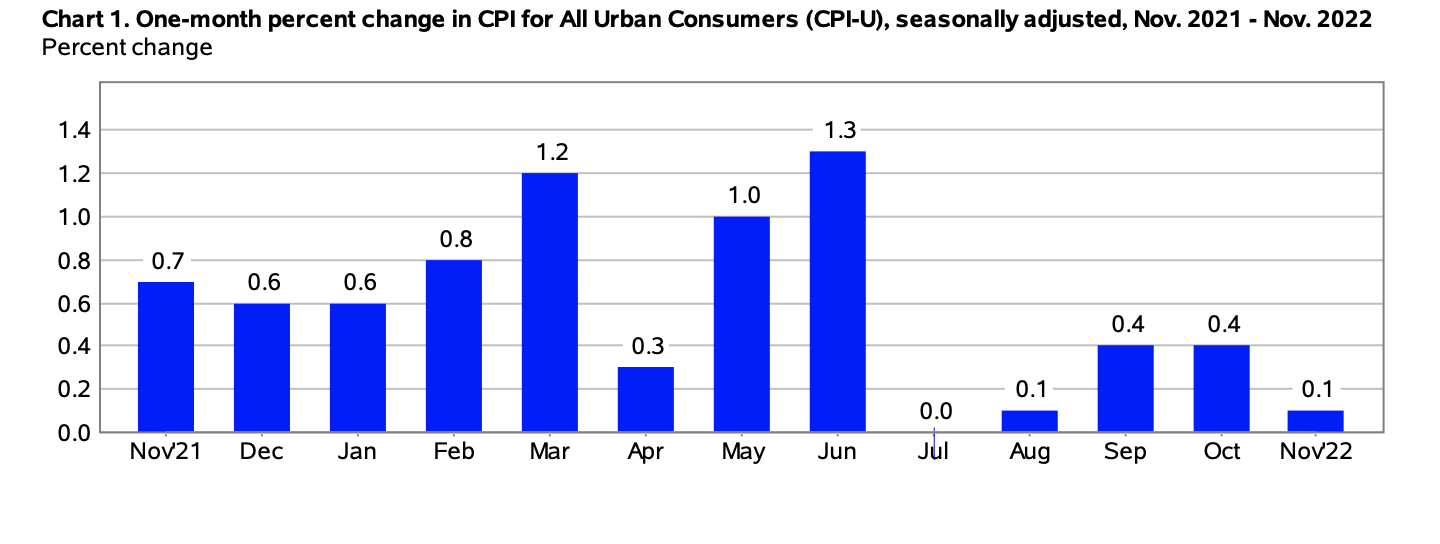
(Source: U.S. Bureau of Labor Statistics)
Food
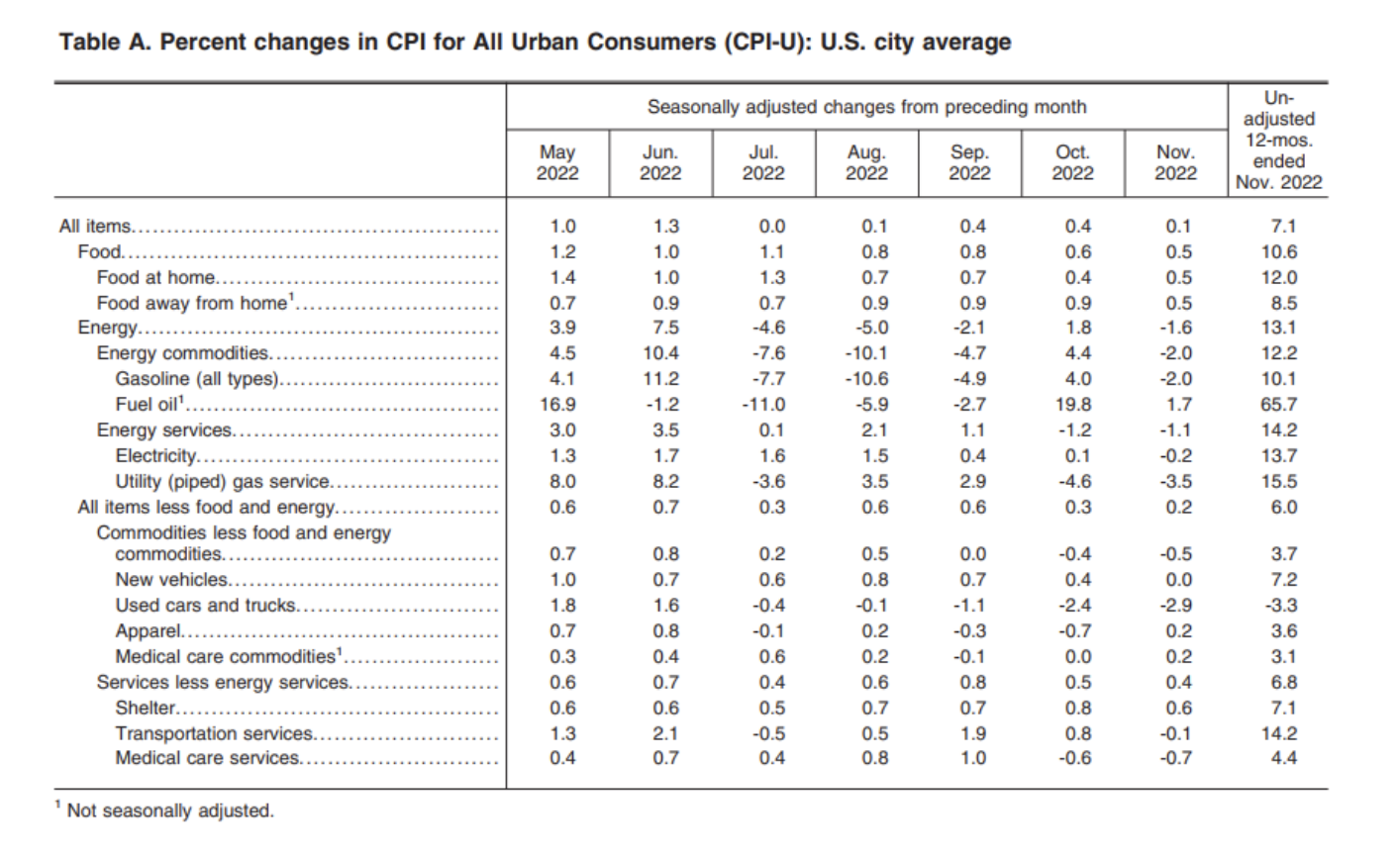
In November, the index for food rose 0.5%. Moreover, foodstuffs purchased from a grocery store (the food at home index) increased 0.5% over the month. Over the last 12-month period, American consumers paid 12% more for food from grocery stores.
Grocery items that were the main contributors to the overall rise in the index included fruits and vegetables, cereal products, bakery products, and nonalcoholic beverages. Conversely, the composite index for meats, poultry, fish, and eggs dropped 0.2%, the index for beef fell 0.8%, and the pork index dropped 0.3%, respectively, in November.
The Price of Gasoline
American consumers paid less for gasoline at the pumps over the month. The price of gasoline declined by 2% in November, after the 4% rise seen the previous month.
In November, prior to seasonal adjustment, the price of gasoline dropped 3.6%.
Year-over-year, the price of gasoline has risen by 10.1%.
(Source: U.S. Bureau of Labor Statistics)
Energy
In November, the index for energy declined 1.6%, largely because of the decrease in the respective prices of gasoline, natural gas, and electricity.
American consumers paid 3.5% less for natural gas, and 0.2% less for electricity over the month.
Since this time last year, the index for energy grew by 13.1%. Year-over-year, the price of fuel oil skyrocketed an astounding 65.7%. In addition, American consumers paid 15.5% more for natural gas and 13.7% more for electricity since this time last year.
All Items Less Food and Energy
In November, the all items less food and energy index edged up 0.2%. Americans continued to pay more shelter themselves, as the index rose 0.6% over the month.
Furthermore, rent prices also increased by 0.8%, and the index for owners’ equivalent rent, which is correlated to the value of housing prices, rose 0.7% over the month.
The US Bureau of Labor Statistics noted that the index for shelter was the primary factor for the monthly rise in the percentage of the all items less food and energy index.
Year-over-year, the all items less food and energy index increased by 6%. Over the last 12-month span, the composite index for shelter rose 7.1%. Additionally, the index for medical care grew by 4.2% and new vehicles cost American consumers 7.2% more since thos time last year.
Want to learn more about how inflation is impacting the economy? Here is our table highlighting the 2022 CPI and Inflation Rate for the United States, try our U.S. inflation calculator, and subscribe to our newsletter.
Source Cited: https://www.bls.gov/news.release/archives/cpi_12132022.htm
by Sarah Bauder | Nov 10, 2022 | CPI
The Consumer Price Index for All Urban Consumers (CPI-U) edged up by 0.4% on a seasonally adjusted basis in October, reported the U.S. Bureau of Labor Statistics. This is the identical percentage increase seen in September. Year-over-year, prior to seasonal adjustment the all items index rose by 7.7%.
The primary contributors to the percentage rise seen in October were a rise in shelter costs, food, and the price of gasoline.
“The index for shelter contributed over half of the monthly all items increase, with the indexes for gasoline and food also increasing,” explained the Bureau of Labor Statistics in its monthly report.
For American consumers, this means they paid more for shelter costs, and food items at grocery stores, in addition to paying more at the gas pumps. Ultimately, this denotes that many Americans are still contending with meeting basic daily needs.
Despite the fact that core inflation decelerated in October, nonetheless, the Federal Reserve increased interest rates to their highest levels since 2008.
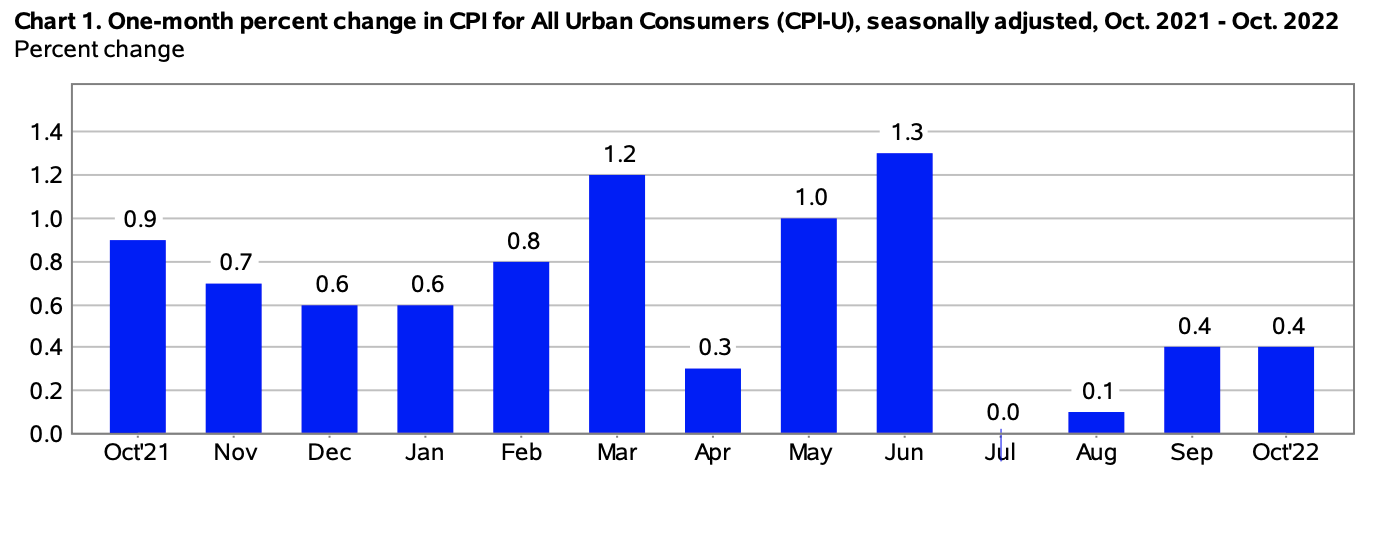
(Source: U.S. Bureau of Labor Statistics)
Food
In October, the index for food rose 0.6%. The index for food at home, which indicates foodstuffs at grocery stores increased by 0.4%. It should be noted that this marks the lowest monthly percentage increase seen since December 2021.
Since this time last year, American consumers have paid more for food items bought at grocery stores, as the index for food at home increased by 12.4%. Year-over-year, grocery items that were the main contributors to the overall increase in the index included cereals and bakery products, dairy and related products, in addition to meats, poultry, fish, and eggs.
Gas Prices
American consumers paid more at the gas pumps in October. Gas prices increased by 4% in October, after consumers enjoyed a bit of respite with lower prices for gasoline seen over the previous three months.
In October, prior to seasonal adjustment, the price of gasoline increased by 3.1%.
Over the last 12-month period, the price of gasoline rose by 17.5%.
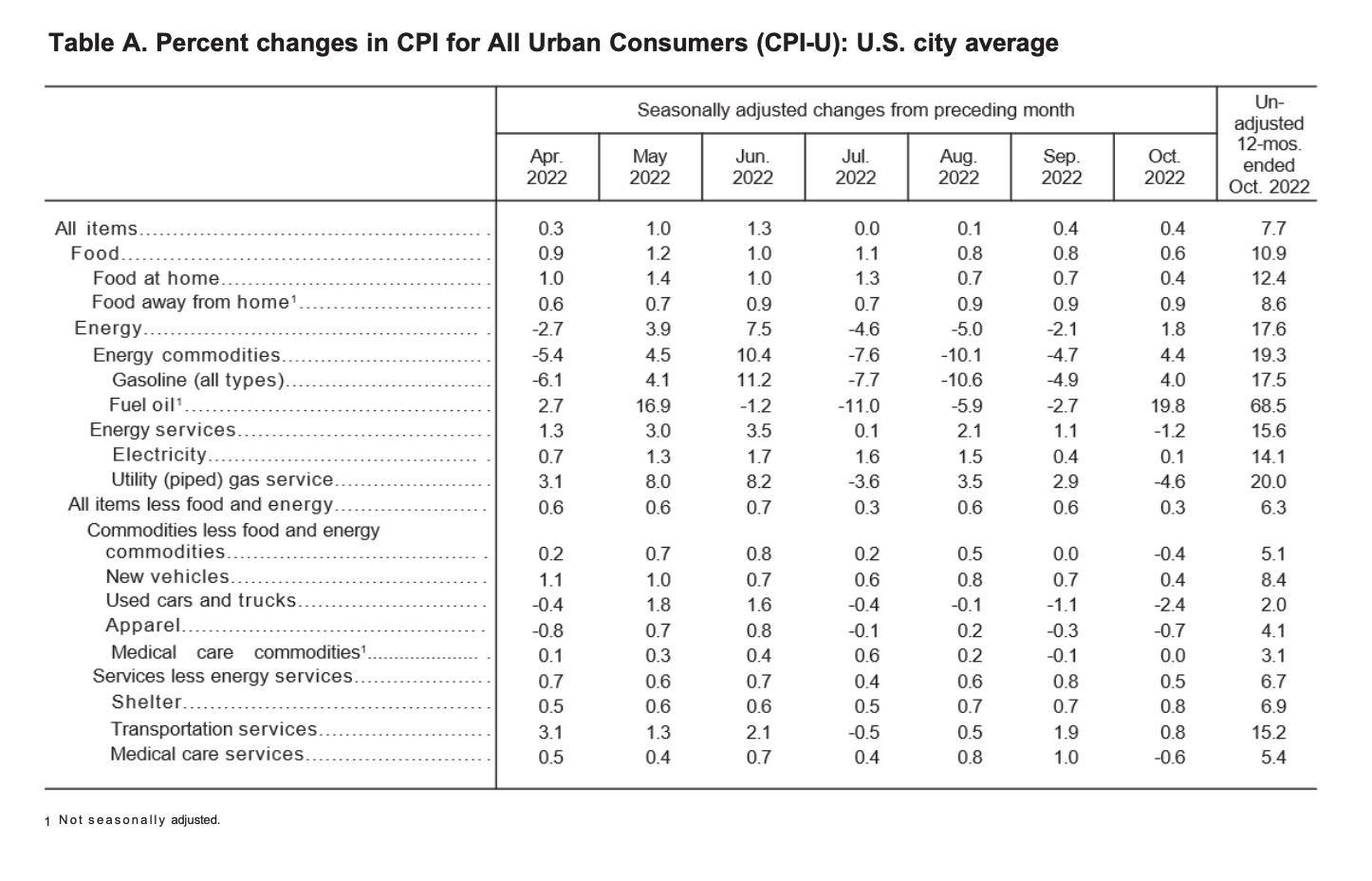
(Source: U.S. Bureau of Labor Statistics)
All Items Less Food and Energy
In October, the all items less food and energy index increased 0.3%. American consumers continued to pay more for shelter, as the index grew 0.8% over the month. It should be noted that this is the largest monthly rise in shelter costs since August 1990.
Furthermore, rent prices also rose 0.7%, as did the index for owners’ equivalent rent by 0.6%, which is correlated to the value of housing prices.
Conversely, Americans paid less for medical costs in October. The index for medical care dropped 0.5%. Over the month, major medical care composite indexes saw percentage declines. The hospital services index fell 0.2%, and the price of prescription drugs dropped 0.1%.
Year-over-year, the all items less food and energy index increased by 6.3%. Over the last 12-month span, 6.9%. Likewise, the index for medical care increased by 5% since this time last year.
Want to learn more about how inflation is impacting the economy? Here is our table highlighting the 2022 CPI and Inflation Rate for the United States, try our U.S. inflation calculator, and subscribe to our newsletter.
Source Cited: https://www.bls.gov/news.release/archives/cpi_11102022.htm