
Alex Demolitor
Alex Demolitor is a financial writer and cross-asset analyst who completed the CFA Program, passing all three levels of the CFA exams. He has a Bachelors degree from King's College in Ontario and specializes in the fundamental analysis of stocks, bonds, commodities, and FX, with a focus on U.S. and Canadian economic indicators like CPI and inflation. His market analysis has appeared on major publications such as FXEmpire, Investing.com, and AdvisorPedia.
by Alex Demolitor | Oct 21, 2026 | Debt Relief
If debt problems are mounting and pressure from creditors has become overwhelming, seeking professional help can ease the burden. Instead of forging the difficult path alone, strategizing with experts reduces the economic and psychological strain.
But, is Oak View Law Group the right partner to get you out of debt?
About the Company

- URL: https://www.ovlg.com/
- Phone: 1-800-530-6854
- Email: clientintake@ovlg.com
- Company HQ: Auburn, CA
- Trustpilot Reviews: 4.4/5 stars (15 reviews)
- Google Reviews: 4.4/5 stars (12 reviews)
- Better Business Bureau (BBB) Reviews: 4.7/5 (12 reviews)
Pros and Cons
For a quick breakdown of how Oak View Law Group stacks up, please see the list below:
Pros:
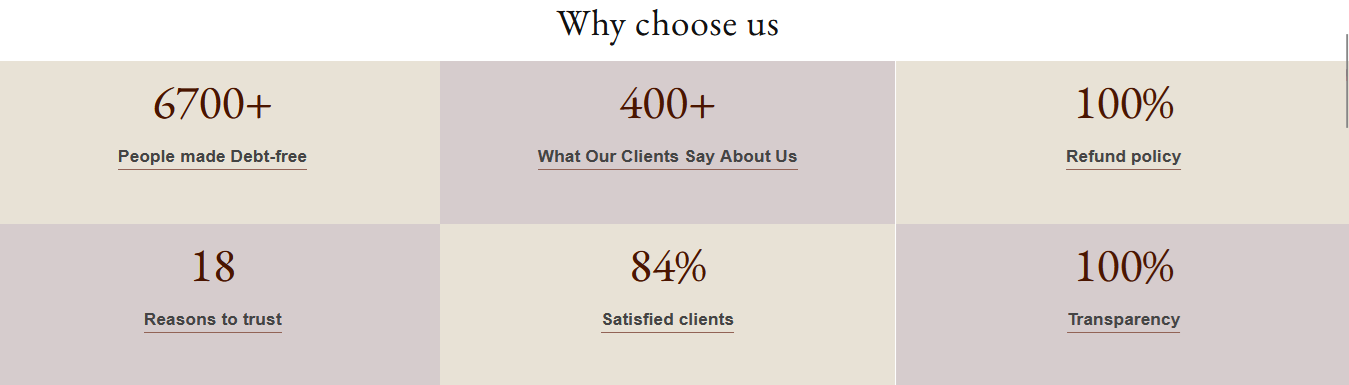
- Has helped more than 6,700 clients become debt-free
- Its team of experts has experience across 15 segments of consumer law
- There is a “No-Questions-Asked Refund Policy”
- Oak View Law Group provides professional guidance and mentorship throughout the debt-relief process
- Oak View Law Group can often settle your debts at 40% to 60% of the outstanding balance
- There are services for auto, medical, and student loan debt
- Highly rated by clients
Cons:
- Fees are federally regulated but can be high in some cases
What is Oak View Law Group?
Helping more than 6,700 clients become debt-free, Oak View Law Group is a consumer law firm headquartered in California. It specializes in debt relief, debt consolidation, and bankruptcy services. The group helps clients save money, avoid lawsuits, and has a team of experts with experience across 15 segments of consumer law. Moreover, Oak View Law Group has a “No-Questions-Asked Refund Policy,” where your fees and trust account balance are reimbursed if you’re unsatisfied with the service.
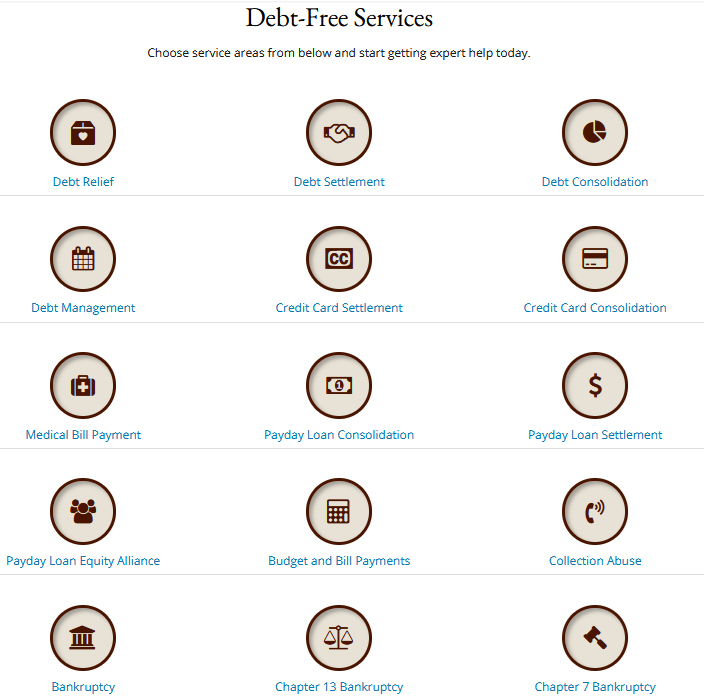
Some of Oak View Law Group’s services include:
- Debt Consolidation
- Debt Settlement
- Chapter 7 Bankruptcy
- Chapter 13 Bankruptcy
- Payday Loan Consolidation
- Payday Loan Settlement
For more insights on the value of these services, the Federal Trade Commission (FTC) has a helpful guide on How To Get Out of Debt.
How Can Oak View Law Group Help Me?
Working with a credit professional is like having an experienced coach to draw up plays on your behalf. And like any sport, it allows for a clearer strategy to achieve the team’s goals.
Oak View Law Group provides professional guidance, mentorship, and develops an effective debt-relief strategy, similar to a dedicated debt relief attorney. We have an in-depth guide on credit counseling services, which can help you determine whether settlement, a repayment plan or bankruptcy is the better route. Some of the differences include:
- You often forfeit more personal assets in bankruptcy
- Bankruptcy has a greater impact on your credit score
- A Chapter 7 bankruptcy stays on your credit report for 10 years from the filing date, and a Chapter 13 for 7 years, while a settlement or repayment plan leaves no bankruptcy record at all
For more on how the options compare in the United States, see our guide to debt relief options in America
Similarly, Oak View Law Group provides parallel guidance to a debt relief attorney. By weighing the pros and cons of several scenarios, its team can help improve your financial health by achieving the following:
- Lower monthly payments and interest charges
- Devise a plan for manageable monthly payments
- Reduce or eliminate late fees
- Reduce or eliminate collection calls
What Is Oak View Law Group’s Settlement Program?
When working with Oak View Law Group, its team handles the day-to-day negotiations with creditors. For example, they manage creditor calls, negotiations, bill payments, and ensure you can enjoy your professional and personal lives with minimal disruption.
How Long Does It Take to Become Debt-Free?
Depending on the amount owed and your excess income, estimates can vary widely. In a nutshell: it often depends on how much funds you want to allocate to debt repayments.
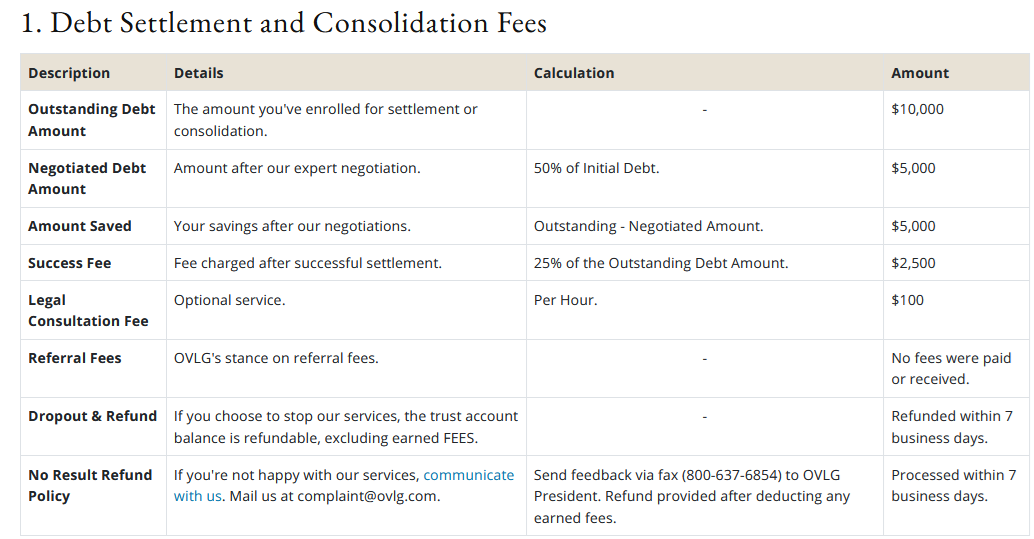
For example, let’s say you have $10,000 in debt and Oak View Law Group negotiates a 50% settlement. You have to pay $5,000 and can choose a lump-sum payment or monthly installments.
The firm notes that “As per the industry trends and our experience, debt can be settled at 40% to 60%, but we always negotiate for the lowest settlement percentage possible to save more for our clients.”
Thus, if you can cut the collection amount in half by working Oak View Law Group, it should greatly enhance the speed at which you become debt-free.
What Does Oak View Law Group Charge In Fees?
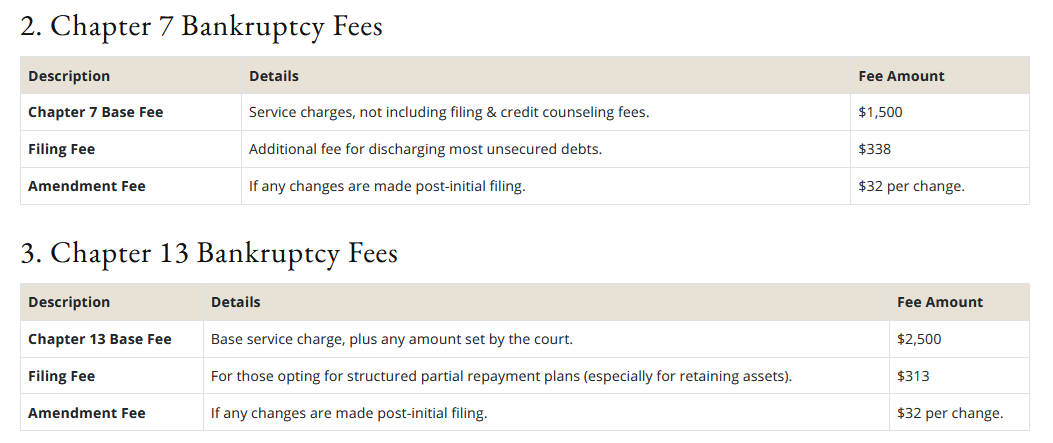
Adhering to FTC guidelines, Oak View Law Group’s fees are outlined in the graphics below:
What Other Services Does Oak View Law Group Provide?
If you’re struggling with auto, medical, or student loan debt, Oak View Law Group can assist in these areas too.
- Regarding auto loans, the firm can help if the vehicle has been repossessed, sold, or is being processed by a third-party collection agency.
- For overdue medical bills, the firm notes that healthcare companies “do not provide settlement offers.” Consequently, Oak View Law Group can only help you negotiate a manageable repayment plan.
- Likewise, student loan companies do not provide settlement plans either, and Oak View Law Group can only help if the account has been transferred to collections.
How Do Clients Rate Oak View Law Group?
While the firm doesn’t have a lot of Google or Trustpilot reviews, the vast majority of clients were satisfied with Oak View Law Group’s services. Many cited efficient settlement procedures and noted how Oak View Law Group provided support and guidance throughout the process. A few of the testimonials read:
- Oak View Law Group was able to settle my huge payday loan debts. The staff were very helpful and understanding. I can’t believe how fast and easy they were able to settle my debt. Much respect to Oak View Law Group. Thank you for getting me out of debt.
- OVLG assisted me in resolving three payday loan debts. Mr Sanchez assured me that all debts would settled by the projected date and I would have access to himself, agents, and my account online. The process went just as planned, he communicated with me every step of the way and was patient to answer all my concerns. I would definitely return as well as recommend OVLG.
- I have worked with OVLG, specifically, Diego, and I cannot say enough good things that he and OVLG have done for me. They have helped me so much and are diligent, professional, and understanding. I am truly amazed at how quickly Diego replies. Great company, great assistance. They truly give you hope.
As a result, not only does Oak View Law Group develop strategies for effective debt relief, but it also shows empathy when dealing with difficult situations.
Are We Believers In Oak View Law Group?
Because client testimonials are the best indicator of distinguished service, Oak View Law Group’s reviews speak for themselves. By providing guidance, mentorship, and working with clients every step of the way, the firm has developed a compassionate reputation.
Moreover, if Oak View Law Group can negotiate debt settlements at 40% to 60% of the outstanding balance, the cost savings can greatly outweigh the service fees. On top of that, the “No-Questions-Asked Refund Policy” adds further credibility and reduces your risk if you’re unhappy with the process.
All in all, there is a lot to like about Oak View Law Group, and if your debts have become unmanageable, it may be the right firm for you.
If you want to learn more, visit: https://www.ovlg.com/
by Alex Demolitor | Oct 14, 2026 | Definitions
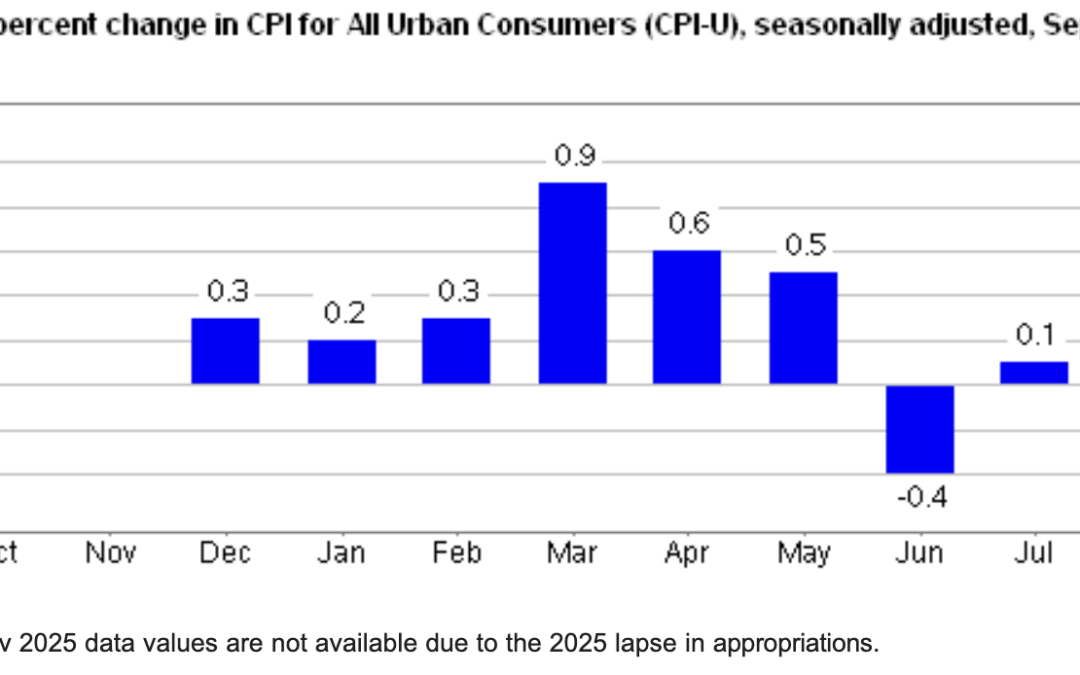
The September 2026 Consumer Price Index of All Urban Consumers (CPI-U) report indicates that inflation rose by 0.6% this month, up from a 0.4% jump in August. These data were released at 8:30 am EST on October 14, 2026, by the Bureau of Labor Statistics (BLS). Before seasonal adjustment, the year-over-year (Y-o-Y) inflation rate in the all-items index grew by 3.7%, above the 3.4% increase from August.
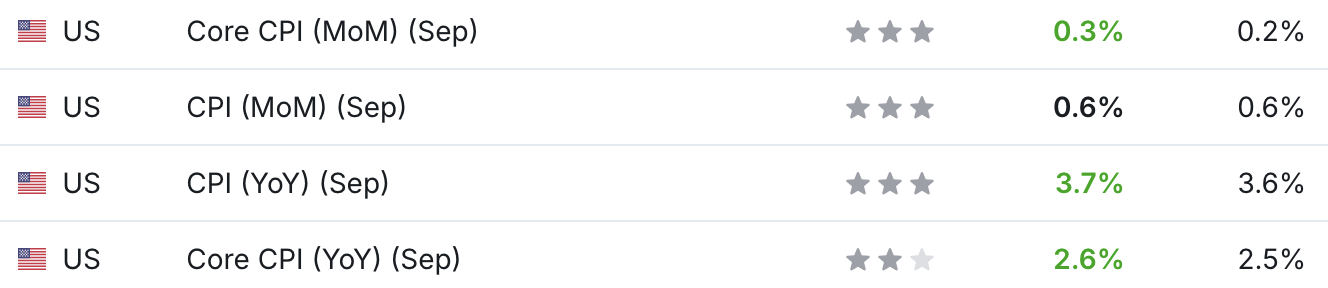
This month’s results surpassed economists’ consensus estimates. The table below is courtesy of Investing.com. The left column represents September’s figures, while the right column represents forecasters’ expectations. As you can see, both CPIs were slightly hotter than anticipated.
Moreover, with the US-Iran war still unresolved, and inflation concerns festering, Cleveland Federal Reserve president Beth Hammack said on October 12 that “I see inflation pressures as relatively broad-based rather than concentrated in one component. And it’s not just the supply side. Demand-side pressures coming from the AI build-out are raising prices. Because of the breadth of inflationary pressures, my baseline forecast is that it will take some time for inflation to return to 2%, even with appropriate monetary policy.”
As such, while she advocated for higher interest rates, the committee will have to decide as a group whether or notmore hikes are needed in the months ahead.
Food Prices
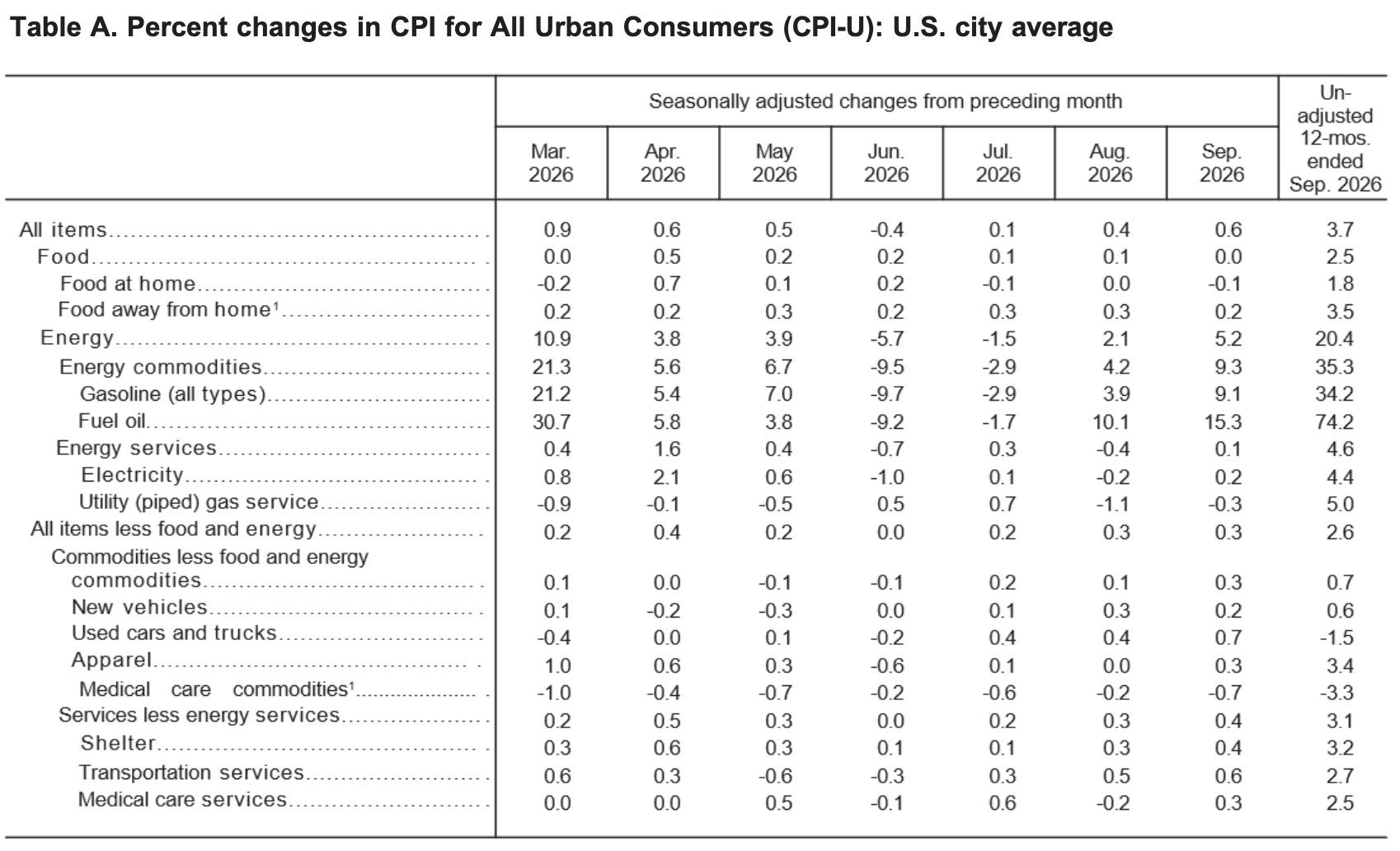
The food index was flat in September after increasing by 0.1% in August. Three of the major grocery indices recorded deflation, while three increased.
- Cereals and bakery products (+0.1%)
- Meats, poultry, fish, and eggs (-0.5%)
- Dairy and related products (-0.9%)
- Fruits and vegetables (+0.5%)
- Nonalcoholic beverages (+0.9%)
- Other food at home (-0.2%)
In addition, the food away from home index increased by 0.2%, as restaurant inflation surpassed grocery inflation once again in September.
Energy Prices
The energy index rose by 5.2% MoM in September, well above the 2.1% increase from August. Gasoline prices jumped by 9.1%, while electricity rose by 0.2%, and natural gas fell by 0.3%.
Core CPI
The September core CPI rose by 2.6% Y-o-Y, up from 2.4% in August. Below is an itemized breakdown of the various components:
- Shelter index: (+0.4%) [August: +0.3%]
- Rent index: (+0.2%) [August: +0.2%]
- Owners’ equivalent rent: (+0.3%) [August: +0.2%]
- Motor vehicle insurance: (+0.1%) [August: -0.8%]
- Medical care services: (+0.3%) [August: -0.2%]
- Physician services: (+0.0%) [August: +0.0%]
- Hospital services: (+0.7%) [August: +0.0%]
- Airline fares: (+1.2%) [August: +2.7%]
Seasonally Unadjusted CPI
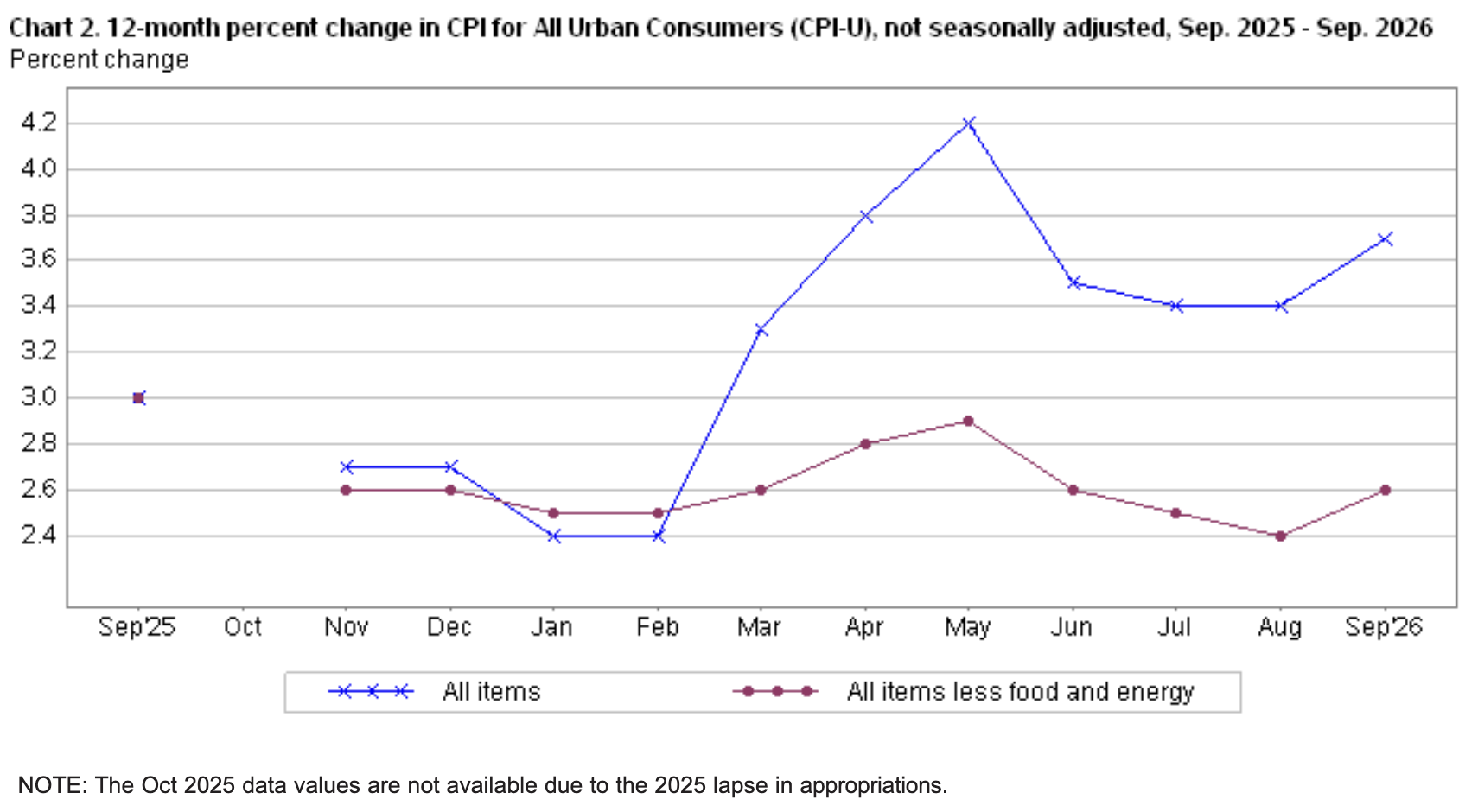
Before seasonal adjustments, the CPI-U for September 2026 increased by 3.7% Y-o-Y to an index level of 336.940. Since these figures are unadjusted, they include regular seasonal price fluctuations that can create volatility in the results.
More Tough Choices
After raising interest rates at the last monetary policy meeting, the Fed confronts a bond market that’s pricing in more restrictive policy. And while arguments can be made for, or against, further increases in the overnight lending rate, recent economic data paints a mixed picture.
For example, US nonfarm payrolls missed expectations on October 2, and average hourly earnings (wage inflation) also materially underperformed. Consequently, the labor market does not seem to be a source of inflation, which helped ignite the spiral in 2021-2022.
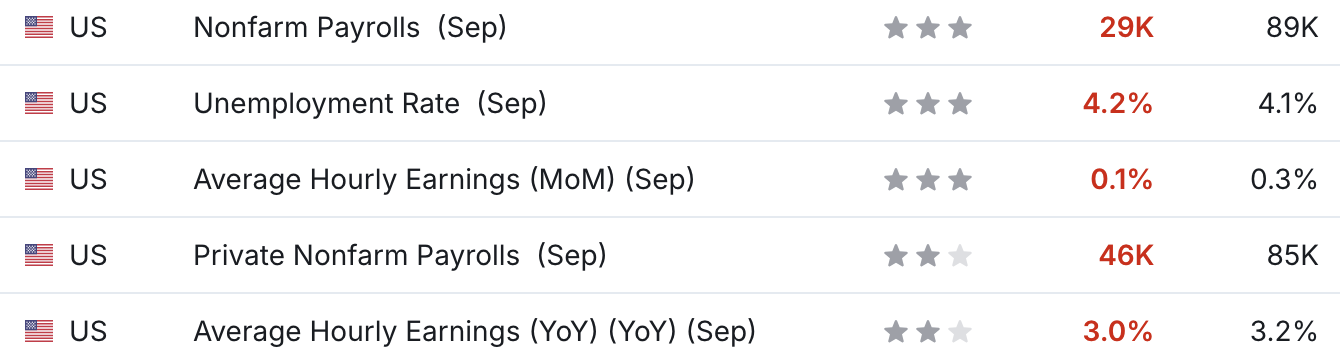
To that point, the BLS added in the October 2 release:
“The change in total nonfarm payroll employment for July was revised down by 31,000, from +21,000 to -10,000, and the change for August was revised down by 29,000, from +162,000 to +133,000. With these revisions, employment in July and August combined is 60,000 lower than previously reported.”
So, while inflation remains the primary concern, the other half of the Fed’s dual mandate could come under pressure as interest rates rise.
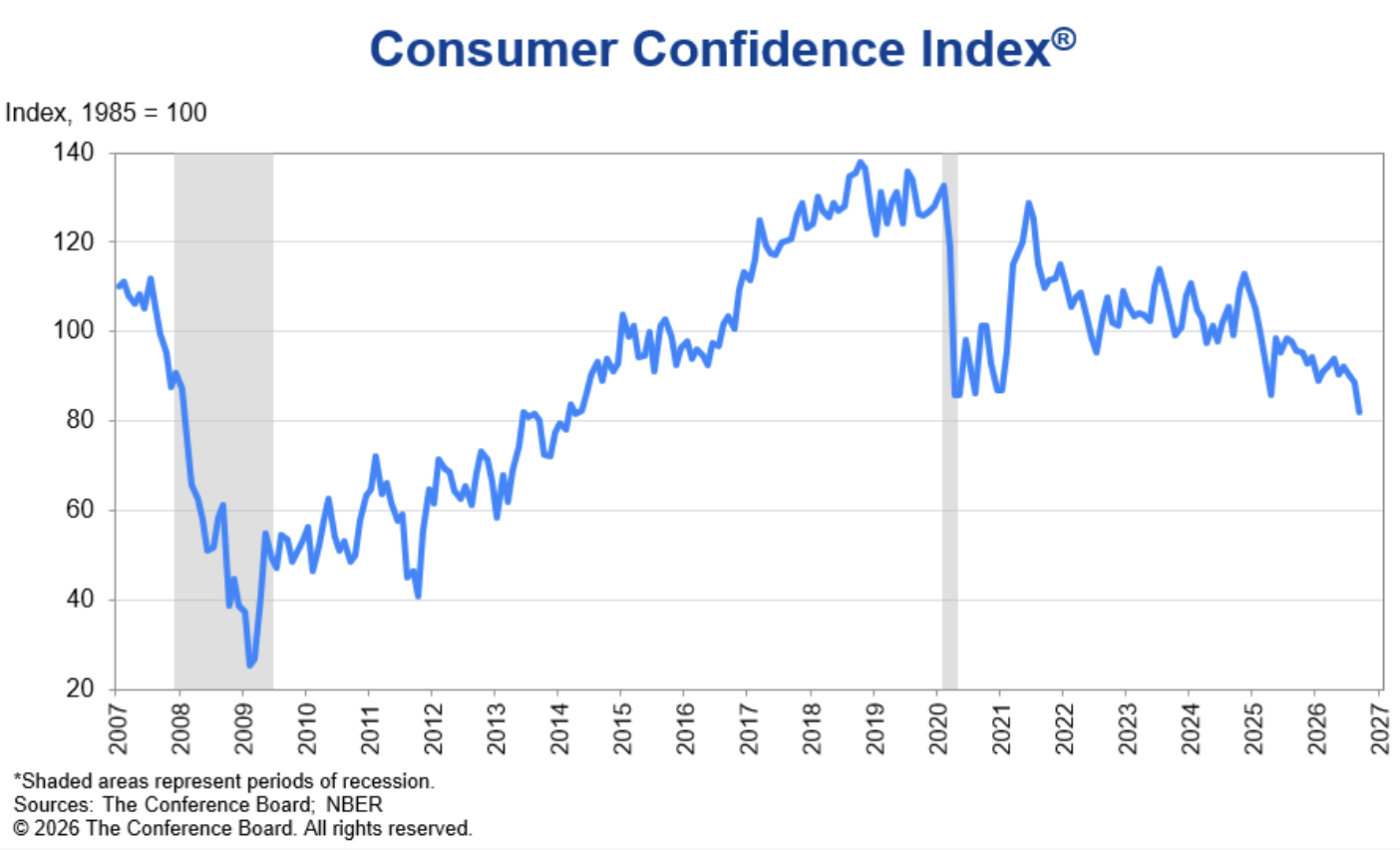
Similarly, The Conference Board released its US Consumer Confidence Index on September 29. An excerpt read:
“The Consumer Confidence Index deteriorated notably in September, following two prior months of softening. The Present Situation Index fell sharply, while the Expectations Index slipped further into negative territory. Consumer appraisals of current business conditions became negative for the first time since September 2024. Perceptions of the current labor market also worsened, though remained within positive territory.”
As it stands, the index is at its lowest level in more than a decade, surpassing the low realized during the COVID-19 pandemic.
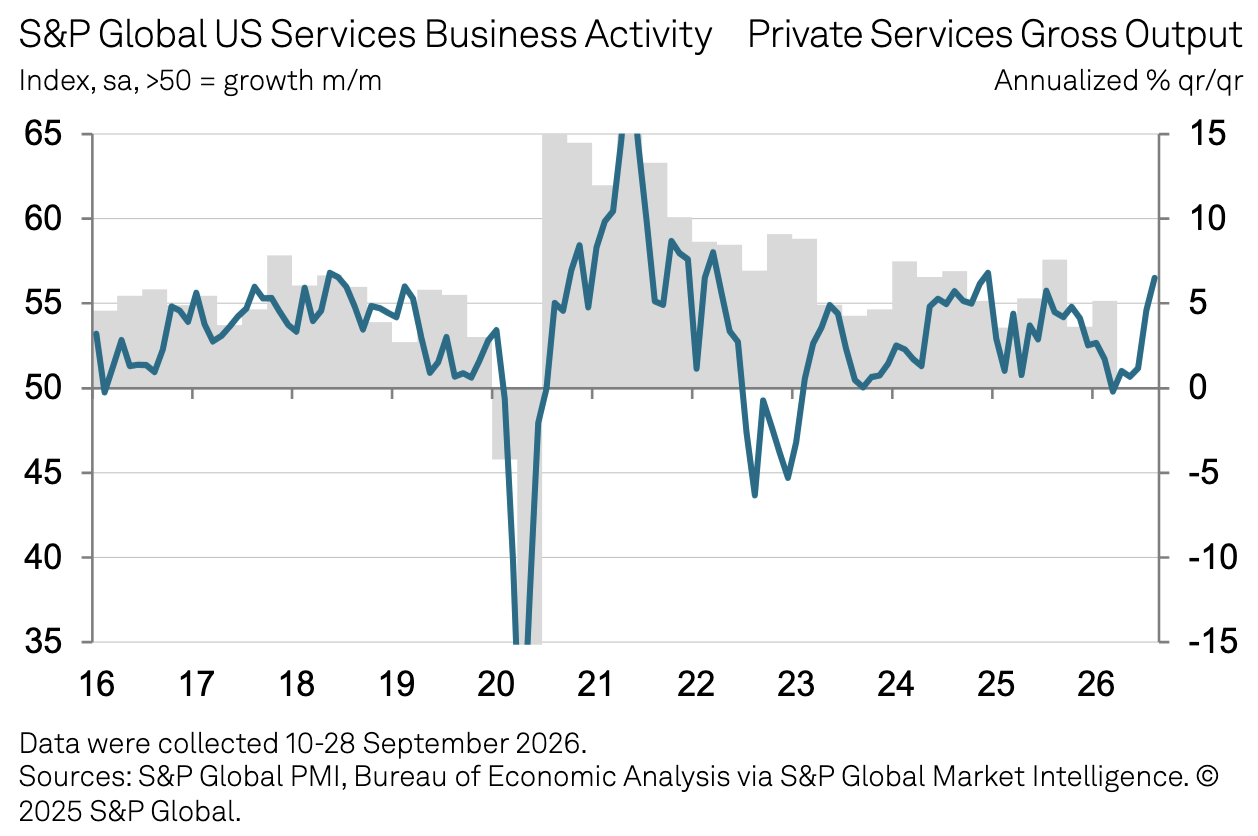
On the flip side, S&P Global released its US Services PMI on October 5. The report stated:
“US service sector business activity surged higher in September, rising at the fastest pace in over five years on the back of a further sharp increase in new orders….
“With total new orders rising rapidly again in September and some companies able to fill previously vacant positions, workforce numbers increased for the third month running. Moreover, the rate of job creation was the fastest since June 2022.”
As you can see, the robust results contrast the data from the BLS and The Conference Board. Therefore, the Fed will need to decide which results deserve the most attention when deciding its next move.
As for gold, it continues to suffer alongside higher interest rates and a stronger US dollar. And while several assets need interest rates to decline to prosper once again, Bank of America strategists said on October 12 that patience could be a virtue. They wrote:
“Gold rallied alongside equities when the market was not concerned about rising rates. Yet, when the Fed turned hawkish, inflation rose and the dollar appreciated, the yellow metal came under substantial pressure. The takeaway: gold will in all likelihood only bottom out once concerns over inflation/the Iran war subside, USD stops appreciating, and the Fed is no longer in a tightening cycle….
“We remain cautious near-term as the macro environment remains challenging: we have an average 4Q26 forecast of $4,000/oz, but then expect prices to average $4,813 in CY27.”
So, while volatility may persist, gold should stabilize and appreciate once the macro outlook becomes more favorable.
Are you thinking about diversifying into precious metals? Talk to your financial advisor about initiating a gold IRA account today, allowing you to invest in this red-hot asset on a tax-advantaged basis. Additionally, our complimentary CPI inflation calculator remains at your disposal, enabling you to assess inflation’s impact on your finances. Please seek the guidance of a financial advisor before making any investment decision.
As a worthwhile option, Augusta Precious Metals specializes in precious metal IRAs, helping to roll your existing retirement accounts, such as a 401 (k), into IRAs backed by physical gold or silver. You can also purchase bullion directly, and the company has an exceptional reputation, with either AAA or 4.5 to 5-star reviews across multiple ratings agencies.
For more alternatives, our guide on the Top 12 Best Gold Investment Firms covers the pros and cons of the top dealers available. You can compare items like product availability, investment minimums, and buyback policies to determinethe right option for you.
Furthermore, if higher interest rates have complicated your financial outlook, seeking professional advice can help ease the burden.
Accredited Debt Relief has strong public ratings, BBB A+ accreditation, ACDR membership, IAPDA-certified specialists, and a substantial company-stated track record (1.3M+ clients, $15B+ resolved, 15+ years). As a result, if unsecured debts like credit cards or personal loans have become unmanageable, Accredited Debt Relief may be a worthwhile resource.
Similarly, Beyond Finance is one of the US’s largest debt consolidation companies, helping Americans streamline their unsecured claims. You have access to a built-in financial wellness program with accredited financial therapists, and the firm also has thousands of 4.5+ star reviews across multiple platforms. Therefore, an introductory call may be helpful in deciding the correct path for your unique situation.

by Alex Demolitor | Sep 11, 2026 | Definitions
The August 2026 Consumer Price Index of All Urban Consumers (CPI-U) report indicates that inflation rose by 0.4% this month, up from a 0.1% increase in July. These data were released at 8:30 am EST on September 11, 2026, by the Bureau of Labor Statistics (BLS). Before seasonal adjustment, the year-over-year (Y-o-Y) inflation rate in the all-items index grew by 3.4%, matching the print from July.
This month’s results mostly aligned with economists’ consensus estimates. The table below is courtesy of Investing.com. The left column represents August’s figures, while the right column represents forecasters’ expectations. As you can see, there weren’t many surprises.

Yet, as the US-Iran war intensifies and oil prices surge, Fed policy is back in the spotlight. Although interest rates have risen materially, many analysts expect the Fed to increase its policy rate at next week’s meeting. There are several crosscurrents the committee must navigate, which makes the decision highly crucial for the US economy and the financial markets.

Food Prices
The food index increased by 0.1% in August, matching the 0.1% rise in July. Four of the major grocery indices increased this month, one was flat, and one decreased.
- Cereals and bakery products (+0.0%)
- Meats, poultry, fish, and eggs (+0.1%)
- Dairy and related products (+0.3%)
- Fruits and vegetables (-0.4%)
- Nonalcoholic beverages (+0.2%)
- Other food at home (+0.1%)
In addition, the food away from home index increased by 0.3%, as restaurant inflation surpassed grocery inflation once again.
Energy Prices
The energy index rose by 2.1% MoM in August after dropping by 1.5% MoM in July. Gasoline prices jumped by 3.9%, while electricity fell by 0.2%, and natural gas by 1.1%.
Core CPI
The August core CPI rose by 2.4% Y-o-Y, down from 2.5% in July. Below is an itemized breakdown of the various components:
- Shelter index: (+0.3%) [July: +0.1%]
- Rent index: (+0.2%) [July: +0.3%]
- Owners’ equivalent rent: (+0.2%) [July: +0.3%]
- Motor vehicle insurance: (-0.8%) [July: -0.3%]
- Medical care services: (-0.2%) [July: +0.6%]
- Physician services: (+0.0%) [July: +0.2%]
- Hospital services: (+0.0%) [July: +0.5%]
- Airline fares: (+2.7%) [July: +2.2%]

Seasonally Unadjusted CPI
Before seasonal adjustments, the CPI-U for August 2026 increased by 3.4% Y-o-Y to an index level of 334.980. Since these figures are unadjusted, they include regular seasonal price fluctuations that can create volatility in the results.
A Fork In the Road
While higher oil prices remain troublesome for inflation, it’s difficult for the Fed to control geopolitics and the pricing pressures that follow. As a result, core inflation is typically the best metric to follow — since it excludes the effects of food and energy. However, market participants seem keen on forcing the Fed’s hand, which makes for difficult decisions in the weeks ahead.
For example, US nonfarm payrolls greatly exceeded expectations on September 4. The economy added 162,000 net new jobs, and the unemployment rate held steady near multi-year lows. Consequently, the labor market outlook remains solid, which could allow the Fed to focus solely on inflation.

In contrast, the rapid rise in Treasury yields and oil prices is causing immense stress in the subprime bond market. Lenders charge an interest rate ‘spread’ above government bonds to compensate for potential default risks. And with the spread on CCC & Lower bonds (the riskiest borrowers) surging, stressed companies will face even more trouble refinancing their loans and obtaining credit.
As such, a rate hike will likely only worsen the situation, potentially creating a default event that shifts the Fed’s problem in the other direction.

But despite the juggling act, market participants have officially chosen the former. The chart below highlights how the US oil price (blue) and the US 2-Year Treasury yield (black) have soared in recent weeks. The 2Y is a known proxy for the federal funds rate, and given its rapid ascent, investors expect more than one rate hike to materialize in the months ahead.

As for gold, it remains caught in the volatility, as higher interest rates are typically bearish for the yellow metal. However, Goldman Sachs increased its year-end 2026 gold price forecast to $4,900 (from $4,600) on August 28, citing central bank purchases as the main driver. The report noted:
“Goldman Sachs Research expects central banks to buy an average of 50 tonnes of gold per month in 2026, up from an average of 17 tonnes per month before 2022.
“Central bank purchases accelerated to 100 tonnes per month in June 2026 (on a three-month seasonally adjusted basis) from 66 tonnes the previous month, according to Goldman Sachs Research’s nowcast of central bank activity. China’s central bank was the largest identifiable buyer in the market in June.”
Thus, while headline-driven swings may persist, gold’s structural outlook remains constructive.

Are you thinking about diversifying into precious metals? Talk to your financial advisor about initiating a gold IRA account today, allowing you to invest in this red-hot asset on a tax-advantaged basis. Additionally, our complimentary CPI inflation calculator remains at your disposal, enabling you to assess inflation’s impact on your finances. Please seek the guidance of a financial advisor before making any investment decision.
As a worthwhile option, Augusta Precious Metals specializes in precious metal IRAs, helping to roll your existing retirement accounts, such as a 401 (k), into IRAs backed by physical gold or silver. You can also purchase bullion directly, and the company has an exceptional reputation, with either AAA or 4.5 to 5-star reviews across multiple ratings agencies.
For more alternatives, our guide on the Top 12 Best Gold Investment Firms covers the pros and cons of the top dealers available. You can compare items like product availability, investment minimums, and buyback policies to determine the right option for you.
Furthermore, if higher interest rates have complicated your financial outlook, seeking professional advice can help ease the burden. Accredited Debt Relief has strong public ratings, BBB A+ accreditation, ACDR membership, IAPDA-certified specialists, and a substantial company-stated track record (1.3M+ clients, $15B+ resolved, 15+ years). As a result, if unsecured debts like credit cards or personal loans have become unmanageable, Accredited Debt Relief may be a worthwhile resource.
Similarly, Beyond Finance is one of the US’s largest debt consolidation companies, helping Americans streamline their unsecured claims. You have access to a built-in financial wellness program with accredited financial therapists, and the firm also has thousands of 4.5+ star reviews across multiple platforms. Therefore, an introductory call may be helpful in deciding the correct path for your unique situation.
by Alex Demolitor | Aug 12, 2026 | Definitions
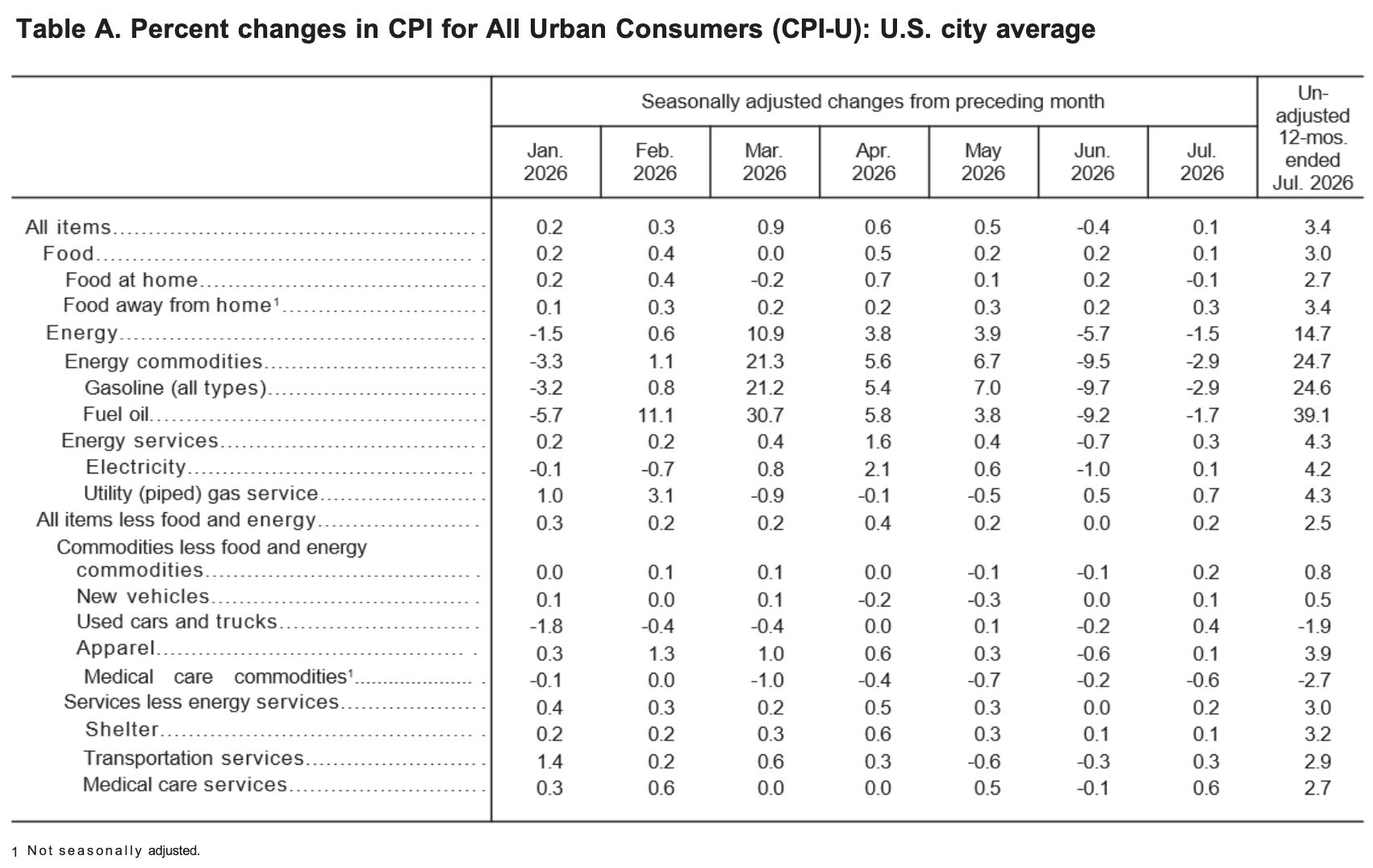
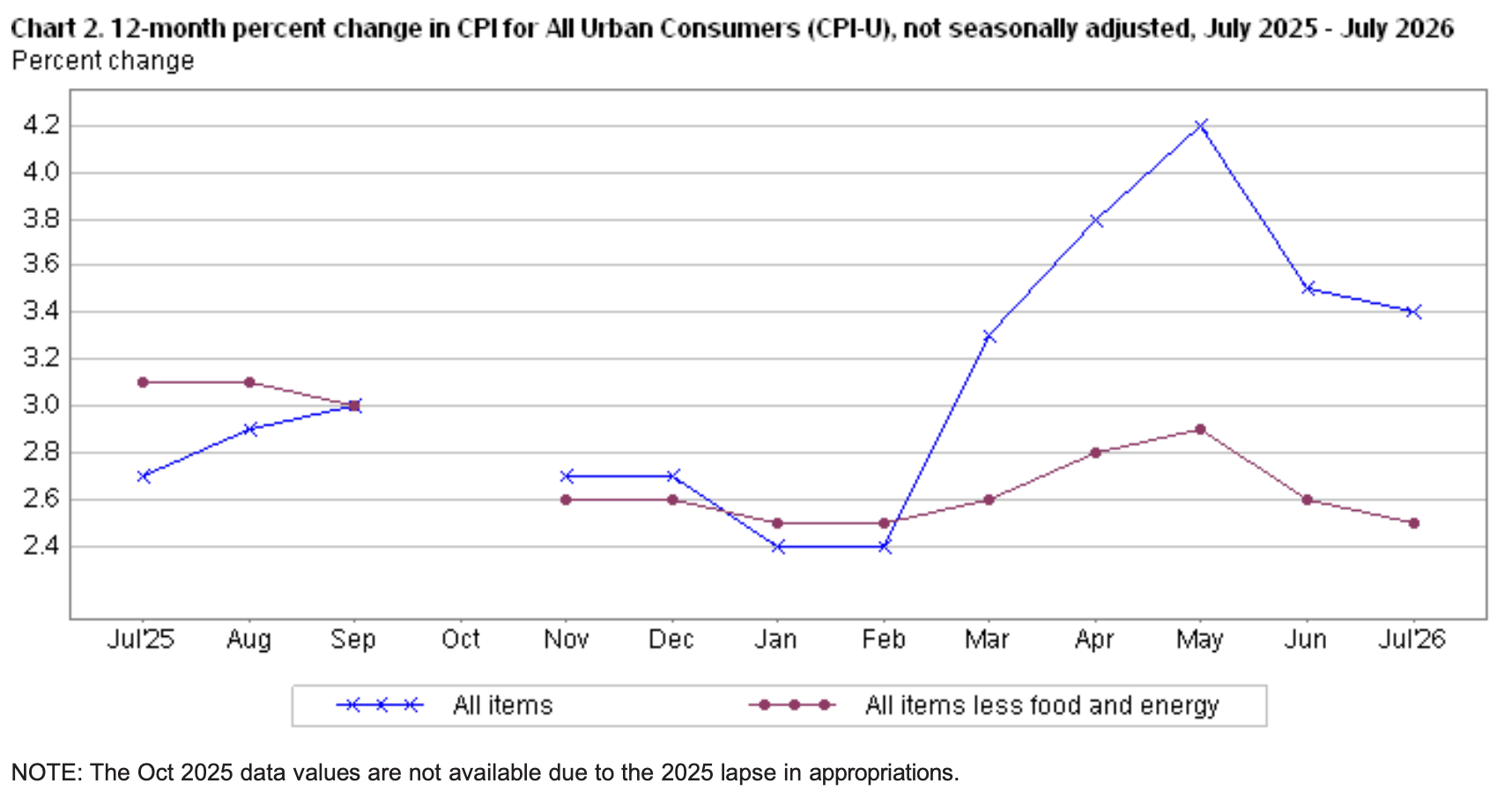
The July 2026 Consumer Price Index of All Urban Consumers (CPI-U) report indicates that inflation rose by 0.1% this month, up from a 0.4% decline in June. These data were released at 8:30 am EST on August 12, 2026, by the Bureau of Labor Statistics (BLS). Before seasonal adjustment, the year-over-year (Y-o-Y) inflation rate in the all-items index grew by 3.4%.
This month’s results matched economists’ consensus estimates. The table below is courtesy of Investing.com. The left column represents July’s figures, while the right column represents forecasters’ expectations. As you can see, there weren’t any surprises.
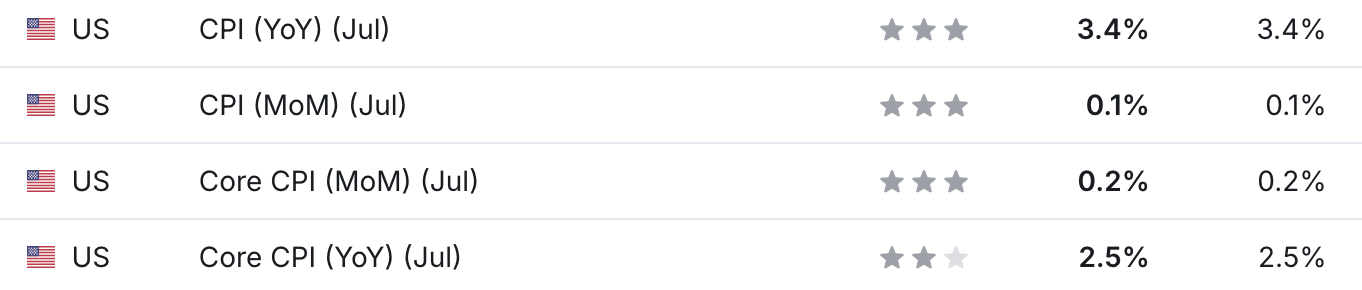
Yet, as inflation concerns fester among the investing public, Fed Chair Kevin Warsh said after the latest Monetary Policy Meeting on Jul. 29 that the bond market has already done much of the heavy lifting.
“Nominal and real yields are materially higher across the Treasury curve. In fact, some of the increases in market interest rates between FOMC meetings are among the most significant in the last two decades, ranking around the top decile or so,” he said.
“If I were to try to break down—just aggregate the Treasury market signals—I wouldn’t be able to do it perfectly. But the bond market’s saying many of those same things, and that’s why we’re seeing a tightening both in nominals and in reals, even while, at some level, we haven’t done much in 42 days. The markets have done quite a bit.”
Thus, while investors debate the merits of rate hikes, Warsh believes higher interest rates have already been priced into the U.S. economy.
Food Prices
The food index increased by 0.1% in July, decelerating from the 0.2% rise in June. Four of the major grocery indices increased this month, while two decreased.
- Cereals and bakery products (+0.2%)
- Meats, poultry, fish, and eggs (-0.7%)
- Dairy and related products (-0.1%)
- Fruits and vegetables (-0.1%)
- Nonalcoholic beverages (+0.9%)
- Other food at home (+0.0%)
In addition, the food away from home index increased by 0.3%, as restaurant inflation surpassed grocery inflation.
Energy Prices
The energy index fell by 1.5% MoM in July after dropping by 5.7% MoM in June — the largest monthly drop since April 2020. Gasoline prices fell by 2.9%, while electricity rose by 0.1%, and natural gas by 0.7%.
Core CPI
The July core CPI rose by 2.5% Y-o-Y, down from 2.6% in June. Below is an itemized breakdown of the various components:
- Shelter index: (+0.1%) [June: +0.1%]
- Rent index: (+0.3%) [June: +0.1%]
- Owners’ equivalent rent: (+0.3%) [June: +0.1%]
- Motor vehicle insurance: (-0.3%) [June: -2.0%]
- Medical care services: (+0.6%) [June: -0.1%]
- Physician services: (+0.2%) [June: -0.2%]
- Hospital services: (+0.5%) [June: +0.1%]
- Airline fares: (+2.2%) [June: +0.2%]
Seasonally Unadjusted CPI
Before seasonal adjustments, the CPI-U for July 2026 increased by 3.4% Y-o-Y to an index level of 333.918. Since these figures are unadjusted, they include regular seasonal price fluctuations that can create volatility in the results.
A Juggling Act
While interest rates have risen dramatically in recent months, investors seem keen on encouraging a rate hike from the Fed. However, recent data signals that tighter financial conditions may already be impacting the real economy.
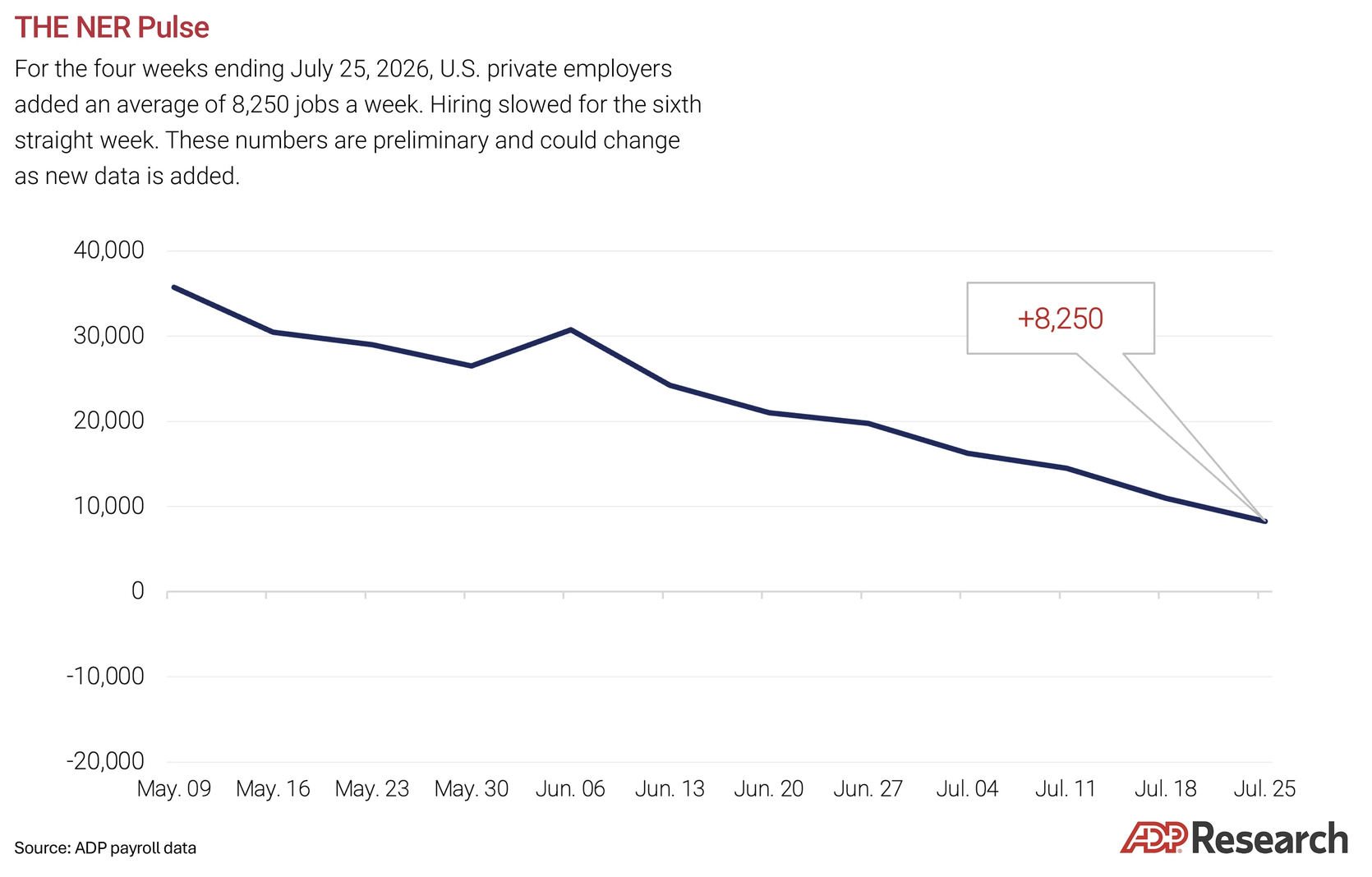
For example, ADP private payrolls underperformed expectations last week, and the firm noted on Aug. 11 that its Weekly NER Pulse has slowed for six straight weeks. Consequently, weakening labor market metrics have become increasingly common.
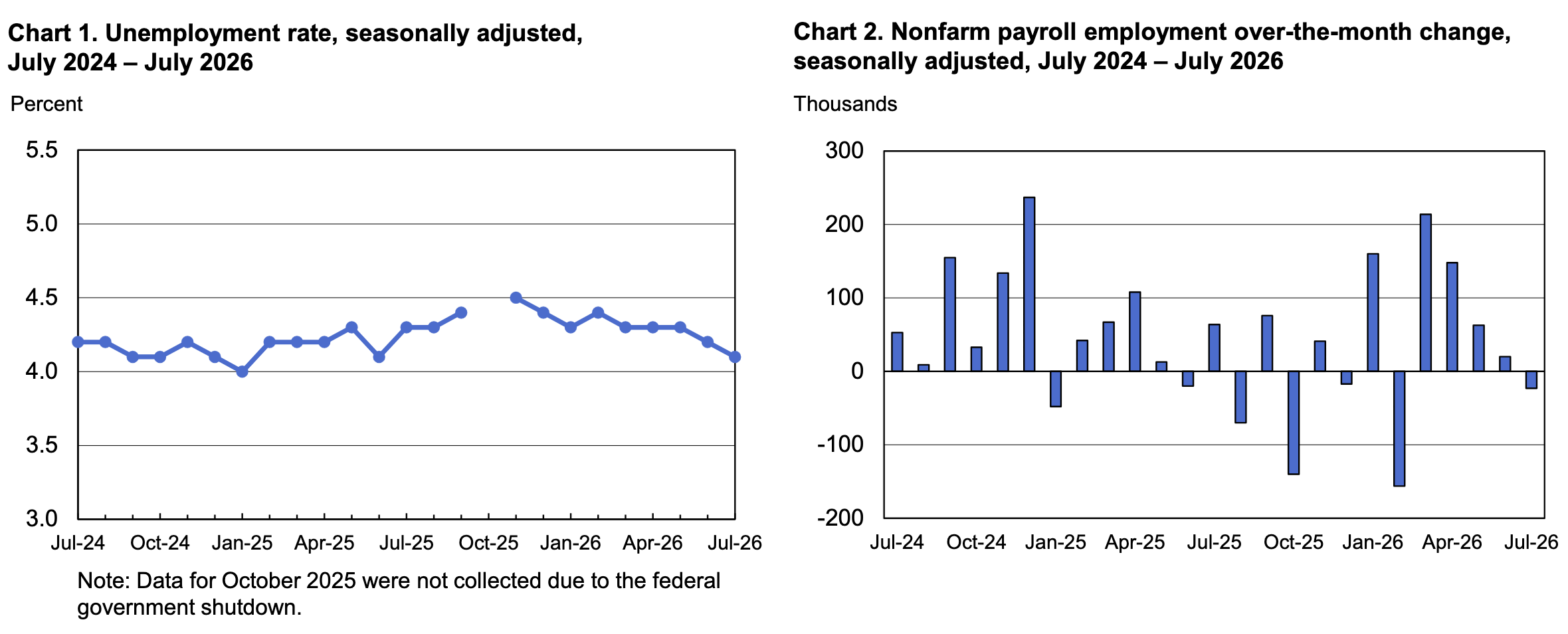
Speaking of which, the BLS reported on Aug. 7 that U.S. nonfarm payrolls fell by 23,000 in July. And if you analyze the trend on the right side of the chart below (the one on the right), you can see that monthly payroll growth had declined over the last few months before turning negative in July. As a result, the slowdown is similar to the results from ADP.
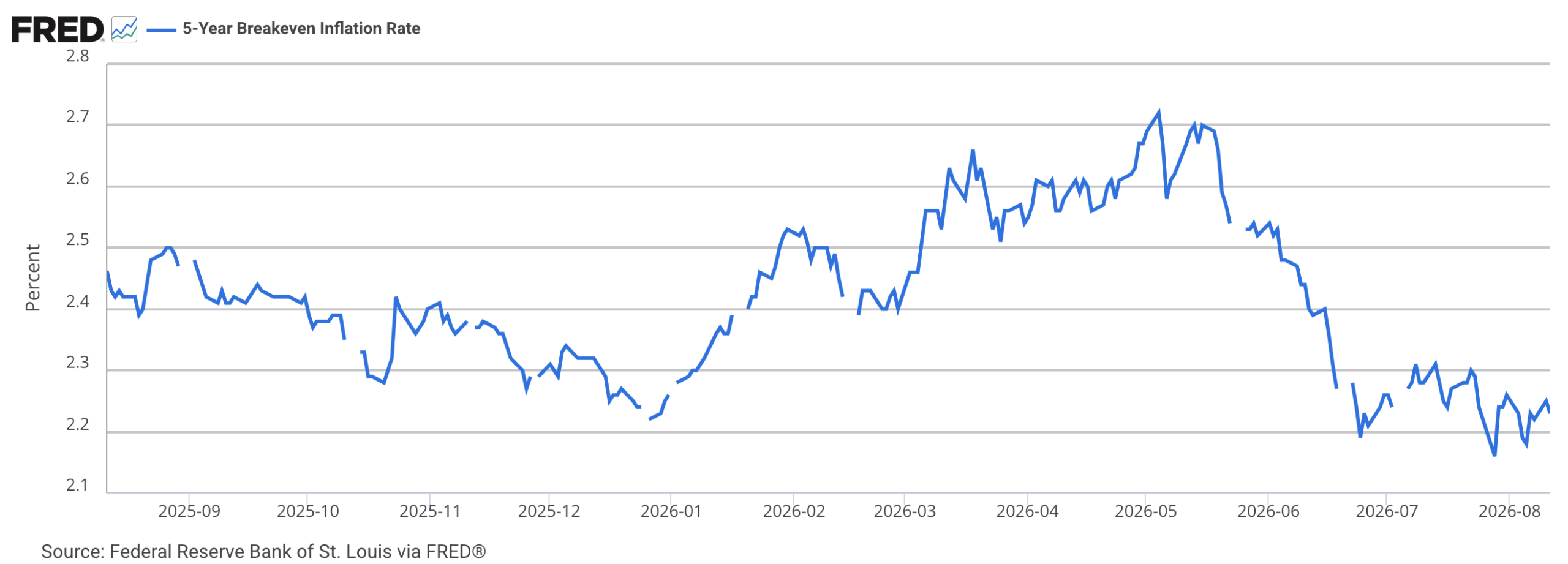
Finally, while inflation is top of mind among the investing public, institutions are less concerned about the pricing pressures. The blue line below tracks the U.S. 5-Year breakeven inflation rate — a gauge of institutions’ annual inflation expectations over the next five years. And with the metric standing at 2.23% as of Aug. 11, it shows much less apprehension than the narrative suggests.
Turning to the financial markets, gold has found its footing in recent days and could be poised for a substantial comeback into year-end.
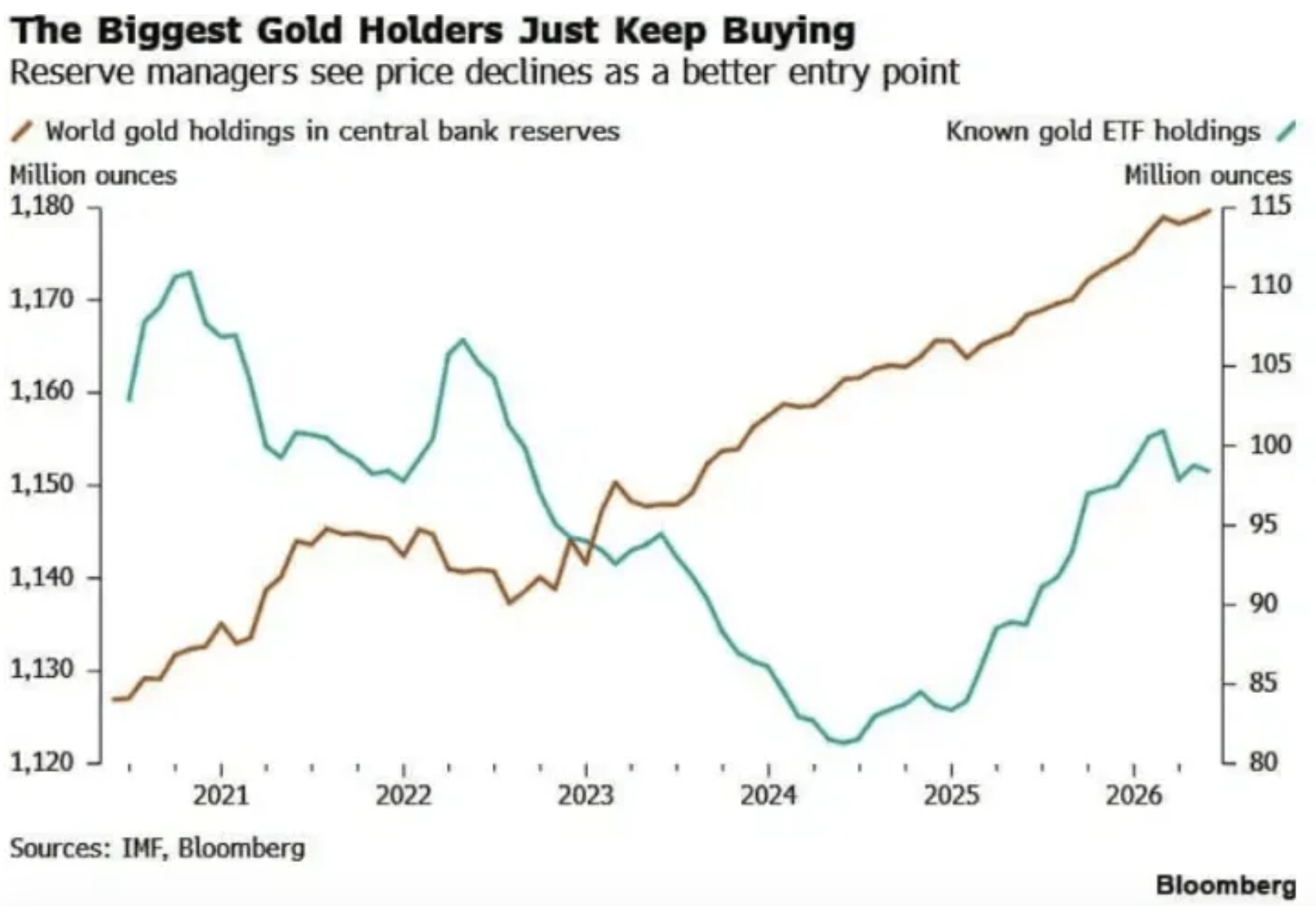
To explain, the green line above tracks known gold ETF holdings, while the brown line above tracks world gold holdings in central bank reserves. If you analyze the performance of the latter, you can see that the recent price slump didn’t deter the largest buyers in the market.
As such, the recent dip has only emboldened the bullion bulls, and when combined with oversold conditions and strong fundamentals, the activity could help propel gold higher over the next several months.
Are you thinking about diversifying into precious metals? Talk to your financial advisor about initiating a gold IRA account today, allowing you to invest in this red-hot asset on a tax-advantaged basis. Additionally, our complimentary CPI inflation calculator remains at your disposal, enabling you to assess inflation’s impact on your finances. Please seek the guidance of a financial advisor before making any investment decision.
As a worthwhile option, Augusta Precious Metals specializes in precious metal IRAs, helping to roll your existing retirement accounts, such as a 401 (k), into IRAs backed by physical gold or silver. You can also purchase bullion directly, and the company has an exceptional reputation, with either AAA or 4.5 to 5-star reviews across multiple ratings agencies.
For more alternatives, our guide on the Top 12 Best Gold Investment Firms covers the pros and cons of the top dealers available. You can compare items like product availability, investment minimums, and buyback policies to determine the right option for you.
Furthermore, if you need a financial reset but are unsure which company and path are right for you, several reputable options are available.
Up first, CuraDebt has been in business since 1996 and helps Americans struggling with unsecured claims like credit cards, personal loans, medical bills, and tax obligations. The company helps negotiate with creditors on your behalf and has roughly 300 positive reviews. The only downside is that service is not available in all states.
Second, Americor sets itself apart by providing counseling and consolidation services, but also offers in-house loans through its affiliate lender, Credit9. The firm has nearly 25,000 positive reviews, but may not be the best fit if you have a low credit score.
Similarly, we created an extensive guide covering the 23 Best Debt Relief Companies that deserve consideration. Comparing the various options helps identify their strengths and weaknesses, and often makes it easier to find the best option for your unique situation.
by Alex Demolitor | Jul 14, 2026 | Definitions
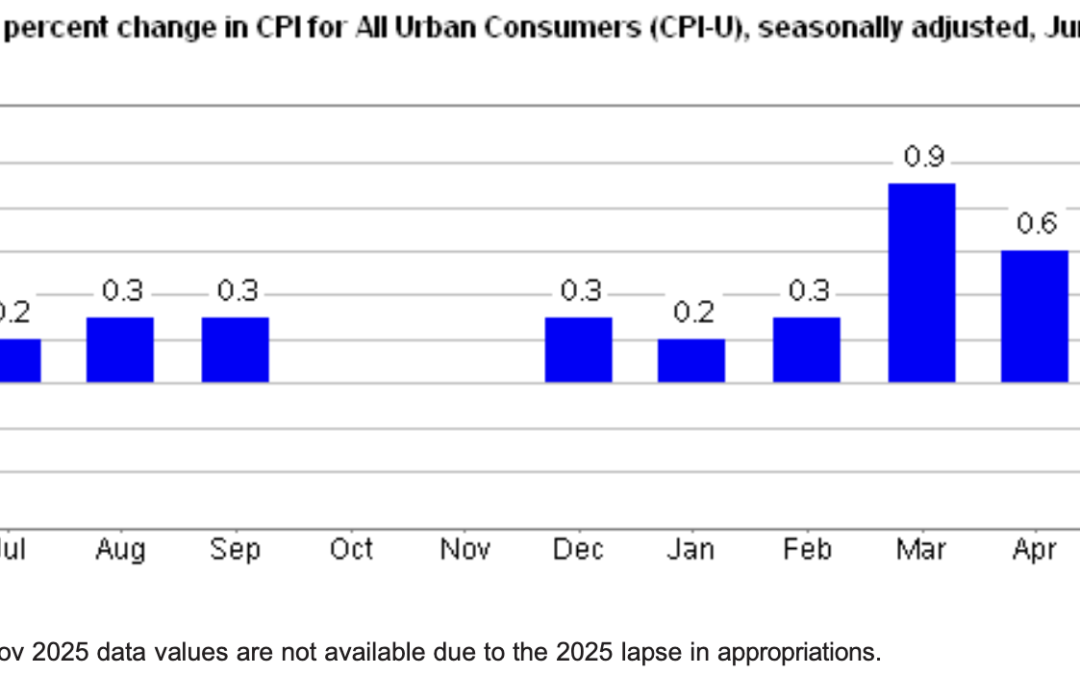
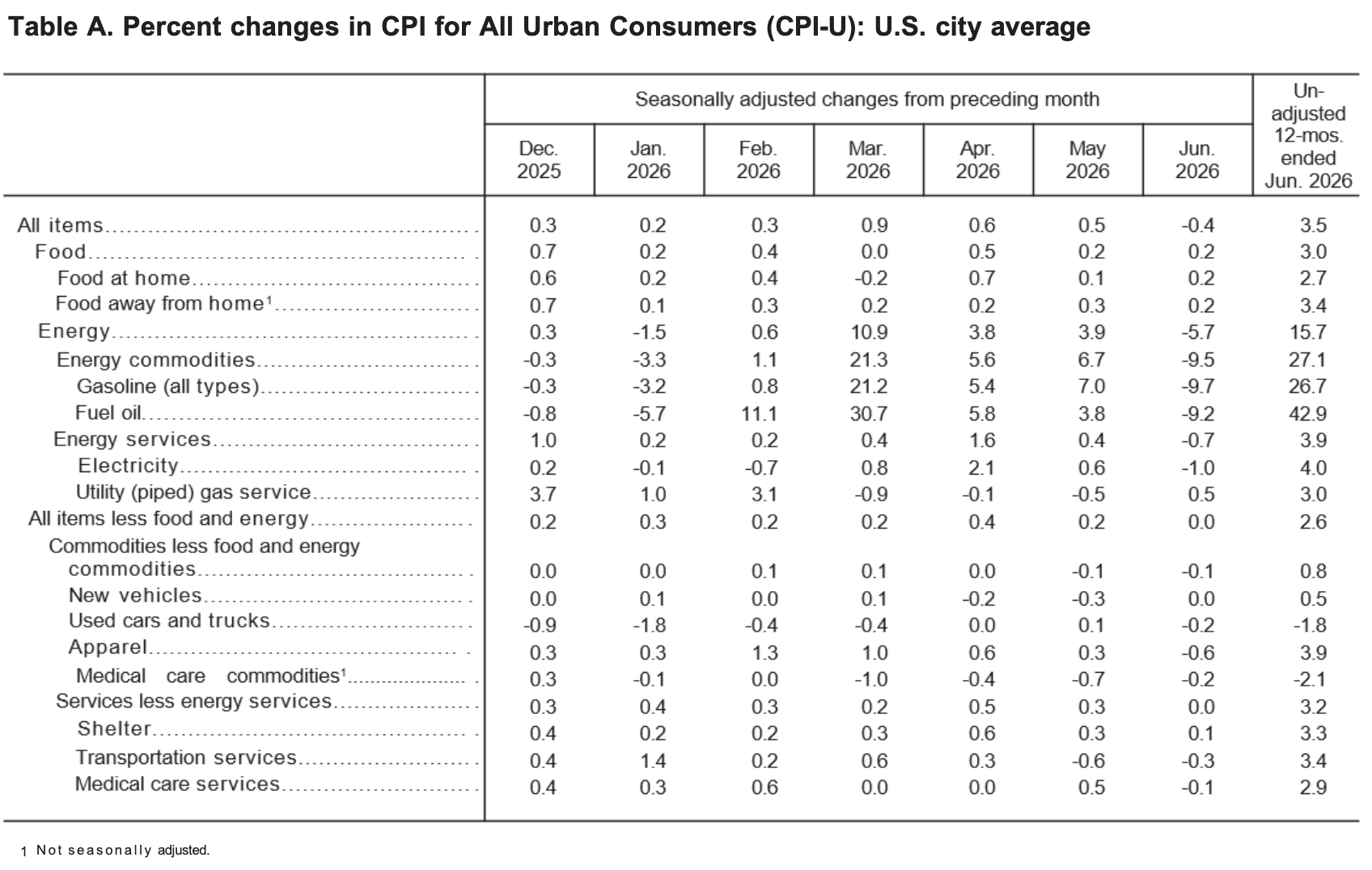
The June 2026 Consumer Price Index of All Urban Consumers (CPI-U) report indicates that inflation declined by 0.4% this month, down from a rise of 0.5% in May. These data were released at 8:30 am EST on July 14, 2026, by the Bureau of Labor Statistics (BLS). Before seasonal adjustment, the year-over-year (Y-o-Y) inflation rate in the all-items index grew by 3.5%.
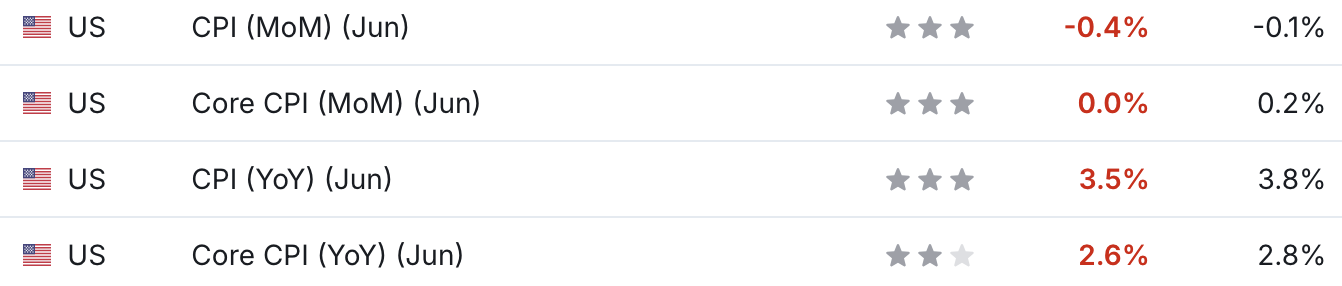
This month’s results missed economists’ consensus estimates. The table below is courtesy of Investing.com. The left column represents June’s figures, while the right column represents forecasters’ expectations. As you can see, the red metrics highlight the monthly underperformance.
Yet, with the U.S.-Iran conflict heating up again, the inflationary impact has Fed officials hinting at rate hikes. Fed Governor Christopher Waller said on Jul. 13 that “We’re building off of basically almost, you know, five to six months of ‘higher, higher, higher, higher,’ on inflation readings. If I get another higher one, I’m going to treat that as signal, not noise….
“I am concerned about the equally plausible case that data in the coming weeks will show that inflation will remain at its elevated level or even trend higher, requiring tighter monetary policy in the near term.”
As such, the recent spike in oil prices should only embolden his view the longer it persists.
Food Prices
The food index increased by 0.2% in June, matching the rise from May. Four of the major grocery indices increased this month, while two decreased.
- Cereals and bakery products (+0.3%)
- Meats, poultry, fish, and eggs (+0.6%)
- Dairy and related products (+1.2%)
- Fruits and vegetables (-0.2%)
- Nonalcoholic beverages (-1.5%)
- Other food at home (+0.5%)
In addition, the food away from home index increased by 0.2%, as restaurant inflation aligned with grocery inflation.
Energy Prices
The energy index fell by 5.7% MoM in June, the largest monthly drop since April 2020. Gasoline prices fell by 9.7%, electricity by 1.0%, and natural gas rose by 0.5%.
Core CPI
The June core CPI rose by 2.6% Y-o-Y, a deceleration from the 2.9% recorded in May. Below is an itemized breakdown of the various components:
- Shelter index: (+0.1%) [May: +0.3%]
- Rent index: (+0.1%) [May: +0.4%]
- Owners’ equivalent rent: (+0.2%) [May: +0.3%]
- Motor vehicle insurance: (-2.0%) [May: -1.7%]
- Medical care services: (-0.1%) [May: +0.5%]
- Physician services: (-0.2%) [May: +0.0%]
- Hospital services: (+0.1%) [May: +0.7%]
- Airline fares: (+0.2%) [May: +2.7%]
Seasonally Unadjusted CPI
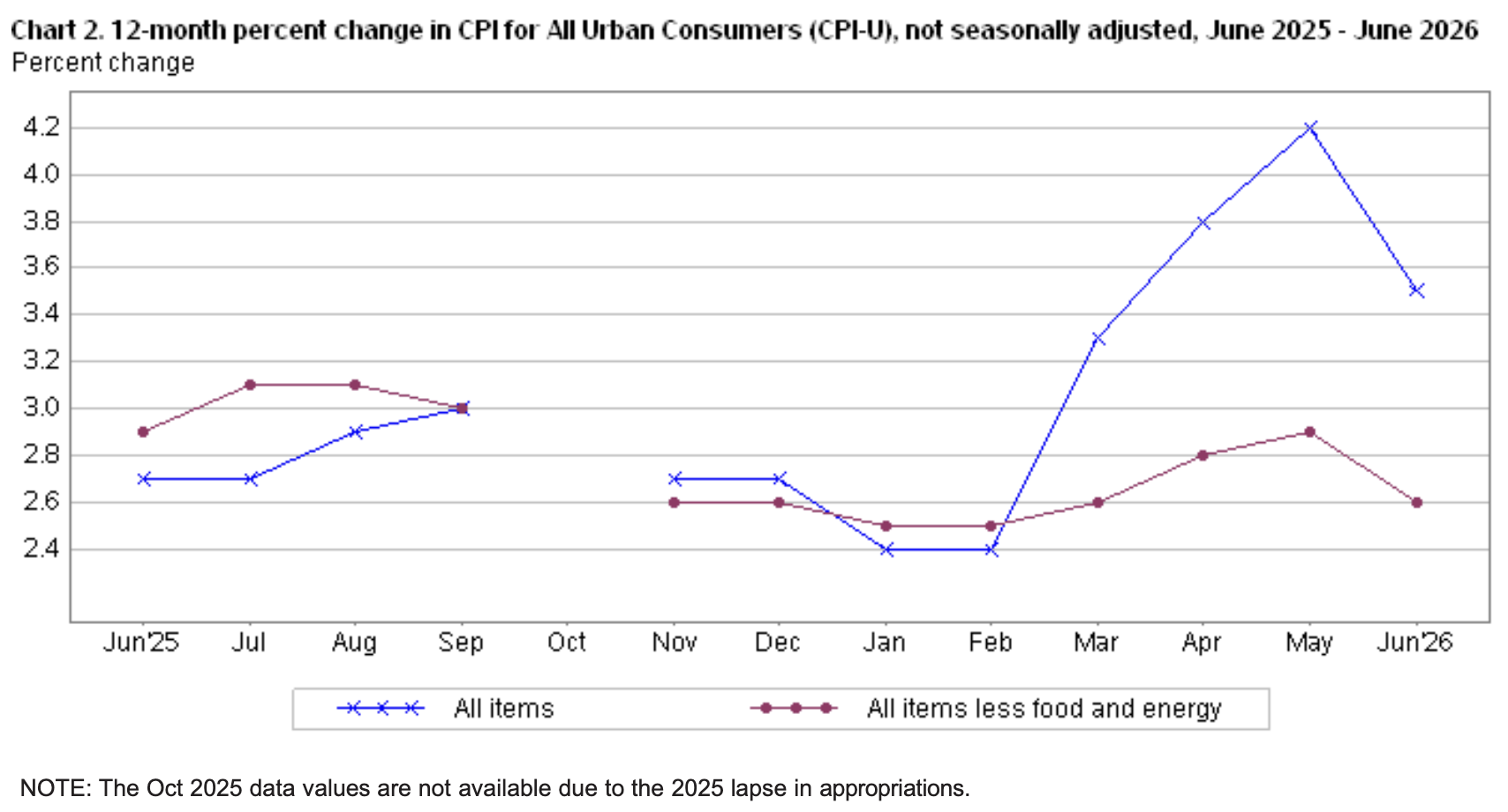
Before seasonal adjustments, the CPI-U for June 2026 increased by 3.5% Y-o-Y to an index level of 333.952. Since these figures are unadjusted, they include regular seasonal price fluctuations that can create volatility in the results.
The Chaos Continues
After another escalation in the U.S.-Iran conflict, higher oil prices and potentially higher inflation are back in the spotlight. Yet, this time the uncertainty and the bond market sell-off are occurring when U.S. economic growth is slipping.
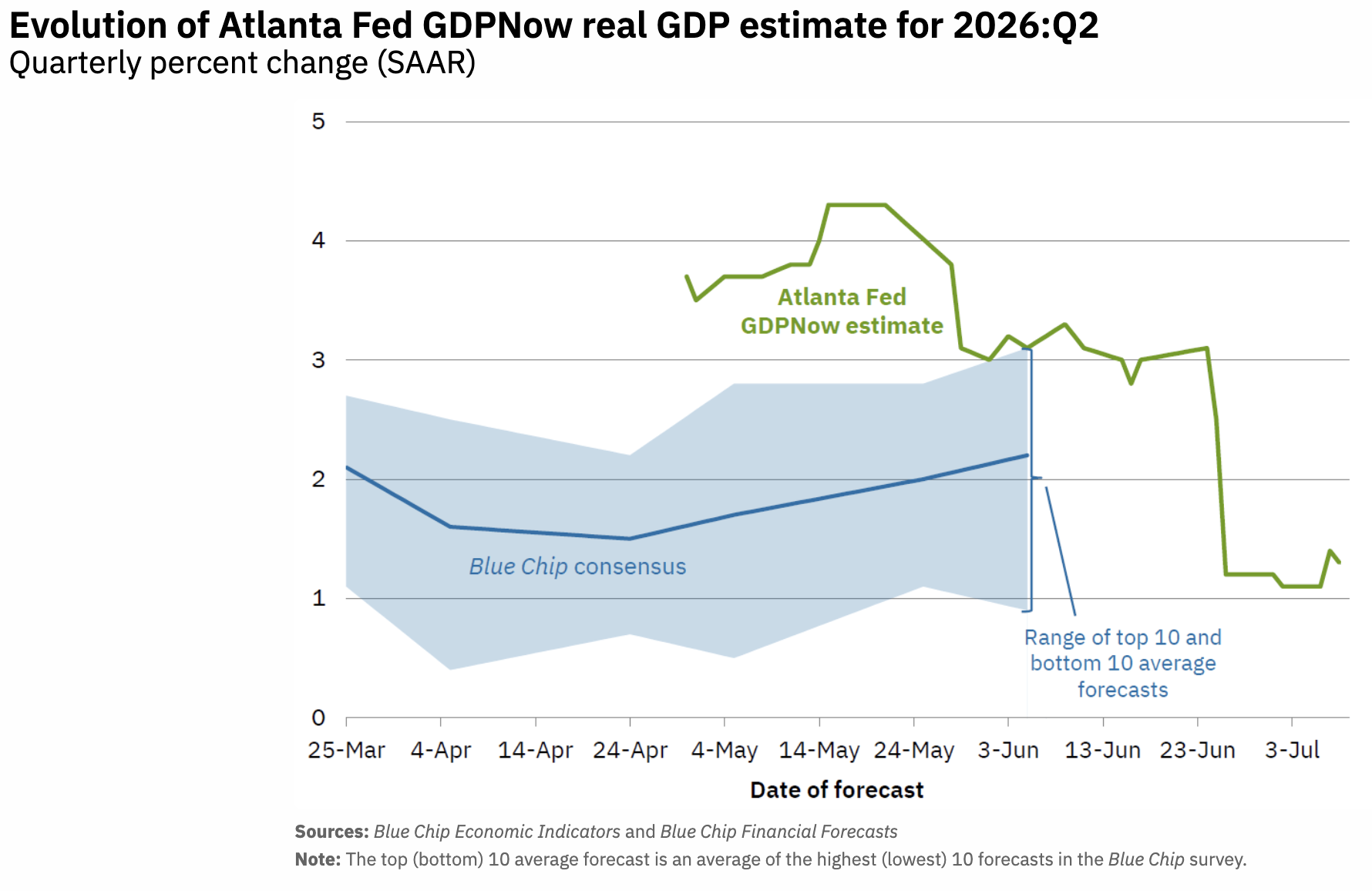
To explain, the green line above tracks the Atlanta Fed’s second-quarter 2026 GDP growth estimate. If you analyze the movement, you can see that higher interest rates and financial market volatility are starting to weigh on economic output. Moreover, with the metric sitting near 1.30%, the U.S. economy may continue to struggle until the geopolitical turmoil ends.
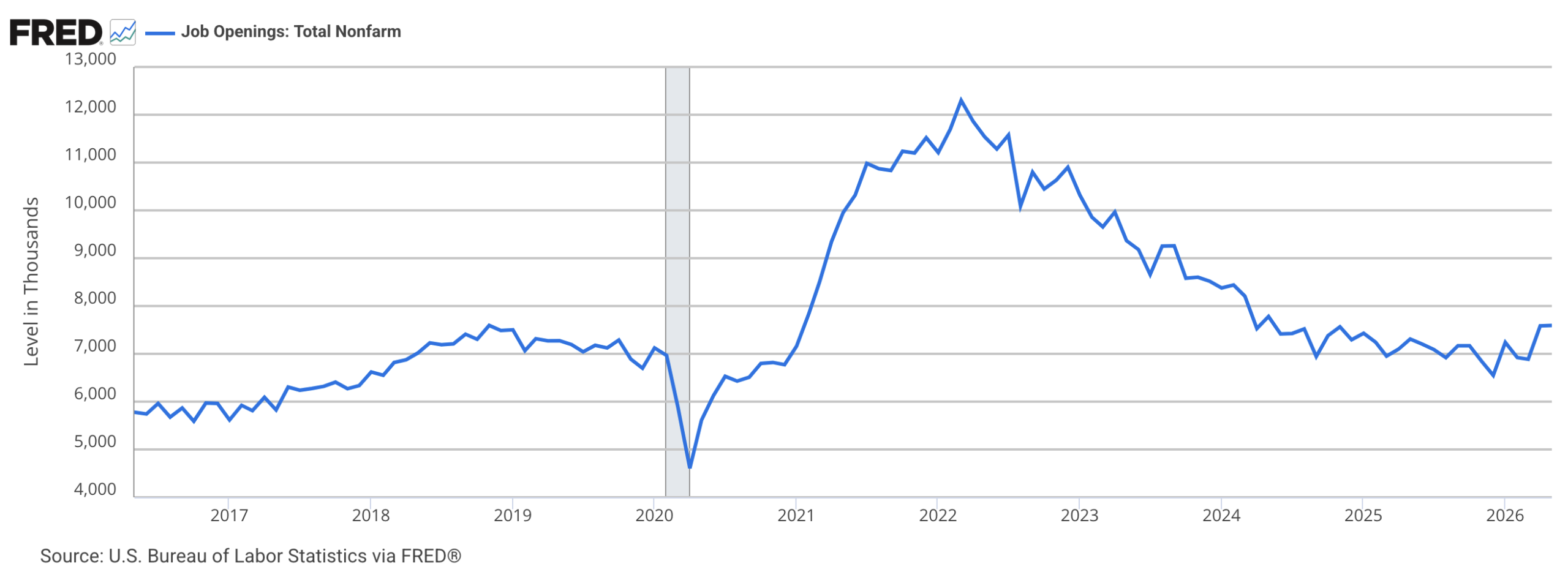
In contrast, U.S. job postings have increased recently. After bottoming near 6.6 million in December 2025, the metric has increased to almost 7.6 million as of the end of May. Consequently, divergent data make the outlook even more murky for policymakers.
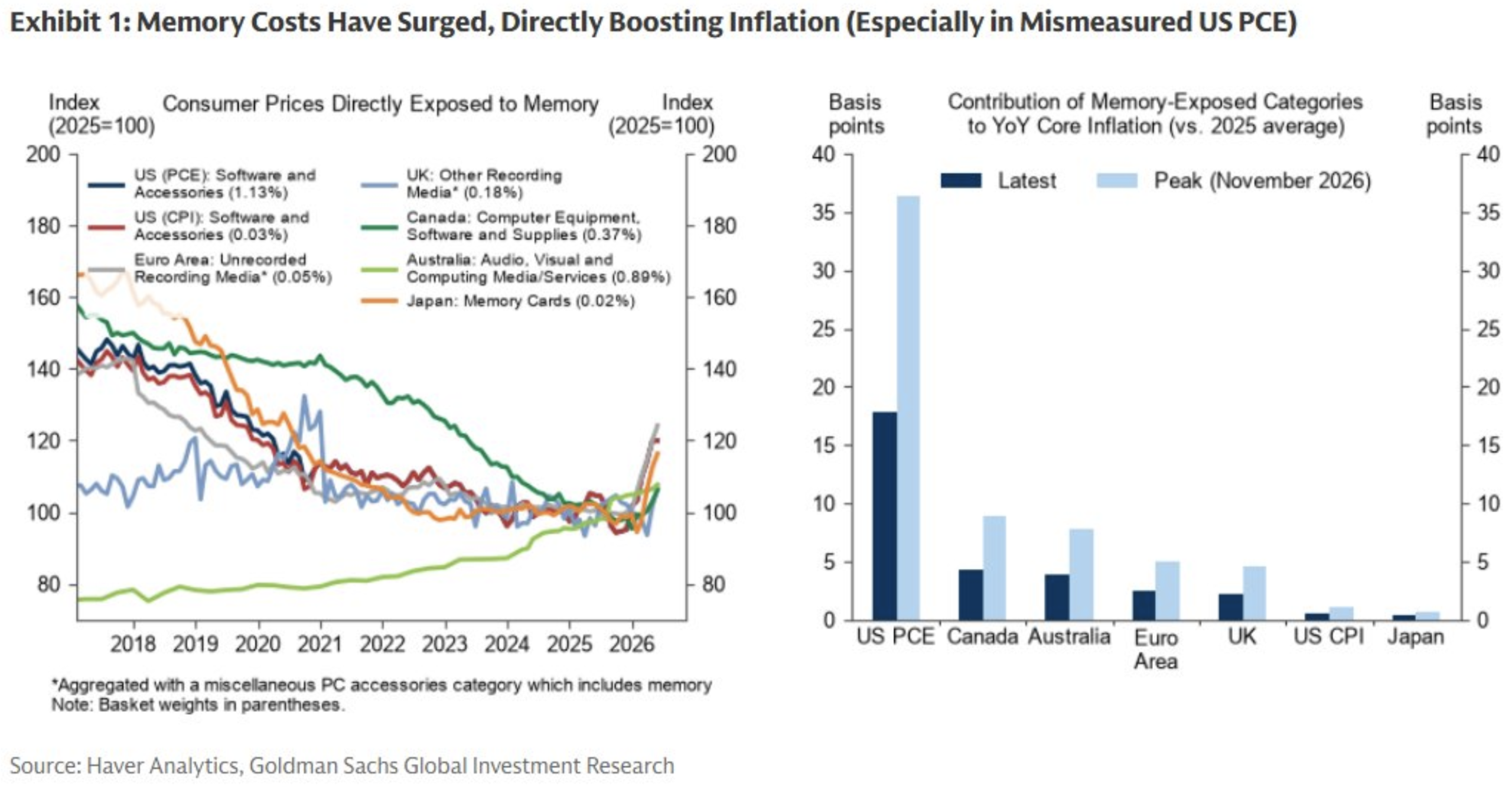
Finally, Goldman Sachs told clients recently that the AI spending spree could uplift inflation. With soaring memory, software, and electricity prices poised to flow into the PCE and CPI baskets, they could create even more challenges for the Fed in the months ahead.
Turning to the financial markets, gold continues to suffer from the geopolitical volatility. But interestingly, the recent correction is similar to 2008, right before the multi-year surge.
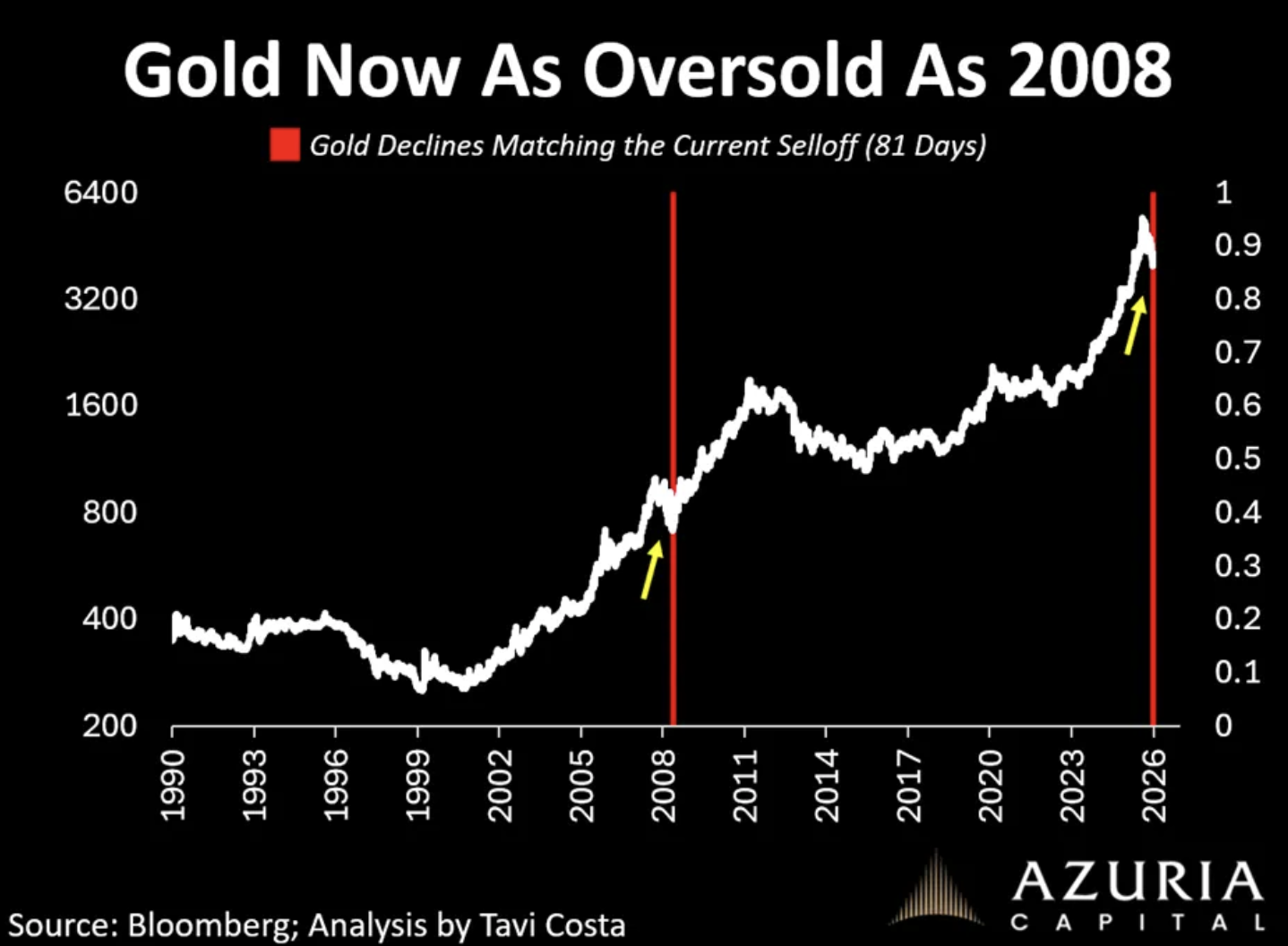
To explain, the vertical red lines above highlight the similarity between the 2008 correction and the current one. And with the timeframes and magnitude quite consistent, it could be an interesting clue that gold is nearing an inflection point.
Are you thinking about diversifying into precious metals? Talk to your financial advisor about initiating a gold IRA account today, allowing you to invest in this red-hot asset on a tax-advantaged basis. Additionally, our complimentary CPI inflation calculator remains at your disposal, enabling you to assess inflation’s impact on your finances. Please seek the guidance of a financial advisor before making any investment decision.
As a worthwhile option, Augusta Precious Metals specializes in precious metal IRAs, helping to roll your existing retirement accounts, such as a 401 (k), into IRAs backed by physical gold or silver. You can also purchase bullion directly, and the company has an exceptional reputation, with either AAA or 4.5 to 5-star reviews across multiple ratings agencies.
Furthermore, if you need a financial reset but are unsure which company and path are right for you, several reputable options are available.
Up first, CuraDebt has been in business since 1996 and helps Americans struggling with unsecured claims like credit cards, personal loans, medical bills, and tax obligations. The company helps negotiate with creditors on your behalf and has roughly 300 positive reviews. The only downside is that service is not available in all states.
Second, Americor sets itself apart by providing counseling and consolidation services, but also offers in-house loans through its affiliate lender, Credit9. The firm has nearly 25,000 positive reviews, but may not be the best fit if you have a low credit score.
Last, we created an extensive guide covering the 23 Best Debt Relief Companies that deserve consideration. Comparing the various options helps identify their strengths and weaknesses, and often makes it easier to find the best option for your unique situation.