Sarah Bauder
Sarah has been writing on the topics of politics, history and finance for over a decade. She is currently an editor at CPI Inflation Calculator, covering the topics of CPI, inflation, US economy and economic commentary.
by Sarah Bauder | Feb 13, 2020 | CPI, Definitions
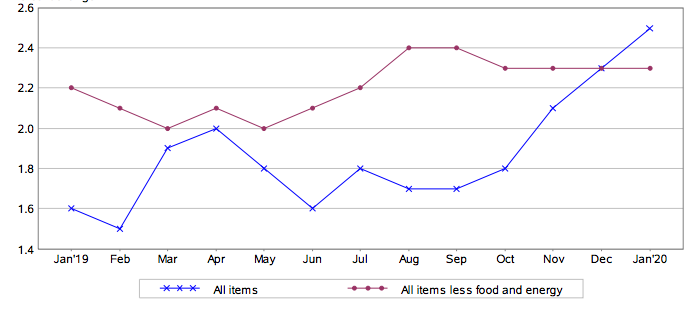
The US Bureau of Labor Statistics (BLS) reported today, that in January, the Consumer Price Index for All Urban Consumers (CPI-U) increased 0.1% on a seasonally adjusted basis. The all items index has risen 2.5% before seasonal adjustment, over the past year.
Based upon the data provided by the BLS, the shelter index was the largest component, which attributed to the rise in the seasonally adjusted all items index. In addition, the medical care and food indexes also increased. Conversely, the energy index dropped in January.
(Source: US Bureau of Labor Statistics)
Energy Index
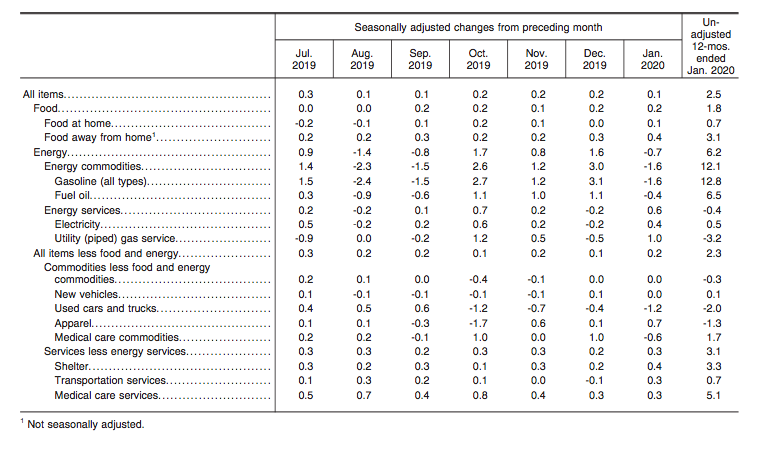
In January, the index for energy decreased by 0.7%. This is in contrast to December when the energy index edged up 1.6%. The price of gasoline dropped 1.6% in January, compared to the 3.1% rise the previous month. The electricity index edged up 0.4%, as did the natural gas index, with an increase of 1.0%.
Overall, over the past 12-month period, the energy index rose 6.2%. The price of gasoline soared up 12.8% since January 2019. The index for electricity edged up 0.5%, while the natural gas index dropped 3.2%.
Food Index
Similarly to December, the index for food rose 0.2%. The food at home index also increased 0.1% in January. The food away from home index also edged up 0.4%.
Since January 2019, the food at home index rose 0.7%. Likewise, the food away from home index also increased 3.1% over the past 12 months.
(Source: US Bureau of Labor Statistics)
All Items Less Food And Energy Index
In January, the index for all items less food and energy rose 0.2% – December saw an increase of 0.1%. As mentioned, the shelter index increased 0.4%. The owners’ equivalent rent index saw a 0.3% increase, and the index for rent rose 0.4%.
The index for medical care also increased by 0.2%, as did the hospital services index, which rose 0.8%.
Over the last 12 months, the all items less food and energy index increased 2.3%. Since January 2019, the index for shelter edged up 3.3%. The medical care index also saw an increase over this same period, rising 4.5%. Over the past 12 months, there have been few indexes that decreased in this category.
Source cited: https://www.bls.gov/news.release/archives/cpi_02132020.htm
by Sarah Bauder | Jan 14, 2020 | CPI
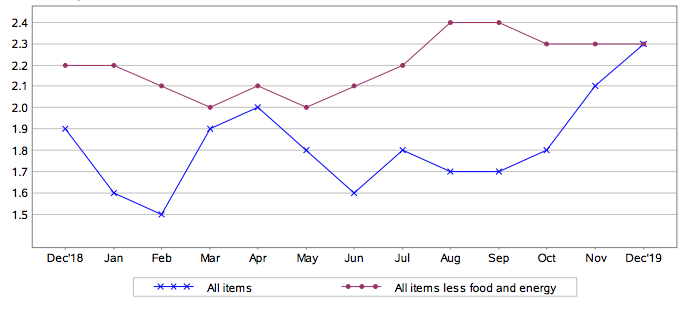
The US Bureau of Labor Statistics released its monthly data for December, indicating that the Consumer Price Index for All Urban Consumers (CPI-U) increased 0.2% in December, on a seasonally adjusted basis, after rising 0.3% in November.
The last 12 months have seen a 2.3% increase in all items indexes before seasonal adjustment. This was larger than the 1.9% rise in 2018, and the largest advance since 2011, which saw a 3% increase.
The price of gasoline, medical care, and shelter all increased in December, which accounted for the rise in the seasonally adjusted all items index.
(Source: US Bureau of Labor Statistics)
The Energy Index
The energy index rose 1.4% in December, marking its third consecutive monthly increase. Gas prices increased 2.8% in December (yet before seasonal adjustment, the price of gasoline fell 1.6%). The natural gas index also increased 0,3% in December, likewise marking it third consecutive monthly rise. Conversely, electricity decreased slipping 0.5% in December.
Over the past 12 months, the energy index saw a 3.4% increase. The price of gasoline rose 7.9% and the fuel oil index also increased 4.6% over the past year. Yet, electricity fell 0.4% and the natural gas index decreased 3.5%.
All Items Less Food And Energy
The index for all items less food and energy edged up 0.1% in December, after rising 0.2% in both the previous months. The shelter index increased 0.2% in December. Both in the indexes for rent and for owners’ equivalent rent rose 0.2%, respectively. The medical care index also increased 0.6% in December.
Overall, the index for all items less food and energy increased 2.3% over the past 12 months. The shelter index increased 3.2% over the past year, and the medical care index likewise increased 4.6%.

(Source: US Bureau of Labor Statistics)
The Food Index
In December, the food index rose 0.2%, after edging up 0.1% in November. The food at home index increased 0.1%, marking the same increase as in November. Additionally, the food away from home index increased to 0.3%.
Over the past 12 months, the food at home index rose 0.7%. Likewise, the food away from home index increased 3.1%.
Overall, the food index rose 1.8%, slightly higher than the 1.6% rise in 2018. Over the past decade, the food index increased at an average annual rate of 1.8%.
Source cited: https://www.bls.gov/news.release/archives/cpi_01142020.htm
by Sarah Bauder | Jan 8, 2020 | Inflation
By definition, inflation is the general increase in the price of goods and services, and the decrease in the purchasing value of a nation’s currency. Inflation is measured in the consumer price index (or simply CPI), which in turn, calculates the value of a basket of consumer and services purchased by the average household. In this article, 5 experts discuss things you didn’t know about inflation.
I Think A Lot Of People Don’t Really Think About Inflation And Their Money Losing Buying Power
“I think there’s a lot of people out there who either just don’t know about inflation period, or don’t think about it. We all intuitively know things get more expensive over time. A Subway Foot Long used to be $5, now its $8 or $9, things go up in price but I think a lot of people don’t really think about inflation and their money, losing buying power.
I was recently talking to a family friend who left a job of 20 years. They had something like 18k in their retirement account despite making a very good living and having been there 20 years. On the other hand I had been at a much lower paying job for something like 5 years and had over 25k in my 401k. It turned out this family friend wasn’t investing, they were just letting money sit in their retirement account because they were scared of risk and scared of investing. I was trying to explain to them that while all investments have risk, what he’s doing now is guaranteed to lose him money through inflation and over time a pretty substantial amount of money. He didn’t seem to get it and continues to let his retirement money just sit and lose over time.”
John Frigo, Digital Marketing Lead, My Supplement Store
The Word “Inflation” As Originally Coined Applied Entirely To The Quantity Of Money
“The average American does not know or appreciate that the word ‘inflation’ as originally coined, applied entirely to the quantity of money. That is to say, inflation is merely an increase in the quantity of money and bank notes that are in circulation plus the quantity of bank deposits that are subject to check. As such, current operations by Central Banks around the world that electronically create ‘money’ or ‘reserves’ through open market operations and programs such as ‘quantitative easing’ are themselves sufficient to satisfy the original definition of ‘inflation’, even if there is no measurable increase on the price on consumer goods.”
David Reischer, Esq. Banking & Business Attorney, LegalAdvice.com
The Average American Has A Hard Time Even Describing What Inflation Is
“The average American attending my workshops on the basics of personal and household finances knows that inflation is something that can hurt their wallet, but they have a hard time even describing what inflation is.
Many people accept that inflation results in higher prices for goods and services, but they do not understand it as an annual change. Rather, they think of it like they would a sales tax, like something added onto the normal price of goods and services.
The average American knows that prices for gasoline, food and cars were much lower when they were younger, but there is a disconnect between the change in prices and the principle of inflation.
The simplest description of inflation I see my adult students understanding is this: You know how prices seem to go up year after year? That is inflation.
Most adults in my classes typically guess that inflation is far higher than it is, believing it is close to 10% a year rather than the 2.5% to 3.5% rate is has been for the past couple decades. However, even at 3.5%, they do not understand that prices will actually DOUBLE in just twenty years. The Rule of 72 is a powerful tool for teaching about the impact of inflation over time.”
Todd Christensen, Education Manager, Money Fit by DRS
The Correlation Between Interest Rates And Monetary Inflation
“Very few people understand the correlation between interest rates and monetary inflation. When interest rates are suppressed below the GDP rate, which is a reflection of economic output, then interest rates anywhere in the interest curve below this rate results in people being paid to borrow. This is because the rate of interest is below the rate of monetary inflation and thus people are encouraged to expand in ways that are not necessarily economic. To that end, assets that are tied to the interest rate complex largely rise in price as interest rates are lowered.
While the apparent gains in value for assets tied to interest rates like real estate, bonds, commodities, collectibles, may seem engendered by real market demand, in most cases the demand is artificially being created by inflation tied to below market price interest rates. Central Bank meddling in the pricing mechanism for interest rates, which some would say is the most important price in a free market, distorts all markets and that’s why many assets are highly susceptible to the boom-bust cycle of bubbles.”
Brian Ma, Broker, Flushing Real Estate Group
Investing In Real Estate Is The Best Hedge Against Inflation
“One of the most important things which the average American does not know about inflation is that investing in real estate is the best hedge against it. While people are generally aware of the many benefits of real estate investments such as relatively low risk and monthly rental income, they often fail to appreciate the fact that investing in real estate properties protects one’s money against inflation. While housing markets take temporary downturns as a result of economic and demographic factors, they always bounce back. Regardless of which market you look at, real estate prices follow an upward trend in the medium and long term. This is due to the constant increase in housing demand (due to population growth) and the fact that the land on which properties are built is a very limited resource. If we look at data from the past few decades, the average annual appreciation rate in the US exceeds the average annual inflation rate. In 2020 inflation in the US is forecast to reach about 2%, while the increase in the median home value is expected to reach about 2.2%. This means that once again the real estate appreciation rate will exceed the inflation rate, offering investors protection of their financial resources.”
Daniela Andreevska, Marketing Director, Mashvisor
Unfortunately, inflation is an economic reality that is unavoidable. You can keep abreast of the monthly inflation rates and the CPI via the Bureau of Labor Statistics release schedule. The best strategy to hedge against inflation is to ensure that one has a diversified portfolio.
by Sarah Bauder | Dec 11, 2019 | CPI
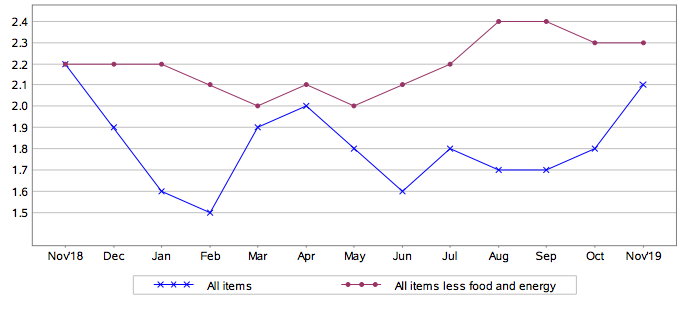
The US Bureau of Labor Statistics released its monthly data, stating that the Consumer Price Index for All Urban Consumers (CPI-U) rose 0.3 % in November on a seasonally adjusted basis, after rising 0.4% in October.
Despite historically low unemployment coupled with tariffs on Chinese imports, this signals that inflation remains in check.
American households paid more for energy, food, rent, and healthcare in November.
Source: US Department of Labor
The Energy Index
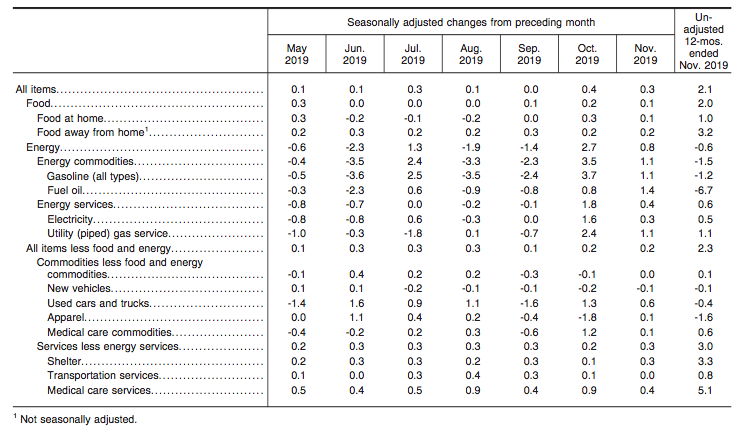
The price of gasoline increased by 1.1%, and the other major energy component indexes also increased 0.8% in November. Other major energy categories also saw an increase, with electricity edging up 0.3% and natural gas increasing 1.1%.
Over the past 12 months, the energy index has decreased 0.6%. Gasoline prices declined 1.2% over the past year, and the fuel oil index fell 6.7% over the past 12 months. Conversely, the natural gas index rose 1.1% and the electricity index increased 0.5% over the year.
The Food Index
Food prices edged up 0.1%, rising for a third straight month, with the categories for both food at home and food away from home both increasing over November.
Food at home increased 0.1%, after seeing a 0.3% increase in October. Likewise, the food away from home index increased 0.2%.
Over the last 12 months, the food at home index increased 1.0%. The food away from home category also increased 3.2% over the past 12 months.
Source: US Department of Labor
All Items Less Food And Energy
The shelter index rose 0.3% in November. The index for rent also rose 0.3%, while the index for owners’ equivalent rent increased 0.2% over the month. Over the past 12 months, the index for shelter has increased 3.3%. The medical care index increased 0.3 percent. Over the past year, the index for medical care rose 4.2%.
Overall, the index for all items less food and energy rose 2.3% over the past 12 months.
by Sarah Bauder | Dec 10, 2019 | gold
Considering that precious metals such as gold have enjoyed a bullish market, there’s no better time than now to invest. An easy way for investors to keep abreast of the price of the glittering metal is with a gold calculator. The question that arises is gold and inflation. In this article, 4 experts discuss whether gold is a good inflation hedge.
Gold Might Be A Valuable Addition To A Portfolio, But Not Because It Is A Good Hedge Against Anything
“In times of economic uncertainty, many advisors suggest gold as a hedge, especially against inflation. In other words, the expectation is that holding gold in the portfolio will compensate for other assets declining in value. Luckily, we don’t need to leave this question to opinion. Instead, we can answer it based on quantifiable facts.
The Federal Reserve Bank of St. Louis maintains a site nicknamed FRED, providing time series of almost any aspect of the U.S. economy. As a measure of inflation, we can use the Consumer Price Index for All Urban Consumers.
By dividing the gold fixing price by the consumer price index, we can inflation-adjust the gold price. With the data available on FRED, we can do so back to 1968. If gold was a good hedge against inflation, we should see the resulting chart continuously trend up.
Unfortunately, this is not what we see. Instead, we can identify the following course periods:
– from 1968 to 1980, gold was by far outperforming inflation
– after 1980, gold prices fell by 75%, and it took until 2011 for prices to recover
– from 2011 to 2015, inflation-adjusted gold prices fell by 30%
– since 2015, gold prices have been mostly flat
Interpreting these results, we find that over the 50-years from 1968 to 2019, gold prices rose about six times faster than inflation. This single finding supports the idea of gold being a good hedge against inflation. However, there have been long periods of underperformance: for about half the time throughout the past 50 years, gold prices were not only lagging inflation but declining at high rates.
In summary, we believe that gold might be a valuable addition to a portfolio, but not because it is a good hedge against anything. Instead, gold can have a place in an investor’s portfolio because its price is mostly uncorrelated to any other economic factor. However, investors considering gold should have a long investment horizon, and only allocate a small percentage of their funds to gold.”
Felix Bertram, Owner, Investment Adviser Representative, Bertram Solutions LLC
Since The US Dollar Is Based On Gold, That Makes Gold A Good Inflation Hedge
“Since the US dollar is based on gold, that makes gold a good inflation hedge because if the US starts printing too much money and dollars lose their value, anyone who has gold will retain its value even if the dollar becomes worthless from over-printing and inflation.”
Stacy Caprio, Deal Scoop
Gold Isn’t A Hedge Against Inflation
“Gold isn’t a hedge against inflation. It’s a hedge against volatility.
Gold peaked in the early 1980s and then declined for many years. Inflation grew while the price of gold fell. When the price of gold reached its nadir, the stock market was booming in the late 1990s. Then, as the markets corrected in the early 2000s, gold began its ascent. The price of gold seems to do well when people are not making money in financial markets and not when inflation is actually rising.”
Holmes Osborne, CFA, Osborne Global Investors
You Never Really Know What Is Going To Be An Inflation Hedge Until After The Event
“Up until 2007 the gold price largely tracked the increase in Federal Debt, but since then the relationship has largely broken. Initially, the gold price outperformed the increase in US debt, but more recently, it seems to have underperformed.
The million-dollar question being why? And will all this money printing lead to inflation.
With bonds yields being so low, invariably negative, you’d expect inflation. But it’s not happening. One would also expect gold to do well – let’s say, better than it has. But that clearly has not happened.
But is that about to change?
At Mines & Money last week I spoke with a portfolio manager at a US pension Fund. Although I know he’s always been an advocate of gold, he told me that more and more fund managers were looking at the yellow metal. Increasingly viewing it as a “safe haven asset”.
This does not seem to have fed into the gold market yet, but that doesn’t mean it won’t. Time to take a look at the history books.
Appreciate they 1970’s was a long time ago, but if you compare the bull market back then, with the one we’re in now, two things really jump out at you.
Firstly, how the gold price over the past 20 years or so has largely mirrored what happened in the 1970’s and secondly, if the gold price were to take off AND history was to repeat itself, the gold price could go A LOT HIGHER.
Right now, with the increasing debt and general uncertainty in the World across the World, do you think it’s ridiculous to have at least 1% of your wealth in gold? I don’t
You never really know what is going to be an inflation hedge until after the event. But right now, I think gold should be part of a solution – not THE solution. Because I don’t think there is A solution.”
Simon Popple, Brookville Capital
Taking into account the current uncertainties and volatility apropos of the global economy, gold is a good addition to a diversified portfolio. For those US investors interested in investing in gold with an IRA, have a look at the top Gold IRA companies. In addition, for those who already own gold and are considering storing it offshore, have a look at the top companies for your offshore gold investment.