Note: we are an independent blog. Our content doesn't constitute financial advice. We strive for accuracy, but please always cross-check inflation numbers directly with the BLS. We may receive compensation from some services and products reviewed on this site (learn more).
Symple Lending is not a debt relief company. That is the single most important thing to understand before you read another word, because a large share of the people searching its name think it is one. Symple Lending is a loan broker. It matches you with a personal or consolidation loan from a panel of partner lenders, and that loan is new debt used to pay off your old debt.
For the right borrower that is a genuinely good trade. Swapping several credit cards at 26 percent for one fixed loan at 12 percent saves real money and simplifies your life. For the wrong borrower it is the worst thing you can do, because you clear your cards, keep the cards, and end up owing twice. Which of those you are comes down to your credit score and your spending discipline, and I will help you work that out below.
Not sure whether a consolidation loan is the right move for you? Our two minute quiz compares consolidation, settlement, nonprofit counseling and bankruptcy against your actual numbers, with nothing to buy at the end.
Yes. Symple Lending, LLC is a licensed lender under the Utah Department of Financial Institutions with NMLS ID 2508833, it is BBB accredited with an A+ rating, and it has close to 11,000 public reviews averaging 4.84 on a volume-weighted basis. For a company founded in 2022 that is an unusually clean record, and the complaint count backs it up.
Source
Rating
Reviews
Notes
Trustpilot
★★★★★4.9
9,707
95 percent five-star. Very large and very recent review base.
Google
★★★★★4.5
962
Listed as a loan agency, not a debt relief provider
BBB (A+, accredited)
★★★★★4.08
333
Lower than the others, which is normal for BBB
Volume-weighted average
★★★★★4.84
11,002
How we score every company in our rankings
The number that impressed me most is the complaint count: 46 BBB complaints in three years, 16 closed in the last twelve months. To put that in perspective, I have spent this month going through the files of tax and debt firms carrying 598 and 786 complaints over the same period. Symple Lending is operating at a fraction of that rate. Whatever else you conclude, the operational side of this business is not generating widespread anger.
Two honest caveats on those reviews. First, a Trustpilot profile that is 95 percent five-star and only three years old is usually a company actively soliciting reviews at the point of funding, which is the happiest moment in the customer relationship. That is not misconduct, it is just selection: you are reading people who got approved. Second, brokers structurally attract fewer complaints than the lenders behind them, because the part that can go wrong later, servicing the loan, is somebody else’s job.
Who is actually lending you the money
This is the part almost no other review covers, and it matters. Symple Lending does not fund your loan. It routes your application to a panel of partners, and the ones named in its own disclosures are:
Achieve Personal Loans, NMLS #227977
Achieve Loans for HELOCs, NMLS #1810501
ML Enterprise Inc. / Engine by MoneyLion, NMLS #1475872
Follow that first name and it gets interesting. Achieve is the company formerly known as Freedom Financial Network, founded in 2002 by Andrew Housser and Brad Stroh, which rebranded in September 2022. It is the same corporate family as Freedom Debt Relief, the debt settlement company we review separately.
None of that is hidden and none of it is improper. But it is worth knowing that if you go to Symple Lending for a consolidation loan and to Freedom Debt Relief for settlement, you may end up dealing with the same corporate group through two very different doors. Ask which lender your offer is coming from before you accept it, and look that lender up on its own merits.
What Symple Lending costs
The advertised range is 6.99 percent to 35.99 percent APR, fixed, on loans of 5,000 to 100,000 dollars over 24 to 84 months. That is a very wide spread and where you land in it is the whole ballgame.
Here is the arithmetic that actually decides whether this is worth doing. Take a 20,000 dollar balance across cards averaging 24 percent APR:
Route
Rate
Term
Rough outcome on 20,000 dollars
Keep the cards, pay minimums
24 percent
Decades
Interest can exceed the original balance
Consolidation loan at 10 percent
10 percent
60 months
Roughly 5,500 dollars in total interest
Consolidation loan at 18 percent
18 percent
60 months
Roughly 10,500 dollars in total interest
Consolidation loan at 30 percent
30 percent
60 months
More than the cards were costing you. Do not do this.
Figures are illustrative and rounded, but the shape is the point. A consolidation loan only helps if the rate you are offered is meaningfully below what you are already paying. If your credit is bruised enough that the offer comes back near 30 percent, consolidation is not solving your problem, it is renaming it. Our walkthrough on paying off 20,000 dollars in credit card debt runs the full comparison.
Consolidation loan vs debt settlement vs nonprofit plan
These three get confused constantly and they are not interchangeable. The right one depends almost entirely on whether you can still qualify for credit.
Route
How it works
Cuts the balance?
Credit impact
Best for
Consolidation loan (Symple Lending)
New loan pays off old debts
No
Minor dip from the hard pull, then usually improves
Good credit, steady income, high card rates
Debt settlement
Creditors accept less than the balance
Yes
Significant damage for years
Already behind, cannot repay in full
Nonprofit debt management plan
Creditors cut your interest rate
No
Cards close, small short-term dip
Current on payments, want structure and lower APR
Bankruptcy
Court discharges qualifying debt
Yes
Severe, 7 to 10 years on file
Debt exceeds any realistic repayment
The dividing line is simple. If a lender will still give you a good rate, consolidate. If no lender will, that is the market telling you the problem is bigger than your interest rate. At that point look at our ranking of debt relief companies or the wider debt relief guide instead.
Pros and cons
👍 What Symple Lending gets right
An exceptionally low complaint rate. 46 BBB complaints in three years against nearly 11,000 public reviews is the best ratio I have seen in this category recently.
Soft credit pull to see offers. Checking your rate does not damage your score.
Real licensing. NMLS #2508833, licensed under the Utah Department of Financial Institutions, and partner NMLS numbers are published.
Fixed rates, no prepayment penalty. Your payment does not move and you can clear it early.
Fast funding, commonly 24 to 48 hours after approval.
Wide range. 5,000 to 100,000 dollars covers most consolidation situations.
👎 Where Symple Lending falls short
It is a broker, not a lender. Your actual loan, servicing and dispute path all sit with a partner you have not chosen.
The APR ceiling is 35.99 percent. Advertised “from 6.99 percent” rates go to the strongest credit profiles only.
No published origination fee. Consolidation loans commonly carry one and it comes out of your proceeds, so ask before you sign.
Founded 2022. A short track record compared with lenders that have been through a full credit cycle.
It cannot help if you are already behind. Missed payments mean either no approval or a rate that defeats the purpose.
Consolidation does not fix overspending. Clearing your cards and keeping them open is how people end up owing twice.
Not sure whether you would even qualify at a rate worth taking? The quiz uses what you owe, what you earn and how far behind you are to tell you whether consolidation, settlement, a nonprofit plan or bankruptcy is the realistic route. Two minutes, no signup.
Worth applying if: your credit score is roughly 640 or better, your income is steady and documentable, your cards are charging you 20 percent or more, your total unsecured debt sits between 5,000 and 100,000 dollars, and you are current on your payments. That borrower gets a genuinely lower rate and a fixed end date, and both of those are worth having.
Do not apply if: you are already behind, your score is below about 600, your debt-to-income ratio is above roughly 50 percent, or you honestly cannot promise yourself the cards will stay unused afterwards. I have been writing about consumer debt for over twenty years and the single most common story in my inbox is the person who consolidated, felt relief, and had the cards full again inside eighteen months. The loan did not cause that, but it did fund it.
One practical safeguard: close or freeze the cards the same week the loan funds. Not later, that week. If you cannot bring yourself to do it, you are not ready to consolidate.
What to check before you accept an offer
Which lender is this offer actually from? Look them up separately.
What is the origination fee, in dollars? Confirm whether it is deducted from your proceeds.
What is the total repayment over the full term? Compare it against what your cards would cost.
Is the rate fixed for the whole term? It should be.
Who services the loan and where do payments go? Often a different company again.
Is there any prepayment penalty? There should not be.
Are the funds paid to my creditors directly or to me? Direct payment removes a large temptation.
Rate shopping is also safer than most people think. Multiple loan enquiries inside a short window are generally treated as one event for scoring purposes, so getting three quotes costs you almost nothing. If high rates are what put you in this position, our piece on interest rate caps and predatory lending explains what protections actually exist, and the CFPB’s explainer on consolidating credit card debt is a five minute read worth doing first.
How Symple compares to similar lenders
Symple is not the only company running this model. If you are shopping around, three others I have reviewed use a near identical structure, and the differences show up in the paperwork rather than the pitch.
Liberty First Lending discloses fourteen separate companies on the form you sign, which tells you a lot about where your details go.
Lending Tower carries a California lending licence, and also a 2023 consent order from the state regulator.
West Capital Lending leans on home equity products, which changes the risk profile entirely.
Final thoughts
Symple Lending is a legitimate, properly licensed loan broker with the cleanest complaint record of any company I have looked at this month. If you have decent credit and expensive cards, it is a reasonable place to shop for a consolidation loan, and the soft credit pull means looking costs you nothing.
What it is not is debt relief. Nobody is going to reduce what you owe here. You will owe exactly the same principal to a different lender at, hopefully, a better rate. That is a refinancing decision, not a rescue, and the people who get burned are the ones who arrived looking for a rescue and were offered a refinance instead.
So be honest with yourself about which one you actually need. If the answer is the second one, this is a good option. If it is the first, close this page and look at settlement or a nonprofit plan, because a loan will make things worse. For a comparable broker-style option, our Simple Path Financial review covers a firm with a very similar model.
Frequently asked questions about Symple Lending
Is Symple Lending legit?
Yes. Symple Lending, LLC is a licensed lender under the Utah Department of Financial Institutions with NMLS ID 2508833, founded in 2022 and operating from Irvine, California. It is BBB accredited with an A+ rating and holds roughly 11,000 public reviews averaging 4.84 volume-weighted: 4.9 on Trustpilot from 9,707 reviews, 4.5 on Google from 962, and 4.08 on BBB from 333. Its complaint record is notably clean at 46 BBB complaints in three years.
Is Symple Lending a debt relief company?
No, and this is the most common misunderstanding about it. Symple Lending is a loan broker. It matches you with a personal or consolidation loan from partner lenders, which is new debt used to pay off your existing debt. Nobody reduces what you owe. Debt relief companies negotiate your balances down; Symple Lending refinances them. They are different products for different situations.
Does Symple Lending actually lend the money?
No. Symple Lending brokers your application to partner lenders. Its own disclosures name Achieve Personal Loans (NMLS #227977), Achieve Loans for HELOCs (NMLS #1810501) and ML Enterprise Inc. trading as Engine by MoneyLion (NMLS #1475872). Ask which lender your specific offer comes from, because that is the company that will hold and service your loan.
What credit score do you need for Symple Lending?
Symple Lending does not publish a minimum. Based on how the partner lenders price, a score around 640 is roughly where meaningful offers begin, and the advertised 6.99 percent floor goes to much stronger profiles. Below about 600 you are likely to be declined or offered a rate high enough that consolidating makes no financial sense.
What are Symple Lending’s rates and loan amounts?
Fixed APRs from 6.99 percent to 35.99 percent on loans of 5,000 to 100,000 dollars, with terms from 24 to 84 months depending on the product. That is a very wide range. The only rate that matters is the one you are actually offered, and it needs to be meaningfully below your current card APR for the loan to be worth taking.
Does checking my rate with Symple Lending hurt my credit?
No. Seeing your offers uses a soft credit pull, which has no effect on your score. A hard inquiry happens only if you proceed with a formal application, and that causes a small temporary dip. Rate shopping across several lenders within a short window is generally treated as a single inquiry for scoring purposes.
Does Symple Lending charge an origination fee?
No origination fee is published on its site. Consolidation loans in this market commonly carry one, typically deducted from your loan proceeds so you receive less than the face amount. Ask for the fee in dollars and confirm whether it comes out of your funds before you accept any offer.
How fast does Symple Lending fund a loan?
The company states funding in as little as 24 to 48 hours after approval. Actual speed depends on the partner lender, how quickly you return documents, and whether funds go to you or directly to your creditors. Direct payment to creditors is slower but removes the temptation to spend the money on something else.
Is Symple Lending connected to Freedom Debt Relief?
Indirectly, through a shared lending partner. Symple Lending routes loans to Achieve Personal Loans. Achieve is the company formerly known as Freedom Financial Network, founded in 2002 by Andrew Housser and Brad Stroh and rebranded in September 2022, and it is the same corporate family as Freedom Debt Relief. Symple Lending and Freedom Debt Relief are separate businesses offering different products, but you may end up dealing with the same corporate group through either door.
Will a Symple Lending loan hurt my credit score?
Short term there is a small dip from the hard inquiry and from opening a new account. Medium term most borrowers improve, because paying off revolving card balances sharply lowers your credit utilisation ratio, which is a major scoring factor. The risk is behavioural rather than mechanical: if you run the cards back up after clearing them, your score and your finances both end up worse.
Should I consolidate or settle my debt?
Consolidate if a lender will still offer you a rate meaningfully below what your cards charge, which generally means you are current on payments and your credit is intact. Settle if you are already behind and cannot realistically repay the full balance, accepting that settlement damages your credit for years. If no lender will approve you at a sensible rate, that is the market telling you the problem is larger than your interest rate.
What states does Symple Lending operate in?
Symple Lending does not publish a state exclusion list, and availability ultimately depends on which partner lender picks up your application, since each holds its own state licences. Confirm availability for your state during the application, and check that the lender making the offer is licensed where you live.
Can I pay off a Symple Lending loan early?
Yes. The company states there is no prepayment penalty, so paying ahead of schedule reduces your total interest. Confirm this in your specific loan agreement, because the term comes from the partner lender rather than from Symple Lending itself.
Why does Symple Lending have so few complaints?
46 BBB complaints in three years against nearly 11,000 public reviews is a genuinely low rate, and part of that reflects a company running a tidy operation. Part of it is structural, though: brokers attract fewer complaints than lenders, because the things that go wrong later, servicing, payment posting and collections, are handled by the partner lender rather than the broker.
Simple Path Financial (www.simplepathfinancial.com) is a California-based debt settlement company offering personal loans, debt consolidation, and other financial solutions to help consumers manage or eliminate unsecured debt. Founded in 2016 and headquartered in Irvine, California, the company has become a well-known name in the debt relief space, though it operates more as a lender and intermediary than a traditional debt settlement provider. Below is our full review and comparison with New Era Debt Solutions.
Not sure whether a consolidation loan or debt settlement fits your situation? Our two minute quiz compares settlement, consolidation, nonprofit counseling and bankruptcy against your actual numbers, with nothing to buy at the end.
Already sure you want your balances reduced rather than refinanced? New Era Debt Solutions charges no upfront fees.
#1 Rated Debt Relief Company in 2026?
Before you take out another loan or sign up for consolidation, consider exploring New Era Debt Solutions, our top pick for 2026. Instead of adding new debt, New Era helps clients negotiate and settle what they already owe, often reducing balances by 30 to 50% with no upfront fees.
Business Model: Direct lender and broker (partners with lending networks)
Who’s Behind It: Key Founders and Leadership
Based on public records, company profiles (e.g., LinkedIn, RocketReach, Forbes), and executive listings, here’s the core team. The company is led by co-founders with deep roots in debt resolution and financial services:
Role
Name
Background/Details
Co-CEO & Co-Founder
Bradley W. Smith
Primary founder and visionary leader. 18+ years in financial services; started on Wall Street at Merrill Lynch (handled largest Rule 144 trade in history for Disney stock). Co-CEO of Rescue One Financial (Inc. 500 #12). Forbes Finance Council member; Amazon bestselling author of Let’s Talk About Debt. AFCC board member and Treasurer of the largest BBB chapter. Focuses on debt resolution, financial education, and accessible lending.
Co-CEO
Branden Millstone
Oversees operations, strategy, and lender partnerships. Key in scaling services for challenged-credit clients. Limited public bio, but central to growth since founding; manages sales and client acquisition.
Senior Financial Consultant
Jared Peña
Handles client consultations, loan matching, and compliance. Expertise in personalized debt and financing solutions.
Loan Officer
Jacob Lowry
Manages loan processing and borrower support. Focuses on efficient funding for personal and consolidation needs.
Manager of Sales
Cory Gipson
Leads sales team; drives client onboarding and program enrollment.
Additional Founding Details: Bradley W. Smith is the driving force, leveraging his Wall Street and debt relief expertise. No major funding rounds disclosed (private company, estimated annual revenue <$1M per SignalHire). The team emphasizes ethical practices, with no loans issued directly, only brokered matches.
Simple Path is not the only broker working this way. Our Symple Lending review covers a very similar model, including which lenders actually fund the loans and what the real APR range looks like.
Legitimacy, Ratings & Reviews
BBB Rating: A+
TrustPilot: 4.8/5 (3,000+ reviews)
Google Reviews: 4.7/5 average rating
Simple Path Financial is a legitimate company that offers personal loans and debt consolidation solutions through its own lending services and partner network. Many customers praise its easy online process and helpful representatives, though others note that the rates can be high depending on credit score. It’s best suited for borrowers with stable income and fair to good credit who want to simplify their payments.
Check If You Qualify with New Era Debt Solutions
If you don’t qualify for a new loan or simply don’t want to borrow again, you can still get out of debt faster through negotiation. New Era Debt Solutions helps clients reduce what they owe without taking on new credit obligations.
High approval rates: Works with multiple lenders to match borrowers with suitable offers.
Fast funding: Many loans funded within 1 to 2 business days after approval.
Flexible terms: Repayment options from 2 to 7 years depending on loan type.
Good customer support: Positive feedback on responsiveness and professionalism.
Simple Path Financial Cons 👎
Not a debt relief company: You are borrowing more money, not reducing existing balances.
Interest rates vary: Borrowers with lower credit scores may face APRs over 25%.
Potential marketing calls: As a broker, you may receive follow-ups from partner lenders.
May not solve the root issue: Consolidation can simplify payments but doesn’t lower the total owed.
Debt Types They Help With
Credit card debt
Medical bills
Personal loans
Retail credit accounts
Unsecured lines of credit
Check If You Qualify with New Era Debt Solutions
Debt settlement could be a better fit if you can’t qualify for a consolidation loan. New Era helps clients reduce debt balances directly with creditors, no borrowing required and no upfront fees.
Simple Path sits in a crowded segment, and the companies around it are easy to confuse. Two more I have gone through line by line: iMerge Financial, which has the best public star ratings of any firm I have checked recently but no licence number I could confirm, and Liberty First Lending, whose consent form is the most revealing document in the whole category.
FAQ About Simple Path Financial
1. Is Simple Path Financial legit or a scam?
Yes, Simple Path Financial is a legitimate company headquartered in Irvine, California. It is accredited by the Better Business Bureau (BBB) with an A+ rating and thousands of positive client reviews. The company has been in business since 2016 and works with verified lending partners to provide loans and financial products. However, as with any loan service, customers should carefully review all terms, interest rates, and repayment schedules before signing.
2. Does Simple Path Financial affect your credit?
Yes, applying for a loan can affect your credit in two ways:
Pre-qualification: This usually results in a soft credit inquiry, which does not affect your credit score.
Full application: Once you proceed with a loan offer, a hard credit inquiry is performed, which can temporarily lower your credit score by a few points.
If you take out a loan and make consistent, on-time payments, your credit score may improve over time.
3. What types of loans does Simple Path Financial offer?
Simple Path Financial provides unsecured personal loans and debt consolidation loans. These can be used for:
Paying off credit cards
Medical bills
Home improvement
Large purchases or emergencies
Debt consolidation (merging multiple debts into one loan)
They also partner with third-party lenders to expand loan options for borrowers across different credit ranges.
4. What are Simple Path Financial’s loan terms?
Loan amounts typically range from $5,000 to $100,000, depending on credit profile and income. Terms usually span from 24 to 84 months (2 to 7 years), with fixed monthly payments. APRs vary between approximately 7.99% and 35.99%, depending on creditworthiness.
5. Does Simple Path Financial charge any fees?
Some loans may include an origination fee, generally between 1% and 5% of the loan amount. There are no application fees or prepayment penalties, so borrowers can pay off their loans early without extra cost. Always check your loan disclosure documents before signing to confirm exact terms and fees.
6. How fast can I receive my loan funds?
Once approved, many borrowers receive their funds within 1 to 3 business days. Simple Path offers electronic disbursement directly into your checking account. Processing time can vary based on verification of documents and bank details.
7. What credit score do you need to qualify?
Most successful applicants have a credit score of at least 600 or higher. However, Simple Path partners with lenders who may approve loans for borrowers with fair credit, provided there’s sufficient income and a stable debt-to-income ratio.
8. Can you be denied a loan after pre-approval?
Yes. Pre-qualification is not a guarantee of funding, it simply means you meet the preliminary criteria. Lenders may still decline your application after reviewing your credit report, income verification, or debt obligations.
9. What happens if you miss a payment?
Missing payments can result in late fees, a drop in your credit score, and potential collection activity if the account remains delinquent. Borrowers facing financial hardship should contact Simple Path’s customer service immediately to explore payment deferral or restructuring options.
10. Is Simple Path Financial the same as a debt relief company?
No. Simple Path Financial provides loans and does not negotiate or settle debts with creditors. Debt relief or debt settlement companies, like New Era Debt Solutions, work to reduce the total amount owed without requiring new loans.
11. Can I apply for a loan if I have bad credit?
Yes, borrowers with less-than-perfect credit can apply, but they may be offered higher interest rates or smaller loan amounts. Simple Path’s lending partners evaluate multiple factors including income, employment, and debt-to-income ratio.
12. Is my information secure when I apply?
Yes. Simple Path Financial uses industry-standard encryption and data protection measures to secure personal and financial information. Always ensure you’re applying via their official website to avoid phishing or impersonation scams.
13. How do I contact Simple Path Financial?
You can reach Simple Path Financial’s customer service by phone at (888) 575-5505 or through their website’s contact form. Business hours are typically Monday to Friday, 9 AM to 6 PM (PST).
14. How does Simple Path compare to New Era Debt Solutions?
While Simple Path Financial focuses on providing loans, New Era Debt Solutions focuses on helping consumers settle existing debt directly with creditors, no borrowing required, and often at a reduced total cost. If you’re already behind on payments, debt settlement may be a more sustainable solution than taking out another loan.
15. Can you combine Simple Path and New Era services?
Not typically. Simple Path’s loans are used to consolidate debt, while New Era’s programs work by negotiating settlements. It’s best to choose one strategy based on your financial situation, consolidation if you can afford consistent payments, or settlement if you’re already struggling to stay current.
Every few months a mailer lands on my desk from a company I have never heard of, telling me I am pre-qualified for a debt consolidation loan. I keep them, because they are a useful window into how this industry actually works. Liberty First Lending sends a lot of them. What I want to show you is not whether the company is a scam, because it is not, but what actually happens when you call the number on that letter.
Before you call the number on that letter
Compares a consolidation loan against settlement, nonprofit counselling and bankruptcy
Uses your real balances, income and credit
Two minutes, no Social Security number
Your phone number is not passed to a network of lenders and debt firms
18500 Von Karman Avenue, Suite 550, Irvine, California
Started
February 2023, so it is three years old
Named principals
Sam Winkler, Member. Vernon Song, CFO.
What it actually is
Its own site says personal loan services, personal loan brokerage services and lead referral services
BBB
Accredited since June 2023, A+, ★★★★☆4.15 out of 5 from 248 reviews
BBB complaints
25 closed in three years, 4 in the last twelve months
Licensing
Utah Registered Consumer Lender. No NMLS number published anywhere on its sites.
CFPB complaints
Zero under this exact legal name
The fourteen companies on the consent form
This is the most useful fact in this review, and it is not on the mailer.
Liberty First Lending’s application page discloses the parties your information goes to when you submit it. There are fourteen, and they are named: Americor Funding, Credit9, Monevo, Prosper, BestEgg, Upstart, Marcus by Goldman Sachs, Axos Bank, Figure, Even, debt.org, In-Charge, ratespecial.com and Advantage Law.
Read that list again. Prosper, BestEgg, Upstart, Marcus and Axos are lenders, which is what you would expect from a loan application.
But Americor and Credit9 are debt settlement and debt consolidation operations, and Advantage Law is a law firm. Those are different products with very different consequences for your credit.
So when the complaint file fills with people saying they called about a loan and got pitched something else, the explanation is sitting on the company’s own form. This is not a rogue salesperson. It is the design.
One BBB complainant put it more plainly than I could: they called the number on the Liberty First mailer and reported that the phone was answered by a company called Credit Nine. We could not verify common ownership between Liberty First, Americor and Credit9.
All three sit at different Irvine addresses and none lists the others as a related business at BBB. What is verified is the referral relationship, because Liberty First discloses it itself. Our review of Americor covers where that path leads if you end up on it.
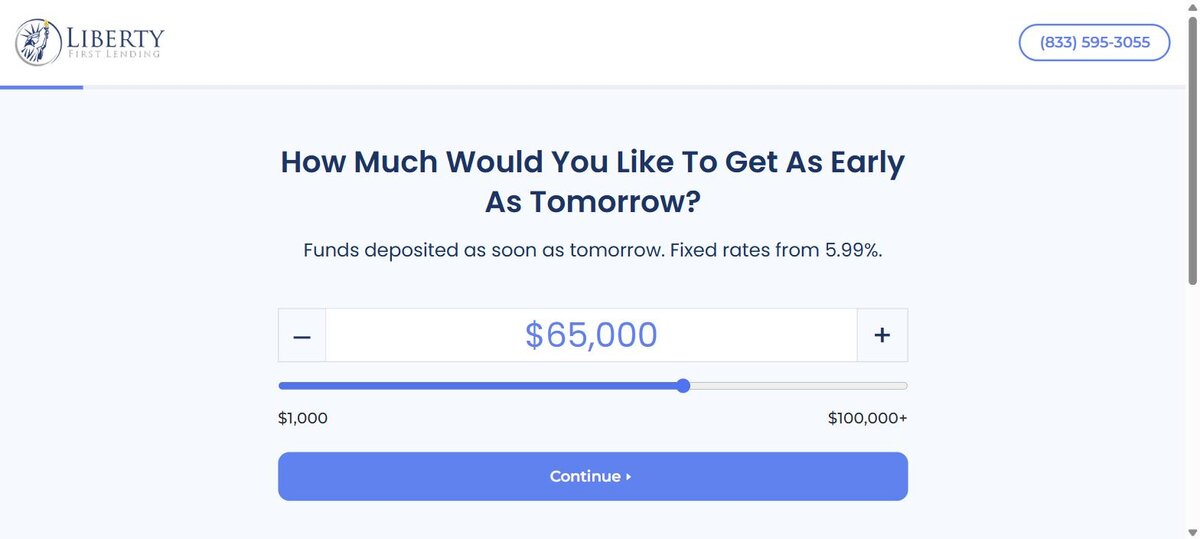
Liberty First Lending’s application funnel opens with a slider running to $100,000 or more, while its two marketing sites publish maximums of $45,000 and $75,000.
What it says it charges
APR range
5.99% to 29.99%
Loan amounts
$2,500 to $45,000 on one of its sites, $2,500 to $75,000 on the other
Origination fee
4.9%, financed into the loan
Term
Up to 60 months
Minimum credit score
None published
Credit pull
Soft at application, hard inquiry before funding
Restriction
The loan must be used to directly pay off qualifying existing debt
Two things to notice. The company runs two marketing sites publishing different maximum loan amounts, $45,000 on one and $75,000 on the other, while the application form offers $100,000 or more as a selectable option.
That is a transparency problem, not a rounding error.
And that 4.9% origination fee is financed into the loan rather than deducted, which means you pay interest on the fee for the life of the term. On a $30,000 consolidation that is roughly $1,470 rolled into the balance and accruing.
The site also concedes that lower interest rate loans and loan amounts above $35,000 may be brokered, alongside the flat statement that not all loans will be made through Liberty and loans may be brokered based on state.
The reviews are real. So is the complaint file. Both matter.
A 4.15 rating across 248 BBB reviews is not nothing, and I am not going to pretend otherwise. Plenty of people had a straightforward experience and said so.
But look at what the complaints are about. They are almost entirely from people who were never customers. That is unusual, and it is the signature of a lead generation operation rather than a lending one.
Theme one: the volume of contact
Since 11/27/24 Liberty First Lending has called and texted over 112 times and has left voicemails in excess causing my voicemail box to fill. (23 January 2025)
For months this place has been texting and calling me from various numbers and area codes spam messages, with my full NAME in all caps. (25 December 2024)
I keep getting unsolicited and unwanted phone calls from this company.
I have repeatedly asked to be removed from their call list. (20 March 2026)
Theme two: the letter promises a loan, the call is something else
Liberty First Lending advertises their business as a debt consolidation loan company and do the classic bait and switch. (24 January 2025)
Their MAILING DOES STATE you are pre-qualified FOR A LOAN. FAKE, FALSE MISLEADING! (three star review, 13 September 2024)
Theme three: where did they get my details
I never have consented for this company to get my information, nor for any other company to run my credit and give it to scam companies like this. (25 November 2024)
About those Google reviews
Worth knowing where the positive volume comes from. Liberty First’s Google review base was built through Birdeye, a paid review solicitation platform, which publishes the account as a marketing case study: zero Google reviews before adopting the platform, 272 at five stars afterwards.
Solicited reviews are legal and extremely common. But a five star average generated by a vendor whose entire job is generating five star averages is not the same evidence as an organic rating, and it should not be weighed the same way.
This is why I lean on complaint counts and regulator records rather than star averages, and why the older third party articles quoting a B plus BBB grade and 3.1 stars are simply out of date. The live figure is A plus and 4.15.
Pros and cons
👍 Publishes an APR range, origination fee and sample payments, which many lead generators never do
👍 Discloses the fourteen parties it shares your data with, on the form, before you submit
👍 BBB accredited with an A+ and a 4.15 customer rating across 248 reviews
👍 Zero CFPB complaints under its legal name, and no regulatory action we could find
👎It is a lead generator, not a lender, and the mailer does not lead with that
👎 Two of the fourteen recipients are debt settlement operations and one is a law firm
👎 Sustained unsolicited contact is the dominant complaint, in one case 112 calls and texts in under two months
👎 No NMLS number published, and a Utah consumer lender registration is a notification filing rather than a substantive licence
👎 Conflicting maximum loan amounts across its own two sites, and a privacy policy link that returns a 404
👎 Three years old, with no consumer finance operating history before 2023
What that mailer actually means
Here is the thing I most want you to take away, and it applies to every letter of this kind, not just this one.
Pre-qualified is a marketing term with no legal weight. It typically means a list broker ran a soft screen against credit bureau data and your profile matched.
It is not an offer, no underwriter has looked at your file, and the rate on the letter is the best case rate for the strongest applicant, not a rate you have been given. The headline 5.99% here is the floor of a range that tops out at 29.99%.
The second thing is that responding costs you something even if you walk away. Your details enter a distribution network. The complaint file for this company is the clearest possible illustration: the loudest and most repeated grievance is not about loan terms, it is about the phone not stopping afterwards.
If you want to stop this class of mail at source, you can opt out of pre-screened credit offers for five years or permanently at OptOutPrescreen.com, the official site run by the consumer credit reporting industry.
The Federal Trade Commission explains how prescreening works in its guide to prescreened offers. That single step will cut the volume more than any amount of asking to be removed from individual lists.
Skip the phone tree
Want the comparison without the calls?
The quiz runs the same triage a good adviser would, across settlement, consolidation, nonprofit counselling and bankruptcy, using your real numbers.
Liberty First may genuinely help if you have good credit, want to compare several lenders quickly, and are relaxed about being contacted. Its partner network includes real lenders and a broker can save you filling in five applications.
But you can reach the same lenders directly. Prosper, Upstart, BestEgg, Marcus and Axos all take applications on their own sites, and going direct means one company holds your details rather than fourteen.
If the honest situation is that a consolidation loan will not solve it, because the balances are too large relative to income or your credit will not carry a decent rate, then the loan route is a detour. Our account of clearing over 100,000 dollars in card debt walks through what actually worked, and our CreditAssociates review covers a settlement provider with a longer track record than anything on this page.
If the problem is interest rather than principal, a nonprofit debt management plan is almost always cheaper than a consolidation loan carrying a 4.9% origination fee. Money Management International is the nonprofit agency we have reviewed most closely. And if you are being sued or garnished, that is a lawyer question rather than a loan question, which our guide to debt consolidation attorneys covers.
Frequently Asked Questions
Is Liberty First Lending legit?
Yes, it is a real registered company. Liberty First Lending, LLC operates from 18500 Von Karman Avenue, Suite 550, Irvine, California, started in February 2023, and has been BBB accredited since June 2023 with an A+ rating and 4.15 stars from 248 reviews. We found no regulatory action and zero CFPB complaints under its legal name. The important caveat is what it is: by its own description it provides lead referral services alongside loan brokerage, so submitting an application shares your details with fourteen named companies.
Is Liberty First Lending a direct lender?
Not reliably. Its own site states that not all loans will be made through Liberty and that loans may be brokered based on state, and it lists lead referral services among its offerings. It also concedes that lower rate loans and amounts above 35,000 dollars may be brokered. Treat it as a broker and lead generator that sometimes lends, rather than as a lender.
Who does Liberty First Lending share my information with?
Fourteen companies, named on its own application form: Americor Funding, Credit9, Monevo, Prosper, BestEgg, Upstart, Marcus by Goldman Sachs, Axos Bank, Figure, Even, debt.org, In-Charge, ratespecial.com and Advantage Law. Most are lenders. Americor and Credit9 are debt settlement and debt consolidation operations, and Advantage Law is a law firm, which is why some applicants are pitched a debt program rather than the loan they asked about.
Is Liberty First Lending connected to Americor or Credit9?
There is a confirmed referral relationship, because Liberty First names both on its own data sharing consent. We could not confirm common ownership. The three companies sit at different Irvine addresses, and none lists the others as a related business on BBB. One BBB complainant reported calling the number on a Liberty First mailer and having the phone answered by Credit Nine. Some third party articles assert an ownership link; we found no corporate record confirming it.
What does Liberty First Lending charge?
Its published range is 5.99% to 29.99% APR with a 4.9% origination fee financed into the loan, on terms up to 60 months. Because the fee is financed rather than deducted, you pay interest on it for the whole term. Loan amounts are stated as 2,500 to 45,000 dollars on one company site and 2,500 to 75,000 dollars on the other, and no minimum credit score is published.
Does Liberty First Lending have an NMLS number?
We could not find one. Neither of its marketing sites, its terms of use, nor its application form publishes an NMLS identifier. The only licensing claim it makes is Utah Registered Consumer Lender. A Utah consumer credit notification is a filing requirement rather than a substantive lending licence, so it is weaker evidence than an NMLS registration would be.
Why won’t Liberty First Lending stop calling me?
Sustained unsolicited contact is the single largest theme in its complaint file. One BBB complainant documented 112 calls and texts in under two months; others describe messages from rotating numbers and area codes. If you responded to a mailer or submitted the form, your details went to fourteen parties, so some of the contact may not be from Liberty at all. Send a written opt out, and cut the source by opting out of prescreened credit offers at OptOutPrescreen.com.
Does responding to a pre-qualified mailer hurt my credit?
The initial check is usually a soft pull that does not affect your score. A hard inquiry is run before funding, and that does show. The larger risk is not the score, it is that your information enters a distribution network, which is what generates the call volume people complain about.
What is the catch with a 5.99% advertised rate?
It is the floor of a range that reaches 29.99%, reserved for the strongest applicants, and the mailer does not commit anyone to it. Pre-qualified has no legal weight. It generally means a list broker matched your credit profile against a screen, not that an underwriter has reviewed your file or that any offer exists.
What are better alternatives to Liberty First Lending?
If your credit is decent, apply directly to the lenders in its own partner list, such as Prosper, Upstart, BestEgg, Marcus or Axos, so one company holds your data instead of fourteen. If a loan will not fix the problem, compare debt relief providers with longer track records. If the issue is the interest rate rather than the balance, a nonprofit debt management plan usually costs less than a consolidation loan carrying a 4.9% origination fee.
Optima Tax Relief is the most heavily advertised tax resolution firm in America, and it is the one readers ask me about more than any other. Founded in 2011 and based at 6 Hutton Centre Drive in Santa Ana, California, it represents people who owe the IRS: installment agreements, Offers in Compromise, penalty abatement, wage garnishment and levy releases, unfiled returns and audit defense.
It is BBB accredited with an A+ rating and holds close to 13,000 public reviews averaging 4.30 on a volume-weighted basis. It also carries 786 BBB complaints in three years, one of the highest counts in the category. Both of those are real, and the honest version of this review is about what explains the gap.
Not sure whether a tax firm is what you need at all? Our two minute quiz compares settlement, consolidation, nonprofit counseling and bankruptcy against your actual numbers, with nothing to buy at the end.
Certain your problem is IRS debt and want a consultation? Optima Tax Relief works in all 50 states and the first call is free.
Optima Tax Relief at a glance
Company
Optima Tax Relief, LLC
Founded
2011
Headquarters
6 Hutton Centre Dr, Suite 300, Santa Ana, CA 92707
Coverage
All 50 states, federal and state tax debt
Minimum tax debt
10,000 dollars
Investigation fee
295 to 495 dollars
Resolution fee
Roughly 1,500 dollars upward, scaling with complexity
Money-back guarantee
15 days, and it applies to the investigation phase fee only
BBB
A+, accredited. 786 complaints in three years, 219 closed in the last twelve months
Services
Installment agreements, Offer in Compromise, Currently Not Collectible, penalty abatement, levy and garnishment release, lien help, unfiled returns, innocent spouse, audit representation, payroll tax
Yes. Optima Tax Relief is a real, long-established firm with a physical office, BBB accreditation, an A+ rating and nearly fifteen years of trading history. The question worth asking is not whether it exists but whether the outcome justifies the fee, and the public record is genuinely split on that.
Source
Rating
Reviews
Notes
Trustpilot
★★★★★4.5
5,198
76 percent five-star, 10 percent one-star
Google
★★★★★4.2
5,649
Large sample, listed as a tax attorney practice
BBB (A+, accredited)
★★★★★4.07
1,984
Sits alongside a very high complaint count
Volume-weighted average
★★★★★4.30
12,831
How we score every company in our rankings
The complaint number you should actually weigh
786 BBB complaints in three years, with 219 closed in the last twelve months. That is the highest three-year count of any firm I have examined in this category, and it is roughly 30 percent above the next closest. Volume alone does not condemn a company, because Optima advertises harder and serves more clients than almost anyone else, so a bigger denominator produces a bigger numerator. But it is a large number by any reading and you should not skip past it.
Reading through them, the pattern that recurs is not fraud. It is expectation. The most common story is a client who paid several thousand dollars and received an installment agreement, which is a legitimate resolution but also one the IRS grants routinely and which many people could have arranged themselves online for a setup fee of well under 200 dollars. The complaint is rarely “they did nothing”. It is “they did something I did not need to pay for”.
There is also an ongoing class action alleging misconduct, negligence and consumer law violations, which Optima denies. I have not seen a judgment and I am not going to characterise unproven allegations as fact. If it matters to your decision, look up the current docket status yourself before you sign anything.
What Optima Tax Relief costs
Optima uses the standard two-phase model, and its entry price is meaningfully lower than most competitors:
Investigation phase: 295 to 495 dollars. Optima pulls your IRS transcripts, establishes exactly what you owe and identifies which programs you qualify for. This is the cheapest phase-one fee among the large firms.
Resolution phase: from roughly 1,500 dollars, rising substantially with complexity. Multi-year, multi-entity or payroll tax cases run far higher.
15-day money-back guarantee, which covers the investigation fee only. It does not cover the resolution fee and it does not survive past that window.
Minimum tax debt of 10,000 dollars.
The low investigation fee is a real advantage and also the thing to watch. It is priced to be an easy yes. Treat the investigation as a paid diagnostic, and when the resolution quote arrives, evaluate it as a completely fresh decision rather than as a continuation of one you already made.
Owe on cards as well as the IRS? Most people who land here do. The quiz works out which debt to attack first and which route fits your numbers, in about two minutes with nothing to buy.
Being garnished or levied right now? Speed matters more than shopping around. Talk to Optima directly.
The Offer in Compromise reality check
Every tax relief advert is ultimately selling the Offer in Compromise, the programme that settles your debt for less than you owe. The IRS publishes the actual numbers. In fiscal year 2025 taxpayers submitted 38,797 offers and the IRS accepted 5,464, worth 98.1 million dollars. That is an acceptance rate of roughly 14 percent.
So an OIC is real, but it is not the default outcome, and qualification turns on your income, allowable expenses and asset equity rather than on how much you need help. The IRS Offer in Compromise page sets out the tests and hosts a free pre-qualifier tool. Run it before you pay anyone, and treat any promise made on a first sales call, before your transcripts have been pulled, as a guess.
Also worth knowing: filing an OIC costs a 205 dollar IRS application fee plus a non-refundable initial payment, and it pauses the clock on the collection statute while under review. A rejected offer can leave you worse off than a straightforward payment plan.
Optima vs Tax Relief Advocates
These two dominate the category and readers compare them constantly. Here is where they actually differ.
Optima Tax Relief
Tax Relief Advocates
Founded
2011
2017
Google rating
★★★★★ 4.2 (5,649)
★★★★★ 4.7 (7,763)
Trustpilot
★★★★★ 4.5 (5,198)
★★★★★ 3.2 (18)
BBB customer rating
★★★★★ 4.07 (1,984)
★★★★★ 4.15 (1,728)
Volume-weighted
4.30 across 12,831
4.60 across 9,509
BBB complaints, 3 years
786
598
Investigation fee
295 to 495 dollars
595 to 795 dollars
Minimum debt
10,000 dollars
5,000 dollars
Refund window
15 days, investigation fee only
Investigation phase only
Optima is cheaper to start with and has the longer track record. Tax Relief Advocates scores better on reviews and takes smaller cases. Neither gap is large enough to decide on its own. Get a written quote from both on identical facts and compare total cost and the exact refund cutoff. For a smaller boutique option, our Five Star Tax Resolution review covers that end of the market.
Pros and cons
👍 What Optima gets right
Fifteen years of operating history, the longest of the major firms.
The lowest investigation fee in the category, 295 to 495 dollars, which makes the diagnostic step genuinely affordable.
Nearly 13,000 public reviews averaging 4.30 volume-weighted, including 4.5 on Trustpilot across more than 5,000 reviews.
Complete service range, including payroll tax and audit representation that smaller firms decline.
BBB accredited with an A+ rating and a documented complaint response process.
Credentialed staff. Enrolled agents, CPAs and tax attorneys who can sign a Form 2848 and represent you directly.
👎 Where Optima falls short
786 BBB complaints in three years, the highest count in the category by a clear margin.
Recurring theme of paying thousands for a standard payment plan that the IRS grants routinely and cheaply.
No published resolution pricing. You only learn the real cost after paying for the investigation.
The guarantee is narrow. 15 days, investigation fee only, nothing on outcome.
10,000 dollar minimum shuts out smaller balances, which is arguably a kindness.
An unresolved class action alleging misconduct and consumer law violations, which Optima denies.
Free options to rule out first
I say this in every one of these reviews because it is where most of the regret comes from. Before paying a private firm, spend an hour on the following:
IRS Online Payment Agreement. Under 50,000 dollars you can usually set this up yourself at irs.gov in about ten minutes for a modest setup fee. This is the single most important item on the list, because it is exactly what a large share of the complaints describe paying thousands to obtain.
First-time penalty abatement. One phone call can remove penalties if you have a clean three-year compliance history.
The Taxpayer Advocate Service. Free help from an independent office inside the IRS when you face genuine hardship or your case has stalled.
Low Income Taxpayer Clinics. Free or near-free representation, including in Tax Court, if your income qualifies. The LITC directory lists them state by state.
Who should hire Optima, and who should not
Worth it if: you owe well above the 10,000 dollar minimum, you have multiple unfiled years, you are facing a garnishment or levy, your case involves a business, payroll taxes or a spouse, or you have tried the IRS yourself and hit a wall. Complexity is what you are paying for and Optima has the staff to handle it.
Also worth it if you simply will not deal with the IRS yourself. That is a legitimate reason. Some people would rather pay several thousand dollars than spend a year on hold, and there is no shame in valuing your own peace of mind.
Not worth it if: you owe between 10,000 and roughly 25,000 dollars, you have filed all your returns and you are not being levied. That profile almost always ends in an installment agreement, and you can obtain one online in ten minutes. After twenty years of reading these stories, this is the most common expensive mistake in the entire industry.
And if your real problem is credit card debt rather than tax debt, a tax firm cannot help at all. Our ranking of debt relief companies covers that, and if bankruptcy has crossed your mind, read whether bankruptcy clears tax debt, because some older tax debt genuinely is dischargeable.
What to ask before you pay the resolution fee
What is the total resolution cost as a single number? Not a range, not “it depends”.
Which specific resolution are you pursuing and why that one?
Could I obtain this same outcome myself through the IRS? Ask it plainly and listen to the answer.
Who is my case manager and how do I reach them directly?
How often will I receive updates? Silence during long cases drives most complaints.
Is back return preparation included or billed separately?
Which credentialed professional signs my Form 2848? Get the name and credential.
For heavier situations, our guide to choosing a tax debt lawyer or attorney explains when an attorney’s hourly rate beats a flat-fee firm, which is usually where criminal exposure or a large business liability is in play.
Final thoughts
Optima Tax Relief is a legitimate, experienced firm that does competent work on complicated cases. It is also the most complained-about firm in its category, and the complaints cluster around one specific failure: people paying premium prices for an outcome the IRS would have given them cheaply.
That makes the decision unusually clear. The value of Optima is proportional to the complexity of your case. Complicated, multi-year, business-involved, actively-being-collected: worth it. Straightforward balance, returns filed, nobody garnishing you: almost certainly not.
Use the 295 dollar investigation as what it is, a cheap diagnostic. Then, when the resolution quote comes back, ask the one question that matters, which is whether you could get the same result yourself. If the honest answer is yes, take the 15-day refund and go do it.
Frequently asked questions about Optima Tax Relief
Is Optima Tax Relief legit?
Yes. Optima Tax Relief, LLC has operated since 2011 from Santa Ana, California, is BBB accredited with an A+ rating, and holds close to 13,000 public reviews averaging 4.30 volume-weighted: 4.5 on Trustpilot from 5,198 reviews, 4.2 on Google from 5,649, and 4.07 on BBB from 1,984. It is a real firm with credentialed staff. It also carries 786 BBB complaints over three years, the highest in its category, so legitimate does not mean trouble free.
How much does Optima Tax Relief cost?
The investigation phase costs 295 to 495 dollars, the lowest entry fee among the major tax resolution firms. The resolution phase starts at roughly 1,500 dollars and rises substantially with complexity, and it is quoted only after the investigation is complete. There is a 15-day money-back guarantee that covers the investigation fee only, not the resolution fee and not the outcome.
What is the minimum debt for Optima Tax Relief?
10,000 dollars in tax debt. If you owe less than that, or you owe between 10,000 and about 25,000 dollars with all returns filed and no active collection, you can almost certainly set up an IRS Online Payment Agreement yourself in about ten minutes for a fraction of any firm’s fee.
Why does Optima Tax Relief have so many BBB complaints?
786 complaints in three years, 219 closed in the last twelve months. Part of this is scale, since Optima advertises more heavily and serves more clients than most competitors. But the recurring theme is specific: clients who paid several thousand dollars and received an installment agreement, which is a legitimate resolution that the IRS grants routinely and that they could often have arranged themselves. Very few complaints allege fraud. Most allege paying for something they did not need.
Is there a lawsuit against Optima Tax Relief?
There is an ongoing class action alleging misconduct, negligence and violations of consumer laws, which Optima denies. We have not seen a judgment and are not treating unproven allegations as established fact. If this matters to your decision, check the current docket status yourself before signing, and search the CFPB consumer complaint database for the exact legal entity name.
Does Optima Tax Relief have a money-back guarantee?
A limited one. The guarantee runs for 15 days and applies to the investigation phase fee only. It does not cover the resolution fee, and it does not guarantee any outcome. Understand exactly when the window closes before you move from the investigation to the resolution phase, because that boundary is where most refund disputes happen.
Will Optima Tax Relief settle my tax debt for less?
Possibly, but the odds are lower than advertising implies. The Offer in Compromise is the programme that reduces what you owe, and in fiscal year 2025 the IRS accepted 5,464 of 38,797 offers, roughly 14 percent. Qualification depends on your income, allowable expenses and asset equity rather than on need. The IRS provides a free pre-qualifier tool, and anyone promising an OIC before pulling your transcripts is guessing.
Optima Tax Relief vs Tax Relief Advocates: which is better?
Close, with different strengths. Optima has been trading since 2011 versus 2017, and its investigation fee is lower at 295 to 495 dollars against 595 to 795. Tax Relief Advocates scores better on reviews, 4.60 volume-weighted against Optima’s 4.30, has fewer complaints (598 against 786) and accepts smaller cases from 5,000 dollars. Get a written quote from both on identical facts and compare the total cost and the exact refund cutoff.
Can Optima Tax Relief stop a wage garnishment or bank levy?
Yes. Levy and garnishment releases are usually granted once an acceptable collection alternative is in place, and this is among the fastest genuine wins in tax resolution. If the IRS has levied your bank account you have 21 days before the funds are remitted, so this is the one scenario where acting immediately matters more than comparing providers.
Does Optima Tax Relief handle state tax debt?
Yes, alongside federal. State revenue agencies run their own programmes and timelines, and several have collection powers more aggressive than the IRS. Confirm during the consultation that your specific state work is included in the quoted resolution fee rather than billed separately.
Does Optima Tax Relief file unfiled tax returns?
Yes, and for many clients this comes first, because the IRS will not agree to any resolution while you are non-compliant. Ask specifically whether back return preparation sits inside the quoted resolution fee or is billed separately per year, because separate billing is common and it is a frequent source of unexpected cost.
How long does Optima Tax Relief take?
It varies enormously by case. An installment agreement on a compliant account can complete in weeks. An Offer in Compromise with several unfiled years realistically takes a year or more, and the IRS review period alone is lengthy. Ask for a written estimate for your specific case, and be sceptical of any promise of a quick resolution on a complicated file.
What credentials does Optima Tax Relief have?
Optima employs enrolled agents, certified public accountants and tax attorneys. Only those three credentials can represent you before the IRS under a Form 2848 power of attorney. Before signing, ask which specific credentialed professional will sign your 2848 and get their name, because the salesperson you speak to first usually is not that person.
Are there free alternatives to Optima Tax Relief?
Yes, and they should be your first stop. The IRS Online Payment Agreement lets you arrange a plan yourself if you owe under 50,000 dollars. First-time penalty abatement often takes one phone call. The Taxpayer Advocate Service helps free of charge in hardship or stalled cases. Low Income Taxpayer Clinics provide free or nominal-cost representation, including in Tax Court, for qualifying incomes.
Will hiring Optima Tax Relief affect my credit score?
No. The IRS does not report tax debt to the credit bureaus, and the major bureaus removed tax liens from consumer credit reports years ago, so neither the debt nor hiring a representative touches your score. What does hurt you financially is an active levy or wage garnishment, which takes money from your account and paycheck directly.
I have been writing about debt relief since the early 2000s, and in that time no company has generated more reader email than National Debt Relief. Some of it is glowing. Some of it is furious. The gap between those two piles is almost always explained by one thing: whether the person understood what they were signing up for before they signed. So let me try to close that gap for you, with the actual numbers, the actual ratings, and the lawsuit that is currently making the rounds in search results.
Not sure settlement is the right route for you? Our two minute quiz compares settlement, consolidation, nonprofit counseling and bankruptcy against your actual numbers, with nothing to buy at the end.
Already decided and want a direct quote? National Debt Relief offers a free consultation and charges no fee unless a debt is settled.
Quick answer: is National Debt Relief legit?
Yes. National Debt Relief is a legitimate debt settlement company. It has operated since 2009, it is accredited by the Better Business Bureau with an A+ rating, and it holds accreditation from the Association for Consumer Debt Relief and the International Association of Professional Debt Arbitrators. It does not charge fees before a debt is settled, which is the single clearest line between a real settlement company and a scam.
Legitimate is not the same as right for you. Debt settlement is a blunt instrument that wrecks your credit on purpose, and for a large share of the people who ask me about it, a nonprofit debt management plan would have been the better call. I will come back to that.
National Debt Relief at a glance
Founded
2009
Settlement fee
15% to 25% of enrolled debt
Minimum debt
$7,500 in unsecured debt
Program length
24 to 48 months
Account fees
$9 one time setup, $9.85 per month for the dedicated savings account
Typical enrollment
Over $27,500 in total debt
Availability
Roughly 45 states. Oregon, Vermont and West Virginia are consistently excluded, and some sources also list Connecticut and Wisconsin. Confirm your state on the call.
Upfront fees
None. You pay only after a settlement is reached and you approve it.
What it actually costs
This is where most of the angry reader mail originates, so read this section twice.
The fee is 15% to 25% of your enrolled debt, not of the amount you save. That distinction is everything. If you enroll $30,000 and they settle it for $15,000, you did not just save $15,000. You saved $15,000 minus a fee calculated on the original $30,000. At a 22% fee that is $6,600, so your real outlay is closer to $21,600.
Industry reporting puts the expected net saving at roughly 20% of enrolled debt after fees. That is a genuine saving, and for someone drowning it can be the difference between a plan and a spiral. But it is nowhere near the “cut your debt in half” framing that floats around the ads.
Worked example
Amount
Debt you enroll
$30,000
Settled for (illustrative 50%)
$15,000
Fee at 22% of enrolled debt
$6,600
Account fees over 36 months
about $364
Total you actually pay
about $21,964
Those settlement percentages are illustrative, not promised. Creditors are under no obligation to settle at any particular number, and some will not settle at all.
Ratings and reviews from third party sources
National Debt Relief scores well, and unusually well for this industry.
Source
Rating
Volume
Better Business Bureau
★★★★★4.71 / 5, A+ accredited
6,282 reviews
Trustpilot
★★★★★4.7 / 5, rated Excellent
Thousands of reviews
The number I always look at second is complaint volume: 520 BBB complaints over three years, with 177 closed in the last twelve months. On a customer base this size that is not alarming, and an A+ accreditation survives it. What matters is the pattern inside those complaints, and the pattern here is consistent and predictable. People are surprised by how far their credit score falls, surprised that creditors kept calling, and surprised that the fee was calculated on enrolled debt. Every one of those is a disclosure problem, not a fraud problem.
About that 2026 lawsuit
If you searched for this company recently you probably saw the word “lawsuit” and got nervous. Here is what is actually going on, because the search results do a poor job of explaining it.
In May 2026 a class action was filed against National Debt Relief LLC in the U.S. District Court for the Northern District of California, Castrillo v. National Debt Relief LLC, case number 3:26-cv-04481. It is a marketing and privacy case, not a case about the quality of the debt settlement service. The complaint alleges that the company, working with an outside marketing firm, sent spam emails that appeared to come from the Department of Veterans Affairs, and that clicking them enabled tracking. It cites California’s anti spam statute and seeks statutory damages per email.
That is a serious allegation about lead generation practices, and it is worth knowing. It is not an allegation that customers’ debts went unsettled. The case is active and unproven, so treat it as an open question rather than a verdict.
One more piece of cleanup, because I see this conflated constantly. There was a $9 million FTC settlement in 2017 over deceptive debt relief solicitations, and it did not involve this company. That action concerned United Debt Services. If you find a page implying National Debt Relief paid an FTC penalty, that page is wrong.
The pros and cons
👍 What works
No fee until a debt is settled. This is the industry’s most important consumer protection and they follow it.
You approve every settlement before it goes through. Nothing is agreed behind your back.
Genuinely strong third party ratings, with an A+ BBB accreditation across more than six thousand reviews.
Sixteen years of operating history, which in this industry counts for a lot.
Broad debt eligibility, including medical bills, collections and some private student loans.
Free consultation with no obligation to enroll.
👎 What does not
The fee is charged on enrolled debt, not on savings. This materially changes the math and it is the number one source of complaints.
Your credit will take real damage. The program requires you to stop paying creditors.
Creditors can still sue you while you are saving toward a settlement. Nothing about enrolling stops that.
Not available in every state, and the excluded list is inconsistent across sources.
Forgiven debt over $600 is generally taxable unless you qualify for an exclusion.
$7,500 minimum puts it out of reach for smaller balances.
No live chat support, which is a small thing until you need an answer quickly.
What debts qualify
Accepted
Not accepted
Credit cards, personal loans, medical bills, payday loans, accounts in collections, repossession balances, lines of credit, some private student loans
Mortgages, auto loans, any secured debt, federal student loans, back taxes owed to the IRS
The tax debt exclusion catches people out. Settlement companies cannot negotiate with the IRS, and if your problem is tax debt rather than credit card debt you are in a different lane entirely. Worth reading how bankruptcy interacts with tax debt before you go anywhere near a settlement firm.
Who this actually suits
After two decades of these conversations, I have a fairly reliable filter.
Debt settlement is worth considering if you have more than $7,500 in unsecured debt, you genuinely cannot clear it in five years on your current income, your credit is already damaged, and you can commit to a monthly deposit for two to four years without missing.
Look elsewhere if your credit is still intact and you want to keep it, your debt is under $7,500, your income is stable enough to handle a structured repayment plan, or your problem is tax debt or a secured loan.
Here is the anecdote I always end up telling. Years ago a reader wrote to me midway through a settlement program, panicking because a creditor had sued her four months in. She assumed enrolling had bought her protection. It had not, and nobody had told her plainly that it would not. She got through it, the account eventually settled, and she was fine. But she spent four months in avoidable terror because of one sentence nobody said out loud. So I will say it out loud: enrolling in a settlement program does not stop a creditor from suing you. Ask directly what happens if you get served, and get the answer before you sign.
The second thing I have learned is that a lot of people arrive at settlement having never seriously looked at a debt management plan. A nonprofit credit counseling agency can often cut your interest rate substantially while you repay the full principal, and your credit comes out of it far healthier. That route is invisible in advertising because nobody makes much money selling it. Start with the NFCC and how nonprofit counseling works, and look at Money Management International as a concrete example of that model. If a DMP fits, take it. If it does not, then settlement is a reasonable next conversation.
The honest summary is that the major settlement companies have converged on nearly identical pricing. What separates them is state availability, how they handle you when something goes wrong, and whether their lead generation is clean. On the first two, National Debt Relief is at or near the top of the category. For the wider field, our ranked comparison of debt relief companies scores everyone on volume weighted third party ratings.
Want to know what you would actually qualify for? The consultation is free, there is no obligation, and it will not cost you anything unless a debt is settled and you approve it.
Not sure settlement is the right route? Our debt relief quiz walks you through the alternatives in about two minutes.
Five things to do before you enroll
Get the fee in writing as a dollar figure, not a percentage. Make them tell you what the total cost will be on your specific balance.
Ask what happens if a creditor sues you. Get the answer before you sign, not after.
Confirm your state is served. Availability lists differ between sources, so trust only what they tell you directly.
Plan for the tax bill. Forgiven debt above $600 is generally reportable income. The IRS guidance on cancelled debt explains the exclusions, and insolvency is the one most people qualify for.
If the numbers still do not work after all that, the honest answer may be that settlement is not your tool. Compare it squarely against the alternative in our breakdown of bankruptcy versus debt relief, and if your balance sits in the middle of the range, our guide to paying off $20,000 in credit card debt lays out every route side by side.
The bottom line
National Debt Relief is one of the better operators in a category that has earned its bad reputation. The ratings are real, the no fee until settled structure is real, and sixteen years without a regulatory action against the company is a meaningful record in this business. The open class action is about marketing conduct rather than service delivery, and it deserves to be watched rather than panicked over.
My reservation is not about the company. It is about the product. Debt settlement damages your credit by design, exposes you to lawsuits while you save, and charges its fee on the debt you brought rather than the money you saved. When it is the right tool it is genuinely the right tool. It is just the right tool less often than the advertising suggests. Check whether a nonprofit debt management plan fits first, and if it does not, National Debt Relief is a reasonable place to have the next conversation.
One last thing worth knowing: predatory lenders circle people in exactly this situation. If anyone offers you a loan to “consolidate” your way out mid program, read our explainer on predatory lending and interest rate caps before you sign a thing.
Frequently Asked Questions About National Debt Relief
Is National Debt Relief legit?
Yes. National Debt Relief has operated since 2009, holds an A+ accredited rating with the Better Business Bureau based on more than 6,000 reviews, and is accredited by the Association for Consumer Debt Relief and the International Association of Professional Debt Arbitrators. It charges no fee until a debt is actually settled and you approve the settlement.
How much does National Debt Relief charge?
The settlement fee is 15% to 25% of your enrolled debt, charged only after a debt is settled. There is also a $9 one time setup fee and a $9.85 monthly fee for the dedicated savings account. Note that the fee is calculated on the debt you enrolled, not on the amount you saved.
What is the minimum debt for National Debt Relief?
You need at least $7,500 in unsecured debt to enroll. The average customer enrolls more than $27,500. If your balance is below $7,500, a nonprofit debt management plan or a structured payoff strategy is usually the better route.
How long does the National Debt Relief program take?
Most programs run 24 to 48 months. The exact length depends on how much you enroll, how much you can deposit each month, and how quickly individual creditors agree to settle. Some accounts settle within months while others take years.
Is National Debt Relief being sued in 2026?
There is an active class action filed in May 2026 in the U.S. District Court for the Northern District of California, Castrillo v. National Debt Relief LLC, case number 3:26-cv-04481. It alleges deceptive spam email and website tracking practices in the company’s marketing, not failures in the debt settlement service itself. The allegations are unproven. Separately, the $9 million FTC settlement from 2017 that is sometimes attributed to this company actually involved a different firm, United Debt Services.
Will National Debt Relief hurt my credit score?
Yes, and significantly. The program requires you to stop paying your creditors so that accounts become delinquent enough to negotiate. Missed payments, charge offs and settled accounts all appear on your credit report and can stay there for up to seven years. Anyone telling you debt settlement is credit neutral is not being straight with you.
Can creditors still sue me while I am in the program?
Yes. Enrolling in a debt settlement program gives you no legal protection from collection lawsuits. Creditors are not obligated to negotiate and some will sue instead. Ask the company directly what support they provide if you are served, and get that answer before you enroll.
What states does National Debt Relief serve?
Roughly 45 states. Oregon, Vermont and West Virginia are consistently listed as excluded, and some sources also list Connecticut and Wisconsin. State availability changes as licensing rules shift, so confirm directly during your consultation rather than relying on any published list.
What debts can National Debt Relief help with?
Unsecured debts including credit cards, personal loans, medical bills, payday loans, accounts in collections, repossession balances and some private student loans. It cannot help with mortgages, auto loans or any other secured debt, federal student loans, or back taxes owed to the IRS.
Do I pay taxes on debt that gets forgiven?
Usually yes. The IRS generally treats forgiven debt above $600 as taxable income and you should expect a 1099-C. There are exclusions, and the insolvency exclusion is the one most debt settlement customers qualify for. Budget for a potential tax bill and speak to a tax professional before your settlements complete.
Is National Debt Relief better than a nonprofit credit counseling agency?
Not for most people. A nonprofit debt management plan typically reduces your interest rate while you repay the full principal, costs far less, and leaves your credit in much better shape. Debt settlement makes sense when the balance is genuinely unpayable within about five years and your credit is already damaged. Check whether a debt management plan fits before you consider settlement.
What happens if I cancel partway through the program?
You can leave a debt settlement program at any time and the money remaining in your dedicated savings account is yours. The problem is what you leave behind. Any accounts that went delinquent while you were enrolled stay delinquent, and you will have paid fees on debts that were already settled. Cancelling early is usually the worst of both worlds, which is why the commitment matters more than the sales pitch.
Family Credit Management is one of the few companies in this industry I have never had to write a warning about. That is not a small thing. I have been covering debt relief for more than twenty years, and the overwhelming majority of the mail I get is from people who signed with a for-profit settlement firm and only understood the fee structure afterward. Family Credit is a different animal: a 501(c)(3) nonprofit that has been doing this for over thirty years, and whose core product costs most people about $28 a month.
Not sure whether a nonprofit debt management plan or settlement fits your situation? Our two minute quiz compares settlement, consolidation, nonprofit counseling and bankruptcy against your actual numbers, with nothing to buy at the end.
Want to speak to a nonprofit counselor directly? The NFCC will refer you to a member agency and the first session is free.
Quick answer: is Family Credit Management legit?
Yes, and it is legitimate in a stronger sense than most companies that get asked this question. Family Credit Management is a registered 501(c)(3) nonprofit, a member of the National Foundation for Credit Counseling, holds an A+ rating with the Better Business Bureau, is ISO certified, is licensed by state banking departments, and is audited annually. It says it has served more than one million consumers and helped repay over $1 billion in debt.
Its credit counseling and budget review sessions are free. You are not paying to find out whether you qualify.
Family Credit Management at a glance
Organization type
501(c)(3) nonprofit
Experience
Over 30 years
Main product
Debt Management Program (DMP)
Average monthly fee
$28 in 2025, on a sliding scale
Average setup fee
$39 one time, on a sliding scale
Counseling cost
Free, always
Accreditation
NFCC member, BBB A+, ISO certified, annually audited, licensed by state banking departments
Track record
Over 1 million consumers served, $1 billion or more repaid
What it actually costs, and why that number matters so much
Here is the comparison that should decide this for most people.
A for-profit debt settlement company typically charges 15% to 25% of your enrolled debt. On a $30,000 balance that is $4,500 to $7,500, and the fee is calculated on what you brought in, not on what you saved. Family Credit’s Debt Management Program charged an average of $28 a month plus a $39 setup fee in 2025. Over a four year plan that is roughly $1,383 in total.
On $30,000 of credit card debt
Approximate cost
Family Credit DMP, 48 months at $28 plus $39 setup
about $1,383
For-profit settlement at 22% of enrolled debt
about $6,600
Difference in fees alone
about $5,217
The tradeoff is real and I am not going to hide it. On a DMP you repay the full principal. Settlement aims to reduce what you owe. So the honest framing is not “the DMP is cheaper” in every sense, it is: a DMP costs far less in fees, protects your credit, and repays everything, while settlement may reduce the balance but costs several thousand in fees and damages your credit for years. Which one wins depends entirely on whether you can realistically repay the principal at a reduced interest rate.
What Family Credit Management actually offers
This is where a lot of coverage elsewhere gets it wrong. Family Credit is usually filed under “debt settlement companies.” That is a mislabel. Settlement is one of four things it does, and it is not the main one.
Debt Management Program. The flagship. Your unsecured debts get consolidated into one monthly payment, and the agency negotiates reduced interest rates with your creditors. You repay the full principal, usually over three to five years.
Debt Settlement. Offered for accounts that are already significantly past due or charged off. This is the exception, not the default.
DualTrack hybrid plan. Combines management and settlement, for people whose accounts are in mixed condition. Some current, some long past due.
Priority Repayment Plan. For situations where certain obligations need to be cleared ahead of others.
Credit counseling and budget review. Free, and available whether or not you enroll in anything.
That DualTrack option is genuinely uncommon and worth knowing about. Most agencies make you pick a lane. If half your accounts are current and half are six months delinquent, being forced to choose one strategy for all of them is a bad fit, and this is one of the few places that will not make you do it.
Ratings and reviews from third party sources
Source
Rating
Detail
ConsumerAffairs
★★★★★5.0 / 5
318 verified reviews, 284 of them five star
Better Business Bureau
★★★★★A+ rating
Long standing, low complaint volume
NFCC
Member agency
Held to NFCC standards, audited annually
A word of caution on that 5.0. Any rating that near perfect deserves a raised eyebrow, and I would not treat 318 reviews as a large sample for an agency that claims a million clients. What makes me comfortable here is not the score itself, it is that the score is consistent with the structure. A nonprofit charging $28 a month simply has fewer ways to disappoint you than a company charging $6,600 up front against uncertain results. Fewer promises, fewer broken ones.
The themes in the positive reviews are what you would expect: fast responses, successful interest rate reductions, staff described as patient rather than salesy. The complaints that do appear are mostly about slow starts and unclear timelines at the beginning of a plan.
The pros and cons
👍 What works
Genuinely nonprofit, a registered 501(c)(3) rather than a for-profit wearing nonprofit language.
Fees are a rounding error next to settlement pricing. Around $28 a month against thousands.
Free counseling with no obligation, so the diagnostic costs you nothing.
You repay the principal, which keeps your credit in far better shape than settlement does.
NFCC membership plus annual audits, which is real external accountability.
The DualTrack option handles mixed situations that most agencies cannot.
Over thirty years of operating history.
👎 What does not
You repay everything you owe. A DMP reduces interest, not principal.
You need enough income to sustain the monthly payment for three to five years. If the budget does not close, a DMP cannot fix it.
Credit cards get closed when they enter the plan, which reduces your available credit and can dent your score.
Creditor participation is not guaranteed. Most banks work with NFCC agencies, but not every account will be accepted.
Review volume is modest relative to the company’s claimed scale, so the ratings are thinner evidence than they look.
State availability depends on banking department licensing, so confirm your state directly.
Not the answer for secured debt such as mortgages and auto loans, or for federal tax debt.
Who this suits, and who it does not
A debt management plan is probably right for you if your problem is the interest rate rather than the principal, you have steady income, your accounts are mostly current or only recently late, and you want to get out of debt without torching your credit.
Look elsewhere if the math does not work even at a much lower interest rate, your accounts are deeply charged off, or your income is too unstable to commit to a fixed payment for several years. In those cases settlement or bankruptcy may genuinely be the more honest answer.
The mistake I see most often is people arriving at debt settlement without ever having had a free counseling session. Settlement gets advertised heavily because there is real money in it. Nonprofit counseling is barely advertised at all because there is not. That asymmetry, not the relative merits, is why so many people have never heard of the cheaper option. If you want the wider context on how the nonprofit side of this industry is organised, start with our review of the NFCC and what member agencies are held to.
Here is the case that stuck with me. A reader once sent me his settlement quote and his DMP quote side by side, on almost the same balance. The settlement projection looked better on the headline number, and he was ready to sign it. What he had not noticed was that the fee sat on the enrolled balance, the timeline assumed every creditor would cooperate, and none of it protected him from being sued in the meantime. The DMP quote was unglamorous and cost a few hundred dollars a year. He took the DMP, finished it, and kept a credit score he could use afterward. Neither document was dishonest. One was just much easier to misread than the other.
Percentage-of-debt fees, $10,000 minimum, tax debt help
If you want the whole field scored on third party ratings rather than marketing claims, our ranked comparison of debt relief companies puts nonprofit agencies and for-profit firms on the same table so the pricing gap is visible at a glance.
Not sure whether a DMP, settlement or something else fits? A free counseling session with an NFCC member agency will give you a straight answer based on your actual budget, with nothing to buy at the end of it.
You can also go directly to Family Credit Management, or take our debt relief quiz to narrow the options in about two minutes.
What to ask on your first call
What will my monthly fee actually be? The sliding scale means the average is not necessarily your number. Ask for yours.
Which of my creditors have you already confirmed will participate? Not all will, and you want that list before you commit.
What happens to my accounts when they enter the plan? Expect them to be closed, and understand what that does to your utilization ratio.
What is my realistic payoff date? If it is longer than five years, the plan may not be the right structure.
What are my alternatives if I do not qualify? A good counselor will tell you honestly, including when bankruptcy is the better route.
Before that call, it is worth knowing what the regulators say. The CFPB’s explainer on debt settlement is blunt about the risks on the for-profit side and points to nonprofit counseling as the safer first stop, and the FTC’s guide to getting out of debt walks through how credit counseling and DMPs are supposed to work so you can spot an agency that deviates from the norm.
The bottom line
Family Credit Management is the kind of organisation I wish more people found before they found the alternatives. It is a real nonprofit with three decades behind it, external accountability through the NFCC, free counseling, and a fee structure that costs a fraction of what the for-profit settlement industry charges. For someone whose problem is a punishing interest rate rather than an unpayable principal, that combination is close to ideal.
It is not a miracle. You will repay what you borrowed, you will need steady income for several years, and your cards will close. If your balance is genuinely beyond reach no matter the interest rate, a DMP will not save you and you should look at settlement or bankruptcy instead. But start here, because the counseling is free and the diagnostic is honest. The worst outcome is that you learn a DMP does not fit, which is exactly the thing you would otherwise pay thousands to find out later.
Frequently Asked Questions About Family Credit Management
Is Family Credit Management legit?
Yes. Family Credit Management is a registered 501(c)(3) nonprofit with over 30 years of operating history, a member agency of the National Foundation for Credit Counseling, ISO certified, licensed by state banking departments, audited annually, and rated A+ by the Better Business Bureau. Its credit counseling and budget reviews are free.
Is Family Credit Management a nonprofit?
Yes, it is a registered 501(c)(3) nonprofit. That is a meaningful distinction in this industry, where some for-profit companies use nonprofit sounding language without holding the status. Nonprofit status also means annual audits and external accountability through the NFCC.
How much does Family Credit Management charge?
Credit counseling and budget reviews are free. For the Debt Management Program, the 2025 average monthly fee was $28 and the average one time enrollment fee was $39. Fees are set on a sliding scale based on your circumstances and state rules, and they are built into your monthly payment.
How does a debt management plan differ from debt settlement?
A debt management plan consolidates your unsecured debts into one monthly payment and lowers your interest rates while you repay the full principal, usually over three to five years. Debt settlement tries to reduce the principal itself, but requires you to stop paying creditors, damages your credit, and typically costs 15% to 25% of your enrolled debt in fees.
Will Family Credit Management hurt my credit score?
Far less than debt settlement will. On a debt management plan you keep making payments, so your accounts stay current. The main short term effect is that enrolled credit cards get closed, which lowers your available credit and can nudge your utilization ratio up. Most people see their score recover and then improve as balances fall.
What services does Family Credit Management offer?
Four main programs: a Debt Management Program (the flagship), debt settlement for accounts that are already significantly past due or charged off, a DualTrack hybrid plan that combines both for mixed situations, and a Priority Repayment Plan. Free credit counseling and budget reviews are available whether or not you enroll.
What is the DualTrack plan?
DualTrack combines debt management and debt settlement in a single plan. It is designed for people whose accounts are in mixed condition, where some are current and suit a management plan while others are long past due and suit settlement. Most agencies make you choose one approach for everything, so this flexibility is uncommon.
Does Family Credit Management work in my state?
Availability depends on licensing with individual state banking departments, so it varies. The company describes itself as licensed by state banking departments across the U.S., but you should confirm your specific state directly during the free consultation rather than relying on any published list.
What debts can a debt management plan cover?
Unsecured debts, primarily credit cards, along with some personal loans, collections and medical bills. Debt management plans cannot help with secured debts such as mortgages and auto loans, and they do not cover federal tax debt or federal student loans.
Do all creditors have to accept a debt management plan?
No. Creditor participation is voluntary. Most major banks work routinely with NFCC member agencies and agree to reduced interest rates, but not every account will be accepted. Ask which of your specific creditors have been confirmed before you enroll.
How long does a Family Credit Management debt management plan take?
Most plans run three to five years. The exact length depends on your total balance, the interest rate reductions your creditors agree to, and how much you can pay each month. The FTC notes that a successful plan can take 48 months or more, so treat it as a multi year commitment.
Is Family Credit Management better than a for-profit debt settlement company?
For most people whose problem is the interest rate rather than an unpayable principal, yes. The fee difference is substantial: roughly $1,383 over a four year plan versus around $6,600 for settlement on a $30,000 balance. You also keep your credit intact. Settlement makes more sense when the principal is genuinely beyond reach and your credit is already damaged.