
Cambridge Credit Counseling is a nonprofit agency founded in 1996 and based in Agawam, Massachusetts. It is a member of the NFCC and the FCAA, HUD approved for housing counseling, ISO 9001 registered, and listed by the Justice Department as approved to deliver pre bankruptcy counseling. What makes it unusual among the agencies I have reviewed is the fee: Cambridge does not publish a flat rate. It sets your fee against what your household can afford, inside whatever ceiling your state allows.
That is how long a debt management plan ties up your budget
Worth knowing whether it is the right tool before you commit to it. Our quiz takes two minutes and asks the three questions that decide it.
Cambridge Credit Counseling at a glance
| Founded | 1996 |
| Structure | Nonprofit credit counseling agency |
| Headquarters | 67 Hunt Street, Suite 305, Agawam, Massachusetts |
| Initial assessment | Free |
| Setup fee | $40 average, $75 maximum |
| Monthly fee | $30 average, $50 maximum |
| Memberships and approvals | NFCC member, FCAA member, BBB accredited A+, HUD approved, ISO 9001 registered |
| Foreclosure and default counseling | Massachusetts, Connecticut, New York, Missouri, Kansas |
The fee is means tested, which is a double edged thing
Cambridge is explicit that two clients with identical debts can pay different fees, because the fee is set against what the household can carry and capped by state rule. I respect the honesty of saying that out loud. Most agencies quote an average and let you discover the variance later.
The practical consequence is that you cannot price this agency before you call it. You can only bound it. The reported figures are a $40 average setup fee against a $75 ceiling, and a $30 average monthly fee against a $50 ceiling.
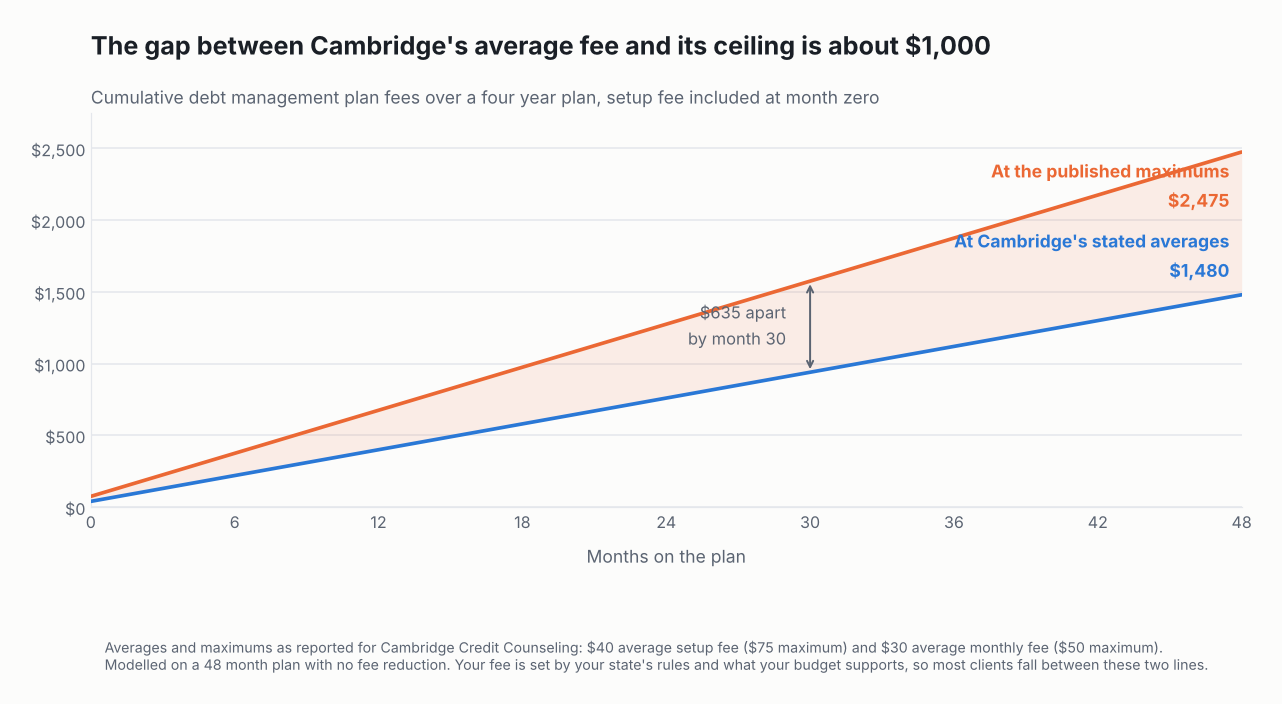
Ask for your fee in writing on the first call. If the counselor quotes the top of the range, ask directly what would move it down, because hardship reductions exist at most agencies and are almost never volunteered.
One point of perspective. Even at the ceiling, roughly $2,500 over four years is small next to the interest a plan removes. If a plan takes a $25,000 balance from 24 percent down to single digits, the saving dwarfs the fee. Fees matter, but they are the second question, not the first. Our guide to what credit counseling services actually cost works through that comparison in full.
The ratings gap you will run into
This is where a Cambridge search gets confusing, and it is worth explaining rather than papering over.
| Platform | Score | Reviews | How I read it |
|---|---|---|---|
| ConsumerAffairs | ★★★★★ 5.0 / 5 | 2,668 | Large volume, but a flawless average across thousands of reviews is rare anywhere. |
| Better Business Bureau | ★★★★☆ 3.83 / 5 | 6 | Only six reviews. Too small to carry weight either way. |
| BBB rating | A+, accredited | n/a | Reflects complaint handling, which is a genuine positive. |
After two decades of reading these platforms I have stopped treating a perfect score as the good news it looks like. ConsumerAffairs discloses in its own footer that companies may pay to be listed as Authorized, and solicited reviews skew upward everywhere, not only there. A 5.0 across 2,668 reviews tells me the agency collects feedback systematically. It does not tell me nobody has ever had a bad experience.
The BBB number has the opposite problem. Six reviews is noise. One unhappy person swings it half a point. Neither figure is a lie, and neither one on its own should decide anything for you.
What I weight instead: how long the agency has operated, whether it holds approvals that can be independently checked, and whether its complaint record is clean. On all three Cambridge does well. Thirty years, multiple verifiable approvals, an A+ grade.
Counseling is free. Committing to a plan is not.
Before you book the call, it helps to know which direction your numbers point:
- Accounts current and the rate is the problem, counseling fits
- Accounts months behind, counseling usually cannot help
- No realistic surplus at all, the conversation is a different one
Pros and cons
| What I like | What I would push back on |
|---|---|
| Thirty years operating under one name, with approvals you can verify yourself | You cannot find out your fee without speaking to them |
| Fees scale to what the household can afford rather than a flat rate | Monthly ceiling of $50 is higher than the cheapest agencies charge |
| HUD approved housing counseling, plus foreclosure work in five named states | Headline 5.0 rating sits on a platform where companies can pay for placement |
| Free initial assessment with no obligation to enroll | Thin independent review volume outside its own preferred platform |
Where Cambridge is genuinely useful: housing
Most credit counseling agencies treat housing as a sideline. Cambridge is HUD approved to deliver housing counseling nationwide, and it names Massachusetts, Connecticut, New York, Missouri and Kansas for foreclosure intervention and mortgage default work specifically.
If your card debt grew because your mortgage payment got ahead of you, that combination matters more than a few dollars of monthly fee. A counselor who can look at both sides of the balance sheet in one appointment is worth seeking out.
You can confirm any agency’s housing approval against the HUD directory of nationally approved housing counseling agencies before you book. If the mortgage itself is the thing you want to attack, our guide to paying off a mortgage in five years covers the maths on accelerating it.
Cambridge against the cheapest agency I have reviewed
The most useful comparison is with American Consumer Credit Counseling, which publishes a flat rate instead of means testing. Here is what a four year plan costs under each, for a household with four enrolled accounts.
| Cambridge | ACCC | |
|---|---|---|
| Setup fee | $40 average, $75 max | $39 flat |
| Monthly fee, four accounts | $30 average, $50 max | $28 |
| Total over 48 months | About $1,480, up to $2,475 | About $1,383 |
| Can you price it before calling? | No | Yes |
On those assumptions ACCC comes out roughly $100 cheaper over the life of the plan, and considerably cheaper for anyone enrolling only two or three accounts. Cambridge can close that gap or beat it for a household whose income pulls the means tested fee down, which is exactly the case its model is built for.
A hundred dollars spread over four years should not be the deciding factor. The quality of the counseling call, and whether housing is part of your picture, matter more.
How Cambridge sits against the alternatives
Every nonprofit agency runs roughly the same product. The differences that actually show up in your bank account are the fee level, whether the agency can handle anything beyond cards, and whether the counselor will tell you a plan is wrong for you.
- Against Trinity Debt Management: similar nonprofit model with a faith based framing. Choose on fee and on how the counselor handles your call.
- Against Take Charge America: both are long established NFCC members. Take Charge America has been operating since 1987 and carries far more independent review volume.
- Against the settlement industry: a different product entirely, for people already behind. Our ranked list of debt relief companies covers that side, and the debt relief hub explains which camp you belong in.
When a Cambridge plan is the wrong answer
- Your accounts are already charged off. Rate concessions come from card issuers, and they do not offer them on debt they have written off.
- Your surplus is zero. A plan needs a payment it can live on. If there is nothing left after essentials, the honest answer is a different one.
- The problem is spending, not interest. A plan will not survive if the balance keeps growing. Fix the inflow first, which is what getting spending under control is about.
- You are in a state with its own programmes. Several states run their own assistance routes worth checking alongside a national agency, as our Ohio debt relief programmes page shows.
How to check Cambridge, or any agency, yourself
- Confirm it appears on the Justice Department’s approved credit counseling list. Cambridge does, at its Agawam address.
- Check the HUD directory if housing is part of your situation.
- Read the ConsumerAffairs profile for volume, then read the one and two star reviews first.
- Ask for the fee in writing, including whether a reduction applies to your household.
- Ask which of your creditors has actually agreed to a concession, and at what rate.
The free first step I point almost everyone to is the National Foundation for Credit Counseling, which Cambridge belongs to. A counseling conversation costs nothing, leaves no mark on your credit file, and there is no downside to having it even if you walk away afterwards. You can reach an NFCC counselor here.
My verdict
Cambridge is a credible, long running nonprofit with real approvals behind it and an unusually sensible attitude to fees. If your situation involves a mortgage as well as cards, its housing counseling makes it a stronger fit than most of its peers.
Two things keep it from being my first recommendation. The fee is unknowable until you call, and the headline rating rests on a platform with a commercial relationship to the companies it lists. Neither is disqualifying. Both are reasons to ask harder questions on the call than the marketing invites.
Work out your route before you book the call
Counseling, consolidation and settlement solve different problems, and picking the wrong one costs years. Two minutes, no email, and you will walk into the conversation knowing what you are asking for.
Frequently asked questions
Is Cambridge Credit Counseling legit?
Yes. Cambridge Credit Counseling is a nonprofit agency founded in 1996 in Agawam, Massachusetts. It is accredited by the Better Business Bureau with an A+ rating, a member of the NFCC and the FCAA, approved by HUD for housing counseling, ISO 9001 registered, and listed by the Department of Justice as approved to provide pre bankruptcy counseling.
How much does Cambridge Credit Counseling charge?
The initial assessment is free. For a debt management plan the reported setup fee averages $40 with a $75 maximum, and the monthly fee averages $30 with a $50 maximum. Cambridge sets fees against what your household can afford within your state’s legal ceiling, so two clients with the same debts can be quoted different amounts.
Why can Cambridge not tell me my fee upfront?
Because the fee is means tested. It depends on your income, your expenses and the maximum your state allows an agency to charge. The agency states this openly. The practical answer is to ask for your specific fee in writing during the first call and to ask what would reduce it.
Why does Cambridge have 5 stars on one site and 3.83 on another?
Volume and collection method. The 5.0 comes from 2,668 ConsumerAffairs reviews, a platform where companies can pay to be listed as Authorized and where feedback is actively solicited. The 3.83 comes from just six BBB reviews, which is far too small a sample to mean much. Neither number should decide this on its own.
Does Cambridge Credit Counseling help with mortgages?
Yes. It is HUD approved to deliver housing counseling nationwide and names Massachusetts, Connecticut, New York, Missouri and Kansas for foreclosure intervention and mortgage default counseling. That is a wider housing remit than most credit counseling agencies carry.
Will a debt management plan show on my credit report?
Some creditors note that an account is being paid through a plan. That notation is not itself a negative score factor. The real effect comes from the accounts being closed, which lowers your available credit in the short term, offset over time by falling balances and a clean payment record.
How long has Cambridge Credit Counseling been in business?
Since 1996, which is about thirty years under the same name. Longevity is one of the few quality signals in this industry that cannot be manufactured, and it is worth more than a nonprofit label on its own.
Can Cambridge settle my debts for less than I owe?
No. A debt management plan repays the full balance at a reduced interest rate. Settling for less than the full balance is a different product with different consequences for your credit file and a possible tax bill on the forgiven amount.
Is the first appointment really free?
Yes. The initial financial assessment carries no fee and no obligation to enroll. Any agency that asks for payment before it has reviewed your budget is one to walk away from.
Sources
- Cambridge Credit Counseling, approvals and company facts
- ConsumerAffairs profile, ratings and reported fees
- Better Business Bureau customer review profile
- US Trustee Program, approved credit counseling agencies
- HUD, nationally approved housing counseling agencies
Fees and ratings checked on 21 October 2026. Both change, so confirm your own figures before enrolling.


Amine is an entrepreneur, investor and financial writer that covers the US economy, inflation, alternative investments, cryptocurrencies and more. He has been involved in the space for over a decade.