
I have been writing about debt relief since the early 2000s, and American Consumer Credit Counseling is one of the handful of agencies that has been doing the same thing under the same name that entire time. ACCC is a nonprofit credit counseling agency founded in 1991 and run out of Auburndale, just outside Boston. The counseling session itself is free. The fees sit on the debt management plan, and they are genuinely low: $39 to enroll and $7 per account each month, capped at $70.
Not sure a debt management plan is even the right tool?
Counseling suits some situations and is the wrong answer for others. Three questions sort it out:
- Is your problem the interest rate, or the balance itself?
- Are your accounts current, or already charged off?
- Can your budget carry a fixed payment for four or five years?
American Consumer Credit Counseling at a glance
| Founded | 1991 |
| Structure | Nonprofit credit counseling agency |
| Headquarters | 130 Rumford Avenue, Suite 202, Auburndale, Massachusetts |
| Free counseling session | Yes, by phone or online, in English and Spanish |
| Debt management plan setup | $39 one time |
| Debt management plan monthly | $7 per account, $70 maximum, $26 stated average |
| Memberships and approvals | NFCC member, BBB accredited, Council on Accreditation, HUD approved housing counseling |
| Bankruptcy counseling | Listed on the Department of Justice approved agency roster |
What is actually free and what you pay for
This is the distinction that trips up most readers, and it is not specific to ACCC. Credit counseling and a debt management plan are two different products that happen to be sold by the same organisation.
The counseling appointment is a budget review. A certified counselor goes through your income, your bills and your balances, and tells you what your realistic options are. That costs nothing and carries no obligation. I have covered this split in more detail in our guide to credit counseling services and what they really cost.
The debt management plan is the paid product. You make one payment to ACCC each month, ACCC distributes it to your creditors, and in exchange most card issuers drop your rate to somewhere in the single digits and stop the late fees. That rate concession is the whole point. The plan does not reduce what you owe.
ACCC’s fees, in plain numbers
ACCC publishes a $39 one time enrollment fee and a monthly fee of $7 per enrolled account, with a hard ceiling of $70 a month. The agency separately states an average monthly fee of $26, which implies the typical client enrolls about four accounts.
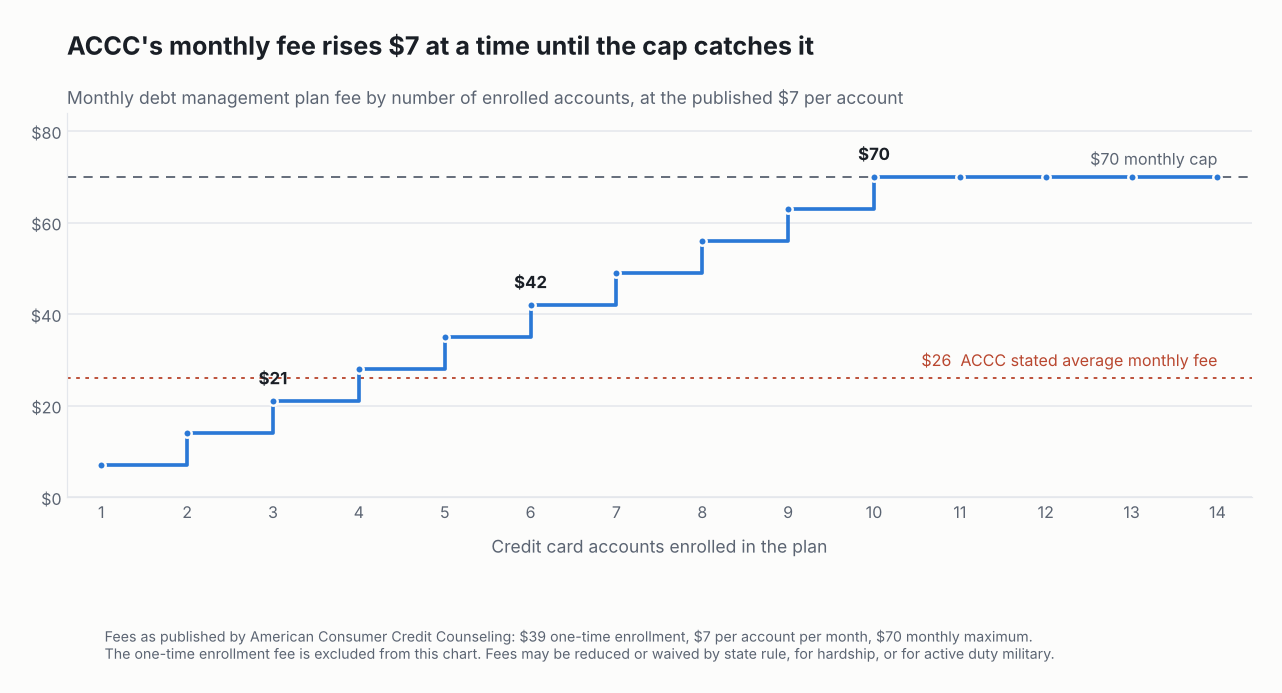
Three things worth knowing about those numbers. First, ACCC says fees can be reduced or waived by state rule, for financial hardship, or for active duty military. Ask. Agencies rarely volunteer it.
Second, the fee page carries a mid 2025 update stamp and says fees are subject to change, so confirm the current figure on your call rather than quoting mine back to the counselor.
Third, and this is the part people miss: the fee is nearly irrelevant next to the interest saving. If a plan drops a $20,000 balance from 24 percent to 8 percent, you are saving several hundred dollars a month in interest. A $26 fee against that is noise. I walk through the arithmetic on a balance that size in how to pay off $20,000 in credit card debt.
What the review platforms say, and which numbers to trust
| Platform | Score | Reviews | What it tells you |
|---|---|---|---|
| Better Business Bureau | ★★★★★ 4.98 / 5 | 1,927 | A real sample. This is the number that counts. |
| BBB rating | A+, accredited | n/a | Letter grades measure complaint handling, not service quality. |
| Trustpilot | ★★★☆☆ 3.6 / 5 | 3 | Three reviews is not a sample. Ignore this score. |
Nearly 2,000 BBB reviews averaging 4.98 is an unusually strong record for this industry, and I do not say that lightly. The Trustpilot profile is unclaimed and has three reviews on it, which is why a 3.6 appears in search results next to the 4.98. One of those numbers is signal and the other is rounding error.
One small thing I noticed while checking: ACCC’s own reviews page still describes the agency as having 22 years in business, which does not square with a 1991 founding. It is a stale page rather than a red flag, but it is a reminder to verify dates and fees on the call rather than from site copy.
A free counseling call is not the same as enrolling
If your accounts are current and the interest rate is what is sinking you, counseling is the right first call. If your accounts are already months behind, it probably is not. Our quiz tells you which camp you are in before you pick up the phone.
Pros and cons
| What I like | What I would push back on |
|---|---|
| Fees are at the low end of the industry, and the $70 ceiling is real | A plan locks you into a fixed payment for four to five years |
| Nearly 2,000 BBB reviews at 4.98, which very few agencies can match | Card accounts on the plan are closed, which shortens your available credit |
| On the Justice Department’s approved list, so it can handle pre bankruptcy counseling | Creditor concessions are set by the card issuer, not by ACCC |
| Counseling and housing counseling both offered, in English and Spanish | Site copy carries dated figures, so verify fees on the call |
How ACCC compares with the other agencies we have reviewed
Nonprofit status tells you almost nothing on its own. Every agency in this table is a nonprofit. What separates them is fee level, how long they have been operating, and how much verifiable review volume sits behind the score.
| Agency | Founded | Setup fee | Monthly fee |
|---|---|---|---|
| American Consumer Credit Counseling | 1991 | $39 | $7 per account, $70 max |
| Money Management International | 1958 | Varies by state | Varies by state |
| Family Credit Management | 1996 | Varies by state | Varies by state |
| Take Charge America | 1987 | Varies by state | Varies by state |
| Cambridge Credit Counseling | 1996 | $40 average, $75 max | $30 average, $50 max |
ACCC is one of the few that publishes a flat, checkable number rather than pointing you at a state table. Most of the others, Cambridge included, set the fee against what your household can carry, which is defensible but means you cannot price them before you call. That transparency is worth something before you have even spoken to anyone.
When ACCC is the wrong call
A debt management plan fixes an interest rate problem. It does not fix a balance problem, and it cannot help at all with debt that card issuers no longer hold.
- Your accounts are already charged off or sold to collectors. Issuers do not offer rate concessions on debt they have written off.
- Your budget cannot carry the payment. A plan that fails in month eight leaves you worse off. Look at bankruptcy against the other debt relief routes before you commit.
- Most of your debt is medical, tax or student loan. Those sit outside what a card focused plan can touch.
- You are considering a retirement account withdrawal to clear it. Read whether you should use a 401(k) to pay off debt first. The answer is usually no.
How to verify any credit counseling agency in five minutes
This is the part I wish more people did, because it takes less time than reading a review like this one. The first time I mystery shopped a counseling agency, years ago, the counselor spent forty minutes on a budget and never once mentioned enrolling in anything. That is still the test I apply to all of them.
- Check the agency appears on the Justice Department list of approved credit counseling agencies. ACCC does.
- Pull the BBB profile and look at the review count, not just the letter grade.
- Read the FTC’s guidance on getting out of debt, which lists the questions to ask before you sign anything.
- Ask for the fee in writing before enrolling, including whether a hardship waiver applies to you.
- Confirm the agency is licensed to operate in your state. Requirements vary and several states cap what can be charged.
The National Foundation for Credit Counseling is the other free first step worth knowing about. ACCC is a member. Speaking to an NFCC counselor costs nothing, does not touch your credit score, and there is no downside to the conversation even if you decide against a plan afterwards. If you would rather be pointed straight at a counselor, you can reach the NFCC here.
What actually happens on the first call
People put this call off for months because they imagine a sales pitch. In my experience with the reputable agencies it is closer to a tax appointment, and it follows the same shape almost everywhere.
- Income and expenses. The counselor builds a monthly budget with you. Have your pay stubs, rent or mortgage, utilities and minimum payments to hand or you will be doing this twice.
- Debts listed out. Every balance, every rate, every creditor. Pull a free credit report first so nothing gets missed.
- The surplus calculation. Income minus essential expenses is what can go toward debt. This single number decides whether a plan is viable.
- Options, not an offer. A good counselor will name self repayment, a plan, settlement and bankruptcy, and tell you which fits. If a plan is the only option you hear, that is a signal.
- Paperwork, only if you want it. Nothing is binding on the call. You should leave with a written proposal showing the payment, the fee and the payoff date.
Three questions worth asking before you enroll
- What rate has each of my creditors actually agreed to? Concessions are set by the card issuer and vary. A projected payoff date built on assumed rates is a guess.
- What is my fee, in writing, and does a hardship waiver apply? ACCC publishes $7 per account with a $70 ceiling, so you can check what you are quoted against that.
- What happens if I miss a payment? Creditors can withdraw the concession. Find out how many missed payments it takes before that happens.
My verdict
ACCC is a legitimate, long established nonprofit with the cheapest published fee structure of any agency I have looked at this year, and a review record that very few competitors can match on volume. If a debt management plan is the right tool for your situation, this is a reasonable place to start the conversation.
The caveat is not about ACCC. It is that a plan is the right tool far less often than the industry implies. Get the free session, get the numbers, and only then decide. If you want a sanity check on the broader picture first, how I worked through six figures of card debt covers what actually moved the needle.
Before you call anyone
Find out whether counseling, consolidation or settlement fits your numbers
Two minutes, no email required, and it will tell you which of the three routes your situation actually points to. Walking into a counseling call already knowing the answer changes the conversation.
Frequently asked questions
Is American Consumer Credit Counseling legit?
Yes. ACCC is a nonprofit credit counseling agency founded in 1991, accredited by the Better Business Bureau with an A+ rating, a member of the National Foundation for Credit Counseling, and listed on the Department of Justice roster of agencies approved to provide pre bankruptcy counseling. It holds close to 2,000 BBB customer reviews averaging 4.98 out of 5.
How much does ACCC charge?
The counseling session is free. A debt management plan costs a one time enrollment fee of $39 plus $7 per enrolled account each month, capped at $70 a month. ACCC states an average monthly fee of $26. Fees may be reduced or waived depending on your state, for financial hardship, or for active duty military.
Does a debt management plan hurt your credit score?
Enrolling is not itself a negative mark. The practical effect comes from the card accounts being closed, which reduces your available credit and can raise your utilisation ratio in the short term. Most people see the score recover and then improve as balances fall and payments land on time every month.
How long does an ACCC debt management plan take?
Most plans run between three and five years. The length depends on your total balance and what monthly payment your budget supports, not on the agency. If a counselor quotes you a far shorter timeline than that, ask them to show you the arithmetic.
Is credit counseling the same as debt settlement?
No, and the difference matters. Credit counseling arranges a lower interest rate and you repay the full balance. Debt settlement attempts to get creditors to accept less than the full balance, which damages your credit and can create a taxable event. Counseling suits people whose accounts are current. Settlement is aimed at people who are already behind.
Can ACCC help with medical, tax or student loan debt?
A debt management plan is built around unsecured credit card debt. ACCC offers counseling on broader budgeting and housing issues, and it is HUD approved for housing counseling, but tax debt and federal student loans have their own programmes and are not resolved through a card focused plan.
Why does ACCC show 4.98 stars on the BBB but 3.6 on Trustpilot?
Sample size. The BBB figure comes from 1,927 reviews. The Trustpilot figure comes from three, on an unclaimed profile. A score built on three reviews moves a full point if one person posts. Weight the BBB number and disregard the other.
Does ACCC charge for the first appointment?
No. The initial counseling session is free and carries no obligation to enroll in anything. If an agency asks for payment before it has reviewed your budget, that is a reason to hang up.
Is ACCC available in every state?
ACCC delivers counseling by telephone and online nationwide, in English and Spanish, and appears on the Justice Department approved list for that delivery. State rules do affect what fees can be charged, so the figure you are quoted may differ from the published average.
Sources
- American Consumer Credit Counseling, published debt management plan fees
- Better Business Bureau customer review profile
- US Trustee Program, approved credit counseling agencies
- Federal Trade Commission, how to get out of debt
Fees and ratings checked on 21 October 2026. Figures change, so confirm them directly before enrolling.


Amine is an entrepreneur, investor and financial writer that covers the US economy, inflation, alternative investments, cryptocurrencies and more. He has been involved in the space for over a decade.