
I have been writing about small business economics for a little over two decades, and the question that has changed the most in that time is not what a business is worth. It is where you go to sell it. Twenty years ago the answer was a local broker and a classified ad. Today you have open marketplaces charging a few hundred dollars, curated digital marketplaces taking fifteen percent, franchise broker networks with a thousand agents, and mid-market advisory firms that will not return your call under a million in revenue.
The honest version of the answer is that there is no best place to sell a business. There is only the right place for what you are selling and how big it is. Put a $90,000 Shopify store in front of a Sunbelt franchise office and nothing happens. Put a $12 million HVAC company on Flippa and you will get tyre kickers and a headache. Below is what each option actually costs, who it actually serves, and how to work out which bucket you are in.
First, the number that decides everything
What is your business actually worth?
Every other decision follows from this one. Where you list, what you accept, whether you go this year or wait two. Earned Exits will run a valuation at no cost and you keep the number whether you sell through them or not.
No cost, no obligation, and no commitment to list.
The short version
Three questions sort almost everyone. What are you selling, what does it earn, and do you want to do the work yourself or pay someone to do it.
| If you are selling | Go here | Roughly what it costs |
|---|---|---|
| A website, app or online store under $100k | Flippa | $29 to $199 to list, plus 10% at closing |
| A profitable online business, $100k to $10M | Empire Flippers or Quiet Light | 15% falling to 8% above $700k |
| A SaaS or startup | Acquire.com | $25 to $100 a month plus 6% to 8% |
| A local bricks-and-mortar business, DIY | BizBuySell or BusinessesForSale.com | $199 to $1,200 total, no commission |
| A local business, want help | Transworld or Sunbelt | 10% to 12%, declining above $1M. Quoted to us at 12% |
| An owner-operated company, $1M to $40M revenue | Earned Exits or a mid-market advisor | Success fee at closing, around 10% |
The one rule worth remembering. Marketplaces sell you exposure. Brokers sell you a process. If your business is simple enough that a buyer can understand it from a listing page, pay for exposure. If it needs explaining, pay for the process. The mistake I see most often is a seller with a complicated business buying a cheap listing and then wondering why nothing happens for six months.
The open marketplaces: you pay to be seen, not to be sold
These are classified sites. You write the listing, you field the enquiries, you negotiate, you close. Nobody takes a percentage. For a straightforward local business with clean books, this is the cheapest route by a wide margin, and it is how a large share of small business sales in America actually happen.
BizBuySell
The biggest one, and it is not close. Owned by CoStar Group since 2012, the same company behind LoopNet and Apartments.com. It is explicit about what it is not: their own FAQ says they are a marketing platform charging advertising fees, not a brokerage firm.
Listing prices on a six month term run $74.95 a month for Basic, $99.95 for Showcase and $199.95 for Diamond. Three month terms cost more per month, twelve month terms cost less. There is no commission at any point.
What makes BizBuySell genuinely useful even if you never list there is the quarterly data. Their Q2 2026 report put the median sale price at $349,250 on median revenue of $692,087 and median cash flow of $155,921, across 2,117 completed transactions, according to their own quarterly Insight Report. That is the closest thing the small business market has to a public price index, and it is worth reading before you set an asking price.
- Largest buyer audience of any US business-for-sale site, 50M+ annual visits by their own count
- No commission, so on a $400,000 sale you keep roughly $400,000 more than a 10% broker deal would leave you
- Publishes real transaction data quarterly, which almost nobody else does
- You do all the work: screening, NDAs, negotiation, coordinating diligence
- Volume of listings means a mediocre listing disappears
- Transaction volume was down 10% year on year in their own Q2 2026 report, so the buyer pool is softer than it was
BusinessesForSale.com
The main alternative, run by Dynamis, a family-operated UK company with US offices in North Carolina. Pricing is a flat one-off rather than monthly: $199 for one month, $299 for three, $399 for six, billed in a single installment, with a 20 day free trial that does not ask for card details. Their own line on fees is blunt: no commission, no hidden charges, choose a package and pay the one off fee.
They report over 55,000 active listings across 145 countries and 1.2 million monthly buyers. The international reach is the real differentiator. If your buyer might be overseas, this is where they are looking.
- Genuinely free trial with no card required, so you can test the water at zero risk
- Strongest international buyer pool of the open marketplaces
- Flat one-off pricing is cheaper than BizBuySell over six months, $399 against roughly $450
- Smaller US-specific audience than BizBuySell
- Publishes no median sale price or deal size data
BizQuest
Worth one line only: BizQuest is owned by the same parent as BizBuySell. LoopNet acquired it around 2010 and CoStar now owns both. Listing on both is not the diversification it appears to be. I tried to pull their current pricing directly and the site returned errors on every attempt, so I am not going to quote a number I could not verify.
Before you pay for a listing
Is your business even ready to list?
The most expensive mistake in this whole process is going to market with financials a buyer cannot follow. Deals die in diligence, not in negotiation. A valuation review tells you what needs cleaning up before a buyer sees it.
Check what your business is worth
Free valuation, and you keep the number either way.
The digital marketplaces: curated, and they take a cut
If you are selling something that lives on the internet, a different set of platforms applies. These vet what they list, which means you get rejected sometimes, and it means buyers trust what is on the shelf. That trust is what you are paying the commission for.
Empire Flippers
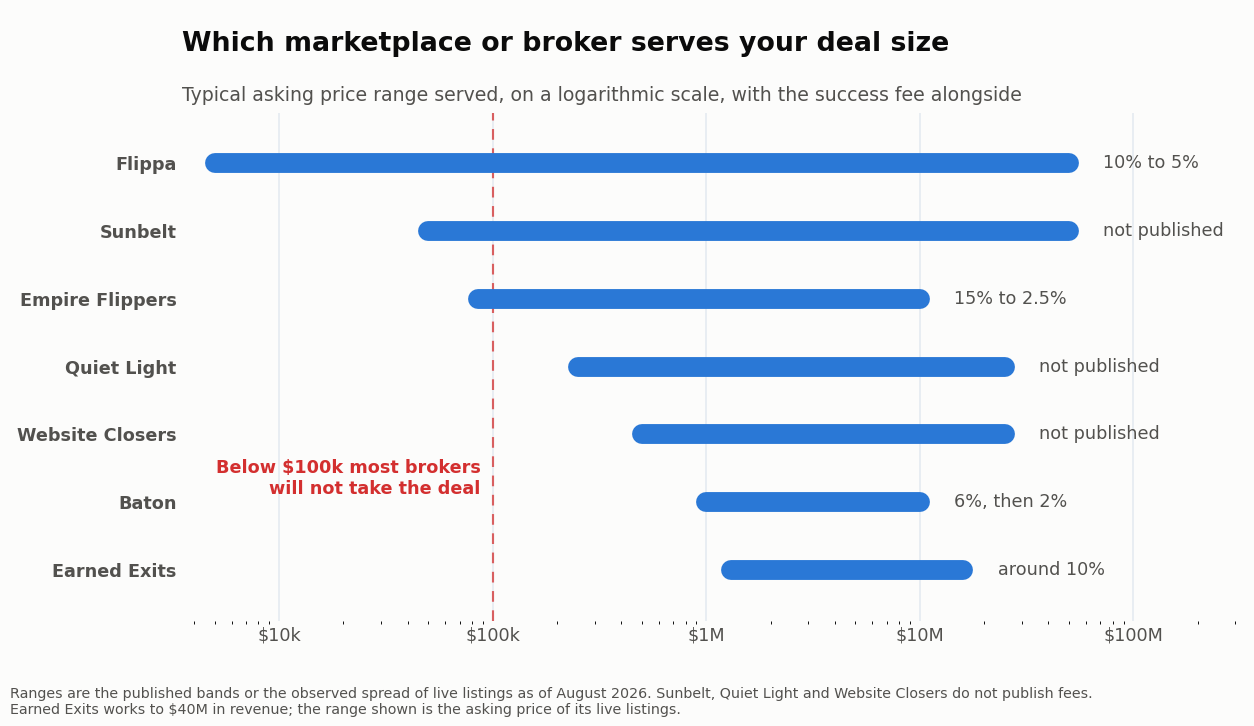
The most structured of the digital marketplaces. No fee to submit or list. The commission is tiered and blended: 15% flat under $700,000, dropping to 8% on the portion between $700,000 and $5M, then 2.5% above $5M. There is a minimum commission of $10,000, which is the part people miss. On a $40,000 sale that minimum is effectively a 25% rate.
To list you need at least $2,000 a month in net profit averaged over twelve months, plus a twelve month trading history and verified expenses. They take a two month exclusivity period. Their public scoreboard reports $604.2 million in lifetime sales across 2,665 listings sold, with 101 of those above $1M. Our full Empire Flippers review works through what that commission actually costs at each deal size, and what their vetting does not cover.
- Vetting is real, which is why their buyer pool takes listings seriously, around 650 NDAs signed weekly
- No upfront cost at all, so the risk sits with them until you sell
- Tiered commission means large deals are not punished the way a flat 15% would punish them
- The $10,000 minimum commission makes anything under about $67,000 expensive in percentage terms
- Two month exclusivity locks you in before you know whether it is working
- The $2,000 monthly profit floor rules out a lot of smaller sites
Flippa
The opposite philosophy: open, self-serve, and it will accept businesses that are not yet profitable. Below $100,000 you list yourself for $29 to $199 and pay a 10% success fee at closing. At $100,000 and above you get a dedicated broker, an upfront fee of $799 to $1,499, and the success fee steps down: 10% to $499,900, 9% to $999,900, 8% to $4.9M, 7% to $9.9M, 6% to $49.9M and 5% above that. Those rates are on their pricing page but only appear once you move the asking price slider, which is why they are so often reported as unpublished. Full detail in our Flippa review.
Their published median closing times are useful: 15 days under $50,000, 49 days between $50,000 and $250,000, and 73 days above $250,000.
One thing I will not soften. Flippa currently holds an F rating with the Better Business Bureau, with three complaints filed and a failure to respond to two of them. A pattern of not answering complaints is a reasonable thing to weigh before you hand a platform your escrow.
- Lowest barrier to entry anywhere, $29 gets you listed
- Accepts pre-revenue and unprofitable assets that Empire Flippers would reject
- Fastest median close of any platform at the small end, 15 days under $50k
- Fee disclosure is scattered: rates sit behind a slider, the Terms point to a Success Fee Page that 404s, and the sell page still advertises “from 3%”, which matches no tier
- BBB rating of F with unanswered complaints
- Open listing model means far more low-quality inventory to compete against
Acquire.com
Startup and SaaS focused, and the cleanest pricing of the lot. It scales by asking price: under $250k is $25 a month plus an 8% closing fee, $250k to $1M is $50 a month plus 7%, above $1M is $100 a month plus 6%. Free valuation, automated NDAs and escrow are included. They report $500M+ in closed deal volume across 2,000+ startups sold.
They hold ★★★★★ 4.5 out of 5 on Trustpilot across 195 reviews, which is the highest verified rating of any platform in this article.
- Fee structure is published in full and scales sensibly with deal size
- Best verified customer rating here, 4.5 on Trustpilot from 195 reviews
- Escrow and legal document tooling included rather than billed separately
- Heavily SaaS-weighted, so a content site or ecommerce store is a worse fit
- Their guided advisory tier only takes profitable SaaS above $100k revenue
Quiet Light and Website Closers
Both are brokerages rather than marketplaces, and neither publishes commission rates. Quiet Light targets businesses valued $250,000 to $25 million with at least $75,000 in annual profit, and reports 750+ businesses sold totalling over $500 million, with 85% of listings selling within 90 days. Website Closers reports $2.23 billion transacted across 2,345 businesses, takes no upfront fees or retainers, and carries an A+ BBB rating along with ★★★★★ 4.8 out of 5 from 206 reviews on Reviews.io.
With both, you will have to get on a call to find out what it costs. That is normal at this end of the market, but go in knowing that industry standard for sub-$5M digital deals sits around 8% to 12%.
The broker networks: a thousand agents, wildly different experiences
Transworld and Sunbelt are the two names you will hear if you ask a local accountant. Both are franchise networks, which is the single most important fact about them. You are not hiring Transworld. You are hiring whoever owns the Transworld office in your county, and the quality range across offices is enormous.
| Transworld | Sunbelt | |
|---|---|---|
| Founded | 1979, franchising since 2010 | 1978, franchising since the mid 1990s |
| Scale | 250+ offices, 1,000+ brokers, 15,000+ businesses sold | Does not publish an office or deal count |
| Deal size | Not published | Roughly $50,000 to $50M+ |
| Fees | Not on the website. Quoted to us in writing: 12% on the first $1M, 10% on the second, 8% on the third | Not published, set per office |
| Trustpilot | ★★★☆☆ 2.8 from 3 reviews | ★★★☆☆ 3.2 from 1 review |
| BBB | A-, not accredited, flagged for failing to respond to a complaint | No corporate profile, individual offices rated separately |
What a Transworld franchise actually quoted us
Neither network publishes fees, so I asked one directly. A Transworld Business Advisors franchise in Ontario put this in writing in March 2026:
“We work on success fees. You pay us only when the business sells, and it is 12% of the selling price for the 1st million, 10% for the 2nd million, 8% of the 3rd million and so on.”
That is a declining scale, and 12% sits at the top of the main street range. Three things came out of that exchange worth knowing before you talk to any franchise broker.
There are usually upfront working fees. Their explanation: part of the fee is charged upfront because launching a sale costs money, in listing fees on industry sites, marketing spend and management time. It is credited against the final payout.
The rate is not negotiable, but the upfront can be. I pushed back and said another firm had quoted 10%. The answer was that rates are set by corporate, the advisor has no say, and they do not compete on price. What I did get was the upfront working fees waived entirely, with the 12% left intact. If you negotiate with a franchise broker, that is where the give is. We collected the same detail from eight companies in our guide to what business brokers actually charge.
You agree the asking price before you sign anything. They value the business off three years of P&L, you discuss it, and if you cannot agree on a number you can walk away before any exclusivity attaches. Only then does the marketing agreement and its exclusive mandate come into force. Worth confirming in writing with whichever office you use.
One thing that surprised me. This broker did not come from a referral or a cold list. He found the business because it was listed on an open marketplace and messaged me through it. If you list on BizBuySell or BusinessesForSale.com, expect brokers to approach you as well as buyers. It costs nothing to hear the pitch, but know that is what is happening.
Those Trustpilot numbers are almost meaningless at three reviews and one review respectively, and I would not weigh them heavily either way. The more useful signal is that neither network publishes what it charges, and neither publishes a corporate-level complaint record you can inspect. Look up the specific office you would be working with on BBB before you sign anything. That profile exists and it is the one that matters.
One Sunbelt franchise office does publish an industry fee guide, and it is a fair description of the market: 10% to 12% on main street deals with a $10,000 to $20,000 minimum, and lower middle market work at 4% to 6% or on a Double Lehman scale, sometimes with a $5,000 to $15,000 retainer.
Baton, the hybrid
Worth knowing about because it prices differently from everyone else. Baton is a New York advisory firm with a marketplace attached. Their free tier gets you a valuation and an anonymised teaser listing at no cost. Their seller plan is $1,000 a month, credited back to you at closing, with a three month minimum, and a success fee of 6% on the first $5M and 2% above that, dropping to 3% if you bring your own buyer. They require $100,000 in adjusted annual cash flow and typically work on businesses valued $1M to $10M. A+ with the BBB, though with zero customer reviews on file.
I will flag one inconsistency: their marketing page leads with free to start while the pricing page discloses the $1,000 monthly retainer. Both are true, they describe different tiers, but the framing is generous to itself.
If you are in the $1M to $40M band
This is the range where the wrong choice costs the most
Below about a million in revenue you have plenty of good options. Above it, listing sites stop working and the quality of your advisor becomes the single biggest variable in what you walk away with. Earned Exits works specifically in this band and will tell you where you stand before you commit to anything.
Free valuation first. No retainer, fees are paid from the sale.
Earned Exits, and where it actually fits
Full disclosure before anything else: Earned Exits is a partner of this site, and I earn a commission if you engage them. That is exactly why I want to be precise about who they are wrong for, and why I published a full Earned Exits review covering their fees, track record and regulatory history rather than a recommendation.
They are a national brokerage and M&A advisory working with companies doing $1M to $40M in revenue. Current listings on their site run from roughly $1.3M to $16M in asking price, across HVAC, waste management, powersports, water services, IT and manufacturing. They report $2.1 billion in combined transactions, a 93% closing rate for clients whose financials are what they call buyer ready, and a typical process of about 117 days with a buyer identified inside 60 days once the numbers are in order.
If you are selling a $60,000 content site or a $250,000 corner cafe, they are not the right call. Go back up this page to Flippa, BizBuySell or Empire Flippers. Earned Exits is built for owner-operated companies in the lower middle market, and the economics only work in that band.
Where they are a good fit, the differentiators worth knowing: a free valuation with no obligation, a three person dedicated team per client rather than a single agent, and an add-backs process that reworks your financials to show true seller discretionary earnings before a buyer sees them. That last one is not a gimmick. Most owner-operated companies understate their real earnings through legitimate personal expenses run through the business, and getting that presentation right is often worth more than anything that happens in the negotiation.
On fees, their own referral page gives the clearest indication they publish: a typical company they sell is around $10 million and their commission on that sale is around $1 million. Call it roughly 10%, paid at closing, with no retainer. Their consulting packages are refunded in full out of the commission if you go on to list with them.
- Free valuation with no obligation and no retainer, so the cost sits with them until close
- Specialised in the $1M to $40M revenue band rather than trying to serve everyone
- Add-backs work on financials before going to market, which is where most value is won or lost
- No independent Trustpilot or BBB profile I could locate, so there is no third-party complaint record to inspect
- Wrong fit for anything under roughly $1M in revenue
- Colorado licensed and nationally operating, but no IBBA or CBI certification is published
How to choose in about five minutes
Work down this list and stop at the first one that describes you.
| Your situation | What to do |
|---|---|
| Under $50,000, digital, want it gone quickly | Flippa. Median close is 15 days at this size and the listing costs less than a tank of fuel. |
| $100k to $2M, online, profitable for a year | Empire Flippers. The 15% hurts but their buyer pool is the reason deals close. |
| SaaS at any size | Acquire.com. Purpose-built and the only one publishing its full fee table. |
| Local business, clean books, you have time | BizBuySell plus BusinessesForSale.com. Under $900 total for six months on both, and no commission on either. |
| Local business, no time or messy books | A broker. Interview three, check each office on BBB individually, and do not sign a twelve month exclusive. |
| $1M to $40M revenue, owner-operated | A mid-market advisor. This is where advisor quality moves the number more than anything else you control. |
| You have no idea what it is worth | Get a valuation before you do anything else. Every option above gets easier once you have a number. |
Two things nobody tells you. First, you can list on an open marketplace and hire a broker later, but not the other way round: most broker agreements claim any buyer who came through their listing period. Second, an exclusive longer than six months is a bad trade at any commission rate. If they cannot move it in six months, the problem is the price or the business, and another six months of exclusivity will not fix either.
What this costs you in real money
Same business, $500,000 sale price, three routes:
| Route | You pay | You keep |
|---|---|---|
| BizBuySell Showcase, six months | About $600 | $499,400 |
| Empire Flippers, if digital | $75,000 at 15% | $425,000 |
| Main street broker at 10% | $50,000 | $450,000 |
That $75,000 gap is not an argument against brokers. It is an argument for knowing what you are buying. A broker who gets you $560,000 instead of $500,000 has more than paid for themselves. A broker who gets you the same price you would have got yourself has cost you a year of your life and a tenth of your business. The question is never whether the fee is high. It is whether this particular person will beat the price you could get alone.
Two guides worth reading before you list
Before you go state by state, these two cover the parts that apply no matter where you operate.
- How Much Can You Sell Your Business For? (2026 Valuation Guide)
- How to Sell a Business in 2026? (Guide + Comparing Options)
What actually changes from one state to another
Three things, in order of how much money they move.
| What differs | Why it matters |
|---|---|
| State income tax | Nine states levy no personal income tax. On a one million dollar exit that gap can be worth six figures on identical deal terms. |
| Tax clearance and bulk sale rules | Several states require a clearance certificate or advance notice before closing. Buyers who know the rule will hold back funds until you produce it. |
| Buyer depth | A restaurant in a metro area may see a dozen credible buyers. The same business two hours out may see two, and price follows competition. |
What does not change anywhere
This is the part owners underestimate. In twenty years I have never seen a deal fall apart over which state it was in. I have seen plenty die over these:
- Books that do not reconcile. If your financials do not tie to your tax returns, every number you quote becomes negotiable.
- Customer concentration. One client at 40 percent of revenue takes a chunk off your multiple before anyone opens the lease.
- Owner dependence. If the business cannot run for three weeks without you, a buyer is purchasing a job rather than an asset.
- Waiting too long. The best time to prepare is a year before you want to sell. Most owners start the month they decide.
The SBA’s guide to closing or selling a business is a solid free overview of the process, and the Tax Foundation’s state income tax data is the cleanest place to check where your state sits before you model an after-tax number.
Still guessing at your number? Most owners I talk to are either 30 percent high or 30 percent low, and both cost real money at the negotiating table.
See What Your Business Might Sell For
Free, no obligation, and you keep the number whether you sell this year or in five years.
Where you are selling from: all 50 state guides
Each guide covers the local filing steps, the state tax picture, what buyers in that market tend to look for, and a city by city view where it makes a difference. Pick your state:
A note on timing and inflation
One thing I would push back on gently: owners often anchor to what a similar business sold for in 2019 and assume that number still applies. It rarely does in either direction. Multiples move with borrowing costs, and the nominal price of everything has shifted underneath us. If you want to sanity check an old comparable against today, run it through our CPI inflation calculator first, and if you are tracking where costs are heading, the CPI release schedule tells you when the next read lands.
If debt is part of the picture
A fair number of owners reading this are selling partly to clear personal or business debt, and that changes the order of operations. Settling debt before a sale can protect your proceeds, but doing it badly can damage your credit right when you need financing to close. If that is your situation, our two minute debt relief quiz maps the options against your actual numbers, and the ranked list of debt relief companies shows who we rate and why.
Frequently Asked Questions
Does the state I sell in actually change anything?
Yes, in three ways that cost real money. First, tax: nine states have no personal income tax, so an owner in Texas or Florida can keep a materially larger share of the same sale price than an owner in California or New York. Second, clearance: states such as Pennsylvania, New Jersey, California and Washington require a tax clearance or bulk sale notice before the deal funds, and missing it can leave the buyer liable for your unpaid tax, which buyers price in. Third, buyer depth: metro markets have more active buyers and tighter timelines than rural counties in the same state.
How long does it take to sell a small business?
Six to twelve months is normal once you are actually on the market, and that assumes clean books. Add three to six months if you need to rebuild financials first. The owners who close fastest are the ones who spent a year preparing before they ever spoke to a buyer.
What multiple will I get?
For most small businesses under two million in revenue it lands somewhere between two and four times seller’s discretionary earnings, with the range driven by recurring revenue, customer concentration and how much the business depends on you personally. Industry matters less than people expect. Owner dependence matters far more.
Do I need a business broker?
If the business is worth under about 250,000 dollars the fee often eats the benefit, and a direct sale to an employee, competitor or family member is common. Above that, a broker earns their keep through buyer screening and confidentiality alone. Get a valuation first either way, so you can judge whether the broker’s suggested asking price is realistic.
Should I sell the assets or the company itself?
Buyers almost always want an asset sale, because they get a stepped-up basis and leave old liabilities behind. Sellers usually prefer a stock or membership interest sale for the capital gains treatment. This is the single largest tax variable in most deals and it is worth paying a CPA to model both before you agree to a structure.
Will inflation change what my business is worth?
Indirectly, and more than most owners realise. Valuations are built on earnings multiples, and earnings move with input costs, wages and pricing power. A business that could not pass cost increases through to customers over the last few years often shows compressed margins that a buyer will notice immediately.
What do I need to have ready before I list?
Three years of financials that reconcile to your tax returns, a clean add-back schedule, current lease and key contracts, an employee roster with roles and pay, a customer concentration breakdown, and any licences that transfer. Buyers walk over messy books more often than over price.
Can I sell if the business still has debt?
Yes, and it is routine. Most debt is settled out of proceeds at closing. What complicates a deal is personal guarantees, liens filed against the assets, and any tax debt, because those attach to the sale itself rather than to you personally.
Where is the best place to sell my business?
There is no single best place. Match the platform to the business. Digital businesses under $100,000 do best on Flippa, profitable online businesses between $100,000 and $10 million on Empire Flippers or Quiet Light, SaaS on Acquire.com, and local bricks-and-mortar businesses on BizBuySell or BusinessesForSale.com if you are willing to run the sale yourself, or through a broker network if you are not. Companies doing $1 million to $40 million in revenue need a mid-market advisor rather than a listing site.
How much does it cost to sell a business online?
It depends entirely on whether you pay for exposure or for a process. Open marketplaces charge a flat advertising fee and take no commission: BizBuySell runs $74.95 to $199.95 a month and BusinessesForSale.com charges $199 to $399 as a one-off. Commission-based platforms charge nothing upfront but take a percentage at closing, typically 15% at Empire Flippers falling to 8% above $700,000, 6% to 8% at Acquire.com, and roughly 10% to 12% for a main street business broker.
Can I sell my business without a broker?
Yes, and a large share of small business sales in America happen this way. Listing on BizBuySell or BusinessesForSale.com costs a few hundred dollars and no commission, which on a $500,000 sale is the difference between keeping roughly $499,000 and roughly $450,000. The trade is that you handle buyer screening, NDAs, negotiation and diligence coordination yourself. It works well for a simple business with clean books and badly for a complicated one.
What is the difference between a business marketplace and a business broker?
A marketplace sells you exposure. You write the listing, buyers contact you directly, and you keep the full sale price minus a flat fee. A broker sells you a process. They value the business, prepare the financials, find and screen buyers, and run the negotiation, in exchange for a percentage at closing. The practical test is whether a buyer could understand your business from a listing page. If yes, pay for exposure. If it needs explaining, pay for the process.
Do business brokers charge upfront fees?
It varies and you should ask directly. Most main street brokers work on success fees only, typically 10% to 12% with a $10,000 to $20,000 minimum. Lower middle market and M&A advisory firms more often charge a retainer, commonly $5,000 to $15,000, credited against the final fee. Baton charges $1,000 a month refunded at closing. Earned Exits and Website Closers both state they take no retainer and are paid from the sale.


Amine is an entrepreneur, investor and financial writer that covers the US economy, inflation, alternative investments, cryptocurrencies and more. He has been involved in the space for over a decade.