
Every article ranking for this question is written by a business broker or by a marketplace that sells broker leads. I checked. That is not a conspiracy, it is just who bothers to write about fees, but it does mean almost everything you will read describes the range in a way that makes the range sound reasonable.
I have been writing about small business economics for over two decades, and over the past year I have collected actual fee quotes rather than industry averages. Some came from published pricing pages. One came from a broker quoting me directly for a business I am selling. That is what is below.
The short answer: 5% to 15%, paid at closing, and where you land depends almost entirely on what your business is worth. Small deals pay the highest percentages. That feels backwards and it is not a mistake.
The fee only matters once you know the number
A 12% fee on a great price beats a 6% fee on a poor one, every time. Work out what the business is actually worth first, then judge whether anyone is worth their percentage.
Work out what your business is worth
Free guide with the multiples buyers are actually paying in 2026.
Real fees from eight companies, verified
No averages, no ranges from memory. Every figure below is either published on the company’s own pricing page or was quoted to us in writing.
| Company | What they charge | How we know |
|---|---|---|
| Transworld Business Advisors | 12% on the first $1M, 10% on the second, 8% on the third, declining after | Quoted to us in writing, March 2026 |
| Flippa | 10% up to $499,900, then 9%, 8%, 7%, 6% and 5% above $50M | Published on their pricing page |
| Empire Flippers | 15% under $700k, 8% on the portion to $5M, 2.5% above. $10,000 minimum | Published |
| Baton | 6% on the first $5M, 2% above. 3% if you bring the buyer | Published |
| Earned Exits | Roughly 10% at closing, no retainer | Implied by their own referral page maths |
| Acquire.com | 8% under $250k, 7% to $1M, 6% above | Published |
| Website Closers | Not published. Flat fee, reverse Lehman or straight Lehman by deal size | Their own site, no numbers given |
| Quiet Light | Not published. You have to get on a call | Their own site, no numbers given |
Two of the eight will not tell you what they charge without a phone call. That is worth noticing before you spend an hour on one.
Why small deals pay more, and why that is not a rip-off
The percentages above look regressive. A $200,000 business pays 12% while a $10 million business pays 6%. Sellers reasonably ask why.
The answer is that the work does not scale with the price. Preparing a $200,000 business for sale, finding buyers, running diligence and closing takes a broker most of the same hours as a $2 million business. Sometimes more, because smaller businesses tend to have messier books and first-time owners who need more hand-holding.
At 12% on $200,000 the broker earns $24,000 for perhaps six months of work, out of which the franchise takes its cut. That is not a windfall. At 6% on $10 million it is $600,000 for a similar number of hours, which is why the rate falls.
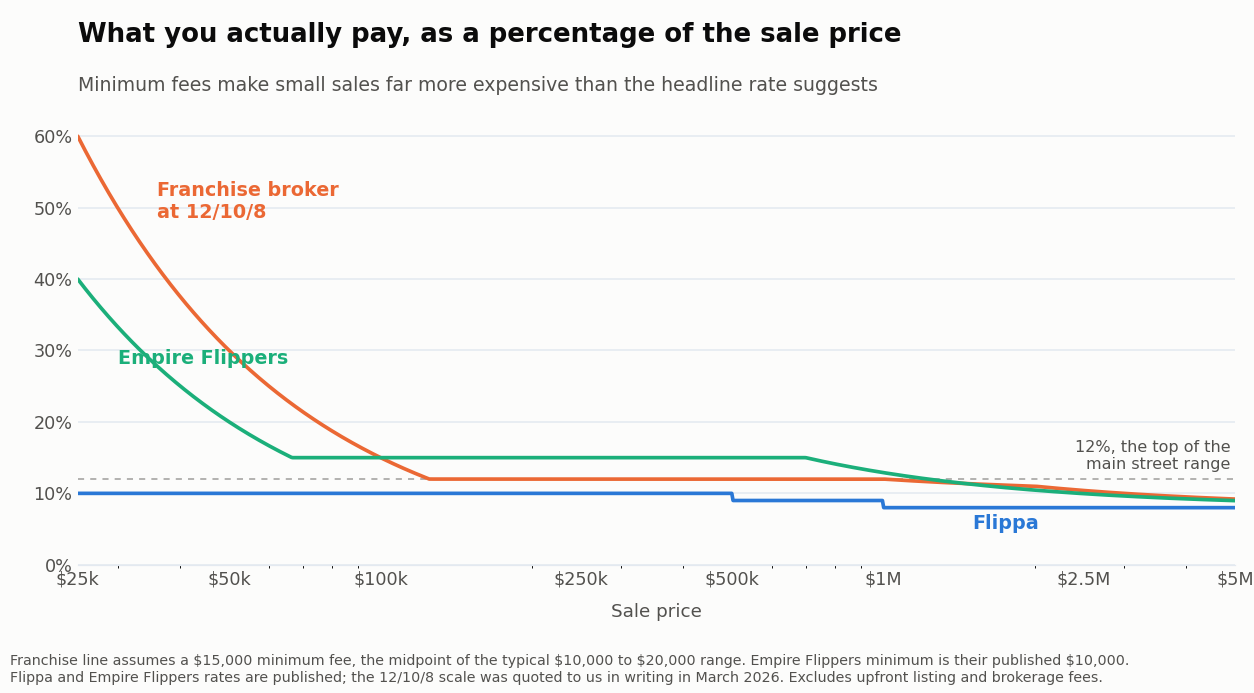
The practical version. Most brokers also enforce a minimum fee, commonly $10,000 to $20,000 at the main street end. Empire Flippers publishes theirs at $10,000, which means a $40,000 sale costs an effective 25%. If your business is worth under about $150,000, check the minimum before you check the percentage. The minimum is the number that will actually apply to you.
The negotiation nobody writes about
This is the part I have not seen covered honestly anywhere, and it comes from my own file rather than from research.
In March 2026 a Transworld Business Advisors franchise approached me about a business I had listed. I asked what they charge. The answer came back in writing:
“We work on success fees. You pay us only when the business sells, and it is 12% of the selling price for the 1st million, 10% for the 2nd million, 8% of the 3rd million and so on.”
So I tried to negotiate. I told them another firm had quoted 10% and asked them to match it. The reply was that rates are set by corporate, the advisor has no say, and, in their words, they do not usually compete on pricing.
But I did get something. A week later, after they had reviewed the financials, they came back and waived the upfront working fees entirely while keeping the 12%.
That is the lesson. With a franchise brokerage the headline percentage is usually fixed and the upfront fees usually are not. The advisor genuinely cannot move the rate, but they can absorb costs their office would otherwise bill you for. If you go in demanding a lower percentage you will hear no. If you ask what they can do on the upfront, you may well get all of it.
What upfront fees actually are
Their explanation, which I found reasonable: launching a sale costs real money before anyone earns a commission. Listing fees on industry websites, marketing spend to promote the business, and a lot of management time preparing the offering, negotiating and fielding buyer questions. The upfront covers some of that and is credited against the final payout.
Typical shapes you will encounter:
- No retainer at all. Flippa, Empire Flippers, Earned Exits and Website Closers all state they take nothing upfront beyond a listing or brokerage fee.
- A listing or brokerage fee. Flippa charges $29 to $199 for self-service, or $799 to $1,499 for a six month broker-led term depending on asking price.
- A monthly retainer, credited at close. Baton charges $1,000 a month with a three month minimum, refunded from the fee at closing.
- Working fees. The franchise model. Waivable, as above.
- Valuation fees. One Sunbelt franchise publishes an industry guide putting these at $7,000 to $20,000 in the lower middle market. Several firms, including Earned Exits, do a valuation free.
What you actually pay, at four deal sizes
Same business, same broker effort, four different prices. This is the table I wish someone had shown me the first time.
| Sale price | Franchise broker at 12/10/8 | Flippa | Empire Flippers |
|---|---|---|---|
| $50,000 | $10,000 to $20,000 minimum fee, so 20% to 40% | $5,000 plus a $29 to $199 listing | $10,000 minimum, so 20% |
| $200,000 | $24,000 (12%) | $20,000 (10%) plus $799 | $30,000 (15%) |
| $1,000,000 | $120,000 (12%) | $80,000 (8%) plus $1,299 | $129,000 (blended 12.9%) |
| $5,000,000 | $420,000 (12/10/8 blended) | $350,000 (7%) plus $1,299 | $449,000 (blended 9%) |
A few things fall out of that table.
For context on what small businesses actually sell for, BizBuySell’s quarterly Insight Report put the median sale price at $349,250 in Q2 2026, which places most sellers squarely in the band where minimum fees bite.
Under about $150,000, minimum fees dominate everything. The percentage is almost irrelevant. Ask for the minimum in dollars, not the rate.
Between $200,000 and $1M, the spread is real money. On a $1M sale the gap between the cheapest and most expensive option here is roughly $49,000. That is worth a few hours of comparison.
Blended scales beat flat ones as you get bigger. Empire Flippers is the most expensive option at $200,000 and cheaper than a 12% franchise broker at $1M, because their rate steps down on the portion above $700,000 while a flat 12% does not step down at all until the second million.
Ask this exact question. “Is your fee blended or flat?” A 12% flat fee on $1.5M is $180,000. A 12/10 blended fee on the same sale is $170,000. Brokers do not always volunteer which one they are quoting, and the wording in the agreement is what counts, not the conversation.
Who pays the broker?
The seller, in almost every case. The fee comes out of the sale proceeds at closing, usually paid directly from the escrow account before the balance reaches you. You do not write a cheque.
Buyers occasionally pay a fee on the buy side if they engage their own advisor, but in a standard business sale the listing side pays. If a broker approaches you as a buyer and asks for a fee, understand who they actually represent before you go further.
Is a business broker worth it?
The honest answer is that it depends on one thing: whether that particular broker gets you a higher price than you would get alone, by more than their fee.
On a $500,000 business at 10%, the broker needs to add $50,000 to the price just to break even against selling it yourself. That is a 10% lift, and a good broker in a competitive process clears it comfortably, because competition between buyers is what moves price. A mediocre one does not.
Where brokers earn their money:
- Recasting the financials. Most owner-operated businesses understate real earnings through legitimate personal expenses. Presenting adjusted earnings properly can move the valuation more than anything in the negotiation.
- Creating competition. One interested buyer is a negotiation. Five is an auction.
- Confidentiality. Selling quietly, so staff, clients and suppliers do not find out before you are ready.
- Keeping the deal alive through diligence, which is where most deals die.
Where they do not: if you already have a buyer, a broker adds paperwork and a percentage. If your business is small, simple and clean, an open marketplace listing at a few hundred dollars does most of the same job. Our comparison of where to sell a business, linked below, works through which route fits which situation.
Red flags in a fee agreement
- An exclusive longer than six months. If they cannot move it in six months the problem is the price or the business, and another six months of exclusivity fixes neither.
- A tail that catches buyers you found. Most agreements say a sale to any buyer during the term owes the full fee, even one you sourced. Ask for a carve-out in writing before you sign, naming anyone already in conversation.
- A tail period after the listing ends. Commonly 90 days for smaller assets and 180 for larger ones. Reasonable in principle, but know the length.
- A fee due on the full price including earn-outs and seller financing. This is standard, and it means you may owe the fee on money you have not received yet.
- A fee schedule that is not in the document. More common than it should be. If the agreement refers to a pricing schedule, check the schedule is actually attached.
Before you sign with anyone
A broker is one of eleven ways to sell, and the cheapest is not always the worst
On a $500,000 sale the gap between a $600 marketplace listing and a 12% brokered sale is about $59,400. Sometimes the broker is worth every penny of it. Sometimes you are paying for something you could do in a weekend. We laid out every option with its real pricing.
Compare every option side by side
Free, no signup, real published pricing throughout.
Fee structures you will hear named
| Name | How it works | Where you see it |
|---|---|---|
| Flat percentage | One rate on the whole price | Main street brokers, most marketplaces |
| Declining scale | Rate drops on each additional tranche | Transworld at 12/10/8 |
| Blended tiers | Different rate applies to each portion | Empire Flippers, Flippa |
| Double Lehman | 10% on the first $1M, 8% on the second, 6% third, 4% fourth, 2% on the rest | Lower middle market |
| Reverse Lehman | Rate rises with price, rewarding a higher sale | Occasionally offered, ask for it |
| Minimum fee | A floor in dollars regardless of percentage | Almost everywhere, $10k to $20k |
If someone quotes you “Double Lehman” without explaining it, that is 10/8/6/4/2 on successive millions. On a $3M sale that is $100,000 plus $80,000 plus $60,000, or $240,000, an effective 8%.
Reverse Lehman is worth asking about and almost nobody does. It inverts the incentive: the broker earns a higher percentage on the portion above your target price, so pushing for more actually pays them. If you believe your business is worth more than the valuation suggests, propose it.
How to compare two quotes properly
Ask every broker the same six questions and write the answers down.
- What is your fee at my expected sale price, in dollars?
- Is that blended or flat?
- What is the minimum fee?
- What do I pay upfront, and is it credited at closing?
- How long is the exclusive, and what is the tail after it ends?
- If I bring my own buyer, what do I owe?
Question one is the important one. A percentage is easy to shrug at. A dollar figure is not, and it is the same number.
Related reading
- Flippa review, including the full 10% to 5% tier table
- Empire Flippers review, and why the $10,000 minimum matters more than the 15%
- Earned Exits review, a mid-market broker at roughly 10%
- How to sell a business in 2026, the full process from preparation to closing
- The SBA guide to closing or selling a business for the regulatory side
Frequently Asked Questions
What is a typical business broker fee?
For main street businesses under about $1 million, 10% to 12% of the sale price is typical, with a minimum fee of $10,000 to $20,000. Above $1 million the rate usually declines: a Transworld franchise quoted us 12% on the first million, 10% on the second and 8% on the third. Lower middle market and M&A advisory work more often runs 4% to 8%, sometimes on a Double Lehman scale of 10/8/6/4/2 on successive millions. Digital marketplaces sit in a similar range, with Flippa at 10% falling to 5% and Empire Flippers at 15% blended down to 2.5%.
How much do business brokers charge to sell a small business?
For a small business the minimum fee usually matters more than the percentage. Most brokers enforce a floor of $10,000 to $20,000, so a $50,000 sale can cost 20% to 40% in effective terms even where the quoted rate is 10%. Empire Flippers publishes a $10,000 minimum, which makes a $40,000 sale an effective 25%. Always ask for the minimum in dollars before you ask about the rate.
Is a 2% broker fee normal?
Not for a whole business sale. 2% appears only at the top of large transactions, as the final tranche of a declining scale. Empire Flippers charges 2.5% on the portion of a sale above $5 million and Baton charges 2% above $5 million, but both charge far more on the first tranche. If someone quotes a flat 2% on a small or mid-sized business, ask carefully what it covers, because it is well below what the work costs to deliver.
Who pays the broker when selling a business?
The seller, in almost every case. The fee comes out of the sale proceeds at closing and is typically paid directly from the escrow account before the balance reaches the seller. Buyers sometimes pay a separate fee if they engage their own buy-side advisor, but in a standard sale the listing side pays.
Do business brokers charge upfront fees?
It varies, and it is negotiable more often than the percentage is. Flippa, Empire Flippers, Earned Exits and Website Closers all state they take no retainer. Baton charges $1,000 a month with a three month minimum, credited back at closing. Franchise brokerages commonly charge upfront working fees to cover listing costs and marketing. When we pushed a Transworld franchise on price they held firm at 12% but waived the upfront working fees entirely, which suggests that is where the flexibility sits.
Can I negotiate business broker fees?
The percentage is often fixed, especially at franchise networks where rates are set by corporate and the individual advisor genuinely cannot change them. What is negotiable is usually everything else: upfront and working fees, the length of the exclusive period, the tail period after it ends, and carve-outs for buyers you introduce yourself. Ask what they can do on the upfront rather than on the rate.
Is it worth using a business broker?
It is worth it if that broker adds more to your sale price than their fee costs. At 10% on a $500,000 business they need to add $50,000 just to break even against selling it yourself. A good broker clears that by creating competition between buyers, recasting your financials to show true earnings, keeping the sale confidential and holding the deal together through due diligence. If you already have a buyer, or the business is small and simple with clean books, a marketplace listing at a few hundred dollars does much of the same work.
What is a Double Lehman fee structure?
A declining scale of 10% on the first million of sale price, 8% on the second, 6% on the third, 4% on the fourth and 2% on everything above. On a $3 million sale that works out at $240,000, an effective 8%. It is common in the lower middle market. Reverse Lehman inverts it so the rate rises with price, which aligns the broker with pushing for a higher number, and it is worth asking for even though it is rarely offered.
What should I ask a broker before signing?
Six questions. What is your fee at my expected sale price in dollars, not percent? Is that blended or flat? What is the minimum fee? What do I pay upfront and is it credited at closing? How long is the exclusive and what is the tail afterwards? And if I bring my own buyer, what do I owe? Get all six answered in writing, and check that any fee schedule the agreement refers to is actually attached to the agreement.


Amine is an entrepreneur, investor and financial writer that covers the US economy, inflation, alternative investments, cryptocurrencies and more. He has been involved in the space for over a decade.