by Sarah Bauder | May 10, 2026 | CPI, Inflation
Inflation is a general increase in the price of goods and services over time. In plain English, it means your money does not buy as much as it used to. That can sound like an economics textbook problem, but it is really a personal finance problem. Inflation affects your savings, investments, debt, retirement income, property costs, and everyday household budget.
I have been writing about financial and investment-related topics for more than two decades, and inflation is one of those subjects that always comes back into focus when people start feeling squeezed. You may not follow every monthly CPI report, but you definitely notice when groceries, insurance, rent, utilities, and borrowing costs start taking a bigger bite out of your income.
Inflation is commonly measured using the Consumer Price Index, or CPI. The CPI tracks price changes across a basket of consumer goods and services. If you want to compare the buying power of money across different years, you can also use our CPI inflation calculator.
According to the U.S. Bureau of Labor Statistics, the Consumer Price Index for All Urban Consumers rose 3.8% over the 12 months ending April 2026. Core CPI, which excludes food and energy, rose 2.8% over the same period. That is lower than the worst inflation Americans experienced in 2022, but it is still high enough to matter when you are planning your savings, investments, and retirement.
Quick Takeaway
Inflation does not just make things more expensive. It changes the real value of your savings, income, investments, debt payments, and future retirement needs. The key is to think in terms of purchasing power, not just the dollar amount sitting in your account.

Historical CPI data helps show how inflation changes purchasing power over time. Source: Bureau of Labor Statistics
The Main Effects of Inflation on Your Personal Finances
Inflation does not affect every part of your financial life in the same way. Some assets may benefit from inflation. Some get hurt by it. Some debts become easier to handle, while others become more expensive.
| Area of Your Finances |
How Inflation Can Affect It |
What to Watch |
| Savings |
Cash can lose purchasing power if interest rates do not keep up with inflation. |
Real return after inflation and taxes. |
| Stocks |
Companies may raise prices, but they may also face higher costs and lower margins. |
Pricing power, earnings growth, and valuation. |
| Bonds |
Fixed payments can become less valuable when inflation rises. |
Interest rates, duration, and inflation protection. |
| Property |
Property values and rents may rise, but ownership costs can rise too. |
Mortgage type, insurance, taxes, repairs, and rates. |
| Retirement |
Future expenses may be much higher than today’s expenses. |
Inflation-adjusted income and withdrawal planning. |
The Effects of Inflation on Your Savings
One area most exposed to inflation is cash savings. A savings account can be a smart place for emergency money, short-term goals, and cash you may need quickly. I am not against holding cash. In fact, I think many people underestimate how important liquidity is when life gets messy.
But cash has one major weakness: it can quietly lose purchasing power if the interest rate on your account is lower than inflation.
For example, if you have $1,000 in a savings account earning 1% annually, you would have $1,010 after one year before taxes. But if inflation is running at 3.8%, you would need about $1,038 just to preserve roughly the same purchasing power. Your bank balance went up, but your real buying power went down.
This is what makes inflation so frustrating. You may not technically “lose” money in a savings account, but the money can still buy less over time.
Important point: The real return on savings is the interest rate you earn minus inflation. If your savings account earns 2% and inflation is 4%, your real return is roughly negative 2% before taxes.
This does not mean you should invest your emergency fund in the stock market. It means you should separate short-term savings from long-term wealth-building money. Cash is useful for stability and flexibility. But long-term money usually needs a plan that has a better chance of keeping up with inflation.
To understand how inflation has changed purchasing power historically, you can review our historical CPI tables or compare specific years using the calculator.
The Impact of Inflation on Stocks
Investing in stocks comes with more risk than keeping money in a savings account. Stock prices move up and down, and nobody can guarantee short-term returns. But over long periods, stocks have often helped investors protect and grow purchasing power better than cash.
That said, stocks are not automatically protected from inflation.
Inflation can affect stocks in a few different ways. When the economy is strong, companies may be able to raise prices, grow revenue, and increase earnings. That can support share prices. But when inflation rises too quickly, companies may also face higher costs for wages, raw materials, energy, shipping, rent, and financing. If those costs rise faster than revenue, profit margins can suffer.
This is why inflation can be especially difficult for companies that do not have pricing power. A business with a strong brand, essential products, and loyal customers may be able to pass some cost increases on to consumers. A weaker business may have to absorb those costs.
From an investor’s perspective, the real question is not only whether stocks go up in dollar terms. It is whether your investment return beats inflation over time.
Investor takeaway: During inflationary periods, focus on real returns, diversification, company quality, pricing power, debt levels, and your time horizon. Inflation can create pressure in the short term, but high-quality businesses may still help preserve purchasing power over the long term.
For a broader look at portfolio decisions during different economic conditions, you can read our guide on investing during inflation and deflation.
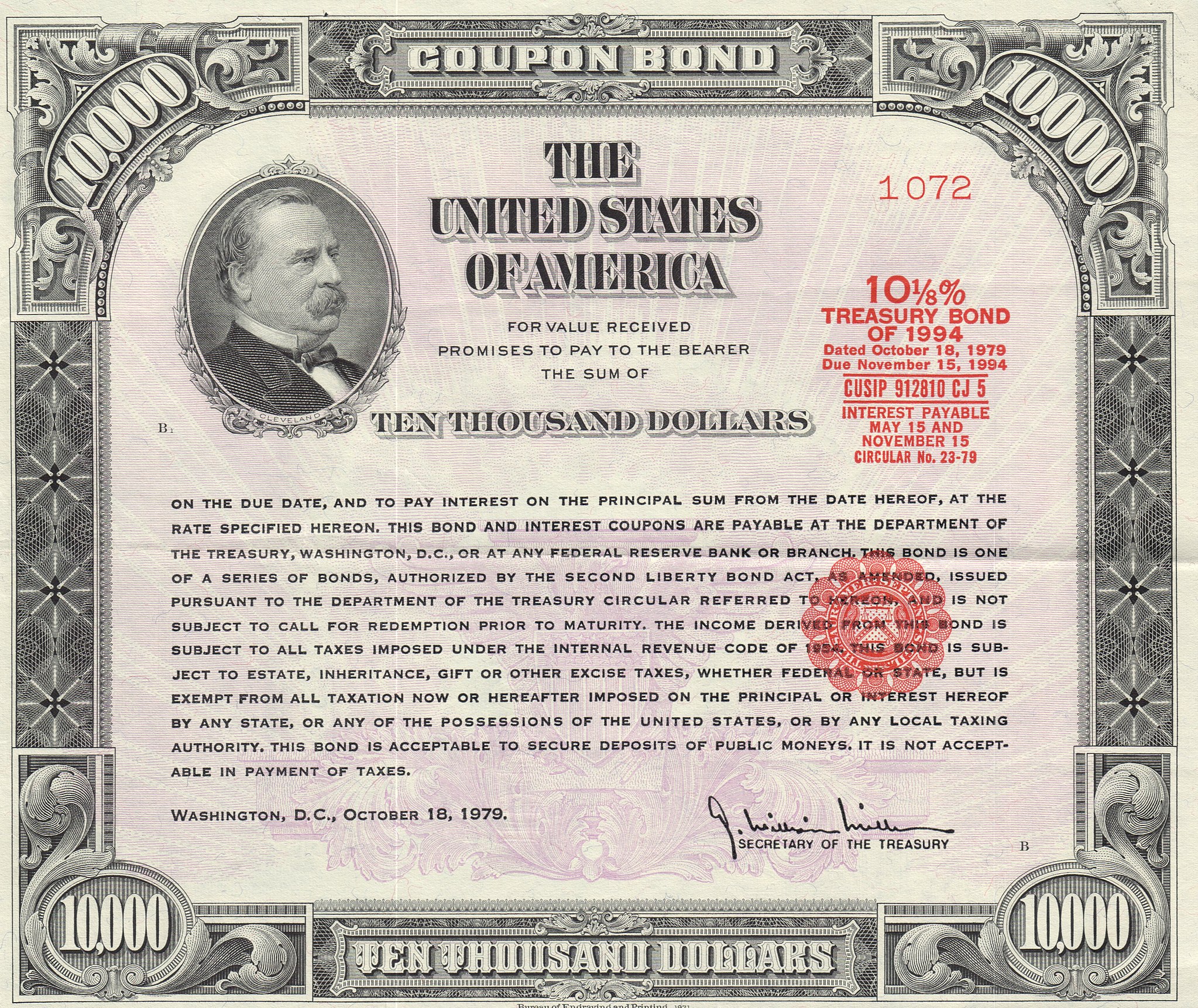
1979 $10,000 Treasury Bond. Fixed-income investments can be affected by inflation because future payments may lose purchasing power. Photo: Wikipedia
The Effects of Inflation on Bonds and Treasury Bills
Bonds and Treasury bills are often viewed as safer investments than stocks, but inflation can still affect them. The main issue is that many debt securities pay fixed interest. If inflation rises, those fixed payments may not buy as much as they did before.
For example, a bond paying 3% may look reasonable when inflation is 2%. But if inflation rises to 4% or 5%, the real value of that bond income may fall. This is one reason bond investors pay close attention to inflation expectations and interest rates.
Inflation can also affect bond prices through interest rates. When inflation is high, the Federal Reserve may keep interest rates higher to help bring inflation down. The Federal Reserve says it sets U.S. monetary policy to promote maximum employment and stable prices. When rates rise, older bonds with lower yields may become less attractive, which can push their market value down.
One option for investors worried about inflation is Treasury Inflation-Protected Securities, also known as TIPS. According to TreasuryDirect, TIPS are designed to help protect investors from inflation because the principal adjusts with changes in the Consumer Price Index.
TIPS are not perfect. They can still fluctuate in value, and they may have tax considerations depending on the account where they are held. But they can be useful for people who want part of their fixed-income portfolio linked to inflation.
You can learn more in our guide to inflation-protected bonds.
Property Ownership and Inflation
Property ownership can benefit from inflation, but it is not as simple as saying real estate always wins when prices rise.
On the positive side, property values and rents may rise over time. If you own a home with a fixed-rate mortgage, your principal and interest payment stays the same even as wages, rents, and general prices increase. That can make a fixed mortgage feel more affordable in real terms over time.
This is one reason many homeowners who locked in low fixed mortgage rates before rates rose have been reluctant to sell. Their monthly mortgage payment may be difficult to replace in the current rate environment.
However, inflation can also make property ownership more expensive. Home insurance, property taxes, repairs, materials, labor, utilities, and maintenance costs can all rise. Higher mortgage rates can also reduce buyer demand, which may make it harder to sell a property at the price you want.
| How Inflation Can Help Property Owners |
How Inflation Can Hurt Property Owners |
| Fixed-rate mortgage payments may become cheaper in real terms. |
Insurance, taxes, repairs, and maintenance may rise. |
| Property values may rise over long periods. |
Higher mortgage rates can reduce affordability for buyers. |
| Landlords may be able to raise rents. |
Operating costs may rise along with rental income. |
Real estate can be a useful inflation hedge in some situations, but it still depends on location, financing, purchase price, cash flow, and ownership costs.
Warren Buffett and the Matter of Inflation
Warren Buffett has written and spoken about inflation for decades, and his perspective is still useful for everyday investors. Buffett has long warned that inflation can quietly reduce the real value of investment returns, even when investors appear to be making money on paper.
In his classic 1977 Fortune essay, “How Inflation Swindles the Equity Investor,” Buffett explained why inflation can be difficult for both bondholders and stock investors. Bonds are vulnerable because future payments are made in dollars that may be worth less. Stocks can also struggle when inflation increases business costs, interest rates, and the amount of capital companies need just to maintain operations.
That does not mean Buffett believes people should avoid stocks. His broader investing philosophy has long favored owning high-quality businesses with durable competitive advantages, strong pricing power, and the ability to generate cash over long periods. Those traits can matter even more when inflation is eating into purchasing power.

Warren Buffett has written about inflation’s impact on investors for decades. Photo: Reuters/Carlo Allegri
The lesson for personal finance is simple: inflation is not just about higher grocery or gas prices. It also affects the real value of savings, bonds, retirement income, and investment returns. That is why investors need to think in terms of after-inflation returns, not just headline returns.
Inflation and Retirement Planning
Inflation becomes especially important when you are planning for retirement. If you are working, you may be able to earn more, change jobs, negotiate higher pay, or adjust your budget. Once you retire, your options may be more limited.
Retirees who depend heavily on fixed income can be vulnerable when prices rise. Even moderate inflation can have a major effect over long periods.
| Today’s Annual Spending |
After 10 Years at 3% Inflation |
After 20 Years at 3% Inflation |
| $40,000 |
About $53,756 |
About $72,245 |
| $60,000 |
About $80,635 |
About $108,367 |
| $80,000 |
About $107,512 |
About $144,489 |
This is why retirement planning should include inflation assumptions. A plan that looks comfortable in today’s dollars may look much tighter once you account for future housing, healthcare, food, insurance, travel, and utility costs.
Some people look at annuities, TIPS, dividend-paying stocks, real estate, or other income-producing assets as part of an inflation-aware retirement plan. None of these are perfect on their own, but they can each play a role depending on your age, risk tolerance, income needs, and total financial picture.
If you are researching this topic, you may also want to read our article on whether annuities are a good investment for inflation protection.
Planning for Inflation
Inflation is part of financial life. You cannot control the CPI, the Federal Reserve, energy prices, food prices, or global supply shocks. But you can build a financial plan that does not fall apart when prices rise.
In my view, the best approach is not to chase one perfect inflation hedge. It is to build layers of protection across your finances.
Practical Inflation Checklist
- Keep an emergency fund. Cash still matters, even if it does not always beat inflation.
- Watch your real return. Compare your savings and investment returns against inflation.
- Be careful with variable-rate debt. Credit cards and adjustable-rate loans can become more expensive when rates rise.
- Consider inflation-protected options. TIPS and other inflation-linked assets may help in certain portfolios.
- Invest for the long term. Diversified portfolios may help protect purchasing power over time.
- Review retirement assumptions. Future expenses may be much higher than today’s expenses.
- Follow CPI data. Use the CPI release schedule to track monthly inflation updates.
Gold is another asset people often consider during inflationary periods. I understand why. Gold has a long history as a store of value, and many investors look to it during periods of currency uncertainty or market stress. But gold is not a guaranteed inflation hedge in every period. It can be useful as a diversifier, but it should not be treated as a complete financial plan.
If you want to explore that topic further, we have a guide on gold and inflation. You can also use our inflation-adjusted gold return calculator to compare gold’s performance in real purchasing power terms.
For a broader look at possible inflation hedges, you may also find our article on inflation-resistant investments helpful. And if you want to understand why inflation can be measured in different ways, read our guide to different ways of measuring inflation.
Final Thoughts
Inflation affects personal finances because it changes the value of money. It can weaken the buying power of cash savings, pressure stocks and bonds, change the math on debt, complicate property ownership, and make retirement more expensive than expected.
The key is to think beyond nominal dollars. A $50,000 savings account, a 5% investment return, or a $60,000 retirement budget only tells part of the story. The more important question is what those dollars can actually buy after inflation.
That is why I believe inflation should be part of every serious financial plan. Not because you can predict it perfectly, but because ignoring it can make your savings, investments, and retirement plan look stronger than they really are.
If you want to stay current, you can review the latest 2026 U.S. inflation rate and CPI data and compare it with prior years such as the 2025 CPI and inflation data.
Frequently Asked Questions About Inflation and Personal Finances
How does inflation affect your personal finances?
Inflation affects your personal finances by reducing the purchasing power of your money. If prices rise faster than your income, savings, or investment returns, you may be worse off even if your account balances are higher in dollar terms.
How does inflation affect savings?
Inflation can reduce the real value of savings when the interest rate on your savings account is lower than the inflation rate. Savings accounts are still useful for emergency funds and short-term needs, but they may not be enough for long-term purchasing power protection.
How does inflation affect stocks?
Inflation can affect stocks by increasing business costs, interest rates, and pressure on consumer spending. Some companies can handle inflation better than others, especially those with strong pricing power, healthy balance sheets, and products people continue buying even when prices rise.
How does inflation affect bonds?
Inflation can hurt traditional bonds because fixed interest payments lose purchasing power when prices rise. Bond prices can also fall when interest rates increase. Inflation-protected securities, such as TIPS, are designed to help address this risk, although they can still fluctuate in value.
Is inflation good or bad for homeowners?
Inflation can help homeowners with fixed-rate mortgages because their monthly principal and interest payments stay the same while prices and wages may rise. However, homeowners may also face higher insurance, taxes, repairs, utilities, and maintenance costs.
Is inflation good or bad for debt?
Inflation can make fixed-rate debt easier to repay over time because the payment stays the same while the value of money declines. However, inflation can make variable-rate debt more expensive if interest rates rise, which is especially important for credit cards, adjustable-rate mortgages, and some personal loans.
How does inflation affect retirement?
Inflation can make retirement more expensive because future living costs may be higher than today’s costs. Retirees and future retirees should account for inflation when estimating income needs, withdrawal rates, healthcare costs, housing costs, and long-term savings goals.
What is the best way to protect your money from inflation?
There is no single best inflation hedge for everyone. A practical approach may include emergency savings, diversified investments, inflation-protected bonds, fixed-rate debt management, real estate, and possibly precious metals or other real assets depending on your goals and risk tolerance.
Why does my personal inflation rate feel higher than official CPI?
Your personal inflation rate may feel higher than official CPI if your biggest expenses are rising faster than the national average. For example, someone spending heavily on rent, groceries, insurance, healthcare, or gasoline may feel more pressure than the headline CPI number suggests.
How often is CPI data released?
The Bureau of Labor Statistics usually releases CPI data monthly. You can follow upcoming release dates using the CPI release schedule and compare current inflation data with historical CPI trends to see how prices have changed over time.
by Sarah Bauder | Jan 8, 2020 | Inflation
By definition, inflation is the general increase in the price of goods and services, and the decrease in the purchasing value of a nation’s currency. Inflation is measured in the consumer price index (or simply CPI), which in turn, calculates the value of a basket of consumer and services purchased by the average household. In this article, 5 experts discuss things you didn’t know about inflation.
I Think A Lot Of People Don’t Really Think About Inflation And Their Money Losing Buying Power
“I think there’s a lot of people out there who either just don’t know about inflation period, or don’t think about it. We all intuitively know things get more expensive over time. A Subway Foot Long used to be $5, now its $8 or $9, things go up in price but I think a lot of people don’t really think about inflation and their money, losing buying power.
I was recently talking to a family friend who left a job of 20 years. They had something like 18k in their retirement account despite making a very good living and having been there 20 years. On the other hand I had been at a much lower paying job for something like 5 years and had over 25k in my 401k. It turned out this family friend wasn’t investing, they were just letting money sit in their retirement account because they were scared of risk and scared of investing. I was trying to explain to them that while all investments have risk, what he’s doing now is guaranteed to lose him money through inflation and over time a pretty substantial amount of money. He didn’t seem to get it and continues to let his retirement money just sit and lose over time.”
John Frigo, Digital Marketing Lead, My Supplement Store
The Word “Inflation” As Originally Coined Applied Entirely To The Quantity Of Money
“The average American does not know or appreciate that the word ‘inflation’ as originally coined, applied entirely to the quantity of money. That is to say, inflation is merely an increase in the quantity of money and bank notes that are in circulation plus the quantity of bank deposits that are subject to check. As such, current operations by Central Banks around the world that electronically create ‘money’ or ‘reserves’ through open market operations and programs such as ‘quantitative easing’ are themselves sufficient to satisfy the original definition of ‘inflation’, even if there is no measurable increase on the price on consumer goods.”
David Reischer, Esq. Banking & Business Attorney, LegalAdvice.com
The Average American Has A Hard Time Even Describing What Inflation Is
“The average American attending my workshops on the basics of personal and household finances knows that inflation is something that can hurt their wallet, but they have a hard time even describing what inflation is.
Many people accept that inflation results in higher prices for goods and services, but they do not understand it as an annual change. Rather, they think of it like they would a sales tax, like something added onto the normal price of goods and services.
The average American knows that prices for gasoline, food and cars were much lower when they were younger, but there is a disconnect between the change in prices and the principle of inflation.
The simplest description of inflation I see my adult students understanding is this: You know how prices seem to go up year after year? That is inflation.
Most adults in my classes typically guess that inflation is far higher than it is, believing it is close to 10% a year rather than the 2.5% to 3.5% rate is has been for the past couple decades. However, even at 3.5%, they do not understand that prices will actually DOUBLE in just twenty years. The Rule of 72 is a powerful tool for teaching about the impact of inflation over time.”
Todd Christensen, Education Manager, Money Fit by DRS
The Correlation Between Interest Rates And Monetary Inflation
“Very few people understand the correlation between interest rates and monetary inflation. When interest rates are suppressed below the GDP rate, which is a reflection of economic output, then interest rates anywhere in the interest curve below this rate results in people being paid to borrow. This is because the rate of interest is below the rate of monetary inflation and thus people are encouraged to expand in ways that are not necessarily economic. To that end, assets that are tied to the interest rate complex largely rise in price as interest rates are lowered.
While the apparent gains in value for assets tied to interest rates like real estate, bonds, commodities, collectibles, may seem engendered by real market demand, in most cases the demand is artificially being created by inflation tied to below market price interest rates. Central Bank meddling in the pricing mechanism for interest rates, which some would say is the most important price in a free market, distorts all markets and that’s why many assets are highly susceptible to the boom-bust cycle of bubbles.”
Brian Ma, Broker, Flushing Real Estate Group
Investing In Real Estate Is The Best Hedge Against Inflation
“One of the most important things which the average American does not know about inflation is that investing in real estate is the best hedge against it. While people are generally aware of the many benefits of real estate investments such as relatively low risk and monthly rental income, they often fail to appreciate the fact that investing in real estate properties protects one’s money against inflation. While housing markets take temporary downturns as a result of economic and demographic factors, they always bounce back. Regardless of which market you look at, real estate prices follow an upward trend in the medium and long term. This is due to the constant increase in housing demand (due to population growth) and the fact that the land on which properties are built is a very limited resource. If we look at data from the past few decades, the average annual appreciation rate in the US exceeds the average annual inflation rate. In 2020 inflation in the US is forecast to reach about 2%, while the increase in the median home value is expected to reach about 2.2%. This means that once again the real estate appreciation rate will exceed the inflation rate, offering investors protection of their financial resources.”
Daniela Andreevska, Marketing Director, Mashvisor
Unfortunately, inflation is an economic reality that is unavoidable. You can keep abreast of the monthly inflation rates and the CPI via the Bureau of Labor Statistics release schedule. The best strategy to hedge against inflation is to ensure that one has a diversified portfolio.
by Sarah Bauder | Dec 3, 2019 | Inflation
Inflation is a general increase in the price of goods and services, and a decline in the value of a nation’s currency. Conversely, deflation is a decrease in the price of goods and services, when the rate of inflation falls below 0%. Additionally, the purchasing power of a nation’s currency will increase during deflation. Inflation is measured by the consumer price index (CPI). The CPI measures the changes in the value of a basket of consumer goods and services purchased by households. In this article, financial experts share their views on whether or not investors should be worried about inflation and deflation.
This Inflation Or Deflation Debate Mixes A Lot Of People Up Because The Same Causal Forces Can Potentially Lead To Both Scenarios
“This inflation or deflation debate mixes a lot of people up because the same causal forces (such as high debt levels) can potentially lead to both scenarios depending on the policy response.
When analyzed in isolation, the current macro environment is deflationary. Debt levels as a percentage of GDP are beyond the point of sustainability, and aging demographics lead to slower economic growth and a larger financial burden on younger generations, leading to high default risk over the next decade. Debt defaults involve the destruction of both liabilities and assets; other peoples’ money, which makes this an extremely deflationary prospect.
However, there is virtually no way that the global financial system, as currently structured, would allow a deflationary debt default to occur in countries that control their own currencies. Historically, the policy response to economic environments with this high of a debt load is for governments and central banks to print their way out of it. In a purely fiat system, there’s nothing stopping financial authorities from increasing the money supply to pay all obligations in nominal terms, even if it causes inflation and fails to pay back those obligations in true purchasing power terms.
Therefore, a deflationary or dis-inflationary environment is possible in the intermediate-term, but an inflationary outcome is almost inevitable over the long term due to the policy response to those deflationary or dis-inflationary forces. Rarely in history do fiat monetary systems allow themselves to default nominally.”
Lyn Alden, founder of Lyn Alden Investment Strategy
Looking Forward Over The Next 12 Months We Do Expect A Dip In The Markets And Some Inflation
“In an inflationary environment the value of money decreases, which spurs consumption and investment. Deflation makes it profitable to simply sit on one’s savings while the value of those savings increases without any special effort, disincentivizing consumption and investing.
Looking forward over the next 12 months we do expect a dip in the markets and some inflation. Therefore we are therefore poised and ready for investment opportunities that may crop up over this period.”
Robin Lee Allen, Managing Partner, Esperance Private Equity
The Commonly-Cited CPI Metric Might Not Be The Best For Practical Purposes
“Sensing you will likely receive numerous responses to your prompt declaring whether investors should worry about potential inflation or deflation, I thought I would offer up a viewpoint about why the commonly-cited CPI metric might not be the best for practical purposes.
The Consumer Price Index (CPI) has long served as the foundational inflation measure for economic activity. In fact, it underpins the health of an economy because a stable CPI measure indicates opportunity for economic prosperity. Absent predictable CPI readings, consumers will not have an accurate signal about price expectations and may change their behavior in detriment to the economy as a whole.
One major limitation to the current CPI measure is its inability to incorporate decisions consumers might actually make when evaluating a fixed basket of goods. For example, when a price increases for one consumer product included in the selection of goods used to measure CPI, many consumers would choose to switch to a substitute. CPI doesn’t account for this reality. Instead, CPI assumes the consumer would simply pay more for the same product. Reality usually shows a different response in the form of choosing a substitute product.
Instead, a better measure, which accounts for this substitution effect would be “chained CPI.” This more closely resembles the substitution decisions consumers would make in response to rising prices of certain items as opposed to simply paying more for the same good. This metric will capture the switching dynamic.”
Riley Adams, CPA
A Cost-Averaging Strategy Into A Healthy, Low-Cost, Diversified Stock Portfolio
“For anyone investing in their future over the long term, they know that everything moves through cycles. There are booms, and there are recessions. Sometimes the latter morph into depressions. And inside these, there are deflationary and inflationary times. Piecing it all together, unless you are an econometric expert, is almost impossible.
The problem is that events in the economy can move fast between inflationary and deflationary forces. Reaction time can be a severe challenge. For the everyday, hard-working American who puts some earnings aside at the end of every month and religiously injects it into a portfolio, keep it up. By cost averaging over time, you automatically smooth out the many ragged edges and the volatility shocks. Then, my recommendation is to invest it in the S&P 500 (a low-cost fund) that evenly spreads every invested dollar over the public markets’ best stocks. By so doing, you are trusting growth stocks and companies immersed in unearthing and refining commodities like gold and platinum (inflationary hedges). Also, defensive stocks like businesses in consumer goods, and well-known dividend-paying stocks (deflationary hedges). You may want to put a small percentage outside the S&P 500 fund into Treasury Inflation-protected treasuries, investment bonds, and keep some cash on hand (both deflationary protectors).
In short, I recommend a cost-averaging strategy into a healthy, low-cost, diversified stock portfolio as the spearhead of a balanced approach to counteract market ups and downs, rollicked by inflation and deflation from within.”
Gordon Polovin, finance expert, serves on the advisory board for Wealthy Living Today
It’s Definitely Something That People Should Be Concerned About
“Central Banks around the world have a target to keep inflation at roughly around 2% (depending on the country this can be higher or lower). Anything more or less than that can be harmful to the economy. If the inflation is too high, prices of goods and services will rise sharply, and the value of cash or bonds will fall. This has happened numerous times in countries like Germany (after the war), Argentina, Zimbabwe etc. Things can get so bad sometimes that prices double every few hours! This is called hyperinflation and Zimbabwe eventually ended up abolishing its currency and instead using foreign currencies as legal tender! Inflation that is too low or negative (deflation) is equally dangerous. It essentially means that good and services will be cheaper tomorrow than they are today. This incentivizes hoarding of cash. With less demand, economic growth slows down and businesses begin to suffer. Inflation levels also impact export competitiveness compared to other countries, foreign investments and can also impact the value of personal or national debts. It’s definitely something that people should be concerned about which is why Central Banks have set targets in the first place.”
Gaurav Sharma, Founder at BankersByDay
Deflation Can Mean A Drop In Wages Or A Drop In Market Prices
“Deflation can mean a drop in wages or a drop in market prices. Not everyone experiences these drops equally and those who are already secure in a higher paycheck won’t notice either of these factors. However, those who are at the bottom of the business have something to worry about. They are likely to experience a cut in hours or a cut in pay, meaning that while they might notice a drop in market prices, they won’t have the additional income to appreciate it. It’s also important to consider that people are constantly looking for a better deal. In the hopes of finding this deal, people will often stop buying and wait. This can cause a dip in sales and cause trouble with the economy.
Inflation doesn’t necessarily make people secure, however. Inflation means a bump in prices, meaning that the dollar in your pocket is worth less than it was before inflation. Now your paycheck doesn’t go as far and you’re concerned about that. You’ll have less for superfluous spending. You’ll hold onto what little wealth you have and as a result the economy will start to dip.”
Chane Steiner, CEO, Crediful.com
The Outlook Right Now Looks Like One Of Slower Inflation And Because Of That The Risk Of Deflation Is More Of A Concern Now
“Currently the outlook right now looks like one of slower inflation and because of that the risk of deflation is more of a concern now than that of inflation. There are a number of reasons for slower inflation including an aging demographic, technology advancement, inflation expectations, and a stronger dollar. Studies have shown that the aging of demographics has a negative correlation for inflation. In other words, that as a population ages, inflation starts to fall. A good example of this would be Japan, which has battle very low inflation for around the last 25 years. Technology advancement has brought down the price of goods that use new technologies intensively. Historically there has been a correlation of higher productivity with lower inflation. Productivity has been lower recently ,so unless this changes this could be a reason why we start to see inflation rise.
Next, inflation expectations is an important factor in inflation. The higher people think prices are going to go, the more workers will want higher wages, and the higher businesses will believe their costs, and the prices they can charge, will rise. The opposite is true as well, as we are currently seeing inflation expectations from that of the University of Michigan as well as the break-even inflation rate set in Treasury inflation-protected securities. Finally, the stronger dollar leads to lower inflation. This happens because a strong dollar makes foreign imports cheaper which in turn result is cheaper products at U.S. stores, and those lower prices translate to low inflation. So, in order to see the inflation outlook change, we would need to see changes in these factors in order to make that happen.”
Scott Pederson, Financial Advisor, Harmony Wealth Managment LLC
Investor Should Be Worried About Inflation And Deflation
“Yes, the investor should be worried about inflation and deflation. These both are the major economic factors, and investors should keep them in mind before investing money.
Inflation means the increase in the price of products and a decrease in the value of money value. Regarding this basic rule, investors should invest in products whose return or profit margin would be higher than the inflation rate. For example: If the investor is investing $100 and is expected to get $2 profit next year. He must see what would be the inflation rate. If it would be 3%, then the investor is at a loss of $1.
In times of deflation, investors should preserve the capital or invest in the good having the high return potential in the future. Investment in gold is recommended because no matter what, even after a minimal decrease, its prices go high. So, the rule of thumb is either to preserve the capital or invest it in the products with the potential of higher ROI. Business bankruptcy rates increase during this period. So, do not keep your stock shares or corporate bonds in the companies having the risk of bankruptcy. Instead, invest them in potential business or goods to remain on the safe side. “
CJ Xia, VP of Marketing & Sales at Boster Biological Technology
Both Have Negative Consequences
“Generally, as the economy recovers, banks are able to loan out their excess reserves to the public. With the increase in money supply, inflationary pressure is also built, causing the prices of goods and services to rise. This worries ordinary citizens, especially those who live pay check-to-pay check because the affordability of basic goods and services is more difficult.
On the other hand, deflation impacts consumers by way of raising their purchasing power since goods and services have become more affordable. But while this may be good news to the public, the same thing cannot be said for enterprises who are affected by the low prices of their goods and services. Eventually when deflation persists, they will be forced to cut jobs and shut down. The public then experiences decline in incomes and therefore, consumer confidence plunges.”
Doug Keller, Writer, Finance Fox
Both inflation and deflation are economic components that unfortunately cannot be avoided. Keep up with monthly inflation rates and the CPI via the Bureau of Labor Statistics release schedule. In order to offset the market ups and downs during periods of inflation and deflation, a diversification strategy for one’s portfolio is the best bet.
by Sarah Bauder | Oct 14, 2019 | Inflation
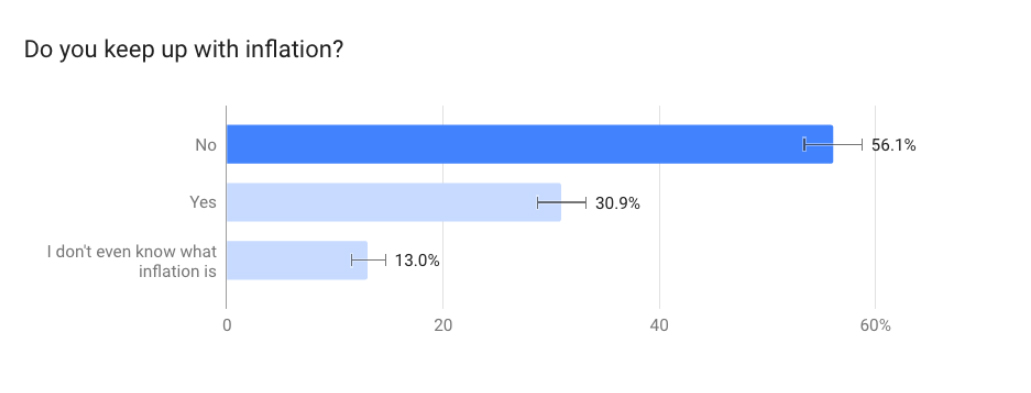
We conducted a survey asking 1,500 US respondents whether or not they kept abreast of inflation. We used Google Surveys and targeted males and females between the ages of 18 to 65+ from coast to coast. We asked the following question with three possible responses:
Do you keep up with inflation?
- No
- Yes
- I don’t even know what inflation is
The Average American Woman Does Not Keep Up With Inflation, Especially 18 to 24-year-olds
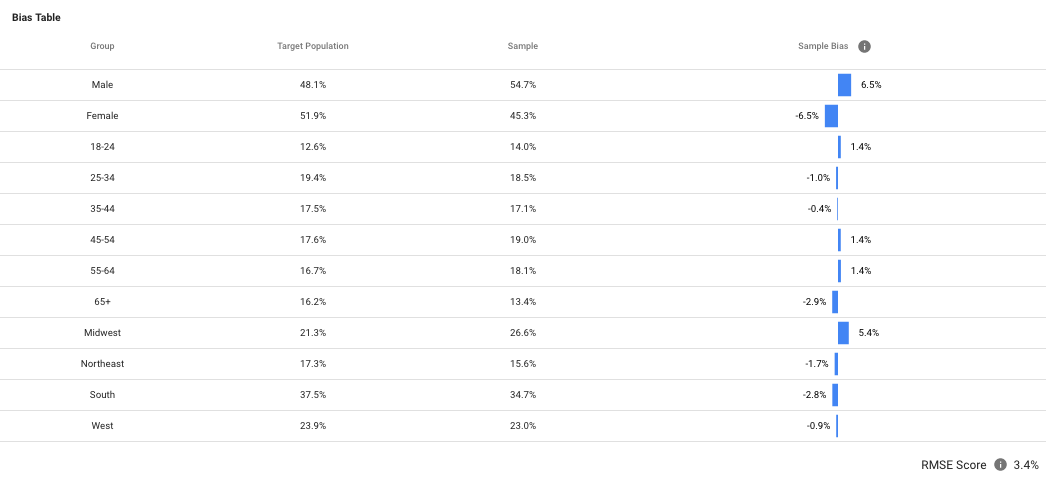
The overwhelming response of Americans, who took part in the survey, indicated that they did not keep up with inflation. A full 56.1% chose this response.

When demographic filters were applied to the survey results factoring females, very compelling insight was discovered. The percentage leaped to 63.6% and skyrocketed to an astounding 75.1% of females between 18-and 24-years-old.
Conversely, when demographic filters targeted specifically males, 48% stated that they did not keep abreast of inflation. Of the males between 18 and 24 who responded to the survey, 59.8% chose this option.
One possible explanation for the drastic variance of the percentage between genders could be the finance sector. Although blessedly changing, positions across the spectrum of finance and business have typically been held by males – thus, making a larger percentage of males more inclined to keep up with inflation.
Males Are More inclined To Keep Abreast Of Inflation, Especially Middle-Aged Males
The second most popular response to the survey was 30.9% of respondents indicated that they did, in fact, keep up with inflation.

Yet, when demographic filters were applied focusing specifically on gender, 38.9% of male respondents stated that they kept up with inflation, while conversely, 23.5% of female respondents selected the same option.
When the demographic filters targeted middle-aged males between 45 and 64-years-old, the results soared to 42%. Because almost half of this cohort indicated that they kept up with inflation, they have the highest percentage of respondents who answered “yes” to the survey question.
These results could further be demonstrative of the fact that males, especially middle-aged males, populate a higher percentage of positions across the spectrum of finance and business, which would warrant them keeping up with inflation.
American Women Between 25 and 34-years-Old Indicate That They Don’t Know What Inflation Is
Of the American respondents who participated in the survey, 13% indicated that they didn’t even know what inflation was.

Yet, interesting insight was discovered when demographic filters were applied to the results, targeting specifically gender. 13.1% of male respondents indicated that they did not know the definition of inflation, while 12.9% of female respondents chose the same response.
However, when demographic filters focused specifically on females between 25 and 34-years-old, 18.6% of this age bracket indicated that they didn’t know what inflation was. Thus, it was the second most popular response to the survey question for this demographic.
Conclusion
Based upon the results of this survey, more than half of all Americans who responded did not keep abreast of inflation. Although a higher percentage of males who participated indicated that they did not know the definition of inflation, the highest percentage of respondents who did not know what it was were females aged 25 to 34. Yet, males, especially middle-aged males, were more inclined to keep up with it. This could be explained by the fact that as a generalization, jobs within areas of finance and business which would necessitate keeping abreast of inflation, are typically dominated by males.
Details About The Study And RMS Score

by Sarah Bauder | Aug 28, 2019 | Inflation
Annuities are a popular insurance contract that provides guaranteed returns for a set period or for a lifetime. In this article, financial experts discuss whether or not annuities represent a good investment for inflation protection.
Carefully Evaluate Any Annuity And Pay Special Attention To The Inflation Riders And How It is Calculated
“Single-Premium Annuities are not designed to be inflation protection, they are insurance product designed so that you don’t run out of money. Annuities are simply a promise to pay you and income for the rest of your life how long or short that may be. Annuity companies usually offer the opportunity to purchase or not purchase an inflation rider when you purchase one of these contracts. An annuity is not really an investment to protect against inflation because your actual return, that is how many and long you receive payments- is primarily delivered by how long you live!
An inflation rider might be purchased and in this case, inflation might outpace the contract terms and your payment would be adjusted upwards to keep up with the rising costs of goods and you would see your real income keep up with the rising costs. Inflation may be similar to historical averages and your income would be similar throughout the term of the contract.
Currently, we are at near-historic low rates of in inflation and if an example consumer purchased an SPIA and then saw a run-up in inflation, the real income of the annuitant could be significantly reduced. Inflation may be very low and you may have paid a premium for inflation protection, but if the inflation rate was very low you may have been better off not purchasing the option.
This only covers single-premium annuities, there are also period certain annuities, return of premium annuities and many more. The main point is to carefully evaluate any annuity and pay special attention to the inflation riders and how it is calculated, as well as understand the pros and cons of
the contract you are evaluating.”
Jason B. Ball, CFP®, ChFC®, CLU®, Ball Comprehensive Planning, LLC
When Setup Properly Annuities Can Provide A Lifetime Income Stream
“I am an independent insurance broker specializing in annuities – and yes – I believe annuities are a good investment.
When setup properly, annuities can provide a lifetime income stream for individuals and couples. That income stream can also increase each year based on moves in the CPI index. And once the income stream increases, it can’t go back down.
A guaranteed lifetime income annuity that increases payments based on moves in the CPI (or other inflation indexes) can be a valuable piece to any retirement plan. It acts as a pension plan and can reduce the financial strain that comes along with the overall market volatility we’ve experienced the last decade and a half.”
Adam M. Hyers, President, Hyers and Associates, Inc.
Annuities Are A Great Way To Make Sure Your Money Grows
“Annuities are a great way to make sure your money grows at a rate that outpaces inflation. Annuities are also often guaranteed not to go down when the market goes down. This means they are protecting you against losing everything in a crash as well, making them ideal for people who need to have a certain amount of money each month to live on when they are no longer working.”
Stacy Caprio, Financial Blogger, Fiscal Nerd
They Come With Several Costly Caveats That Do Not Make Them Worthwhile For Most Investors
“Annuities are not a great buffer against inflation. They provide guaranteed returns, but they come with several costly caveats that do not make them worthwhile for most investors.
Annuities typically have several fees (including administrative or death benefit costs) associated with them above the cost of investment fund management fees. Inflation-protected annuities have additional fees for this benefit as well.
Annuities payments are not guaranteed. If the insurance company an investor purchased from goes bankrupt, it is possible that the individual might lose their payments.
If the investor decides they no longer want to the annuity, there is usually a penalty fee to cancel it and withdraw the money.
In general, a better strategy would be to invest in low-fee options that return healthy dividends. Over time the stock market historically outperforms what an annuity can offer, so investors with many years to go will do much better putting their available funds into 401K and IRA options than to purchase annuities now.”
Isaiah Goodman, Becoming Financial
Good Investment For Inflation Protection But Should Not Be Used As Pure Inflation Protection Vehicles
“Annuities can be a good investment for inflation protection but should not be used as pure inflation protection vehicles. They should only be used as inflation protection vehicle if the investor has an additional concern such as running out of money too quickly, having a stable income for peace of mind, or having some form of downside protection. Most annuities offer a cost of living adjustment rider which allows the income to scale based on one of the economic inflation metrics. However, annuities are primarily insurance for running out of money too fast. The way this happens is that you either live too long, you can’t budget to save your life, or you panic every time the market gets volatile.
If you don’t think you experience one of these core problems than there are a variety of better investments, you can make to protect your self from inflation concerns. If you are conservative in nature you can buy Treasury Inflated Protection Securities. Not only are they guaranteed by the federal government, but they are very stable investment. Their payments adjust directly based on inflation, so it is a direct hedge for inflation. However, if you want the best inflation-adjusted investments then look no further than the stock market. Equities are the best available investment when it comes to inflation. The cost of your day to day goods will directly be represented in the cost of goods these companies sell.”
Alex Caswell, CFA CFP, Wealth Planner, RHS Financial
Annuities Are A Very Misunderstood Product
“Annuities are a very misunderstood product. Annuities are a popular choice for investors who want to receive a steady income stream in retirement. There are different types of annuities that can play a beneficial part in anyone’s holistic strategy. As an industry professional, I believe that annuities serve a purpose for anyone, and can’t fall into a lump-sum of good or bad.”
Danita M. Harris, Managing Member, Guice Wealth Management
Fixed And Indexed Annuities Will Almost Certainly Beat Inflation With No Risk Of Loss
“Most long-term instruments will likely beat inflation, and therefore are good for inflation protection; however, most individuals who are looking for inflation protection are also just as concerned with the safety of principal and long-term liquidity. Fixed and indexed annuities will almost certainly beat inflation with no risk of loss, offering significantly higher interest rates than most fixed instruments. Additionally, annuities are tax-deferred, resulting in an even higher effective rate of interest. Once the surrender period has expired (usually between about five and ten years), most annuities are completely liquid provided the account owner is age 59.5 or older, unless of course, the account is annuitized (set to pay out a guaranteed income stream, usually for life or beyond).”
Rob Drury, Executive Director, Association of Christian Financial Advisors
It Depends What Type Of Annuity You Choose To Invest In
“I think it depends on what type of annuity you choose to invest in. Inflation can be unpredictable, and since annuities tend to be long-term investments, they may not be the best way to protect your finances from inflation. Even in a fixed annuity, you would guarantee the same amount of capital in return, but inflation could potentially negate any capital gains from this type of investment.
However, you could take out an immediate annuity that would start paying out in the short-term, making it a very viable option. This way you could start receiving your investment in small parts over the course of time, which is better than receiving a lump sum in the distant future. Smaller short-term capital gains will help you hedge against rising inflation, and you can always halt your annuity in the event inflation rises unexpectedly in the future.”
Igor Mitic, Co-Founder, Fortunly.com
It Is Generally Not The Top Of Mind Reason One Would Purchase An Annuity
“Annuities CAN have a place in someone’s overall financial planning for part of someone’s overall assets. Inflation protection could be a component of the reason why one would purchase an annuity, although the more common reasons found involve potential guarantees of income for life and the death benefit…always for additional fees. There are step-up features whereby the income benefit base steps up each year, or where the death benefit base steps up annually…or both. The increasing income base can mitigate the effects of inflation, depending on the specifics of the particular feature. There is not a one-size-fits-all, in that annuities can be tied to the stock market [variable annuity], a fixed rate of return [fixed annuity], or tied to an index [indexed annuity]. The fees can vary depending on the insurance carrier and the ancillary benefits purchased. The distribution options can vary as well, depending on the income need. All of that said, while inflation protection can be a component of the features of an annuity, it is generally not the top of mind reason one would purchase an annuity.”
Jimmy Masters, AIF(r), CRPS(r), Vice President – Investments, The Alcaraz Fisher Justis Wealth Management Group of Wells Fargo Advisors
Although annuities provide guaranteed payments to investors, there is no overall consensus as to whether or not they provide good inflation protection. If you are thinking about investing in annuities, take into account what the financial experts have discussed in this article, and always do your due diligence.